
In short
- What’s there: a 100-meter-long church, an organ with 8,000 pipes, Colbert’s tomb, a painting from Rubens’s workshop and a triptych by Keith Haring
- How much it costs: admission is free, and so is the Sunday organ recital
- When it’s open: Monday to Friday 8:30 a.m.-6:30 p.m., Saturday and Sunday 10:00 a.m.-7:45 p.m., no visits during Mass
- Getting there: 146 rue Rambuteau, Metro Les Halles (line 4) or RER A, B and D at Châtelet-Les Halles
- When to come: Sunday at 5:00 p.m., for the organ recital
- History: a chapel from 1213, the cornerstone of the current church laid in 1532, consecrated in 1637
- Bonus: a direct RER B train from the station near Charles de Gaulle Airport
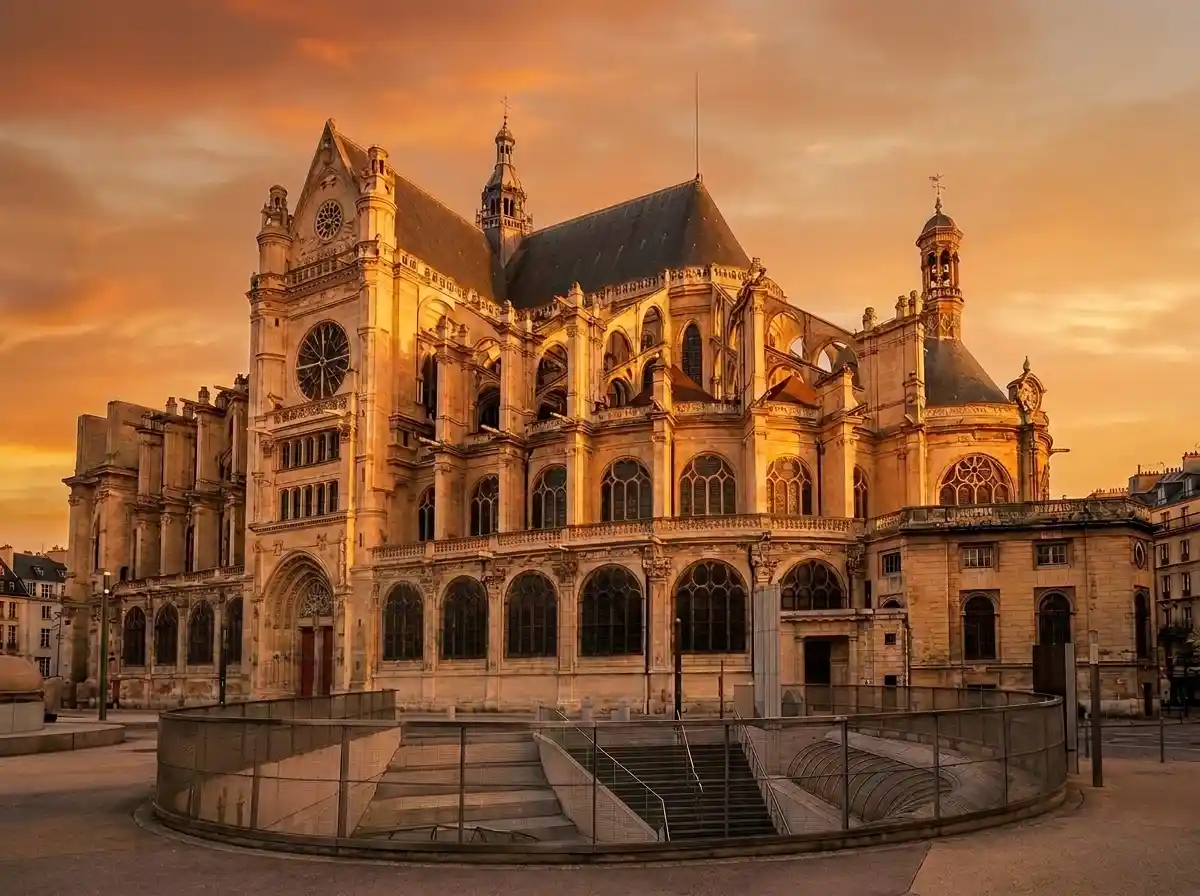
Saint-Eustache Church (Église Saint-Eustache) is my favorite church in Paris, and every time I’ve walked this city with Francophiles, I’ve been surprised all over again to find how many of them didn’t know it. It stands at the heart of the Les Halles neighborhood, right where rue Montorgueil begins, and quite a few travelers walk right past it on their way to eat without stepping inside.
From the outside, it’s a Gothic church with dimensions that recall Notre-Dame. Inside, it’s dressed in Renaissance decoration, and above the entrance hangs one of the most important organs in France, which you can hear every Sunday without paying for a ticket. Beyond that, this is a church that the history of Paris passed straight through: Cardinal Richelieu (Armand Jean du Plessis de Richelieu, 1585-1642) and Molière (1622-1673) were baptized here, and Louis XIV held his first communion ceremony here. But as you’ll see, the connection between Molière and Saint-Eustache didn’t end with his baptism.
The church’s location is also why I recommend this area as a base for a trip to Paris: the Marais, the Louvre and rue Montorgueil are all within walking distance, and a direct RER B train runs from Châtelet-Les Halles station to Charles de Gaulle Airport.
So before we head out and visit Saint-Eustache, let’s talk about what you’ll find in this article. I’ll start with the practical information (hours, getting there and when it’s best to come), move on to what you shouldn’t miss inside the church, and from there to the story of its 800 years, including the night Molière was buried without a ceremony. After the history, you’ll find attractions within walking distance, hotel recommendations for the area, and answers to the questions I get about the church.
Practical information for visiting Saint-Eustache Church
Days and opening hours at Saint-Eustache
The church is open every day of the week. Monday through Friday it’s open from 8:30 a.m. to 6:30 p.m., and Saturday and Sunday from 10:00 a.m. to 7:45 p.m. During French school holidays, and on civil holidays like May 1 or November 11, the doors open only at 10:00 a.m.
Remember that this is a working church, not a museum, and you can’t wander between the chapels during Mass. Weekday Masses are held at 8:00 a.m. and 6:30 p.m., Saturday at 6:30 p.m., and Sunday at 11:00 a.m. and 6:30 p.m., with a solemn vespers service at 6:00 p.m. before the last Mass.
How to get to Saint-Eustache Church
The church’s address is 146 rue Rambuteau in the 1st arrondissement. The nearest metro station is Les Halles on line 4, and the nearest RER station is Châtelet-Les Halles, where lines A, B and D stop (you can read about the lines and tickets in the article on the Paris metro).
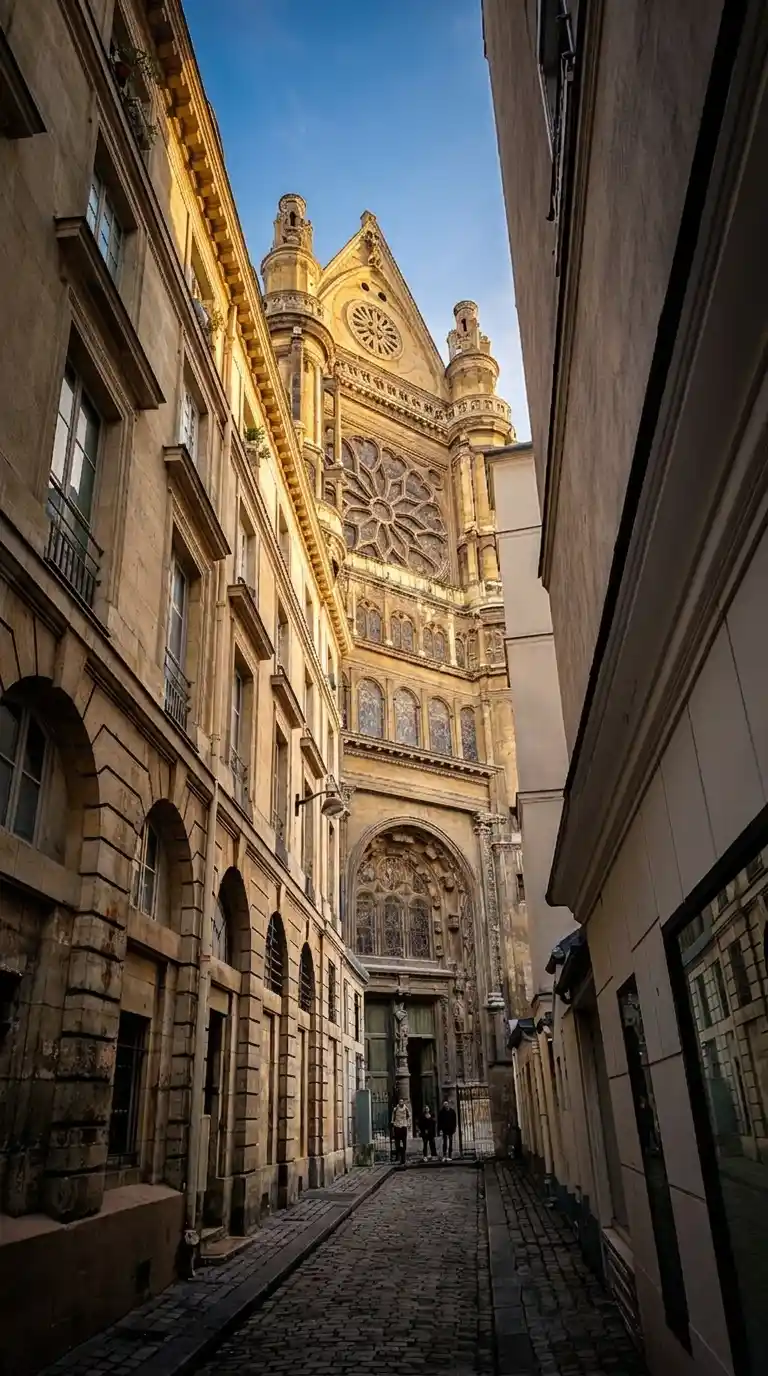
The main entrance is through the west facade, on the rue du Jour side, which reopened to visitors in February 2024 after restoration. You can also enter through the south door facing the Les Halles garden when the weather allows, from the corner of rue Rambuteau and rue Montmartre, and from impasse Saint-Eustache.
If you’re landing at Charles de Gaulle Airport, the RER B train brings you directly to Châtelet-Les Halles station, in a ride of 35 to 50 minutes with no train changes. A ticket between Paris and the airports costs 14 euros.
Tickets and admission to Saint-Eustache Church
Admission to the church is free. Every Sunday at 5:00 p.m., there’s an organ recital (audition d’orgue), performed by the church’s resident organists or by guest musicians, and that’s also free: any donation at the end is up to you. Note that restoration work on the great organ is expected to begin sometime in 2027, so it’s worth checking the church’s website to make sure a recital is scheduled on your date.
For a self-guided visit, you can use the Les pierres parlent app: scan the QR code inside the church, and it guides you between the chapels with your phone. At the reception desk, you can also ask for the Parcours historique de Saint-Eustache booklet. The church also hosts concerts throughout the year, and you’ll find the schedule on the classical music in Paris page.
How much time to spend, and when to come to Saint-Eustache
It’s worth timing your visit for a Sunday afternoon: arrive a bit before 5:00 p.m., walk between the chapels, sit down for the organ recital, and head off from there for dinner on rue Montorgueil. If you come that same morning, you’ll find the Les Halles food market on rue Montmartre, next to the church, which operates Sundays from 7:00 a.m. to 2:30 p.m. and Thursdays from 10:00 a.m. to 8:00 p.m. (you’ll find the rest of the markets on the markets in Paris page).
On weekdays, keep in mind that the 6:30 p.m. Mass closes the visiting hours, so it’s better to come in the morning or at midday and pair your visit with one of the attractions further down this article.
What not to miss at Saint-Eustache Church
The nave: Notre-Dame’s daughter
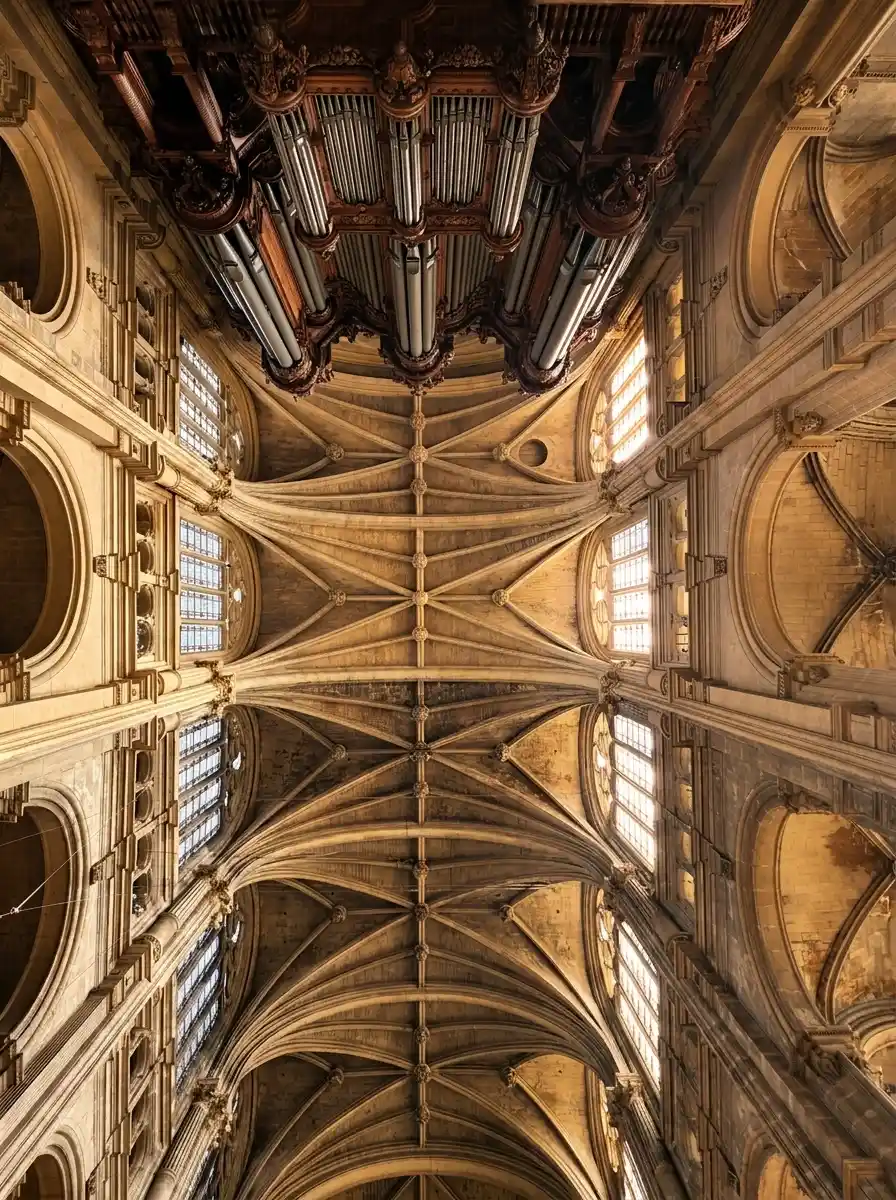
The first thing you’ll notice when you walk in is the size. The church’s interior runs 100 meters long, 43 meters wide, and the ceiling rises to a height of 33 meters. Its layout is borrowed from Notre-Dame Cathedral: a central nave with a pair of side aisles on each side and a row of chapels, a transept that doesn’t project outward, and a choir surrounded by two ambulatories and another row of chapels.
This Gothic skeleton is dressed in Renaissance decoration, and not everyone loved the combination. The architect Eugène Viollet-le-Duc (1814-1879) wrote that Saint-Eustache was a confused pile of fragments gathered from every direction, “a kind of Gothic skeleton wearing Roman rags stitched together like patches on a harlequin’s coat.”
In the middle of the nave stands a wooden bench made for the church’s vestry members (banc d’œuvre), built around 1720, with a statue of Saint Agnes and three angels, a reminder of the first chapel that once stood here. Facing it is the pulpit designed by Victor Baltard (1805-1874), the architect who also built the Les Halles market pavilions, and in the choir you’ll find the main altar he designed and the large stained-glass windows by Antoine Soulignac.
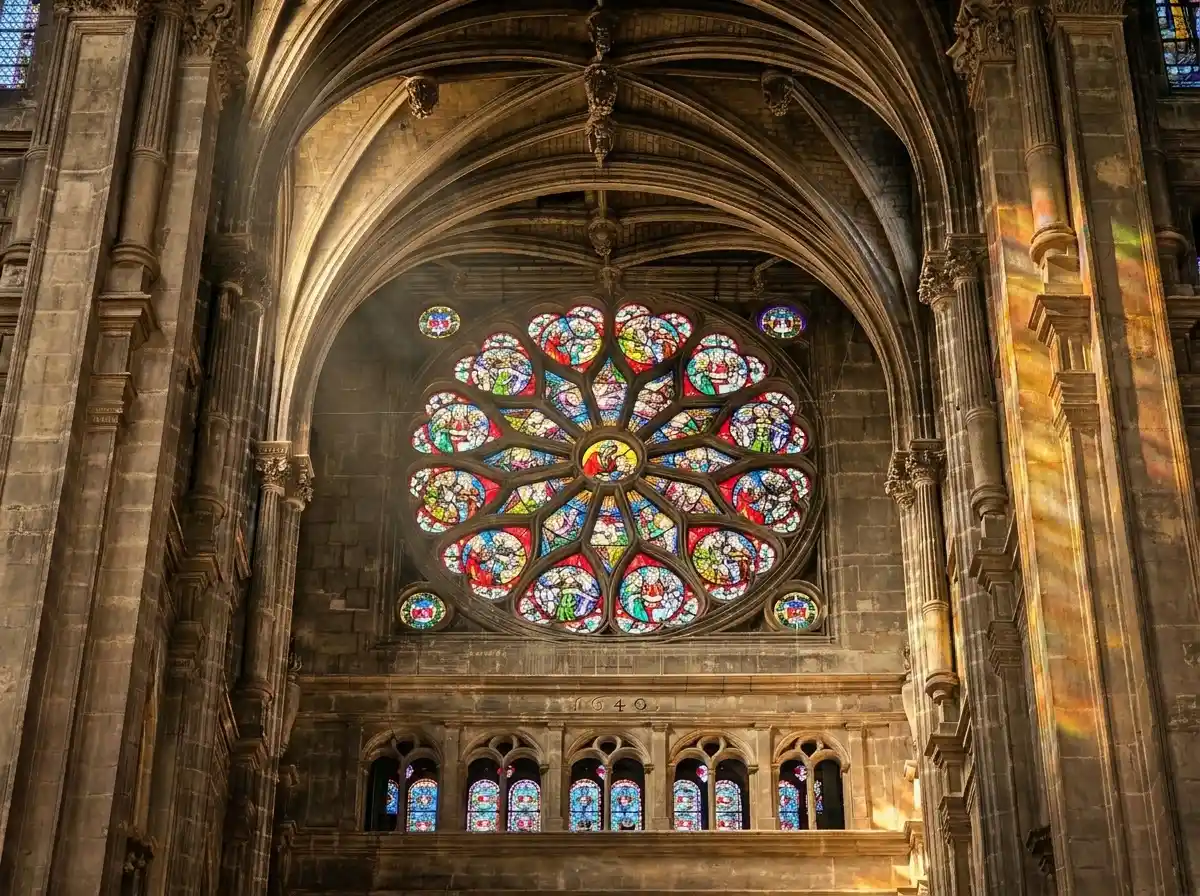
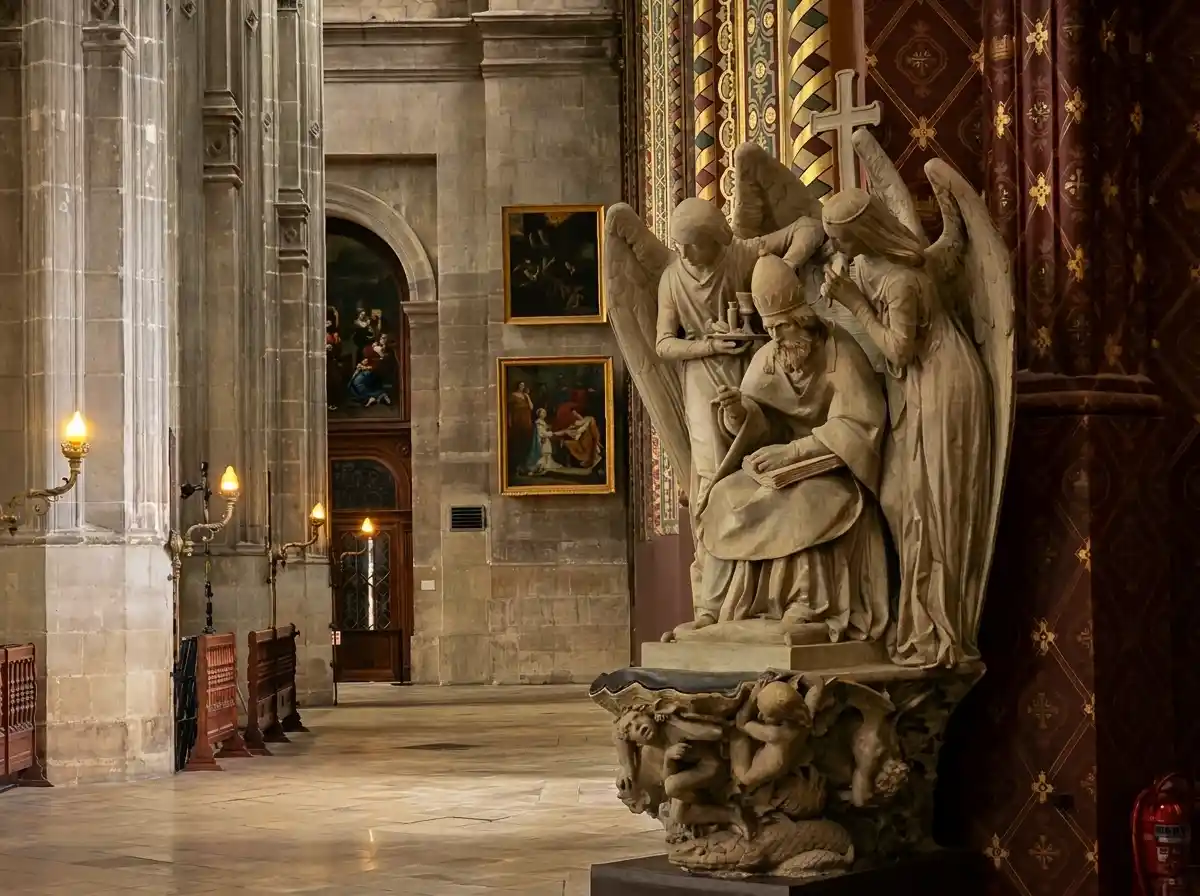
In the north arm of the transept stands a monumental plaster holy water basin (bénitier) more than two meters tall. The sculpture above it was created by Louis-Eugène Bion (1807-1860) and depicts Pope Alexander II (r. 1061-1073) seated between two angels, overseeing the use of holy water. Bion showed it at the Salon of 1834, and visitors were not impressed. It was apparently meant originally for Notre-Dame, but the state transferred it to Saint-Eustache, and this is the only known copy to survive to this day (sometimes a scathing review is the surest way to become one of a kind).
The great organ of Saint-Eustache
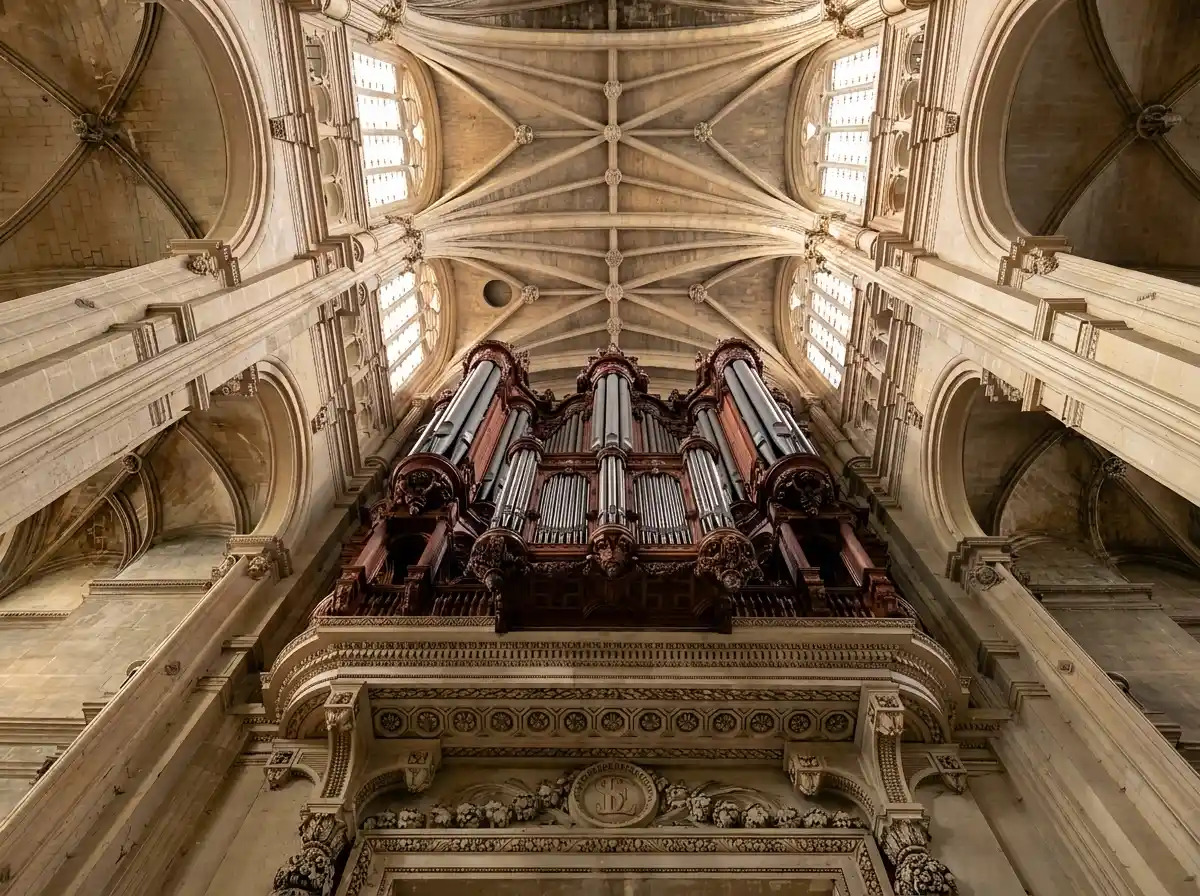
Above the west entrance hangs the great organ, the reason I keep coming back here again and again. It has 101 stops and 8,000 pipes and is considered one of the most important organs in France. Baltard designed its carved case in 1854, and the Dutch organ-building workshop Van den Heuvel rebuilt the playing mechanism itself in 1989. The organ has two consoles, which is fairly rare: one in the gallery, and the other mobile, so the organist can sit inside the nave, close to the audience.
In the video below you can hear the organ of Saint-Eustache, and understand why it’s worth planning your visit around the Sunday recital.
The organ isn’t just an instrument for prayer. Over the years, Saint-Eustache has premiered no shortage of contemporary works for organ, and the church has worked with the Institute for Research and Coordination in Acoustics/Music (IRCAM) in Paris on experiments in new uses for the organ.
Colbert’s tomb
To the left of the Lady Chapel, behind the choir, is the tomb of Jean-Baptiste Colbert (1619-1683), Louis XIV’s controller-general of finances and head of the vestry at Saint-Eustache. The tomb was designed by the painter Charles Le Brun (1619-1690), and the statues were made by Antoine Coysevox (1640-1720) and Jean-Baptiste Tuby (1635-1700). Colbert is shown kneeling in prayer, hands pressed together, wearing the robes of the Order of the Holy Spirit (Ordre du Saint-Esprit), with a sword at his side.
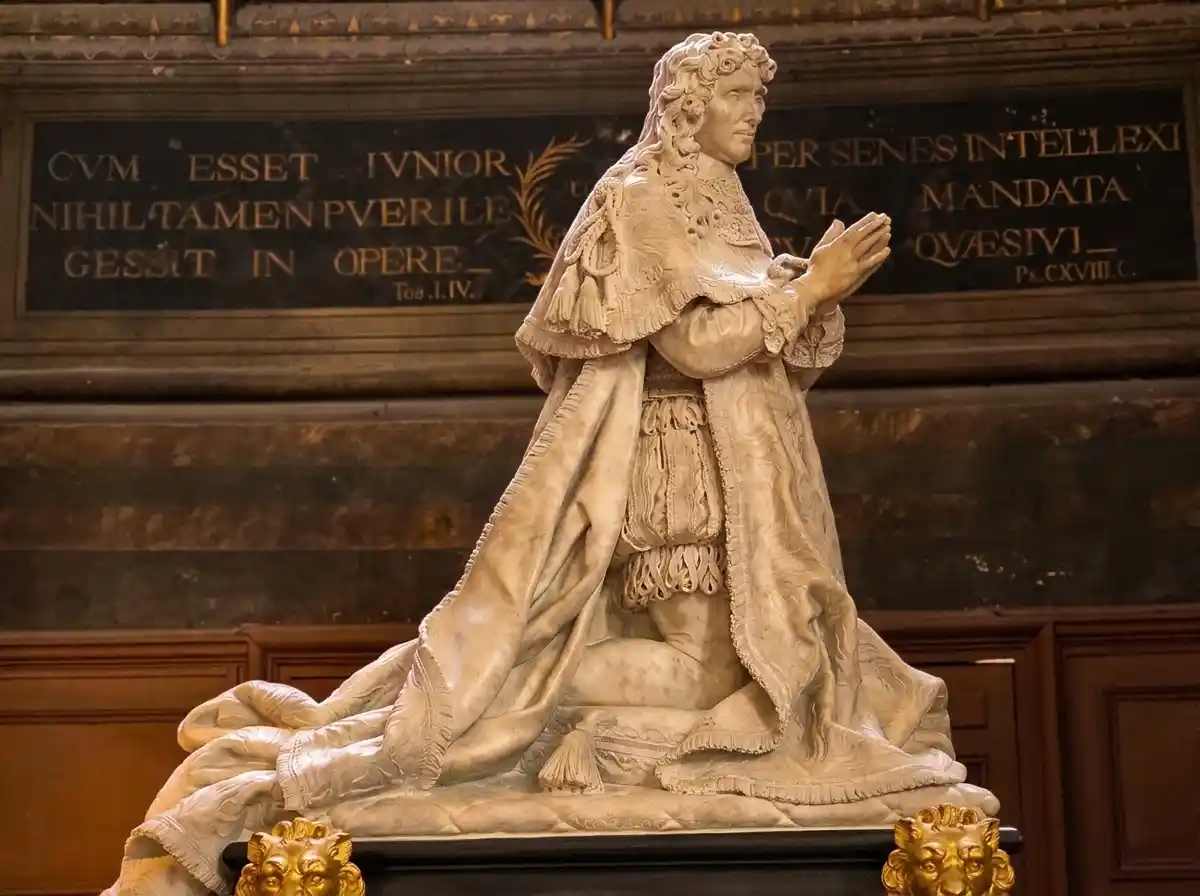
On either side of the tomb sit two female figures. On the left is Fidelity, identified by the dog, the key and the seal, and on the right is Piety, with a flame on her head, a hand on her heart and a horn of plenty.
Rubens, Vouet, and Pigalle’s Virgin
In the chapel next to Colbert’s tomb hangs one of the most striking paintings in the church, “The Pilgrims of Emmaus” (Les Pèlerins d’Emmaüs), attributed to the workshop of Peter Paul Rubens (1577-1640). Look for the expression of astonishment on the disciples’ faces, the head of the old servant woman on the right, and the still life on the table. In the baptistery hangs another painting connected to Rubens, a copy of his “Adoration of the Magi” (L’Adoration des Mages).
Since 2022, two large paintings have hung on either side of the choir, as was the custom before the Revolution. On the right hangs “The Martyrdom of Saint Eustace” (Le Martyre de saint Eustache) by Simon Vouet (1590-1649), which Cardinal Richelieu commissioned for the main altar. The painting originally had an upper section, “The Saint’s Ascension into Heaven,” but after it was removed from the church the two parts were separated. The upper section remains today in a museum in Nantes, and the lower section passed between collectors until 1855, when it was bought by the city of Paris, which returned it to the church.
In the Lady Chapel, which projects out behind the choir, stands a marble statue of the Virgin and Child sculpted by Jean-Baptiste Pigalle (1714-1785) for the chapel at Les Invalides. The chapel was consecrated on December 28, 1804, by Pope Pius VII (r. 1800-1823), who had come to Paris for Napoleon‘s coronation. The paintings on its walls are by Thomas Couture (1815-1879), who was the teacher of Édouard Manet (1832-1883).
The contemporary art of Saint-Eustache
In the chapel named for Saint Vincent de Paul, there is a bronze triptych with a white gold finish, “The Life of Christ,” by the American artist Keith Haring (1958-1990). This was his final work before he died of AIDS, and it recalls the years when Saint-Eustache was the central site in the Diocese of Paris that welcomed AIDS patients and held their funerals.
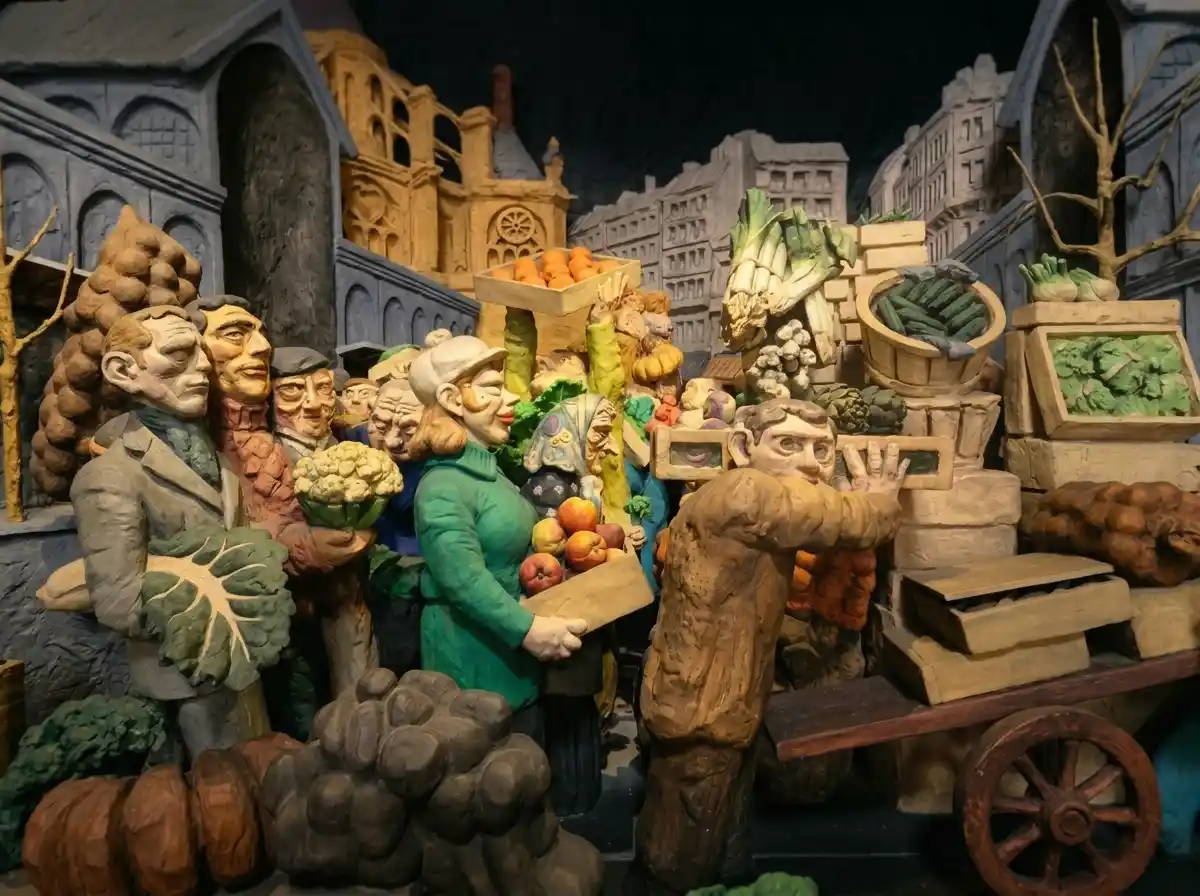
Opposite the Chapel of Saint Joseph is a colorful work by the British sculptor Raymond Mason (1922-2010), whose title explains exactly what it depicts: “The Departure of Fruit and Vegetables from the Heart of Paris, February 28, 1969” (Le départ des fruits et légumes du cœur de Paris, le 28 février 1969). Mason shows a procession of market workers bidding farewell to Les Halles, with Saint-Eustache itself visible in the background.
Near the entrance at the corner of rue Rambuteau and rue Montmartre is the Chapel of the Charcutiers (chapelle des Charcutiers), a reminder of the days when several of the trade guilds of Les Halles had their own religious centers within the church. An association of sausage and delicatessen makers adopted the chapel, added a stained-glass window and a contemporary work by the artist John Armleder (b. 1948), and every year a solemn Mass is held there on behalf of the National Confederation of Charcutiers of France.
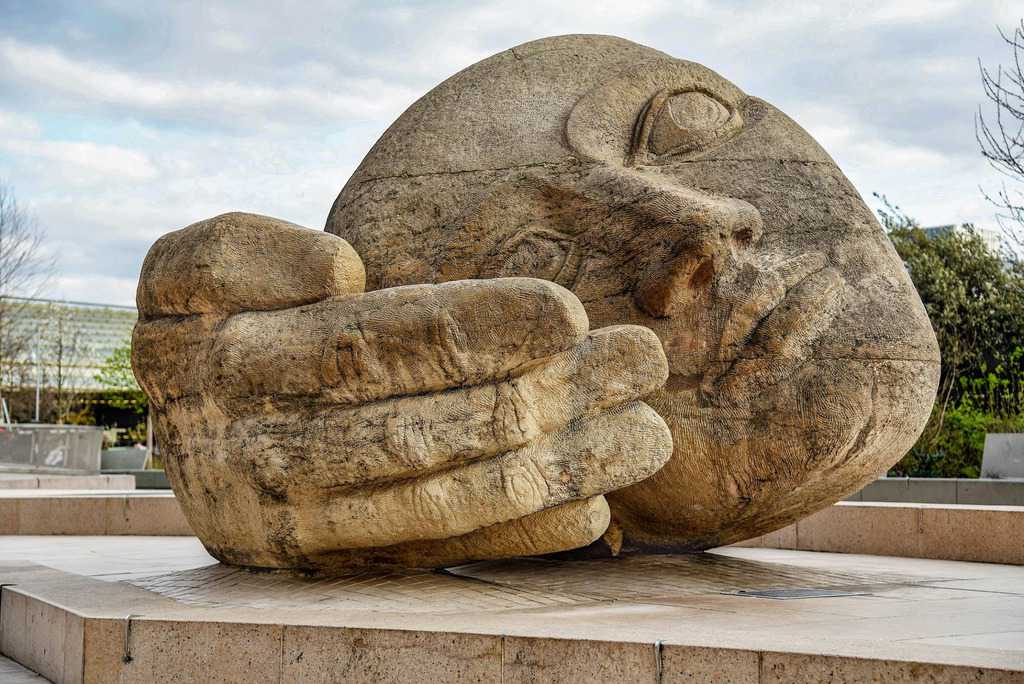
As you leave the church toward the Les Halles garden, look in place René-Cassin for “L’Écoute” (Listening), the sculpture by Henri de Miller (1953-1999) listening to the noises of Paris. It’s one of my favorite statues in the city, and you can read about it in the article 10 statues in Paris you have to see.
The history of Saint-Eustache Church
The 13th to 17th centuries: from a fish merchant’s chapel to a royal parish church
At the start of the 13th century, on the road that led from the Île de la Cité to the hill of Montmartre, near the city wall built by Philip Augustus (r. 1180-1223), a modest chapel was built here and dedicated to Saint Agnes. According to tradition, it was funded by a Paris merchant named Jean Alais, who lent the king a large sum and received in return the right to collect one denier for every basket of fish sold at the Les Halles market. The story continues that when the tax passed to another collector, Alais died of grief, and asked to be buried next to the chapel he built, where the market’s water channels once flowed.
By 1213, the chapel is already mentioned as a new building in an arbitration ruling given in a dispute between its priest and the church of Saint-Germain-l’Auxerrois, to which the chapel was attached. In 1223 the chapel gained the status of a church, and in 1303 it became a parish church and took the name of Saint Eustace, a Roman saint who was martyred, after the Abbey of Saint-Denis gave it some of his relics.
The parish grew along with the market, and the old church was no longer big enough. On August 19, 1532, during the reign of Francis I (r. 1515-1547), the cornerstone was laid for the current church. The name of the first architect is unknown, and construction continued for more than a hundred years, until April 26, 1637, when Jean-François de Gondi (1584-1654), the first Archbishop of Paris, consecrated the church. The west facade, the part meant to close off the building, was left unfinished.

In the 17th century, Saint-Eustache received the title of “royal parish” (paroisse royale), which it held until the Revolution. At the time, it served both the merchants and craftsmen of Les Halles and the nobles who lived within the parish and held private chapels there. Cardinal Richelieu was baptized here, and years later commissioned the Vouet painting you’ll see near the choir for the main altar. Between 1613 and 1623, Vincent de Paul (1581-1660) lived within the parish, working at the time as a private tutor for the Gondi family, before he became a saint.
On Saturday, January 15, 1622, an infant named Jean Poquelin was baptized at Saint-Eustache, the son of an upholsterer who lived on rue Saint-Honoré. Years later he added “Baptiste” to his name to distinguish himself from his brother and father, and the world knows him as Molière (you’ll find the walking route in his footsteps in the article a walking tour of the 1st arrondissement following Molière). In 1649, during the Fronde, the young Louis XIV held his first communion ceremony at Saint-Eustache, and in 1666 the priest Jean-François Senault (1599-1672) delivered the eulogy here for Anne of Austria (1601-1666), the king’s mother.
February 17, 1673: the priest of Saint-Eustache refused to bury Molière
To understand what happened to Molière, you need to know the church rules of the time. The ritual book of the Diocese of Paris forbade giving communion to the “unworthy,” including usurers, people living in sin, known criminals, and actors. An actor could receive last rites and be buried in consecrated ground only if he formally renounced his profession in writing, or declared it on his deathbed before a priest. Molière, who at the time lived on rue de Richelieu, belonged to the parish of Saint-Eustache.

On Friday, February 17, 1673, Molière took the stage for the fourth time in the lead role of “The Imaginary Invalid” (Le Malade imaginaire), and after the performance he went home. Around nine in the evening he fell ill, and according to the petition his widow filed the next day, he asked for a priest so he could die as a good Christian. Servants were sent to Saint-Eustache several times, and two priests of the parish refused, again and again, to come. Molière’s brother-in-law went himself and woke a third priest, but all of this took more than an hour and a half, and the priest arrived just as Molière died.
The rumor that Molière died onstage, in the middle of the scene where the imaginary invalid pretends to be dead, spread very quickly (it was simply too good a story to let go of). But all the testimonies from that time agree that he died at home, and because he died without confession, shortly after performing a comedy, the priest of Saint-Eustache refused to bury him.
His widow, the actress Armande Béjart (1642-1700), petitioned the Archbishop of Paris, François de Harlay de Champvallon (1625-1695), with an account that detailed the hours of that night, the names of the priests who refused to come, and the witnesses who saw him die “feeling like a good Christian,” including two nuns who were staying at the house. According to a later story, she also traveled to Versailles and threw herself at the feet of Louis XIV, but made a grave mistake when she told the king that if her husband was a criminal, his crimes had been approved by His Majesty himself. The king sent her back to the archbishop.
The archbishop ordered an investigation into the facts, and after it concluded, he allowed the priest of Saint-Eustache to bury Molière in consecrated ground, under clear conditions: no grand ceremony and no requiem Mass, with only two priests present, and outside daylight hours. The burial record was copied from the parish registers in the 19th century, before Paris’s civil records burned along with the city hall building on May 24, 1871, which is how its text survived.
On Tuesday, February 21, 1673, around nine in the evening, the coffin left rue de Richelieu for the cemetery of the Chapel of Saint Joseph (chapelle Saint-Joseph) on rue Montmartre, which belonged to the parish of Saint-Eustache. Despite the instructions, a large crowd gathered in the street: according to one eyewitness’s account, four priests carried the coffin, six children held candles in silver candlesticks, and between 1,000 and 1,200 livres were handed out to the poor who were standing there. According to a story that circulated afterward, when the coffin passed on rue Montmartre, someone asked a woman who was being buried. “Oh, it’s that Molière fellow,” she answered. Another woman shouted at her from a window: “What, you wretch? He’s Monsieur Molière to you!”
What happened afterward to Molière’s body is far from clear. One version holds that his body was removed from the grave and thrown into the mass grave for unbaptized infants, but there’s no evidence from that period to support it. During the Revolution, what was believed to be his remains were removed from the cemetery, and they moved from place to place until they reached Père Lachaise Cemetery. There, in a tomb bearing his name, they rest to this day. Maybe.
The 18th to 21st centuries: the unfinished facade, the Revolution, and the market that left
The story of the facade begins in the 17th century, when Colbert, then head of the vestry, ordered two chapels built beneath the facade’s towers. The work damaged its stability so badly that the facade and the first section of the nave had to be demolished. On May 22, 1754, the Duke of Chartres, Louis-Philippe d’Orléans (1747-1793), who would later become known as Philippe Égalité, laid the cornerstone for the new facade. The work ran into technical difficulties and a shortage of funds, and when it stopped in 1788, the south tower was left unfinished, as you’ll still see it today.
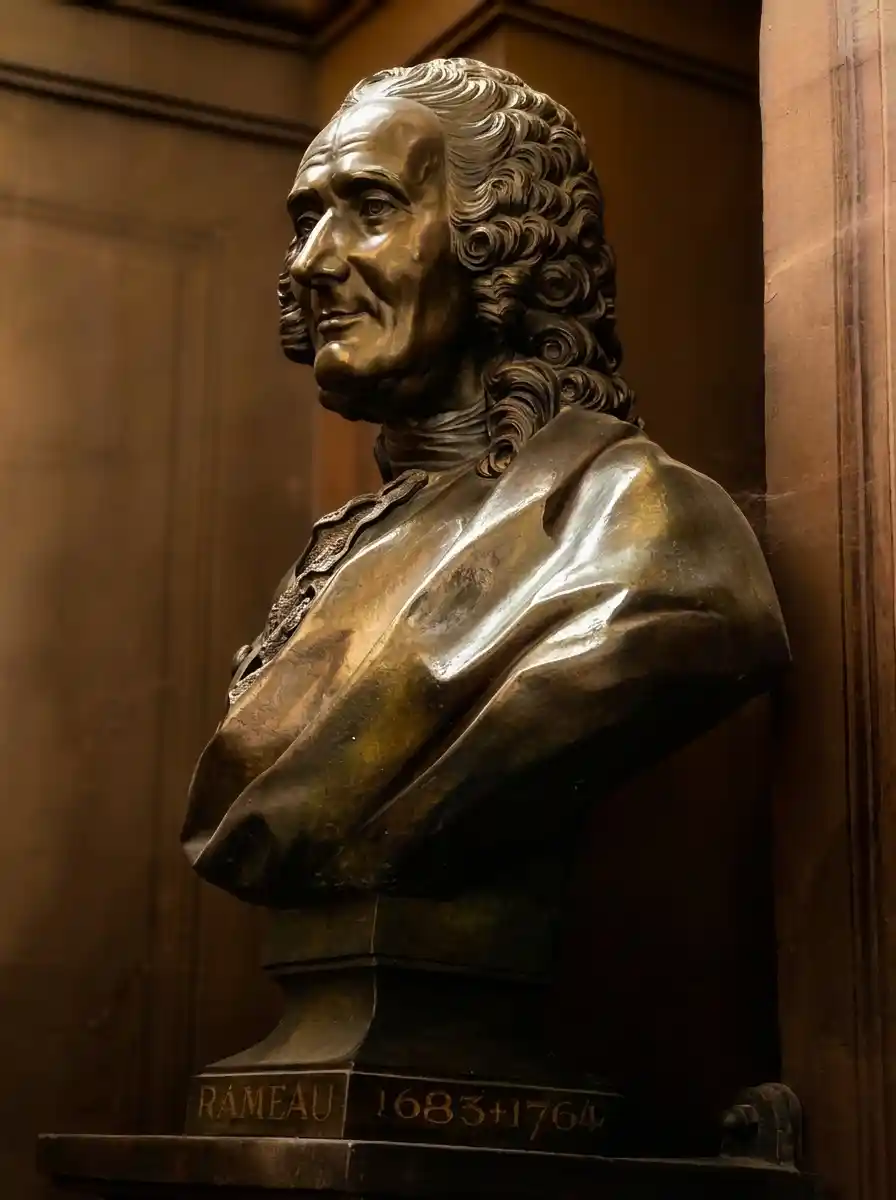
In the meantime, Saint-Eustache continued to accompany the famous figures of Paris. On December 30, 1721, an infant girl named Jeanne Poisson was baptized there, who would later be known as Madame de Pompadour (1721-1764), the mistress of Louis XV (r. 1715-1774). In 1764, the church held the funeral of the composer Jean-Philippe Rameau (1683-1764), and on July 4, 1778, Wolfgang Amadeus Mozart (1756-1791) came here for the funeral of his mother, Anna Maria Mozart (1720-1778), who died in Paris during her son’s concert tour.
In the years after the Revolution broke out, the body of the revolutionary Mirabeau (Honoré-Gabriel Riqueti de Mirabeau, 1749-1791) was laid out at Saint-Eustache in a grand ceremony. In 1793 the church was closed to Catholic worship and turned into a “Temple of Agriculture” (temple de l’Agriculture). It reopened in 1795, but part of it was handed over to the Theophilanthropists (théophilanthropes), a religious movement that arose during the Revolution, and during this period the church and its furnishings suffered heavy damage.
The 19th century was a time of repairs. Between 1846 and 1854, Baltard led a comprehensive restoration of the church, designed the organ case, the pulpit and the main altar, and oversaw the restoration of all the wall paintings. On April 30, 1855, Hector Berlioz (1803-1869) conducted the performance of his “Te Deum” here. In 1862, Saint-Eustache was declared a protected historic monument (monument historique), and on March 15, 1866, Franz Liszt (1811-1886) heard the first performance of his Gran Mass here.
After the Franco-Prussian War and the Paris Commune (1870-1871), the roofs, buttresses and south facade of the church were repaired. Around it, the market continued to beat inside the iron and glass pavilions Baltard had built, and Émile Zola (1840-1902) wrote his novel “The Belly of Paris” (Le Ventre de Paris) about it in 1873 (you’ll find the walking route in his footsteps in the article a walk through Paris following Émile Zola). In 1922 the church was handed over to the Oratorians (Oratoire de France).
In 1969, the fruit and vegetable market left Les Halles for Rungis, south of Paris, and in 1971 Baltard’s pavilions were torn down. Only since then has it been possible to see the south facade of Saint-Eustache at its full height, and in the market’s place rose a regional transit hub, a large shopping center, and cultural institutions. In 1989 the great organ was rebuilt, and in the years that followed, the church was the central site in the diocese that welcomed AIDS patients.
After the fire at Notre-Dame on April 15, 2019, the Easter and Christmas Masses of that year were moved to Saint-Eustache. In 2024 the parish celebrated its 800th anniversary, and at a Mass held on February 4, 2024, the west facade was rededicated after two years of restoration and resumed its role as the main entrance.
Attractions within walking distance of Saint-Eustache Church
Saint-Eustache sits at the heart of an area where nearly every corner is worth a stop. North of the church begins rue Montorgueil, where you’ll find the Stohrer pâtisserie, and east of Les Halles begins the route through the western Marais. The closest of all is the Bourse de Commerce, which stands at the west end of the Les Halles garden, a few minutes’ walk from the church (and a lot less than the walk to the Louvre). Anyone who loves churches will find Saint-Roch Church about a ten-minute walk west, with its chain of chapels and the cannonball marks of Napoleon on its facade. These are the attractions I recommend pairing with your visit to the church:
-
Modern art
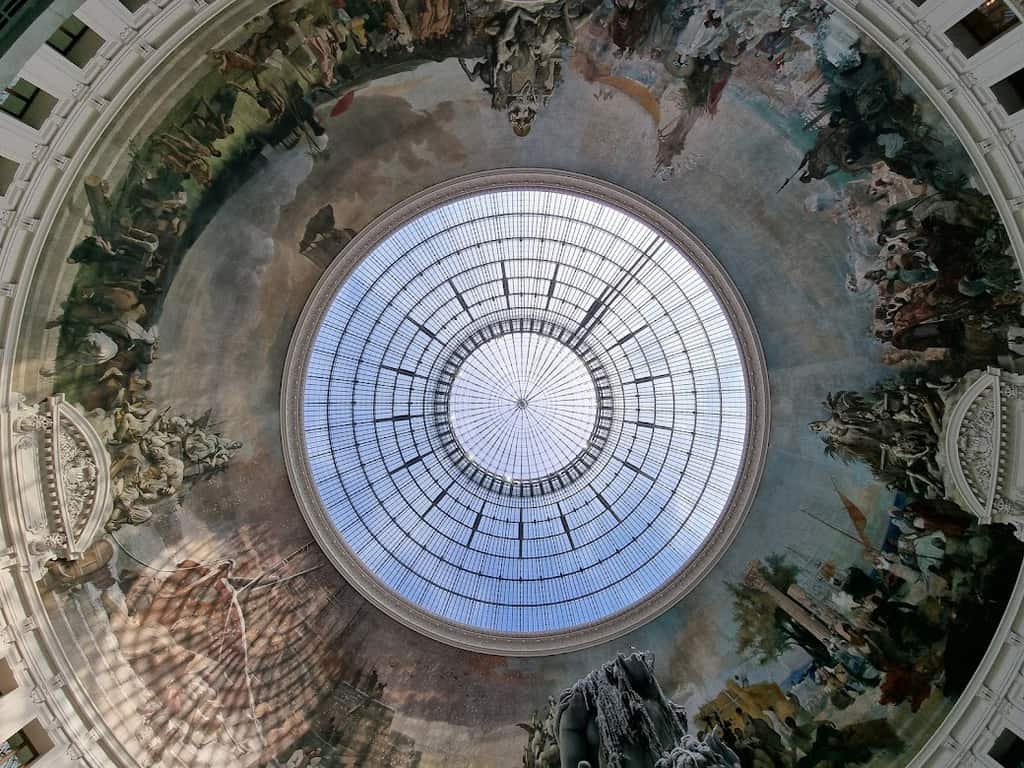
Bourse de Commerce
A modern art museum housed in the historic former wheat exchange, home to François Pinault’s art collection.
The combination of the historic building and the concrete cylinder installed inside it is the main reason to come here, even if modern art isn’t usually your thing. The exhibitions rotate, so it’s worth checking what’s on display before you buy a ticket.
-
Must-see

The Louvre Museum
The largest museum in the world, and don’t try to see all of it in one day. All you’ll get is art overload.
This is where you’ll find the Mona Lisa and the Venus de Milo, alongside an enormous collection of classical art, Egyptian antiquities and ancient Near Eastern art. Because of its size, it’s worth deciding in advance which wings you’ll visit, otherwise you’ll find yourself walking for three hours and remembering nothing.
-
Free admission

The Palais-Royal
The palace Cardinal Richelieu built for himself, surrounded by the quietest garden in central Paris.
The palace itself now houses the Council of State and isn’t open to visitors, but the garden and courtyards are open and free. In the main courtyard stand Buren’s Columns, an installation that caused a public uproar when it was installed and has since become a popular photo spot. The garden itself is surrounded by a colonnade of antique shops, and it’s one of the corners I return to on every visit.
-
Free admission

Galerie Véro-Dodat
One of the most beautiful covered passages in Paris, and maybe the only one where the marble floor alone is reason enough to step inside.
The passage connects the Les Halles area to the Palais-Royal, and it was built in an era when covered passages were how you shopped without getting wet. The floor here is laid in black and white marble squares, and the ceiling is glazed, so the light falls in a way that’s hard to find elsewhere. The visit takes ten minutes, and every one of them is worth it.
You’ll find more museums, restaurants and walking routes nearby on the 1st arrondissement of Paris page.
Hotels near Saint-Eustache Church
The Saint-Eustache area is one of the neighborhoods I recommend to anyone visiting Paris for the first time: the Marais, the Louvre and rue Montorgueil are all within walking distance, and the RER B train takes you from Châtelet-Les Halles station straight to Charles de Gaulle, with no train changes to deal with while hauling suitcases. These are the hotels I recommend in the area, and the first one is a hotel where I’ve personally stayed:
-

Hôtel Molière
I stayed here once and absolutely loved it. The hotel sits on the quiet rue Molière, between the Palais-Royal and the Palais Garnier, in a building that’s been renovated from top to bottom. There’s a spa with a sauna and steam room you can book for private use, and coffee, drinks and pastries are available free all day long (and for anyone who’s read the history section above, the street name alone isn’t a bad reason to book).
-
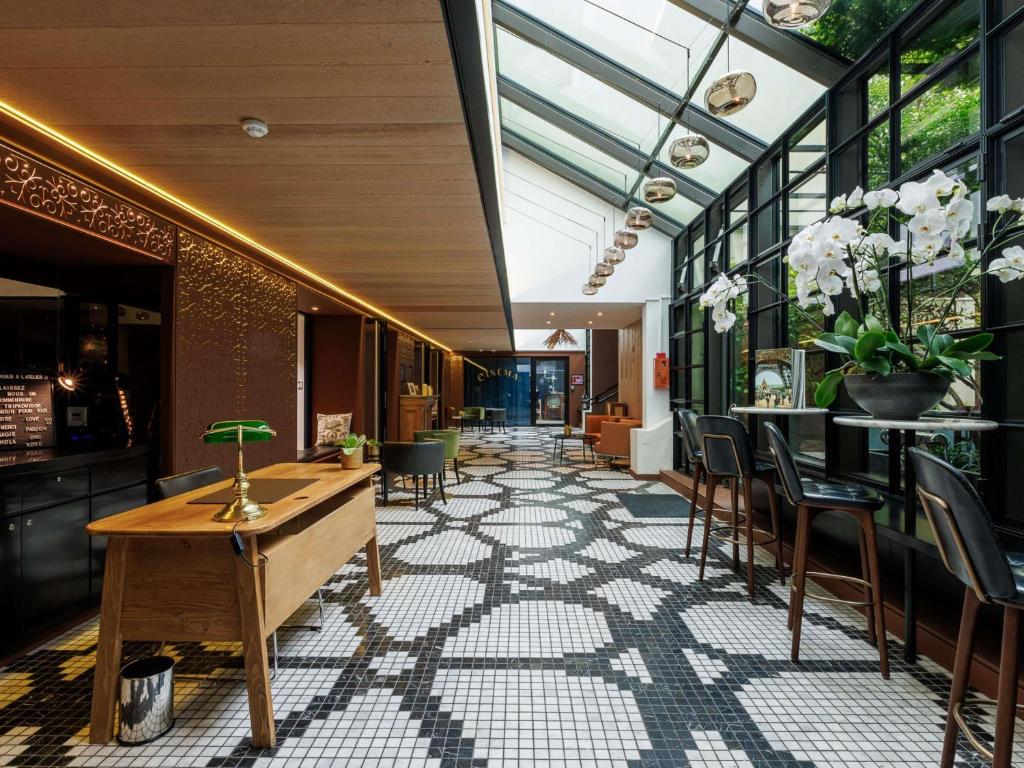
Novotel Paris Les Halles
Yes, it’s a chain hotel. But it sits right above Châtelet-Les Halles station, where the direct train to Charles de Gaulle departs, and anyone who’s ever hauled suitcases up metro stairs knows how much that’s worth. It has a private garden with play equipment and a game room, and the family suites fit up to five people. Ask for a room facing the garden.
-
Hotel Bachaumont
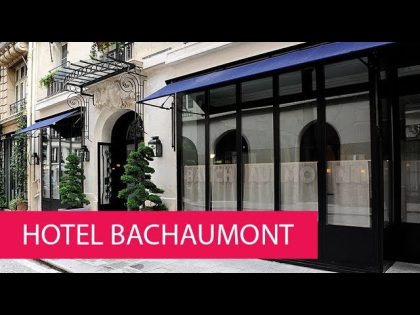
49 rooms on a side street off rue Montorgueil, a one-minute walk from the Les Halles area. Breakfast is served in a dining room under a glass roof, and the Night Flight bar stays open late and draws locals too. Room sizes range from 17 to 50 square meters, so pay attention to which category you’re booking. Light sleepers should ask for a higher floor, since the lower rooms facing the street pick up metro noise at night.
-

Hôtel Crayon Rouge
Just 17 rooms on rue Croix-des-Petits-Champs, each with its own wallpaper in a colorful retro style, plus a shared wine bar and lounge. The hotel sits right next to the Palais-Royal, a seven-minute walk from the Louvre. The rooms are compact, and anyone looking for a neutral beige room will feel out of place here, but if you love color, you’ll enjoy it a lot.
You’ll find more recommendations on the hotels in the 1st arrondissement of Paris and hotels in the 2nd arrondissement of Paris pages, and if you’re still deciding which area to stay in, read the article where to stay in Paris.
Another church worth pairing with the same visit is Saint-Paul-Saint-Louis in the Marais, the Baroque church the Jesuits built in the 17th century, home to Delacroix’s “Christ in the Garden of Olives.”
Frequently asked questions about Saint-Eustache Church
Answers to the questions I get about Saint-Eustache Church:
Is admission to Saint-Eustache Church free?
What are the opening hours of Saint-Eustache Church?
When can you hear the organ at Saint-Eustache?
How do you get from Charles de Gaulle Airport to Saint-Eustache Church?
Is Molière buried at Saint-Eustache Church?
Related reading
