

Saint-Germain-des-Prés is without a doubt the most legendary neighborhood in Paris, and it’s considered a favorite among travelers (in every survey I’ve run, this area always comes in first for “where would you like to stay in Paris?”). And honestly, there are plenty of good reasons for that, starting with its central location (not far from the Luxembourg Gardens and the Latin Quarter on one side, and the Seine and the Right Bank on the other) and continuing with the lively atmosphere thanks to the cafés, the galleries and more.
I don’t dismiss any of those things that make Saint-Germain so beloved by travelers, but the main reason I keep coming back is actually the history (well, I’m sure that statement didn’t surprise my loyal readers one bit 🙂 ).
So today I want to take you on a trip through time and tell you the fascinating history of this neighborhood. We’ll start with the abbey that grew up here, which was practically a city within a city, and we’ll end, of course, with the intellectuals who sat in the cafés near the famous church and turned the neighborhood into a kind of “church of the intellect.”
And of course I haven’t forgotten those of you planning your trip to Paris right now. I’ve included important practical information at the end of the article, like recommended restaurants nearby, walking routes and more.
So let’s put on our best intellectual face and get going!
The History of Saint-Germain-des-Prés
There Used to Be Fields Here
Our story begins in the 6th century, when King Childebert I (r. 511-558) decided to go to war against the Visigoths and invaded the Iberian Peninsula. During the war he laid siege to the city of Zaragoza, and the city’s notables offered him a deal. He would lift the siege, and in exchange they would give him the vestments of Saint Vincent (died 304), who had been the city’s first bishop and ended his life essentially grilled alive by the Romans.
When the king returned to Paris, he decided to build a church in honor of Saint Vincent where the vestments would be put on display (exactly as King Louis IX would later do when he built Sainte-Chapelle almost 700 years later). In 558, the church of Saint Vincent was finished, just in time to receive the body of King Childebert I, who died that same year.

This made the church the first royal necropolis of France, until the Basilica of Saint-Denis took over that role in the 7th century. The church that Childebert built was one of the most beautiful and impressive in Paris. According to the historical record, it had mosaics made by the great artists of the time and a gilded roof that could be seen from far away.
The man who consecrated the church, and who was also responsible for Childebert I’s burial, was Germain, bishop of Paris, who was later made a saint. The reasons he received that coveted title were:
- His efforts to prevent bloodshed among the heirs of Childebert I’s brother, King Clotaire I (r. 558-561)
- No small number of miracles attributed to him, starting with his very first one, performed while he was still in his mother’s womb, when he supposedly convinced her not to have an abortion.
When Germain, bishop of Paris, died in 576, he was buried in the church (you can find a plaque there marking the spot), and after he was made a saint, it was decided in the 11th century to change the church’s name from Saint-Vincent to Saint-Germain. You’re probably wondering why the church is called Saint-Germain-des-Prés, or Saint-Germain “in the fields”? Where are these fields, you ask? After all, today there’s nothing around but buildings, boulevards and cafés.

The reason the place was called Saint-Germain “in the fields” is that the church and the abbey built alongside it stood outside the city walls, next to vegetable and fruit fields tended by the monks. Vineyards were added to these fields too, producing excellent wine, which isn’t too surprising, since Saint Vincent was the patron saint of winegrowers and vintners.
The fields and vineyards lasted for hundreds of years and were considered very fertile, because, much like the Marais, the land of Saint-Germain had once been marshland, and marshland tends to be very fertile. What happened to them, and why aren’t they with us anymore? We’ll get to that.
A City Within a City
Putting an abbey and a church in the middle of green fields, outside the walls of a crowded city, might have been a nice idea for the pastoral scenery, but it certainly wasn’t smart once the Vikings started raiding the area. They reached Paris several times during the 9th century, and in one of their raids they looted the abbey and burned the church.

During the 11th century, the church and abbey were rebuilt, and they were consecrated in 1163 by Pope Alexander III (r. 1159-1181). This is the church we know today, and it’s considered the third oldest in Paris. The two older than it are Saint-Julien-le-Pauvre in the 5th arrondissement, right across from Notre-Dame Cathedral, and the church of Saint-Pierre, which sits at the top of Montmartre, not far from the Sacré-Cœur.
The fertile fields made the abbey very rich and independent, and little by little it turned into a kind of city within a city. To protect themselves from possible raids, like those of the Vikings, the abbey’s leaders teamed up with King Philip II and built a stone wall, as well as the Tour de Nesle on the Seine (directly across from the Louvre).
There’s a fascinating story behind this tower, but since we still have a long way to go through the history of Saint-Germain, I won’t tell it here. If you’d like to get to know it, you can do so through Dr. Orna Liberman’s article The Tour de Nesle Affair: Adultery at the Royal Court.
The Saint-Germain Fair and the Birth of Cafés
As I mentioned, the abbey held onto its independence for hundreds of years, so much so that its abbot could even refuse to let the bishop of Paris take part in the consecration ceremony of the new Saint-Germain church, just to remind him of his place. As the abbey grew, new institutions were added, including a prison, a court, and even a gallows, so that the neighborhood’s residents knew their place too.
Of all these institutions, the most important was the abbey’s annual fair, known in French as the Foire Saint-Germain. This fair was first held in 1176 and ran for three to five weeks during the Easter season. At first it took place in temporary structures, but in 1482 Louis XI (r. 1461-1483) decided to replace them with stone buildings, somewhat similar to the ones Louis VI (r. 1108-1137) had built at Les Halles.

During the fair, the area drew plenty of artisans and merchants who brought goods from all over the world. You could find fabrics from Flanders, jewelry from Italy, and spices from the East. Alongside the traders were plenty of acrobats and performers who kept visitors entertained. These performers were, in fact, part of the foundation of French theater, which began to take institutional shape in the 17th century.
There was something almost democratic about this fair, since kings, nobles and commoners mingled there side by side, and it wasn’t unusual to find the king of France among the stalls, haggling over a price or watching a show. Sometimes this ended badly, financially speaking. For example, a letter written to the Duc de Sully tells us that King Henri IV (r. 1589-1610) lost about 3,000 livres at the fair through gambling. At least the king paid off his debt from his own pocket and not from the royal treasury…
Besides its contribution to the birth of theater, the fair also played a decisive role in launching another important Parisian social institution. It all started in 1672, when two men named Pascal and Maliban, who had come to Paris from Armenia, brought with them from the Middle East a hot, fragrant black drink, which they tried to sell to fairgoers for 2.5 sous a cup.
This drink was called coffee, and even though it was served hot, it was met at first with rather lukewarm success.
Some people credited the drink with medicinal properties, while others claimed it actually caused impotence. The Duchess of Orléans went so far as to say its smell reminded her of the breath of the Archbishop of Paris (and no, that wasn’t a compliment).

One visitor to the fair was an Italian nobleman named Francesco Procopio dei Coltelli (1651-1727). He tasted the bitter drink, fell in love with it, and decided to open an establishment where it could be served to the public in comfortable, seated surroundings. That’s how, in 1686, the first café was born, called Le Procope, named after its founder, who quickly “Frenchified” his own name.
The place stood on Rue des Fossés-Saint-Germain-des-Prés, where the Comédie-Française theater was also located. This old café still stands on the same street today, although the street’s name has changed over the years to rue de l’Ancienne Comédie, in honor of the theater that once stood there (the Comédie-Française moved through several buildings in Paris before settling at the Palais-Royal, where it remains to this day).
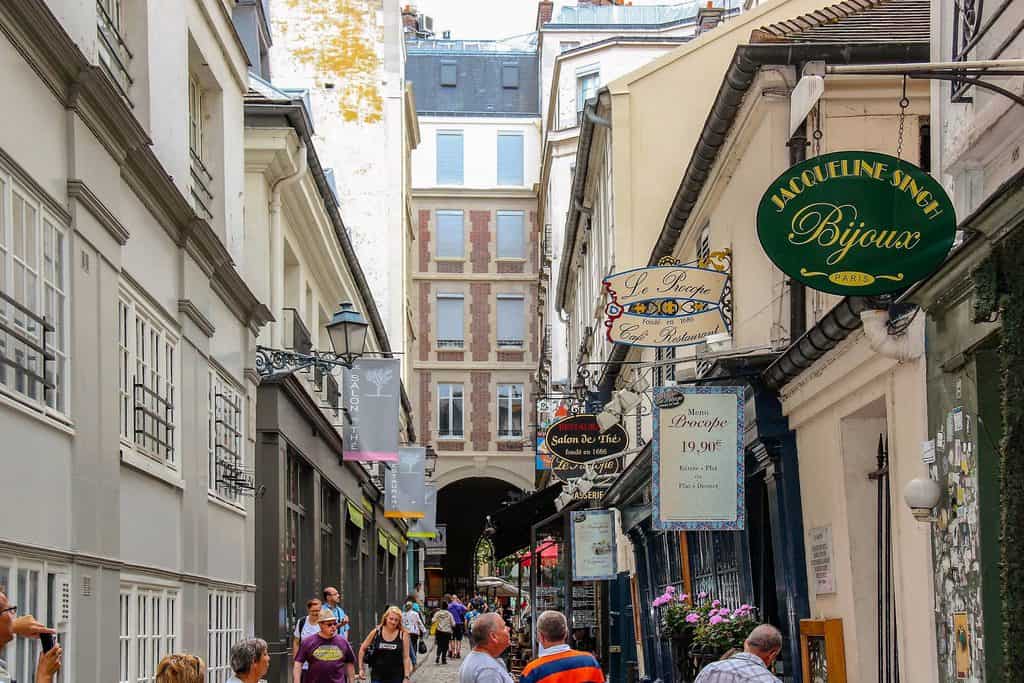
As I mentioned, Le Procope was the first café in Paris, and thanks to it, the drink became hugely popular. As a result, plenty of cafés popped up during the 18th century, and an entire culture formed around drinking coffee while arguing about politics and philosophy. Some of these cafés became legendary in the 20th century, and we’ll talk about them later in the article. But let’s not get ahead of ourselves. We still have a few stories left to tell first.
The Abbey Is Dead, Long Live the Boulevard
Thanks to the wealth it accumulated through the fair and through farming, the abbey of Saint-Germain managed to hold onto its autonomy until the 17th century and was considered the most important abbey in Paris. In 1586, the abbot, Cardinal Charles de Bourbon, built a palace worthy of such a wealthy and important abbot. Later, in 1691, Cardinal Guillaume-Egon de Fürstenberg (1629-1704) decided to upgrade the palace and decorate it with the same red and white brick used earlier at Place Dauphine and at Place des Vosges.
The abbot’s palace still stands today, and you can see it from the outside on Rue de l’Abbaye, but the abbot’s most important “legacy” is the Place de Fürstenberg, right next to the palace, which once served to stable the cardinal’s horses. In my opinion, it’s not only the most romantic square in Paris, but it’s also home to the Musée Eugène Delacroix, dedicated to one of the most important painters of the 19th century. If you’d like to get to know this square better, feel free to read the article Place de Fürstenberg, the Most Romantic Square in the City of Light.

And so the abbey of Saint-Germain continued in splendor and glory, right up until the outbreak of the French Revolution. But before we get into that bloody period, let me show you what Saint-Germain-des-Prés and its surroundings looked like in 1789. There’s a solid reconstruction of Paris from that era built into the video game Assassin’s Creed Unity, which gives a good sense of the neighborhood as it stood then. As you’ll see, a great deal has changed since, and we’ll talk about that very soon.
In 1789, as mentioned, the French Revolution broke out, and the Saint-Germain area, along with the Palais-Royal and the eastern districts of Paris, became one of the biggest hotbeds of political radicalism in the City of Light. The reason was the printing shops scattered through the district, where men like Marat and Danton printed pamphlets that spread their radical ideas and stirred up hatred against their political rivals.
The results of that incitement arrived in September 1792.
The leaders of the Revolution decided to “clear out” the prisons of Paris of political prisoners, and allowed armed mobs to break into the jails and massacre the inmates. One of the largest prisons, holding no small number of political prisoners, was the one belonging to the abbey of Saint-Germain, and dozens upon dozens of prisoners were slaughtered there, until the surrounding streets ran red with blood.

During the 19th century, the area underwent a complete facelift that changed its appearance almost entirely. Napoleon started things off by tearing down the old fair buildings of the Saint-Germain abbey and building in their place the covered market of Saint-Germain, which still stands today at 4-6 rue Lobineau.
In this covered market, you’ll find plenty of stalls selling fruit, vegetables and wonderful cheeses, so if you’re staying in the area and like to cook, you’re in for a treat (by the way, if you’d like to read about other markets in Paris, feel free to check out this article).
But the biggest change the area went through is credited to Napoleon’s nephew, Napoleon III (r. 1851-1870). To solve the area’s traffic problems, it was decided to build the Boulevard Saint-Germain we all know today, and to do so, plenty of small, crowded alleys were demolished, along with parts of the abbey itself, including the prison.
Work on the boulevard began under Napoleon III but wasn’t finished until 1889, just in time for the World’s Fair that gave us the Eiffel Tower. During the construction, a plan arose to demolish the church of Saint-Germain entirely, in order to widen the traffic route. Luckily for us, Victor Hugo, who had already saved Notre-Dame Cathedral, spoke out against these plans and managed to save the church for the generations of francophiles to come.

Alongside the construction of Boulevard Saint-Germain, it was decided to cut through another boulevard that would connect the Montparnasse train station to the Left Bank of the Seine. The result is Rue de Rennes, which starts at the train station and runs all the way to Boulevard Saint-Germain. It’s a wide, pleasant thoroughfare lined with plenty of shops, but I’m very glad it was ultimately decided not to extend it all the way to the Seine, since the small streets between the boulevard and the river have a charm all their own.
Here Come the Intellectuals
The streets around Boulevard Saint-Germain are considered very upscale today, and the hotel prices there reflect that. But here’s the interesting part: at the start of the 20th century, the Saint-Germain district was considered a relatively cheap place to live, and most of its population belonged to the working class.
That may be why Oscar Wilde (1854-1900), who suffered from poor health and an even poorer bank account, chose to spend the last months of his life in this district. He stayed at a cheap, dreary hotel called the Hôtel d’Alsace, and died there on November 30, 1900 (his last words are said to have been something like “My wallpaper and I are fighting a duel to the death. One or the other of us has to go”).
It’s worth noting that over the years, this humble hotel became a five-star hotel and changed its name to L’Hôtel. If your pockets are deep enough, I highly recommend staying there and visiting its charming bar as well.

So how did Saint-Germain go from a poor district to one of the most sought-after in Paris? In a word: intellectuals. They started arriving in the neighborhood during the first half of the 20th century, following publishing houses that opened offices there. But the institutions where most of the intellectual work actually happened were, of course, the cafés.
Going back to the days of Le Procope, which I mentioned earlier, cafés became gathering places for writers, poets and philosophers to exchange ideas. The two most famous cafés in the district, still standing to this day, are of course Les Deux Magots and Café de Flore.
“Magot” is a term for a statue of a Chinese sorcerer. In the 19th century, two such statues stood in a shop that imported silk from the East, and when the shop became a café in 1884, it kept the two statues, which gave the café its name. Since 1914, the café has belonged to the family of Auguste Boulay, who bought the establishment that year and turned it into a mecca for intellectuals.
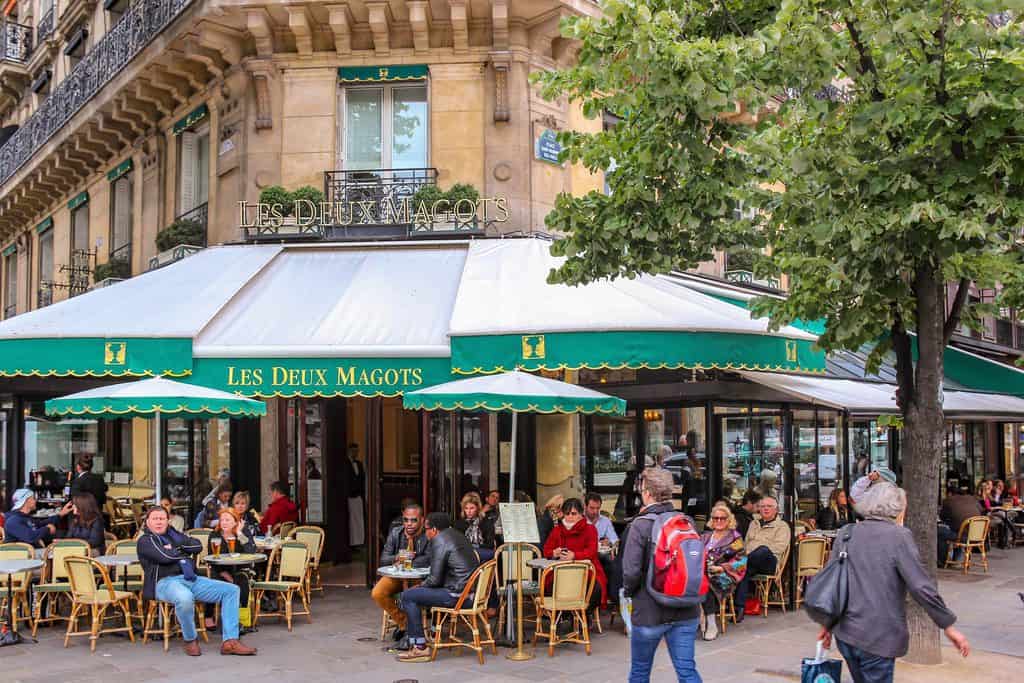
The painter Pablo Picasso, the surrealist writer André Breton (1896-1966), the poet Jacques Prévert (1900-1977), and plenty of other greats all used to sit in this café and on its famous terrace, which looks out onto the church.
Speaking of Pablo Picasso, right next to the church of Saint-Germain-des-Prés there’s a small, magical garden called Square Laurent-Prache. Inside the garden you’ll find a statue honoring the poet Guillaume Apollinaire (1880-1918). When the poet died of the Spanish flu, Picasso, who had been a good friend of his in the early 20th century, was asked to create a statue in his memory.
Picasso didn’t feel like making the effort, and instead of sculpting a statue resembling Apollinaire’s face, he simply gave the poet’s admirers a head sculpture of Dora Maar (1907-1997), one of his famous mistresses. That’s exactly why Apollinaire’s statue looks so feminine.

But let’s get back to our story about the cafés of Saint-Germain. With the Nazi occupation of Paris in 1940, Café Les Deux Magots became one of the favorite haunts of German army officers. As a result, intellectuals who opposed the occupation preferred to move over to the nearby Café de Flore.
One of the most important intellectuals who turned Café de Flore into a kind of office, where he sat and wrote, was Jean-Paul Sartre (1905-1980). The reason he chose this particular café was the heater that the owner, Paul Boubal, had installed on the second floor. Thanks to that heater, Sartre and plenty of other intellectuals and artists were able to keep warm during the brutal winter of 1943-1944.
And so Sartre would show up there day after day, together with his partner, Simone de Beauvoir (1908-1986). During the day, each of them would take a separate table and work quietly, almost without exchanging a word. In the evening, friends would arrive, and with them came the drinking and the political arguments.
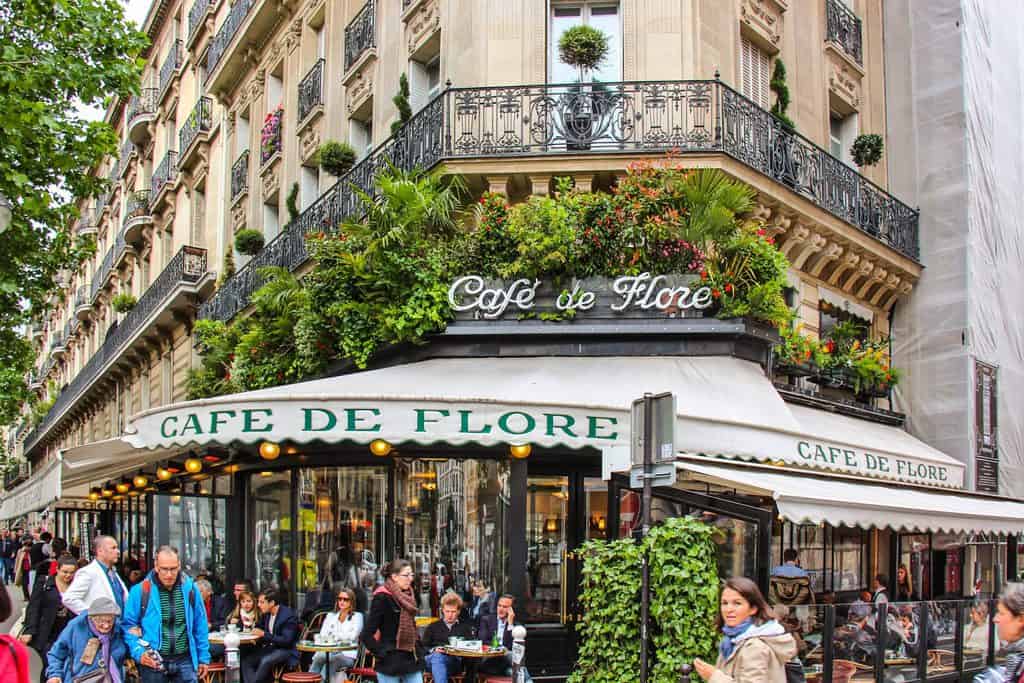
After World War II ended, the intellectuals’ cafés became something of a pilgrimage site, and Sartre and Beauvoir became figures with an almost religious significance. Quite a few people found the phenomenon a bit ridiculous, and came up with the nickname La Grande Sartreuse for Simone de Beauvoir. It’s a play on the phrase La Grande Chartreuse, meaning something like “Sartre’s own holy lady.”
However, it’s worth noting that Café de Flore wasn’t just a meeting place for idealistic intellectuals. It was also a gathering spot for some of France’s most notorious anti-Semites. For example, in 1899, in the wake of the Dreyfus Affair, Charles Maurras (1868-1952) and Léon Daudet (1868-1942) founded the far-right movement l’Action Française here.
Supporters of this movement were responsible for the anti-Semitic propaganda that swept through France during the first half of the 20th century, and many of them collaborated with the Nazis in the extermination of Paris’s Jews. Maurras was even put on trial for his crimes after World War II ended, and he never set foot in this café again.
Why Do Francophiles Love Saint-Germain So Much?
Today, both Les Deux Magots and Café de Flore have long since stopped being meeting places for intellectuals. They’re simply expensive cafés, usually packed with tourists. Most of the grand abbey no longer exists, and the intellectual atmosphere of Paris isn’t what it used to be either. But despite all that, the charm of Saint-Germain hasn’t faded, and francophiles keep coming back to this neighborhood every chance they get.
So what’s the secret of this district’s charm? It’s not easy to answer that question briefly, so I collected a few quotes from francophiles who were asked to weigh in on this question in the Facebook group Paris and Île-de-France:
- One of my favorite districts, the shops, the cafés, the restaurants, everything within walking distance… (Daniel Illouz)
- There’s something in the air, in the little cafés, the slow pace, pure pleasure (Aliza Guterman).
- I love the bookshops in the area, the old movie theaters that show old, quality films from all over the world. And of course the Luxembourg Gardens, whose atmosphere still feels more magical to me than any other part of the city (Katya Popko-Blog).
- I wouldn’t trade the 6th arrondissement, right on the border of the 5th, for anything, because of the calm air, the Sorbonne, the Luxembourg Gardens, the shops, the history, the Champo cinema, and the kind of people you see wandering around (Rachel Manor).
- I love this district because of the hotels with their inner courtyards and crackling fireplaces, like Relais Christine and the d’Aubusson, because of the Buci food market, the little streets Rue Christine and Rue Dauphine, the ethnic furniture shops and galleries, the concerts at the church of Saint-Germain-des-Prés, the bistro Le Petit Prince, the café at Paul, and the bakery of Éric Kayser (Ronit Amir-Yaniv)
I hope all of this, together with the fascinating history of the area, will convince you to come back here on your next visit to Paris. If so, feel free to keep reading the next section of the article, where you’ll find all the practical information you’ll need to enjoy everything the Saint-Germain district has to offer.
Saint-Germain: Information for Travelers
Did you enjoy reading about the history of the church of Saint-Germain and the district named after it? Ready to explore the district, and maybe even stay there (despite the not-so-friendly prices)?
All you need to do is head over to the Saint-Germain district page on the site, where you’ll find recommendations for hotels, apartments and restaurants, along with great walking routes to help you discover all the district’s secrets.
Related reading
