

Saint-Germain is considered one of the most popular neighborhoods among travelers, so chances are many of you have already explored it during a trip to Paris. And even though Saint-Germain has become something of a tourist cliché, let me offer you a walking route that I promise will show you plenty of places you don’t know (or stories you haven’t heard about places you do), even if you’re an advanced Francophile.
This is a relatively short route, so it works even if you’re not up for a marathon walk. It’s the first part of a longer itinerary I call “Southern Saint-Germain,” since in my view, Boulevard Saint-Germain splits the 6th arrondissement into two halves.
The first half lies north of Boulevard Saint-Germain and ends at the Seine. It includes quite a few famous spots, like the École des Beaux-Arts or the Pont des Arts, and I promise that one day I’ll give you a walking route there too.
The second half of Saint-Germain lies south of the boulevard and ends, more or less, at Montparnasse, which borders the 6th arrondissement to the south. In this route, we’ll focus just on the stretch between the Église Saint-Germain-des-Prés and the Église Saint-Sulpice, and we’ll discover charming churches, former brothels, picturesque streets, and more. Let’s get started.
Instead of a map: under the heading of each stop you’ll find its address, and every address is a link. Click it, and the spot will open right away in Google Maps.
Let’s start our walk outside the Saint-Germain-des-Prés metro station, reachable via line 4. If you’re staying in the 6th, 7th, 5th, or 1st arrondissements, chances are you can get there on foot too.
Walking Route Through the Saint-Germain District
The Church of Saint-Germain-des-Prés
3 place Saint-Germain-des-Prés
We’re about to explore the northern part of Saint-Germain, but starting this walk so close to the Church of Saint-Germain-des-Prés, the last remnant of the important abbey that once stood here (Abbaye de Saint-Germain-des-Prés), without stepping inside, would be a crime against Francophiles everywhere.

True, this is one of the most famous churches in Paris (second, perhaps, only to Notre-Dame), and you’ve probably been there before, but you still have to go in.
Why? Because of the extensive renovation the church underwent in recent years, which turned it from a dark church with walls blackened by time into a bright one with a beautiful blue ceiling.
Since time is short and our walk hasn’t really begun, I won’t go into detail about this church here. If you’d like to know more about its history and that of the district, feel free to read my article Saint-Germain-des-Prés: From Ancient Abbey to the Church of Reason.
The Statue of Diderot and Rue du Four
After you finish visiting the church (and maybe having a coffee at Deux Magots, like the last of the tourists), cross Boulevard Saint-Germain heading south and walk east until you reach the square named after Jacques Copeau (1879-1949), a theater critic and director, the most important figure in that field in the 20th century and also one of the founders of the influential literary magazine La Nouvelle Revue française.

Here you’ll find a statue of Denis Diderot (1713-1784), one of the greatest philosophers of 18th-century France and the founder of the Encyclopédie.
This statue was created by Jean Gautherin (1840-1890), and it’s proof of his immense talent. Diderot looks almost alive here, as if he might get up from his chair any moment or mutter some witty remark under his breath. It’s a real shame Jean Gautherin never got to create many more statues like this one, since he died suddenly of an illness at age 49 and was buried in Montparnasse Cemetery.
From the statue at Place Jacques Copeau, continue through Rue des Ciseaux to Rue du Four. This is one of the oldest streets in Paris (it dates back to the 13th century) and was named after the oven (four) of the Abbaye de Saint-Germain, where neighborhood residents used to bake their bread or heat their stews, in exchange for a fee paid to the monks.
The street changed considerably during the 19th and 20th centuries with the construction of Boulevard Saint-Germain and Rue de Rennes, losing almost all of its old buildings. But thanks to “Il n’y a plus d’après,” the famous song by the Jewish singer Guy Béart (1930-2015), performed wonderfully by Juliette Gréco, it will probably remain famous forever (at the start of the song, the hero and his girlfriend say “bonjour” at the corner of Rue du Four).
The Street of Little Ducks and Wine
Continue on to Rue des Canettes, which translates to “street of the little ducks.” Here, at number 5, stood the “Society of Water Drinkers” (Cénacles de Buveurs d’eau), led by Henri Murger (1822-1861), whose book “Scenes de la vie de bohème” became the basis for Puccini’s opera “La Bohème.” This was an important meeting place where quite a few figures of Parisian bohemia gathered starting in 1840, and despite the name, I promise you they weren’t really drinking water…
And speaking of “water drinkers,” at number 11 you’ll find the wine bar Chez Georges, which has been here since 1952(!). I visited a few times in the distant past and really enjoyed the atmosphere. Back then, you could find in the cellar a French guy named Jef who loved Israel, and the moment he heard he had customers from Israel, he’d immediately put on Israeli music, which could lead to some fairly bizarre situations (have you ever tried drinking a Vouvray while Israeli pop songs play in an ancient cellar?).

A lot of wine has flowed since then, and it’s been a while since I’ve visited, so I have no idea whether dear Jef is still there. If any of you stop by in the evening, I’d love it if you asked about Jef and let me know (or maybe I’ll get there myself on my next trip to Paris, whichever comes first).
Another historically significant building is number 17, where Count Nicolas de La Motte (1755-1831) lived from 1820 until his death. The name may not mean much to you, but together with his more famous wife, Jeanne de Valois Saint-Rémy (1756-1791), he was responsible for the scandal that permanently destroyed the reputation of the French royal family.

I’m talking, of course, about the “Affair of the Diamond Necklace” (L’affaire du collier), in which the countess managed to convince Cardinal de Rohan (Louis-René de Rohan, 1734-1803) that Queen Marie Antoinette wanted him to buy an expensive necklace on her behalf. It’s a complicated, tangled affair, but the bottom line is that Marie Antoinette’s image was completely destroyed as a result, since she was portrayed as someone buying herself a terrifyingly expensive diamond necklace while the people were starving for bread.
If you’d like to learn a bit more about this affair, feel free to read my article on Arsène Lupin, which goes into detail about the Necklace Affair and its consequences for the French monarchy.
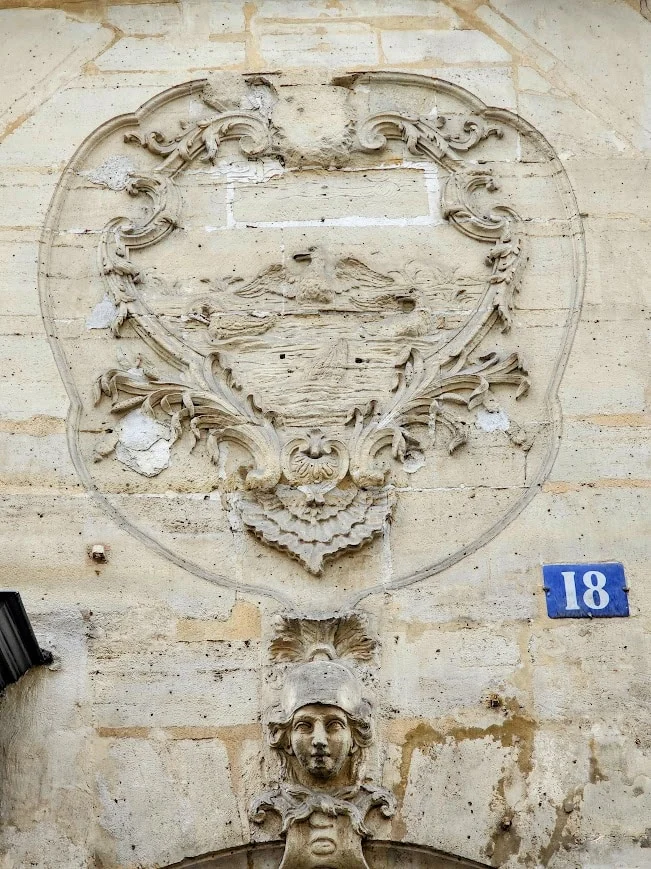
Finally, go to number 18 and take a look at the charming relief on the wall. This relief is actually an old sign for an inn depicting little ducks swimming in a pond. The sign has survived to this day and gave the whole street its name back in 1636. The building’s facade, on the other hand, dates from the early 18th century.
One last place worth mentioning is an excellent crêperie (recommended by Goni Burstein, who studied at Le Cordon Bleu in Paris) called La Crêpe rit du Clown, found at number 6. The name translates to “the crêpe laughs at the clown” and refers to the menu, where many dishes allude to the world of the circus. A great spot for a light dinner before heading to the Chez Georges wine bar.
Two Streets Linked to the House of Guise
rue Guisarde, and rue Princesse
Once you’ve finished exploring rue des Canettes, head to Rue Guisarde, which opened in 1620. The street is named after the House of Guise, a noble family from Lorraine that rose to prominence during the 16th century. At one point, one of its sons (Henri “the Scarred”) became the undisputed ruler of Paris and came within a hair’s breadth of the French crown.

The street is named after the House of Guise because the family had quite a few supporters in this area (the Guise family itself lived at Hôtel de Soubise in the Marais). The nearby Rue Princesse is also tied to the Guise family, named after Princess Catherine de Lorraine (1552-1596), who was the sister of Henri “the Scarred.”

As on Rue des Canettes, you’ll find no shortage of restaurants and wine bars here too (a trend that started around the time of the French Revolution). I obviously couldn’t eat at all of them, but I can definitely recommend Le Palanquin, at 12 Rue Princesse. It’s an excellent, authentic Vietnamese restaurant where I had a meal with a friend and his French girlfriend in November 2023, and really enjoyed it.
Beyond the food and drink, art lovers among you will be glad to know that number 13 Rue Princesse was once home to Jean Siméon Chardin (1699-1779), one of the greatest Rococo painters, who lived there with his second wife.

One last thing: nightlife enthusiasts will be happy to know that number 15 is home to Chez Castel, once one of the most important jazz clubs in Paris during the 1950s. Today it’s a well-known nightclub frequented by the who’s who of France, and from time to time the venue is rented out for private events. Here’s a video from one such event, so you can see what happens inside.
There Used to Be a Fair Here
Marché Saint-Germain, and 78 rue de Seine
Continue on Rue Guisarde toward Rue Mabillon. Right across the street you’ll see a square 19th-century building called “Marché Saint-Germain.” It’s a 19th-century structure that today houses several boutiques, food shops and small restaurants, a pale shadow of the fair that once filled this area.
This fair was created in the 12th century and spread across a large part of the area north of the Saint-Germain abbey. Shortly after it was established, it became a dazzling economic success, thanks in part to the variety of stalls and shops in the area and the entertainment on offer (acrobats, actors and so on). It’s no surprise that even French kings, such as Henri IV (r. 1589-1610), loved to visit and “mingle” with the common people.
It was here, during the 17th century, that the black, aromatic drink we know as coffee first arrived in Paris. It was brought by an Armenian man named Pascal, who used to pour it for fairgoers. But the drink didn’t catch on right away, not so much because of its taste but because of the noisy, unpleasant setting in which it was served.

A Sicilian man named Francesco Procopio dei Coltelli (1651-1727) understood this, and opened the first café in Paris not far from here in 1682. The goal of the café, named after him (Café Le Procope), was to let guests drink coffee in a relaxed atmosphere and chat with one another. The place was a huge success and led to a boom of other cafés, and the rest is history.
In 1762 the fair burned down, and although it was rebuilt a few years later, it was never quite the same. It seems the soul of the fair vanished in the flames and never returned. Over the years, the fairgrounds, which at their peak stretched all the way to Rue Tournon, shrank, until all that remained is the building we see today, built in the 1970s.

Continue on Rue Lobineau until you reach the intersection with Rue de Seine. On your left you’ll find the famous bakery and pâtisserie of Gérard Mulot, which has stood in the same spot since 1975 (two years before I was born). It’s one of the most famous pâtisseries in Paris, thanks to its pastries (try their fruit tart) and the fact that you’ll find here not just sweets, but also a selection of salads.

After visiting Mulot’s shop, continue south on Rue de Seine toward Rue Saint-Sulpice. There, at number 78, you’ll find the candle shop of Trudon.

It all began in 1643, when Claude Trudon opened a boutique selling spices and candles on Rue Saint-Honoré in Paris. The family business grew, and at the start of the 18th century they opened a factory south of Paris, where they managed to produce pure white candles. These candles became a huge success, and in 1719 the Trudon family business became the official candle supplier to the French royal family (later becoming the official candle supplier to Napoleon III as well).
Today, candles are no longer really used as a light source (unless you feel like setting up a romantic evening for yourself), but the Trudon chain lives on thanks to its scented candles, considered among the best in France (and probably the world).
If you don’t really need candles, you’ll be glad to know they also make small statues of French kings and other important historical figures here.
A Seminary, Two Brothels and a Chocolate Mousse You Can’t Miss
After visiting Trudon’s shop, continue on to Rue Saint-Sulpice, named after the church we’ll reach a bit later.
Starting in the 17th century, this neighborhood was home to one of the most important seminaries for young clergymen in Paris. Among the institution’s students was none other than Talleyrand (Charles Maurice de Talleyrand-Périgord, 1754-1838), who would go on to become France’s cynical and famous foreign minister, outlasting a long line of regimes.
Surprisingly, or maybe not, the schooling at the institution did nothing to curb the carnal appetites of either the teachers or the students. While Talleyrand found himself a mistress, others required more “professional” services. That’s why this street was once home to several brothels, and only those with a sharp eye will spot the traces of them.
You’ll find the first brothel at Rue Saint-Sulpice 15. At first glance there’s nothing about this gray apartment building to suggest what went on inside during the 19th century. To uncover its secret, you’ll need to wait patiently until someone comes out of or goes into the stairwell, then slip in right behind them. Look down and you’ll spot the name Alys spelled out in mosaic tiles on the floor. That was the name of the madam who ran the place.

Continue west to number 36. There’s no mosaic here, but you’ll probably notice that the street number looks different from the other numbers on the street (it’s much more prominent).

That prominent number marks the former brothel of Madame Betty, which specialized mainly in sadomasochism, very popular among the teachers at the seminary. Today it’s a dull office building, but in the past you could have found cages, whips, and even a large cross in the rooms, to which wayward clergymen could be tied.
Now that we’ve covered the carnal appetites, let’s talk about a sweeter kind of craving (as if the visit to Gérard Mulot’s shop wasn’t enough). In my opinion, no dessert compares to an airy chocolate mousse (preferably with whipped cream), and that’s exactly what you’ll find at Chapon, at number 34.

Here you’ll find five kinds of chocolate mousse, each with a different flavor and bitterness level. Whichever one you choose will be served to you in a paper cup, similar to an ice cream cup, and all that’s left to do is savor it.
Important: The place closes during lunchtime, and according to the saleswoman the mousse usually runs out by around 4:00 p.m., which creates a tricky logistical problem (you’re not going to eat mousse before lunch, are you? Or maybe you actually would…). I solved the problem by eating lunch nearby and showing up around 3:30 p.m. Sure enough, some of the mousse pots were nearly empty, but I still got to taste this sweet, sweet treat.
If you missed out on the mousse and want a consolation prize, continue west to number 2, where you’ll find a branch of Patrick Roger, one of the best and most expensive chocolatiers in Paris. If you head up to the second floor, you’ll find some of his sculptures.

Saint-Sulpice and a Catherine Deneuve Paparazzi Moment
We’ve now reached the church of Saint-Sulpice, one of the most famous churches in Paris (especially after the publication of The Da Vinci Code). Construction on the current church began in the 17th century and was, in fact, never completed (notice that one of its towers was never finished).

This church has a long history, and for the sake of brevity I won’t go into it here. If you’d like to dig a little deeper, feel free to read my article on the church of Saint-Sulpice.
Once you’ve finished visiting the church itself (and if you’re lucky, you might even get to catch a concert there), head over for a coffee at Café de la Mairie, at 8 Place Saint-Sulpice. The place isn’t exactly known for excellent coffee or great food, but ever since it opened, it’s become an important meeting spot for the literary elite of Paris.
One of those famous writers who used to sit and write there was Georges Perec (1936-1982), a writer who loved playing games with the written word and experimenting with it. For example, he once wrote an entire novel without using the letter E. As a tribute to that writer, you’ll find the street sign below, which is also missing that very letter.

Now head to Rue Bonaparte, across from the church square of Saint-Sulpice. At number 78 you’ll find the town hall of the 6th arrondissement of Paris, but at number 76 you’ll find something far more interesting.
Standing in front of number 76, look to your right and you’ll see a mural starring none other than the famous actress Catherine Deneuve (born 1943).

The mural is here precisely because the famous actress lives in one of the apartments in this building.

How do I know this? Because while a friend of mine and I were admiring the mural, a taxi pulled up nearby and Catherine Deneuve stepped out of it(!). While she waited for the driver to bring out the rest of her luggage, I managed to quickly snap a photo of her on my cell phone, and so I got to live out a brief career as a paparazzo :).
And here, with Catherine Deneuve, we’ll wrap up our walk. If you still have energy left to explore, I invite you to start another walking route called The Secret Spots of Southern Saint-Germain, which picks up right where this one leaves off.
Looking for more about Saint-Germain?
Did you enjoy this walking route and want to explore more of Saint-Germain? Or maybe you’re thinking about where to stay in the neighborhood, or looking for recommendations on good restaurants nearby?
You can find all of that and much more on the Saint-Germain-des-Prés page.
Related reading
