

Boulevard Saint-Germain crosses the Left Bank of the Seine and runs through the Latin Quarter, the 6th arrondissement and the 7th arrondissement. While the boulevard itself is not, for the most part, all that interesting (at least in my opinion), if you step a bit north or south and zigzag your way along it, you’ll discover some truly interesting spots.
Since the boulevard is quite long, one walking route isn’t enough to help you uncover all the secrets hiding along this avenue. That’s why I previously created a route along the stretch of Boulevard Saint-Germain in the Latin Quarter, and now I want to continue the trip, this time through the part that runs through the 6th arrondissement (in the future I’ll finish the trilogy with a route along the part of Boulevard Saint-Germain that’s in the 7th arrondissement).
The starting point
A note about the map: under each stop’s heading you’ll find its address, and every address is a link. Click it, and the place will open right away in Google Maps.
The route starts near the Fontaine Saint-Michel. If you did the route through the Latin Quarter, it ends not far from here at all (at the point where Rue de la Huchette meets Boulevard Saint-Michel), and you’re welcome to cross the street and reach the fountain.
Everyone else can take line 4, RER B or RER C and get off at Saint-Michel Notre-Dame. If you’re traveling by bus, you can get there on lines 21, 27, 38, 96, N14, N13, N12, N21, N122, N123.
You’ve arrived and you’re standing in front of the fountain? Great, let’s start exploring!
The walking route through the 6th arrondissement
You were supposed to see a statue of Napoleon right about now
In the 12th century, a church was built here dedicated to Saint Michael, who slew the dragon, and it served as a kind of twin church (though a less impressive one) to Sainte-Chapelle.

This church was demolished back in 1781, eight years before the French Revolution and about seventy years before Baron Haussmann and Napoleon III began reshaping Paris, so you can’t blame the “usual suspects” for this destruction.
When it was decided to build Boulevard Saint-Michel, as part of Haussmann’s plan to rebuild Paris, Napoleon III wanted to put up a statue of his uncle Napoleon here. But public opinion wasn’t so fond of the idea, and in the end Napoleon decided to put up a fountain with a statue of Saint Michael raising his sword over the dragon instead.
Beyond being a very beautiful fountain, you’ll be happy to hear that a small market is sometimes held here, one I’ve come across a few times myself. Unfortunately, I wasn’t able to track down the days and hours it runs, so you’ll just have to trust your luck.
A Souvenir from Francis I
Cross the street heading west and turn onto Rue de l’Hirondelle. Go down the stairs and walk to number 20. Look up, what do you see? That’s right! A salamander.

Anyone familiar with the history of France knows this is the emblem of Francis I (r. 1515-1547), and here’s the question: why do we run into this emblem here, when most of the time we see it on the various châteaux he built in the Loire Valley?
The reason is that this is where a “love nest” once stood, built by Francis I for his second legendary mistress, Anne de Pisseleu d’Heilly, Duchess of Étampes (1508-1580).

Anne de Pisseleu was considered one of the most beautiful women of her time, and also one of the wisest, and thanks to these two qualities she managed to push out the king’s previous mistress, the Baroness de Châteaubriant (you can read about her in the article The Unhappy Women of Château de Châteaubriant).
The king built her a house, decorated it with the salamander emblem, and met her there discreetly, until she became his official mistress. But every good thing comes to an end, and just as Anne had managed to push out Francis I’s previous mistress from the royal court, she made a fatal mistake of her own and got into a conflict with Diane de Poitiers, the mistress of the crown prince, the future Henri II (r. 1547-1559).
When Francis I died, Anne de Pisseleu was expelled from the royal court, but there’s no need to feel sorry for her. The years she spent as the king’s mistress made her a wealthy woman, and she lived comfortably in Paris until her death at age 72 (considered a very advanced age back then).
Over the years, the building where the Duchess of Étampes lived was demolished, and in the 18th century the building you see today was built. This raises the question: was the salamander taken from the old building and attached to the facade of the new one, or is it a new salamander, created along with the new building as a tribute to Francis I and his mistress? Unfortunately, I wasn’t able to find an answer to that question.
A Nice Crêpe, an Excellent Boulangerie and a Legendary (and Pricey) Restaurant
rue Gît-le-Cœur, and rue Saint-André-des-Arts
Continue on to Rue Gît-le-Cœur, which has existed in Paris since the 13th century and is named after a royal cook. If you’d like to stay on this charming street, perfectly located in the Saint-Germain neighborhood, you’re welcome to book a room at Villa d’Estrées, where some good friends of mine stayed in the past and really enjoyed it.

Continue to Rue Saint-André-des-Arts, and right across from you, you’ll see Crêperie des Pêcheurs (at number 27), where I had a crêpe a few years ago that wasn’t bad at all. Everyone else is welcome to enjoy this lovely facade, which was built in the 18th century.
Continue to number 40 and you’ll find the pâtisserie of Frédéric Bénichou (is he “one of us”?), appropriately named LIBERTÉ. It turns out the place won first place in the 2022 croissant competition, so of course I had to try one of his croissants.

So how was it? Delicious, of course, even very delicious. On the other hand, maybe my palate isn’t refined enough to tell the difference between an award-winning croissant and a “regular” croissant from a neighborhood pâtisserie in Paris. So you won’t catch me traveling out of my way just to eat a baguette or croissant that won a competition, and as you can see, you can find excellent places “along the way” too.
By the way, if crêpes and croissants aren’t enough for you and you want a serious meal, at number 41 you’ll find the restaurant Allard, which has been here since 1932 and has been run in recent years by the famous chef Alain Ducasse.

Here you’ll find traditional French food, carefully prepared and… expensive. If you’re in the mood for frog legs Allard-style, this is the place for you (by the way, at lunch there’s a very limited menu, but at a reasonable price of 34 euros).
Louis XV’s Synagogue
From Rue Saint-André-des-Arts, turn onto Rue de l’Éperon, continue straight, and turn onto Rue Suger. Go to number 5 and you’ll find a sign for a Jewish dentist named Ben Hamou. This isn’t the only Jewish touch here, and what you’re about to read might really surprise you.

Here once stood the Collège de Boissy, built in 1358, one of the institutions of the Sorbonne. In the 16th century a church was built here, and then in 1772 a great surprise happened. King Louis XV (r. 1715-1774) decided to give this church to the Jews and turn it into a synagogue!
Here we have a double surprise: a king turning a church into a synagogue, and beyond that, what were Jews doing in France if they had been expelled in 1394 and weren’t allowed to live there again until 400 years later? Well, it turns out there are Jews and there are Jews, and when the king needs men of finance and trade, he can also turn a blind eye to the law. That’s how Portuguese Jews arrived in France in small “trickles” starting in the 17th century, settling mainly in Bordeaux, but as you’ve seen, also in Paris.
I wasn’t able to go inside to see whether the synagogue still exists behind the facade (I’m guessing not), but don’t worry: if you go back to Rue de l’Éperon and walk to number 8, you’ll find a synagogue there that’s open on Shabbat and holidays.
The Courtyard Where France’s First Guillotine Was Built
cour de Rohan, and cour du Commerce-Saint-André
Continue on Rue de l’Éperon until you see Rue de Jardinet on your right, where the famous composer Camille Saint-Saëns (1835-1921) was born. If you’re lucky and the gate at the end of the street is open, I recommend going in to discover a series of three charming courtyards, connected to one another, called Cour de Rohan.

Chances are you won’t manage to get in, so all that’s left is to continue along Rue de l’Éperon toward Boulevard Saint-Germain and turn right. Walk to number 130 and you’ll see a kind of charming passage that we’ll enter in a moment, but first you’re welcome to look in the opposite direction, to the other side of the street.
Across from you, you’ll see the statue of Danton (Georges Jacques Danton, 1759-1794), one of the leaders of the French Revolution, who sent quite a few people to the guillotine, until he was sent there himself by Robespierre.

Not far from the statue is a very pleasant café called Café Danton, where I once had a nice breakfast, and I definitely recommend it if you feel like sitting down and having a coffee in the middle of the walk (or just using the bathroom).
At number 87, on the other hand, in a lovely Haussmannian building, on the fifth floor, there’s a beautiful dentist’s office. How do I know this? Because in 2016, while I was in Paris, I developed a cavity that got infected and caused me terrible pain. A Parisian friend managed to get me a same-day appointment, and she did a root canal on me. Her eyes were so blue and beautiful that I didn’t even need anesthesia: all I had to do was look into them while she drilled into my tooth, and the pain disappeared completely.

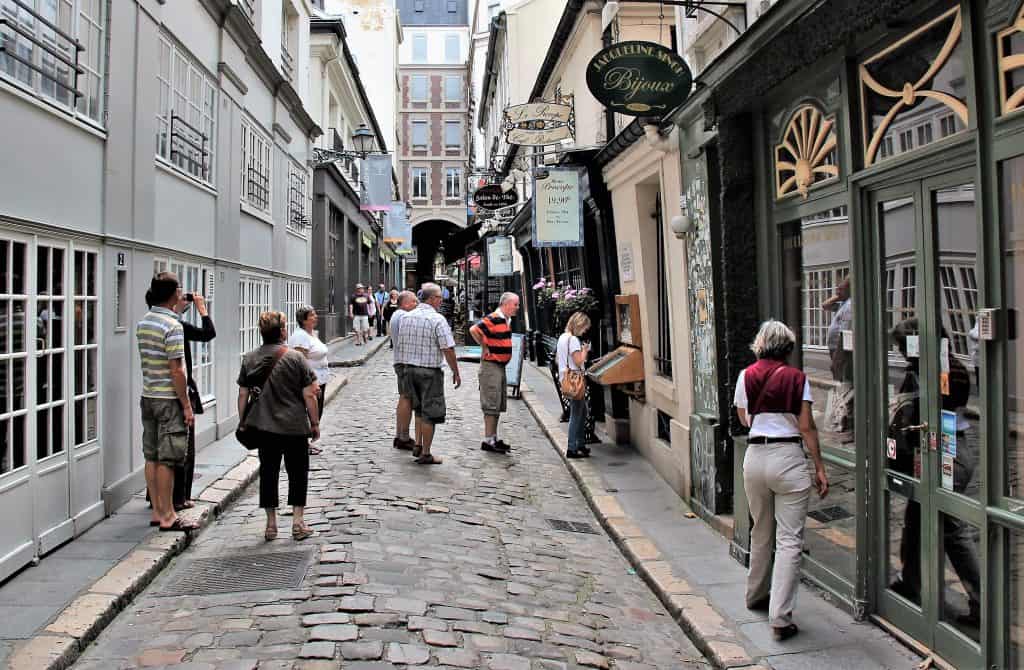
But let’s get back to the reason we’re here. Go into the passage and you’ll reach Cour du Commerce Saint-André. This open-air passage has existed since the 1730s and has a fascinating history, including the fact that France’s first guillotine was built and tested here. If you’d like to read about the place, I highly recommend checking out the article Cour du Commerce Saint-André: The Charming Passage of the Left Bank.
The Most Romantic Square in Paris
After exiting the other side of Cour du Commerce Saint-André, turn left and continue until you reach Rue de Buci. One of the gates of Philippe Auguste’s wall, Porte de Buci, once stood here, and today it’s a lively, bustling street with no shortage of restaurants, most of which, unfortunately, are fairly mediocre.
Continue along this street and turn right onto Rue de Bourbon-le-Château, which becomes Rue de l’Abbaye, named for the Abbey of Saint-Germain, only small parts of which survived. Turn right and you’ll reach Place de Furstenberg, which in my opinion is the most romantic square in Paris.

This square used to be the stable of the abbot of the Abbey of Saint-Germain-des-Prés. Today it’s home to a few boutique shops and the Musée Eugène Delacroix (Ferdinand Victor Eugène Delacroix, 1798-1863). You can read more about the square and the museum in the article From the River to the Abbey, so I won’t repeat everything I wrote there.
Instead, let me recommend going back to Rue de l’Abbaye and continuing until you reach the Church of Saint-Germain-des-Prés, one of the oldest churches in Paris. I highly recommend going inside this church, which underwent a massive restoration in recent years, and the result is… beautiful!

If you’d like to learn the history of this ancient church, feel free to check out the article The History of Saint-Germain-des-Prés: From an Ancient Abbey to the Church of Reason. If you feel like hearing a concert in the church, you’re welcome to visit this link and see if there happen to be concerts on the days you’re in Paris.
Here at the Church of Saint-Germain-des-Prés, we end this walking route. If you’d like to keep exploring, let me recommend the route Between Saint-Germain and Saint-Sulpice, which starts right here and is a natural continuation of this walk.
And if you’ve got some energy left, here’s the continuation of the route north of the boulevard: from Rue Saint-André-des-Arts, through the Odéon theater and the Luxembourg Gardens, to the Church of Saint-Sulpice.
Saint-André-des-Arts: Between Paris’s Oldest Café and the Guillotine
13 rue de l’Ancienne-Comédie, and cour de Rohan
Continue on Rue Saint-André-des-Arts until you reach Cour Saint-André-des-Arts. There you’ll find Le Procope, the oldest café in Paris, and Un Dimanche à Paris, which sells excellent desserts. I also recommend visiting the tea house La Jacobine, if only to look at their wall paintings (it’s best to come without kids). Finally, if you’re feeling a bit adventurous, you’re welcome to try visiting three charming courtyards called Cour de Rohan. These are private courtyards located to the left of the main alley of Cour Saint-André-des-Arts, and as such, visiting them requires sneaking in alone and a bit of luck not to get caught…


From the Odéon Theater to the Luxembourg Gardens
Leave Cour Saint-André-des-Arts onto Boulevard Saint-Germain. Cross the boulevard and go up Rue de l’Odéon until you reach the theater. Take in the Odéon Theater, which was built in the 18th and 19th centuries in neoclassical style and was once home to the Comédie-Française.

From the Odéon Theater, continue toward the Luxembourg Gardens, one of the most charming gardens in Paris. The garden and palace were built in the 17th century at the request of Queen Marie de’ Medici of France. The palace has remained as it was, but the gardens were completely redesigned during the 19th century, and the result is still simply gorgeous. I promise to write a post about it in the future, and in the meantime, treat yourself to sitting in the garden, enjoying the atmosphere and eating the pastry you surely bought at Un Dimanche à Paris. Afterward, take a walk around the park and enjoy the view of the palace (today home to the Senate, so it’s not open to visitors except on Heritage Days), the fountain, the statues of French queens, and… the small-scale Statue of Liberty hiding in a corner of the garden.

And before you move on, do you want to know what the Luxembourg Palace and gardens looked like in the 18th century? If so, feel free to watch this video:
From the Luxembourg Gardens to the Church of Saint-Germain-des-Prés
3 place Saint-Germain-des-Prés
Done enjoying the magic of the Luxembourg Gardens? Head to the Musée du Luxembourg (Paris’s first museum, which predates the Louvre). It hosts rotating exhibitions, so it’s worth checking what’s on. If you decide not to go in, leave the Luxembourg Gardens and walk along Rue Férou. If you’ve read Alexandre Dumas’s novel The Three Musketeers, you’ll remember that Athos, one of the three musketeers, lives on this street. At number 6, you can see the house of Mademoiselle Luzy, the first love of Talleyrand, Napoleon’s famous foreign minister.

Continue along the street until you see the back of Église Saint-Sulpice. Continue to the left and take in the baroque church, both inside and out (did you know that part of Dan Brown’s famous novel The Da Vinci Code takes place here?). One of the church’s towers was recently renovated, and so was the fountain in the square.

Walk down Rue Bonaparte, and if you’d like, buy yourself a macaron or two at Pierre Hermé. Continue along the street until you reach Boulevard Saint-Germain. Cross the boulevard. Across from you, you’ll find the Church of Saint-Germain, one of the oldest churches in Paris (construction began in the 6th century), and to your left you’ll find the cafés Café de Flore and Les Deux Magots, where all of Paris’s who’s who used to sit after World War II, including Sartre and Beauvoir (which probably explains the outrageous prices).


And before we finish the walk, let’s stop, take a short break, and watch a video showing us Saint-Germain in the 18th century. As you’ll see, there’s a good chance that if you traveled back in time to Paris, you wouldn’t recognize it…
Continue along Rue de l’Abbaye and you’ll see on your right the mansion of the Cardinal of Furstenberg, built in the 17th century (currently under renovation). Turn left and you’ll reach Place de Furstenberg, home to the Musée Delacroix (Delacroix). In my opinion, this is the most romantic square in Paris, so if you’ve come here with your partner, this is the perfect moment to end the walk with… a kiss.

Want More Information About the 6th Arrondissement?
If this walk “whetted your appetite” and you want to discover more secrets of the 6th arrondissement, known as the Saint-Germain neighborhood, let me recommend heading to the Saint-Germain travel guide page. You’ll find recommended places to stay (hotels and vacation apartments), walking routes, and of course even more routes to help you uncover the secrets of this charming neighborhood.
Related reading
