
In short
- What’s there: The Brou Monastery with three carved royal tombs, a rare stone rood screen (jubé), original 1525 stained glass, and three cloisters.
- Status: A protected heritage site since 1862, voted France’s favorite monument in 2014.
- Getting there: 1 hour 50 minutes on a direct TGV from Paris, 45 minutes on the TER from Lyon, 1 hour by car from Lyon via the A42, exit 7.
- How much time: Two to two and a half hours for the monastery, a full day for the whole town.
- When: May, June, September and October. The third week of December for the poultry markets.
- Tickets: 11 euros for adults, free for EU citizens up to age 26, includes the Museum of Fine Arts.
- Where to eat: L’Auberge Bressane, across from the monastery, with Bresse chicken and quenelles de brochet, and a simple main-plus-dessert menu for 34 euros (October 2026).
- And a bonus: the historic pharmacy of the Hôtel-Dieu, a five-minute walk away, open only on a guided tour on Saturdays at 2:30 p.m.
For years, Bourg-en-Bresse (the French pronounce it roughly as “boorg-ahn-BRESS”) sat on my list, but I never actually made it there. Two things put it on my must-visit list. The first is the Brou Monastery, and especially the gorgeous tomb of the Duke of Savoy inside it. The second, much more down to earth but just as tasty, is of course the region’s famous chicken.
On my last trip to Burgundy, in October 2026, I decided it was time to visit, come what may. I drove about two hours each way to spend one day in Bourg-en-Bresse, and I can tell you that day turned out to be one of the best of the whole trip. The reason wasn’t the town itself, which actually disappointed me, but the monastery and the best lunch I had on that trip.
Why should you come here? Because Bourg-en-Bresse offers a rare combination. On the monuments side, there’s a masterpiece of flamboyant Gothic architecture, built in under thirty years, that survived the Revolution and holds three carved tombs that are among the most beautiful in Europe. On the food side, this is the capital of poulet de Bresse, the only chicken in the world with its own protected designation of origin (AOC). Usually you’d have to travel to two different cities to get both of these, and here they’re a twenty-minute walk from each other.
There’s another reason, and it’s less tangible. Bourg-en-Bresse isn’t a French town that grew wealthy slowly. For three centuries it was a border town of a foreign state, the capital of Bresse under the House of Savoy, a town that looked at France from the other side of the border. You can see that in every stone built here: in the fortress raised to stop the kings of France, and in the monastery built to announce, from a distance, a belonging that wasn’t French. You can still see the result today. It’s a town that feels a bit different from its neighbors, and it takes a few hours to understand why.
One more thing surprised me: how easy it is to get here. I drove in from Burgundy, but a direct train from Paris reaches the Bourg-en-Bresse station in 1 hour and 50 minutes, and from Lyon it’s less than an hour. In other words, this is a fully doable day trip even for someone based in Paris, which isn’t something you can take for granted in places that are less familiar to tourists.
So, before we hit the road and visit Bourg-en-Bresse, let’s talk about what you’ll find in this article. I’ll open with the practical information: hours, getting there, tickets and how much time to set aside. From there I’ll move to what you shouldn’t miss at the monastery and in the old town, and then to the history, which includes a broken vow, a duel that ended in an orchestrated murder, and a 24-year-old widow who decided to build herself a mausoleum. At the end you’ll find the restaurants where you can eat chicken here, the hotels, and a FAQ.
Practical Information for Visiting Bourg-en-Bresse
Opening Hours of the Brou Monastery
The Royal Monastery of Brou is open every day of the year, with no midday closure. From April 1 to September 30 it’s open from 9:00 a.m. to 6:00 p.m., and from October 1 to March 31 from 9:00 a.m. to 5:00 p.m. Last admission is half an hour before closing, and the staff begin clearing the building a quarter of an hour before closing. The monastery is fully closed on just three days a year: January 1, May 1 and December 25.
A few things worth knowing before you set off. Dogs aren’t allowed inside, except for guide dogs. You can’t eat inside the monument, but there are lockers for suitcases and large bags. Strollers are allowed, and there’s a changing table. The whole complex is wheelchair accessible, and an elevator goes up to the first floor, where you’ll find the upper gallery of the rood screen (jubé), the apartment of Margaret of Austria (1480-1530), and the Museum of Fine Arts.
Getting to Bourg-en-Bresse by Train
This is one of the pleasant surprises of this destination. A direct TGV from Paris reaches Bourg-en-Bresse in 1 hour and 50 minutes, a travel time that makes this a doable day trip even from the capital. From Lyon the ride is even shorter: about 45 minutes on the regional TER.
From the train station to the monastery it’s about a twenty-minute walk, and if you’re tired or it’s raining, bus line 6 stops at “Monastère de Brou” and line 2 stops at “Valéry.” If you like cycling, you’ll find bike paths connecting the station directly to the monastery, with bike racks right across from the entrance, next to the stone benches on the right. It’s convenient to book train tickets in advance through Omio, which brings together the various rail operators in one screen and saves you the hassle of dealing with the French site.
And speaking of train tickets, here’s a detail worth money. If you show a TGV INOUI ticket from the last five days at the ticket office, you pay 9.50 euros instead of 11, and holders of an SNCF Grand Voyageur card pay 8 euros. Hang on to that ticket.
Getting to Bourg-en-Bresse by Car
Bourg-en-Bresse sits at a particularly convenient crossroads. From Mâcon it’s about 35 minutes via the A40, exit 7, then the N75 toward Bourg-en-Bresse. From Lyon it’s about an hour’s drive via the A42, the same exit 7 and the same N75. From Geneva it’s an hour and 15 minutes via the A40. From Beaune it’s about 120 kilometers, roughly an hour and 15 minutes via the A6 and then the A40, and from Semur-en-Auxois, where I was staying, it’s about a two-hour drive along the same route.
There’s parking on the monastery grounds, and visitors with reduced mobility can get right up to the ticket counters via the esplanade in front of the church. If you’re building a bigger trip around this, you can read about the wine regions to the west in Yossi Drori’s article on the wine route in Burgundy.
Tickets and Prices for the Brou Monastery
An adult ticket costs 11 euros, and it gets you into the whole complex: the church, the three cloisters, Margaret’s apartment, the Museum of Fine Arts and the temporary exhibitions. No need to split anything up, no surcharges, and that’s a nice change.
I’d strongly recommend booking a ticket in advance through this link.
The exemptions here are broader than usual, and it’s worth checking if you qualify:
- Children and teens up to age 18
- EU citizens up to age 26
- A person with a disability and one companion
- Architecture students
- Holders of the Pass’Découvertes de l’Ain
- The first Sunday of January, February, March, November and December
Groups of 20 or more paying visitors pay 9.50 euros per person, with groups capped at 50 people. You can pay in cash, by credit card, by check, and with French culture and vacation vouchers. Tickets can be bought in advance on the official website, and in October I didn’t run into any line at all.
If you’re planning a long trip through France and collecting national monuments along the way, you’ll find that Brou is included in the Passion Monuments pass from the Centre des monuments nationaux, which opens up more than 80 sites across the country. It only pays off if you genuinely plan to use it, but on a trip that includes the Château de Bussy-Rabutin, the Panthéon and the Conciergerie, it pays for itself quickly.
How Much Time to Budget for Bourg-en-Bresse, and When to Come
Budget two to two and a half hours for the monastery itself, and add another half hour if you’re the type who stops in front of every stained-glass window. Keep in mind the ticket also includes the Museum of Fine Arts in the other wing, and that’s a museum you can easily spend a full hour in, so if you want to see everything, an hour and a half won’t cut it.
A full day in town is the format I’d recommend: morning at the monastery, a long lunch (where you’ll of course eat chicken from Bresse), afternoon in the old town and at the historic pharmacy. This order isn’t random. The pharmacy is only open for visits at one fixed hour in the afternoon, and the historic center is small enough that you can finish it in an hour and a half on foot from the station. If you want to combine the surrounding area, the fortified village of Pérouges, about 34 kilometers away, or the gastronomic village of Vonnas, 26 kilometers away, you’ll need two days.
The recommended months are May, June, September and October. I came in October, and the monastery wasn’t empty, but it wasn’t packed either, so I could stand in front of the tombs without being rushed. There’s also a very good reason to come in December, and I’ll get back to that in the section about the chicken.
Here’s the day I’d put together if you’re coming for just one day and want to make the most of it:
- 9:00 a.m. The monastery opens. Start with the church while it’s empty, and head up to the rood screen gallery before it fills up.
- 10:30 a.m. The Museum of Fine Arts and the three cloisters.
- 12:30 p.m. Lunch at L’Auberge Bressane, across from the monastery (it’s closed on Mondays and Tuesdays), and yes, it’s a long lunch.
- 2:30 p.m. The pharmacy at the Hôtel-Dieu, if you’ve come on a Saturday. If not, head straight to the old town.
- 4:00 p.m. A walking loop through the historic center, from the Jacobins gate to the co-cathedral.
- 6:00 p.m. Coffee at a brasserie downtown, then on to the station or your hotel.
If you’re arriving by train and want to head back the same day, note that this schedule ends near the station rather than near the monastery, and that’s on purpose.
What you shouldn’t miss at the Brou monastery
The roof, the facade, and the jubé
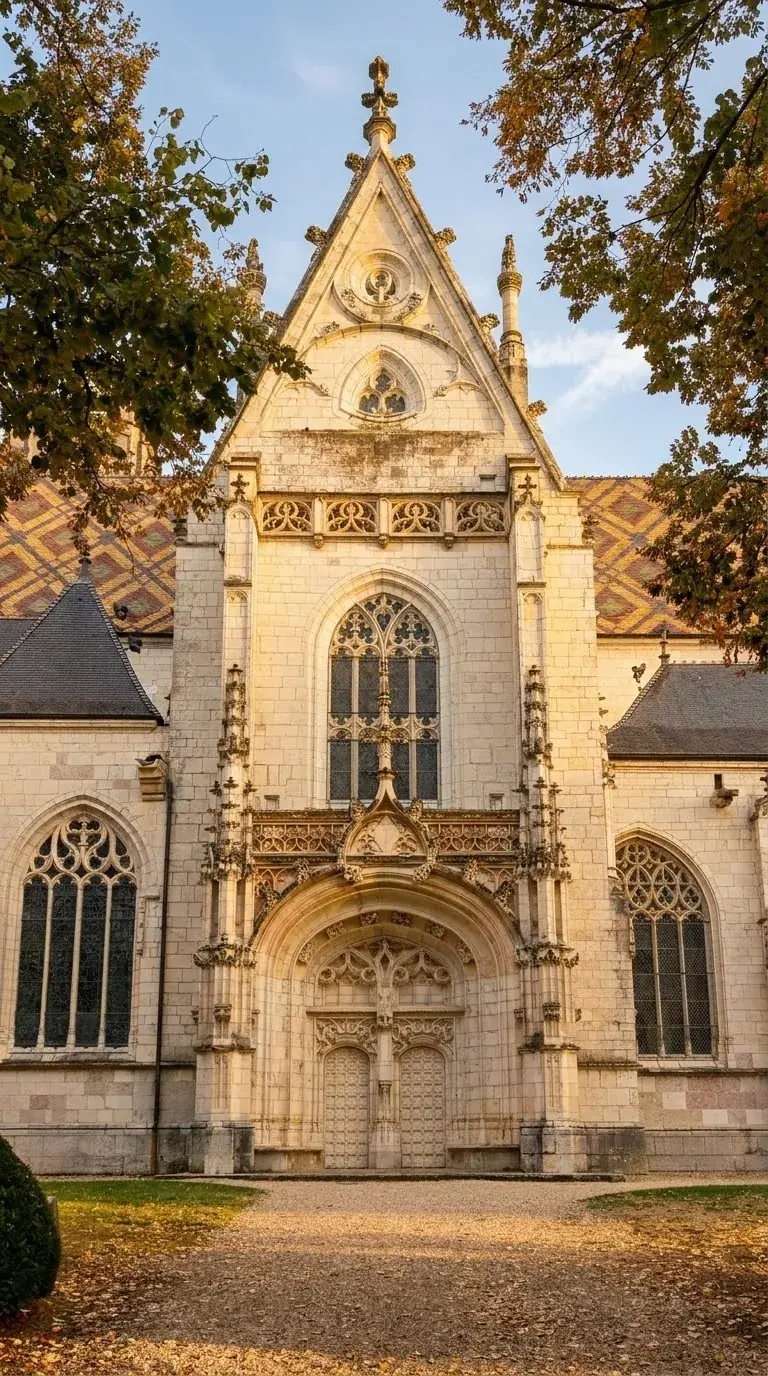
Start from the outside, and don’t rush to go in. The roof of the Saint-Nicolas-de-Tolentin church is covered in glazed tiles in four colors, arranged in a diamond pattern, and this is a political statement rather than decoration. The pattern is distinctly Burgundian, meant to announce from a distance Marguerite of Austria’s claim to the Duchy of Burgundy that her family had lost. The work that restored the roof to its original appearance was carried out between 1996 and 2000.
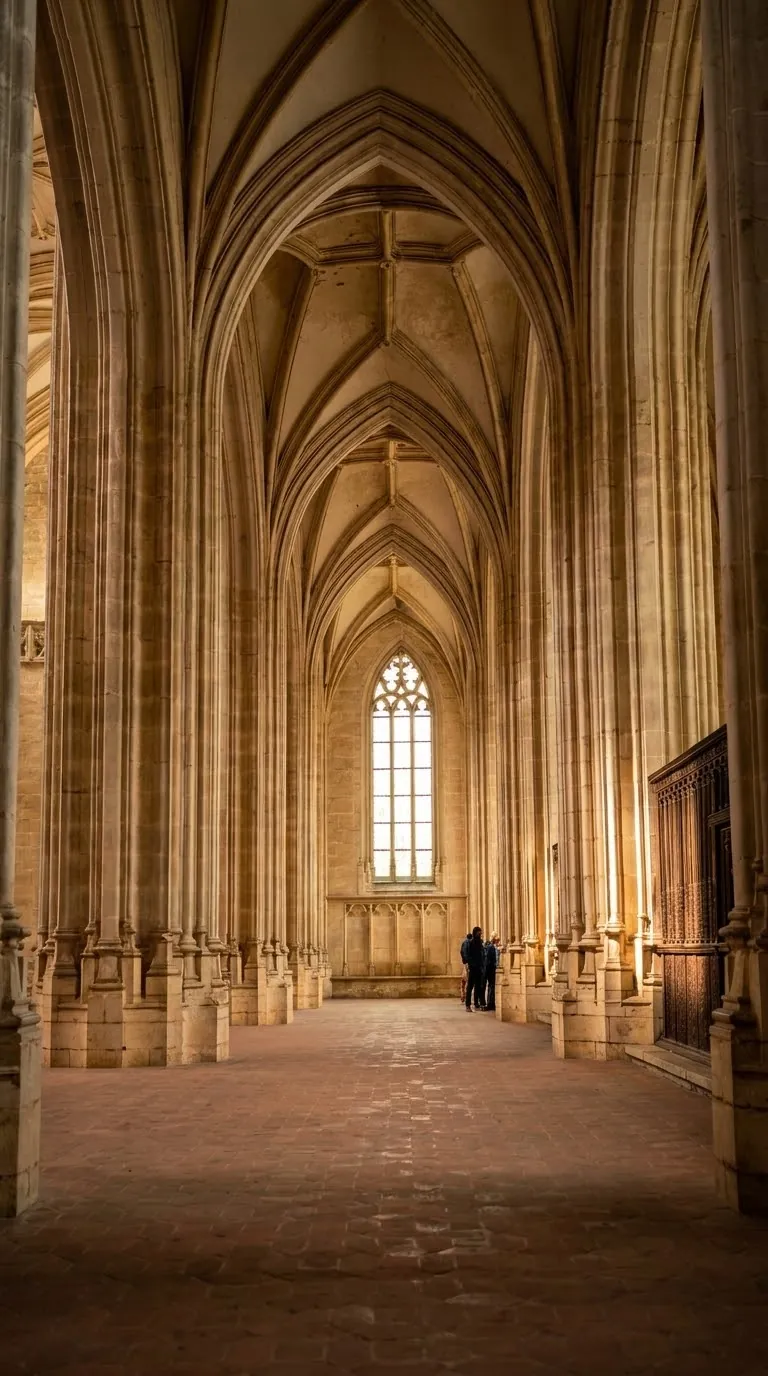
Inside, a sharp contrast awaits. The nave is sober, whitewashed, flooded with light through clear glass, and without pews for worshippers. This isn’t a lapse in preservation: the church was never a parish church but a mausoleum, and only the Augustinian monks prayed here. All the richness is concentrated in the choir.
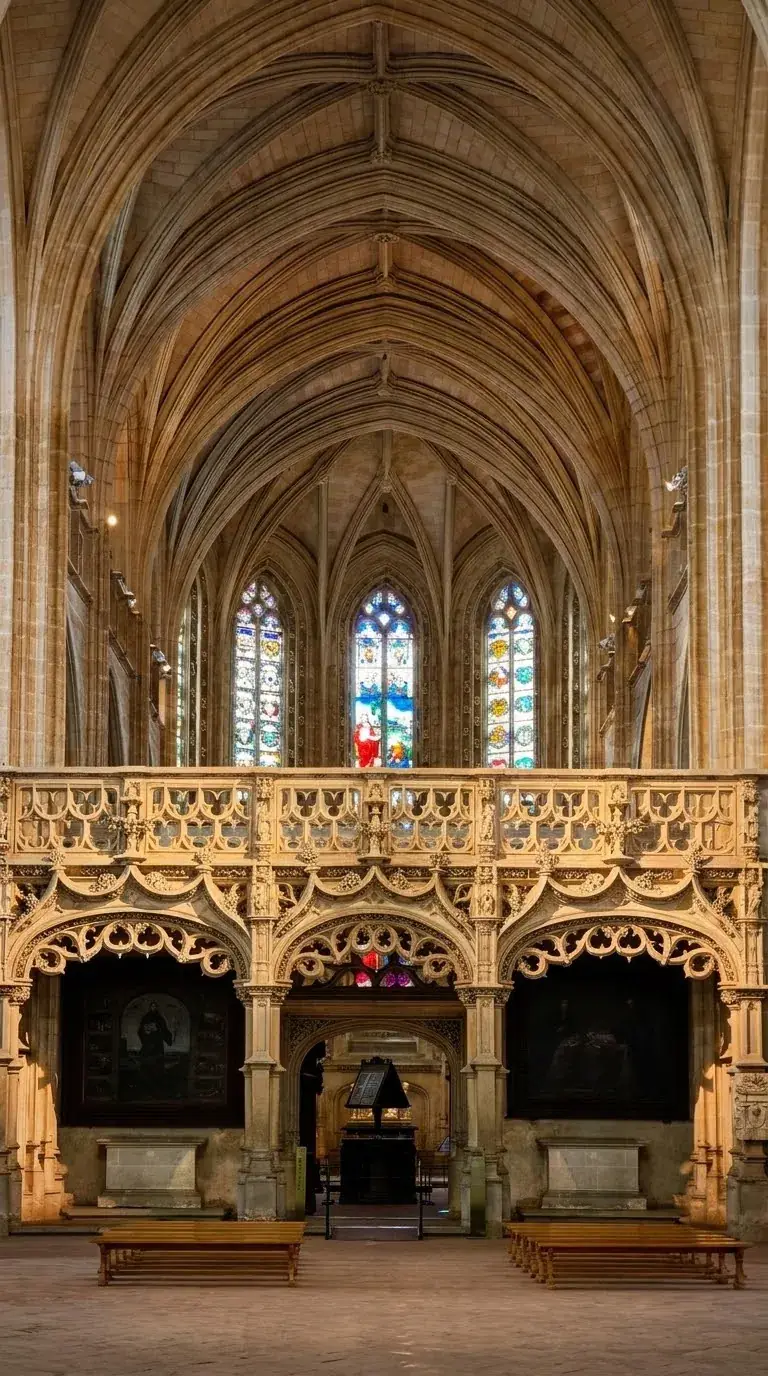
Between the two stands the jubé, a carved stone screen that crosses the church between the nave and the choir. These are rare pieces in France today, since most, such as the one at Notre-Dame Cathedral in Paris, were destroyed, while this one survived. Three flat arches carry a railed walkway above them, which Marguerite designed so she could pass between her private prayer cell and her apartment. During the visit you can go up to the upper gallery, and that’s the moment worth waiting for: from there you can see all three tombs, the whole nave, and the stained-glass windows from a bird’s-eye view.
The three tombs
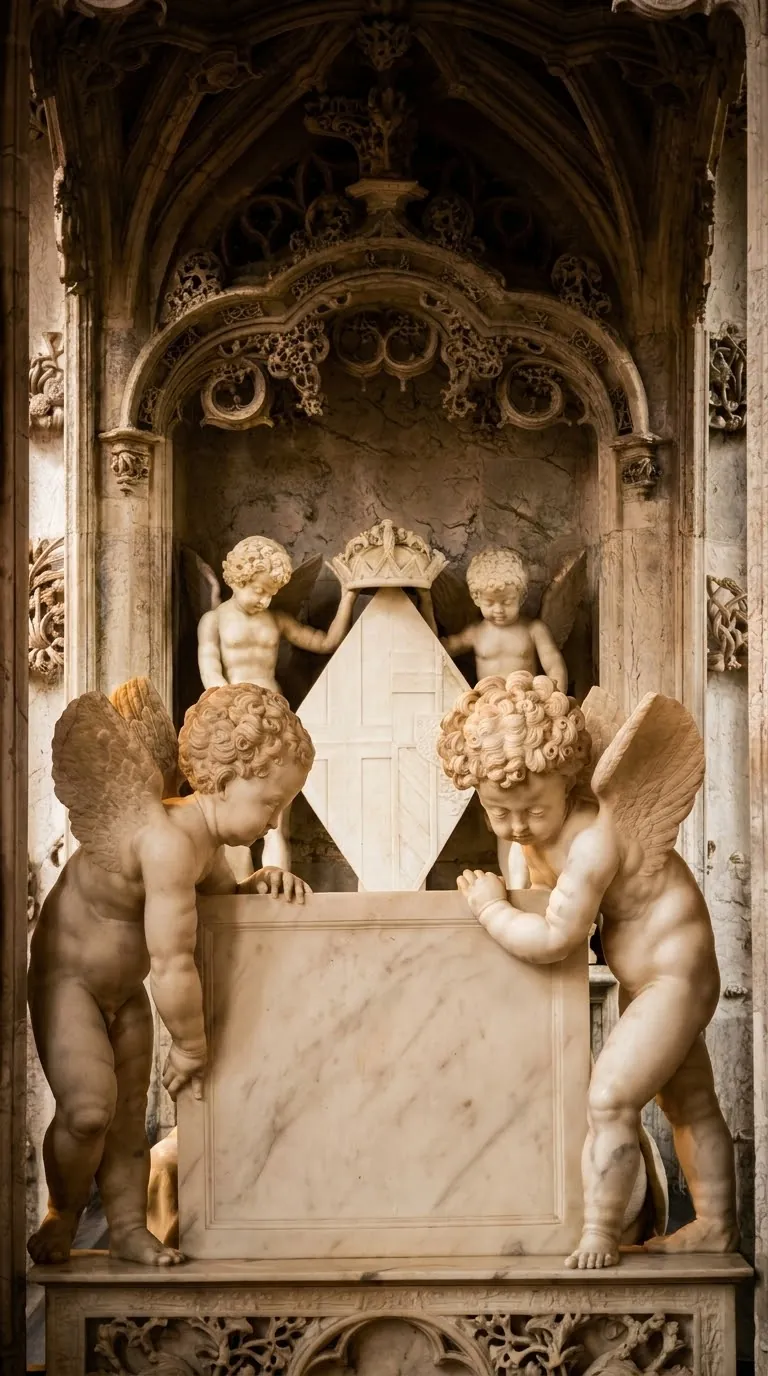
The first tomb belongs to Marguerite de Bourbon (1438-1483), the mother-in-law of Marguerite of Austria. It’s carved into a niche in the south wall, in the older and more modest style. The duchess appears in ceremonial dress, surrounded by cherubs bearing the coats of arms of her father’s house, her feet resting on a small hunting dog, a symbol of loyalty.
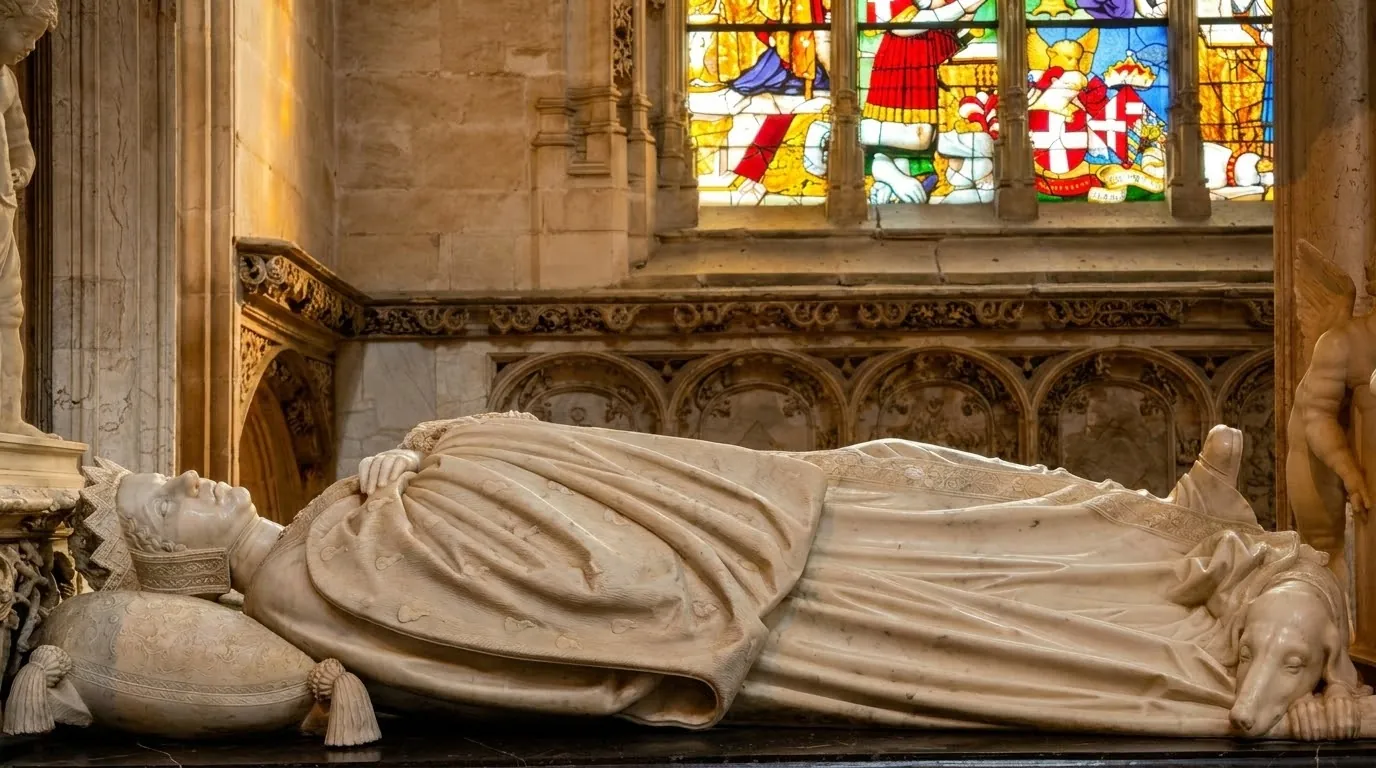
The other two tombs are something else entirely. They’re built in two tiers, in what contemporary documents called a “modern burial”: the upper level shows the gisant, a figure of the deceased as they looked in life, and the lower level shows the transi, the same figure in burial shrouds. Philibert the Handsome lies at the center of the choir in full armor, a lion at his feet, his head turned toward his wife, with ten sibyls surrounding his transi. Marguerite’s tomb, to the north, is built like a canopy bed. Above she’s shown in court dress with a greyhound at her feet, and below the transi wraps her in a shroud, her hair loose and undone.
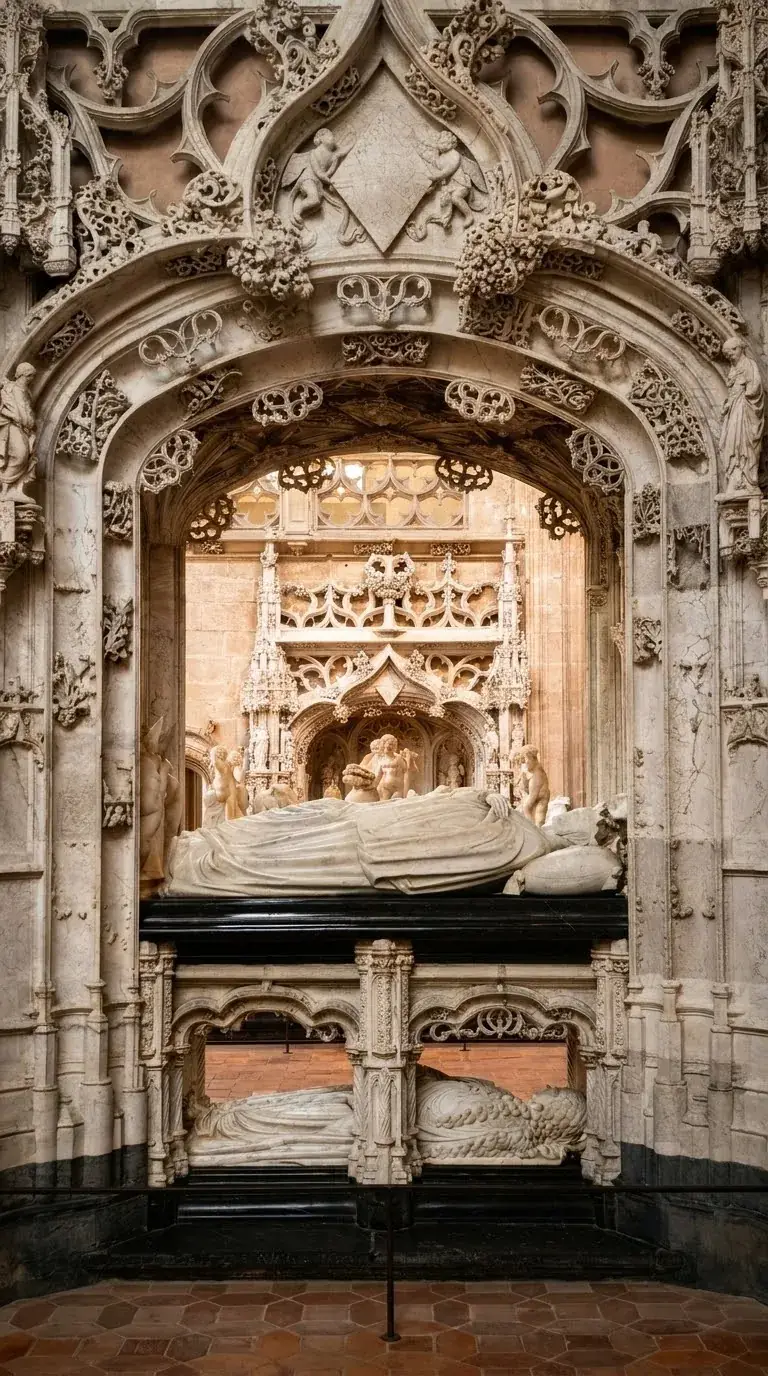
The gisants were completed in 1531 by Conrad Meit, a sculptor born in Worms who served as “figure carver” at Marguerite’s court, while the small statuettes were made by a workshop from Brussels that relocated to work in Bourg. Here’s a detail that’s fun to know and less fun to think about: the bodies themselves aren’t in these magnificent tombs at all, but buried beneath the floor of the choir, in a single sealed recess.
The choir stalls and the stained-glass windows
Seventy-four seats are arranged in two rows on either side of the choir, carved from oak that likely came from the nearby Seillon forest, and made between 1530 and 1532, right at the end of the construction work. The seats tip up on a hinge, and under each one is a misericorde, a small carved ledge meant to let a monk lean on it during long periods of standing prayer. The scenes on the south side are drawn from the Old Testament and those on the north side from the New Testament, and the carving style itself is close to Antwerp Mannerism, with figures in dancing poses.
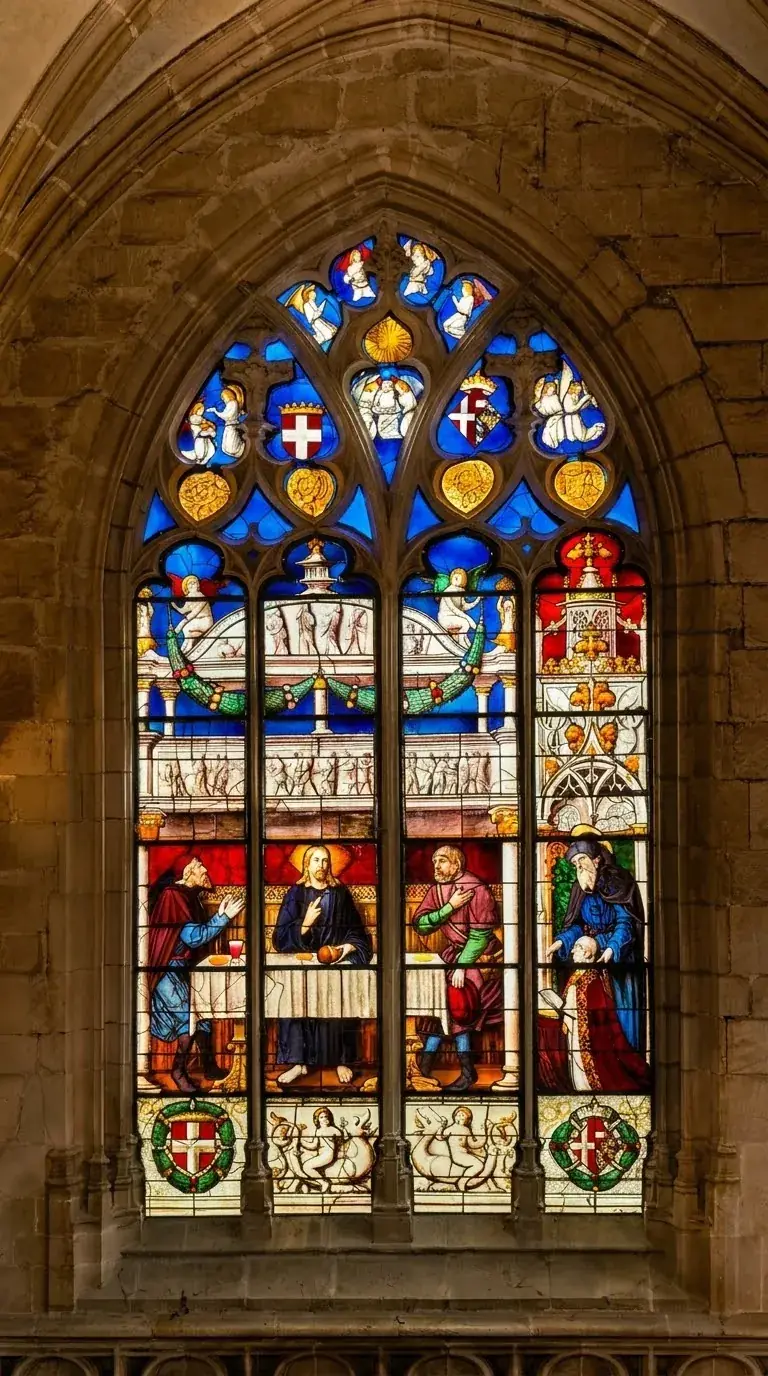
These are original stained-glass windows, created between 1525 and 1532, and they survived the Revolution and both world wars without significant damage. The five windows of the choir are arranged around a scene of Christ’s appearance, with Marguerite and Philibert depicted kneeling in prayer. On the south side is Marguerite’s lineage, the Habsburgs and the House of Burgundy, and on the north side her husband’s, the House of Savoy and Bourbon. The transom windows add 64 coats of arms. Notice also a surprising detail: the glass artists were from Bresse and Lyon, but the designs came from the Low Countries, and some of them are based on engravings by Dürer and Titian.
In the princess’s chapel awaits the window considered the finest of them all, that of the Assumption and Coronation of the Virgin, and its colored light falls on an alabaster altarpiece of the Seven Joys of the Virgin. At the top of the window runs a golden-brown band depicting the Triumph of Faith, based on an engraving by Titian, and at the bottom the princely couple appears once again.
The floor that’s no longer there, and Marguerite’s apartment
Here’s a detail most visitors walk right past, which is a shame. The choir floor was originally paved with colorful, painted terracotta tiles in Renaissance style, featuring ancient figures, coats of arms, musical instruments, and ribbons woven in blue and ochre yellow. The material was fragile, and the floor wore away gradually under visitors’ shoes over the generations. Of roughly nine thousand original tiles, only 200 survive today. This might be the saddest detail in the whole complex, and in my opinion it’s also the most telling about what mass visitation does to a site over time.
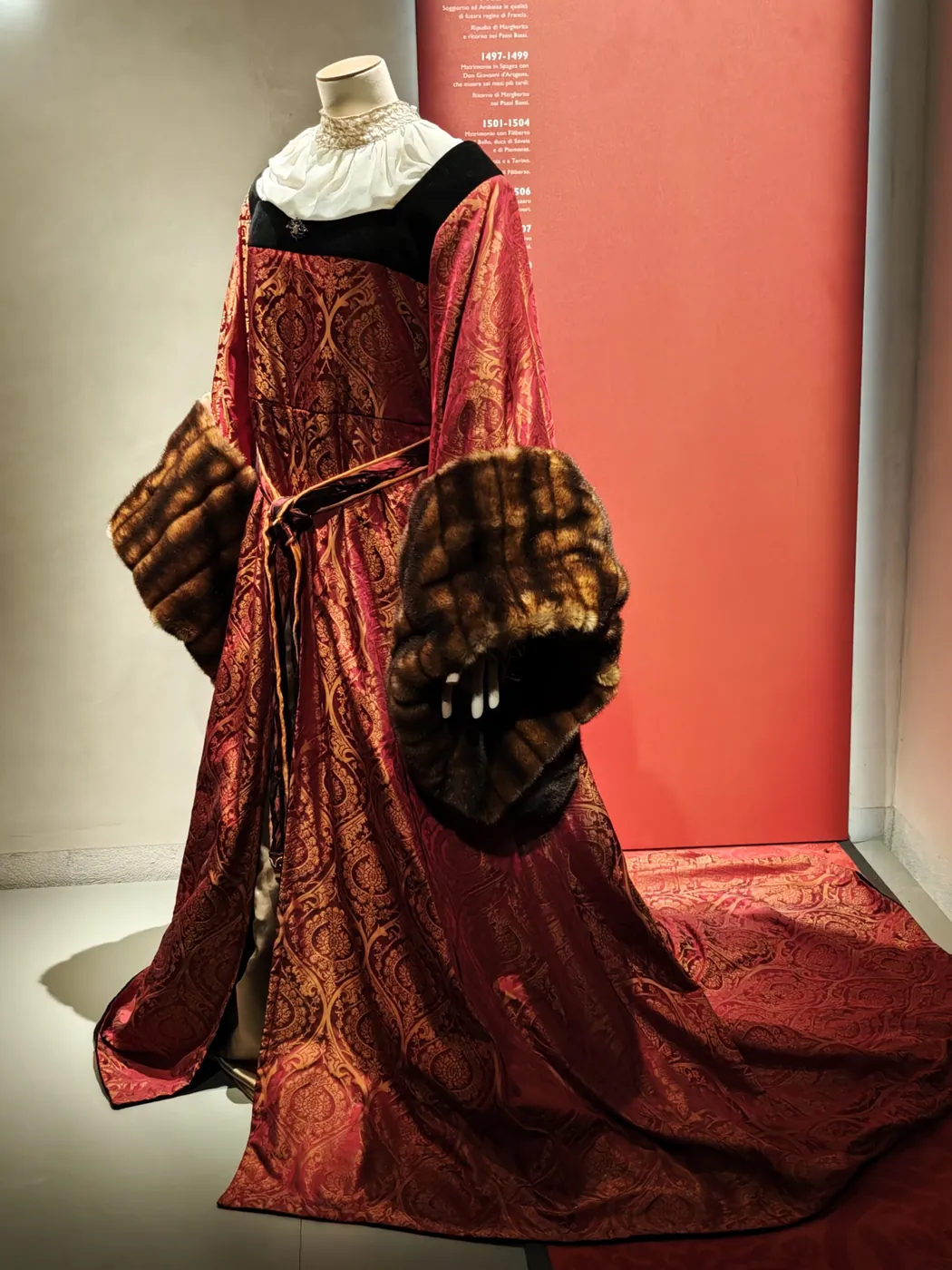
In the first wing is Marguerite of Austria’s apartment, a suite of three rooms that she commissioned in the 1520s, larger than the ones she had at Mechelen. She never lived in them, and never even saw them. Today they serve as exhibition spaces telling the story of her life, and the exhibit was designed to be accessible to visitors with visual and hearing impairments.
On the way out, on the upper floor, you pass through the monks’ corridor. Hanging there is a large painting by Auguste Mathieu from 1842, depicting King Francis I visiting the Brou church. It’s a painting from the “troubadour” style, meaning a 19th-century painting that romantically imagines the Middle Ages and the Renaissance, and it’s always fascinating to see how one generation paints another for itself.
What not to miss in Bourg-en-Bresse if you have half a day more
The Museum of Fine Arts
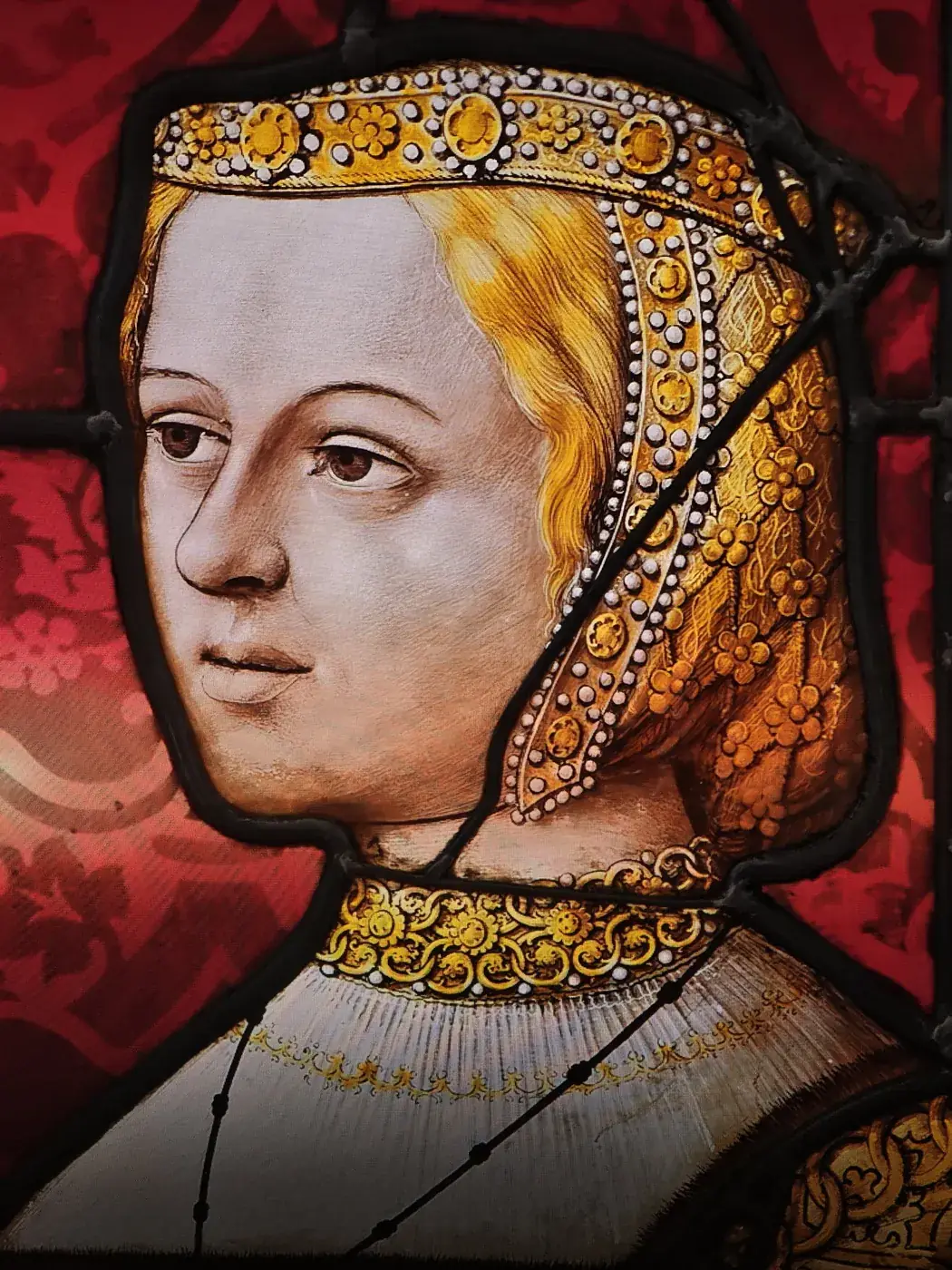
It sits inside the monastery, in the former monks’ cells on the upper floor of the second wing, and has been there since 1922. The collection runs from the 12th century to today, and its strongest sections are medieval sculpture, 16th and 17th century painting from the Low Countries, a rich “troubadour” collection, works by Gustave Doré, and a contemporary painting collection. In the former prior’s apartment you’ll find 18th-century furniture and ceramics from Meillonnas, the local pottery of the region.
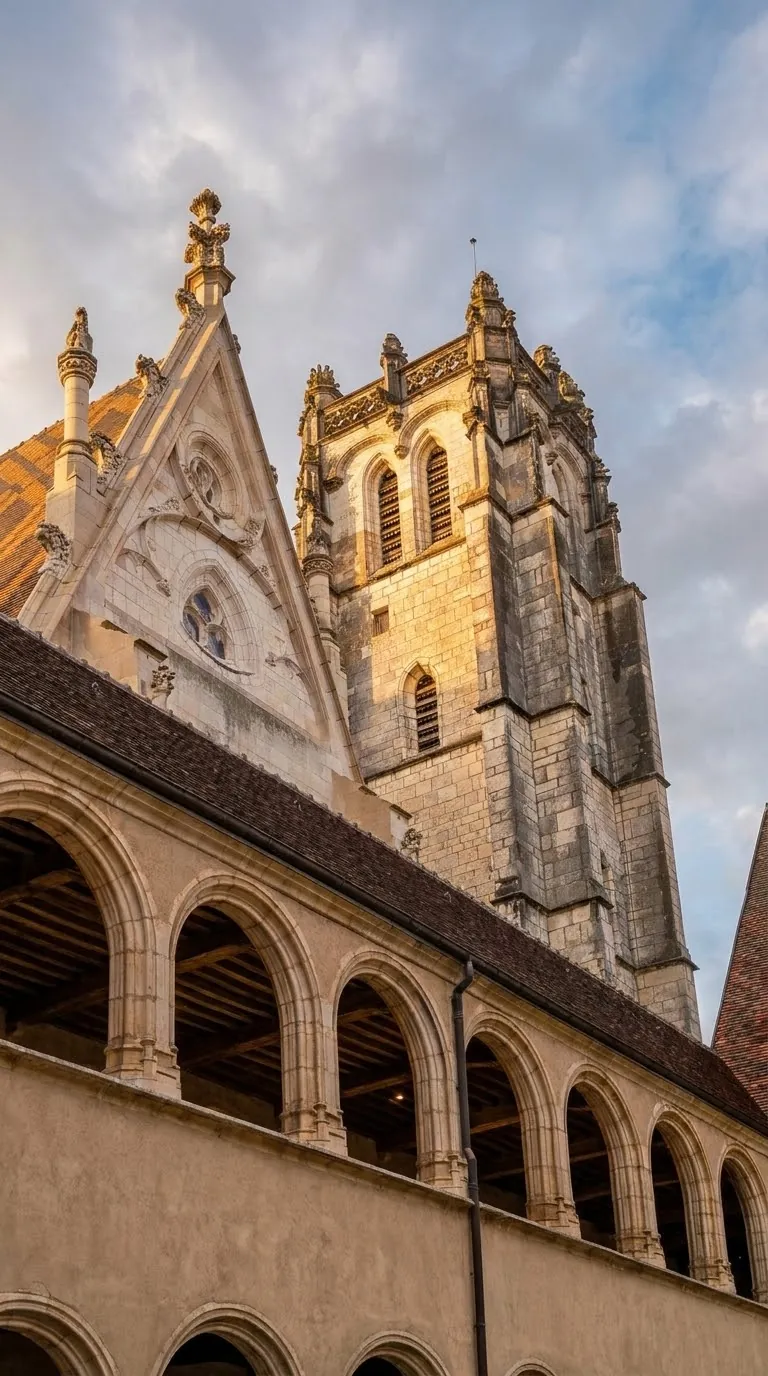
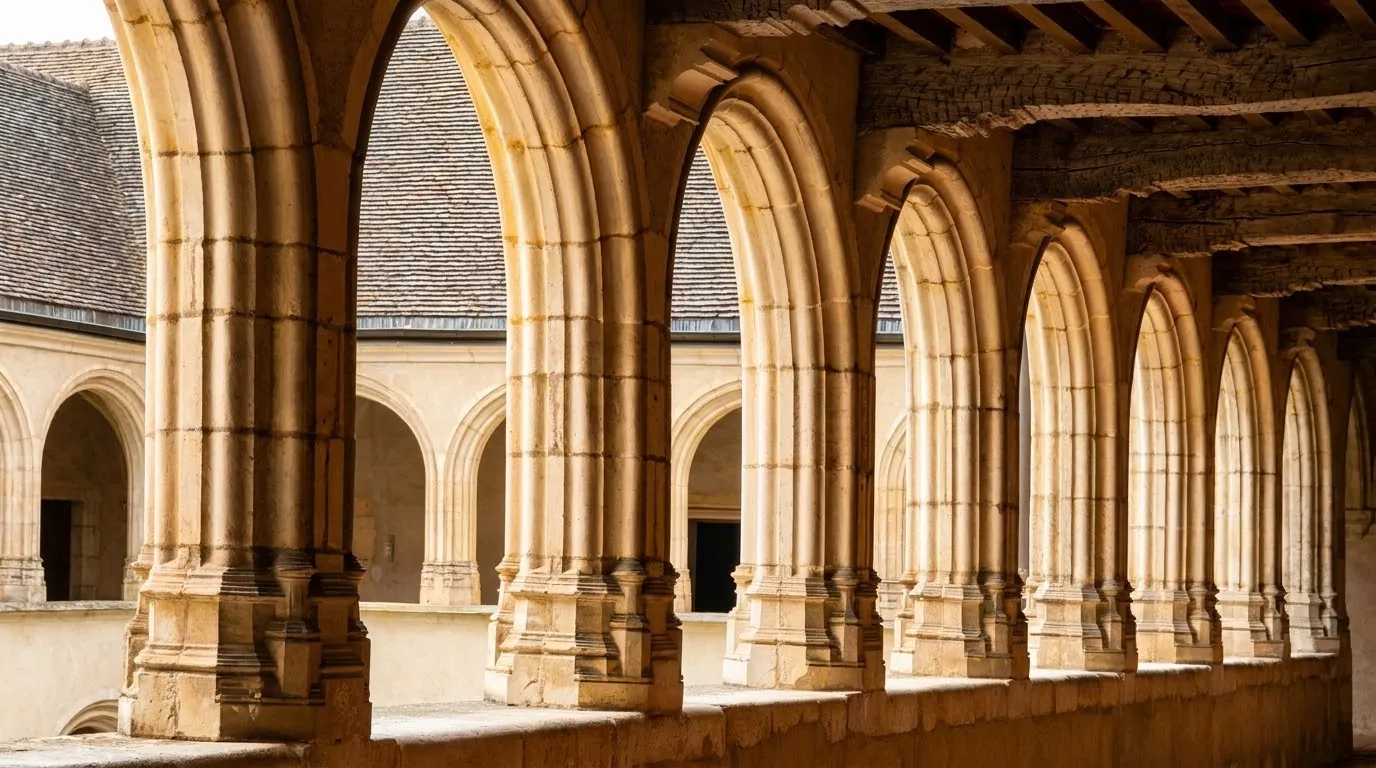
On the ground floor, it’s worth stopping at the three cloisters themselves. They’re built with lower and upper galleries, which is unique in France. The first was a passage between the outside world and the monastic community and housed Marguerite’s apartment, the second is the largest and was used for meditation and walks, and the third, built in a local Bressan style, handled practical needs.
The pharmacy of the Hôtel-Dieu
This is the gem I almost missed, a five-minute walk from the monastery, at 47 boulevard de Brou. The historic hospital (Hôtel-Dieu) was built between 1782 and 1790, and the pharmacy inside it operated continuously until 1963, in the very spot where it stands today.
Three rooms in a row. The laboratory, the rarest of them all and still in working condition, with copper alembics, mortars, a 19th-century casting furnace and a press. A back room, where plants and medicines were sorted and received, which also houses a library with antique books, one of them from the 17th century. And finally the officina, with Louis XV style wood furniture and over a thousand jars, boxes and glass vials, most of which still contain their original plants and ingredients.
Important: this has real practical consequences. You can’t go in on your own. The visit is by guided tour only, every Saturday at 2:30 p.m. sharp, with an extra tour added on Tuesdays at 10:30 a.m. during July and August. The tour lasts an hour and fifteen minutes, admission is 7 euros for adults and 3 euros for children ages 6 to 12, and you can only book online or at the tourist office desk. No phone bookings.
The old town and the co-cathedral of Notre-Dame
I’ll be honest with you: visually, the town itself is quite disappointing. Apart from a few 15th and 16th century timber-frame houses, there isn’t much to see, and besides a visit to the co-cathedral, not much to do either. The reasons to come to Bourg-en-Bresse are the monastery and the food, and if you only have a few hours, spend them at the monastery and on a good meal.
The center of Bourg-en-Bresse is small, and the tourist office has marked a route on the sidewalk that keeps you from missing the interesting facades. Look for the timber-frame houses with upper floors jutting out over the street, starting with the Maison Gorrevod on rue du Palais, a protected historic monument (monument historique). Its ground floor opens with wide arches, and above it two overhanging floors rest on heavy oak beams, with carved corbels and infill bricks arranged alternately flat and in a herringbone pattern. On rue Victor Basch and rue Teynière, too, Renaissance houses from the 16th century have survived, where the timber has already been replaced by stone and brick.
The right place to start a tour of the old town is the Porte des Jacobins, a 15th-century gate that is the historic entry point to the district. From there, continue to the town hall square, around which the pedestrian shopping street is concentrated. The town hall building itself was built between 1761 and 1771 and has a carved triangular pediment, and a short distance away stand beautiful 18th-century aristocratic mansions with balconies and ornate iron railings: the Hôtel Marron de Meillonnas, in Rococo style from 1774, the Hôtel de Bohan from the 1730s, and the Hôtel de Loras from 1771.
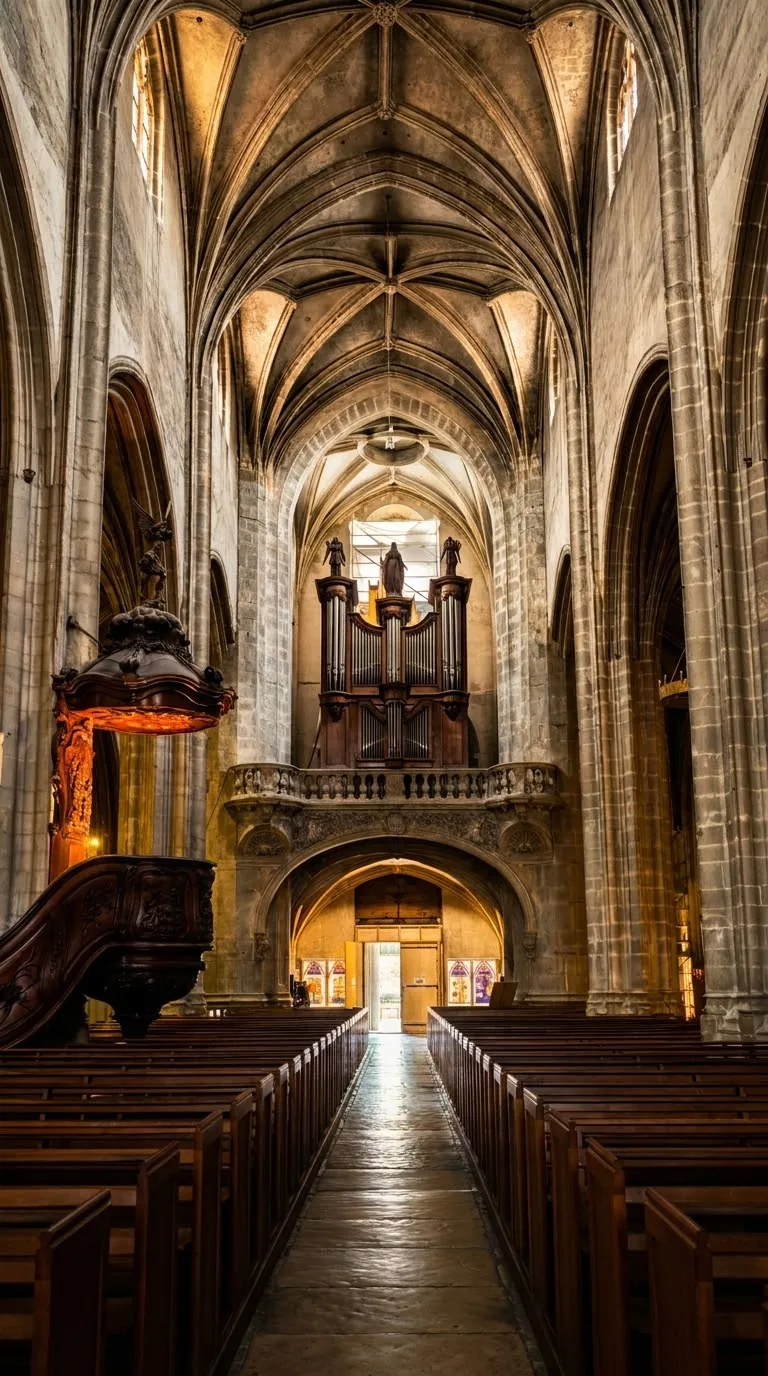
The co-cathedral of Notre-Dame-de-l’Annonciation stands at the center. It’s called a co-cathedral because the diocese of Belley-Ars already has a cathedral in Belley, and here the two share the title. The building has carved choir stalls from around 1530, donated in part by Marguerite of Austria herself, as well as stained glass windows. It also holds a black Madonna, known as Notre-Dame de Bourg, considered the city’s protector. In January 2025, the municipality began a major renovation of the structure, from the roofs to the stained glass windows, and as of October 2026, extensive work is still underway on the exterior of the building. Still, you can go in and visit the interior, and it’s worth lingering over the carved preacher’s pulpit from 1760 and the great organ at the end of the nave.
Two more sites are worth a stop if you have time left. The first is the Jesuit chapel (chapelle des Jésuites) from the 17th century, which belonged to the former Jesuit college that became the Lycée Lalande, and it marks the end of the struggles for influence between Catholics and Protestants in the region. The second is Parc de la Visitation, a former convent garden turned into a shaded city park.
If you’re looking for a souvenir that isn’t a fridge magnet, look for jewelry in Bressan enamel, a distinctly local craft still produced here today. It’s definitely a better option than yet another box of cookies.
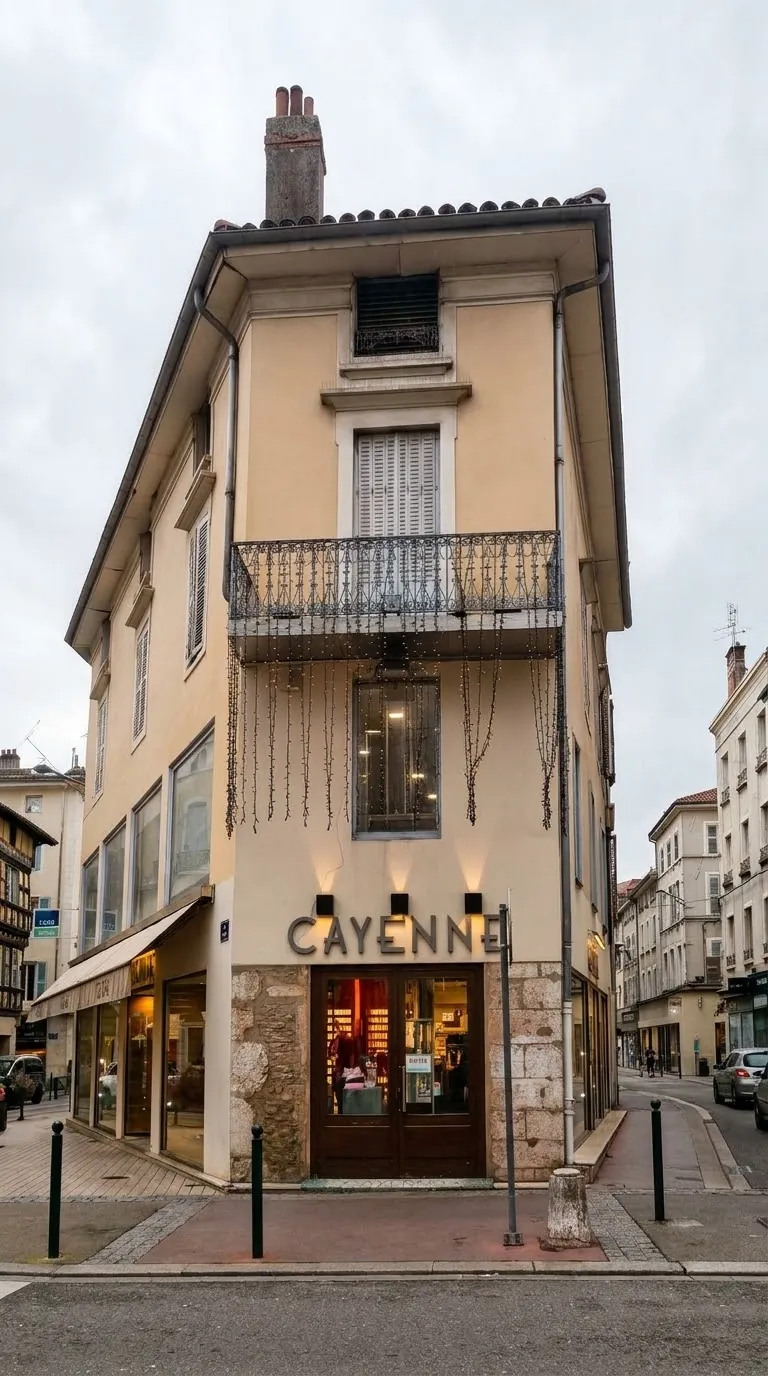
Right across from the co-cathedral, at 15 place Neuve, you’ll find the Cayenne clothing shop. The service was very kind, and I finally managed to buy myself clothes in France without a friend’s help (for me, that’s no small achievement :-)).
A brief history of Bourg-en-Bresse
Bourg-en-Bresse was never a French town that grew rich slowly. In 1272, Bresse passed to the House of Savoy through marriage, and for the next three hundred years the city was the capital of a province belonging to a foreign state, right on the border of the Kingdom of France. Only on January 17, 1601, under the Treaty of Lyon, was it annexed to France along with the Bugey, the Valromey and the Pays de Gex.
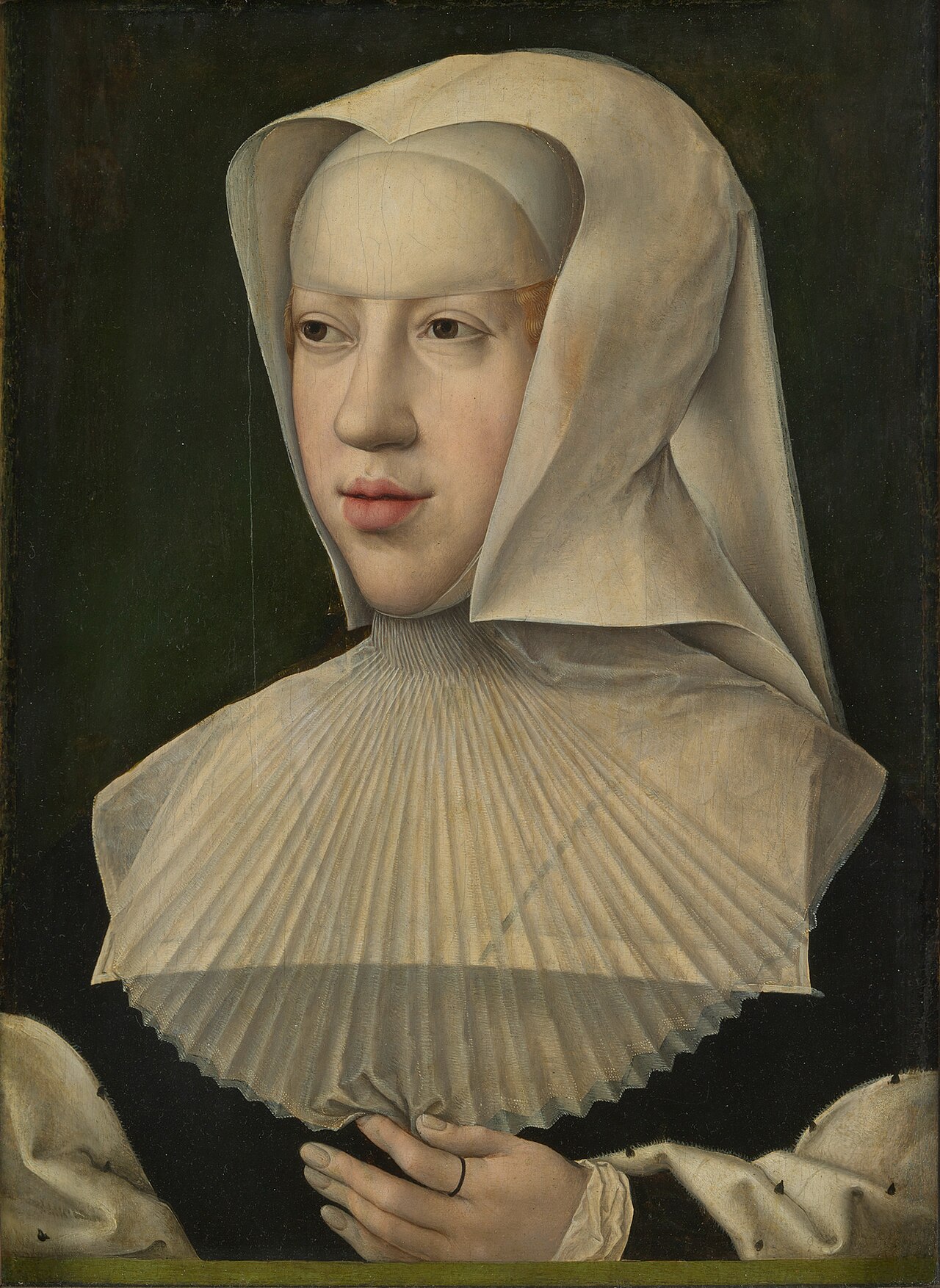
The monastery itself was born from a vow. Marguerite de Bourbon (1438-1483) promised to build a monastery if her husband recovered from an injury. She died before she could fulfill the vow, and their son Philibert the Handsome died in 1504 at the age of 24. His widow, Marguerite of Austria (1480-1530), took the vow upon herself and built a mausoleum here for the two of them between 1506 and 1532. She managed the construction from a distance, from Mechelen in Brabant, and never once saw the result.
That’s the short version, and it isn’t enough. To really understand what you’re looking at in the church choir, why the roof is covered in a specifically Burgundian pattern, and what a judicial duel that ended in a poet’s death was doing here in 1397, it’s well worth getting to know the full story. I wrote it up separately, and you can read it in the history of Bourg-en-Bresse and the Brou monastery.
Where to eat Bresse chicken in Bourg-en-Bresse
Before I give you addresses, two minutes on the product itself, because without them you might order chicken here and not understand why you just paid three times the usual price for it. Bresse chicken is the only chicken in France, in Europe and in the world to hold a controlled designation of origin (AOC), and that happened in 1957. It’s raised free range on grass pasture in three counties around the town, the only recognized breed is the white Gauloise, which happens to carry the colors of the French flag, and every chicken wears a ring on its left leg bearing the name and address of its farmer.
I put together the full story of this bird, from how it’s raised and fattened to the December markets of Les Glorieuses, in a separate article on Bresse chicken. Here I’ll stay at the table: these are the three addresses where it’s worth eating it in Bourg-en-Bresse.
L’Auberge Bressane
This is the address I recommend above all others, and the meal I had here was the best of my whole trip in October 2026. My parents ordered Bresse chicken prepared two different ways, roasted and in a white wine, cream and mushroom sauce, and both dishes were fantastic. It really is the most delicious chicken I’ve ever had (and no, I didn’t just stare at their plates).
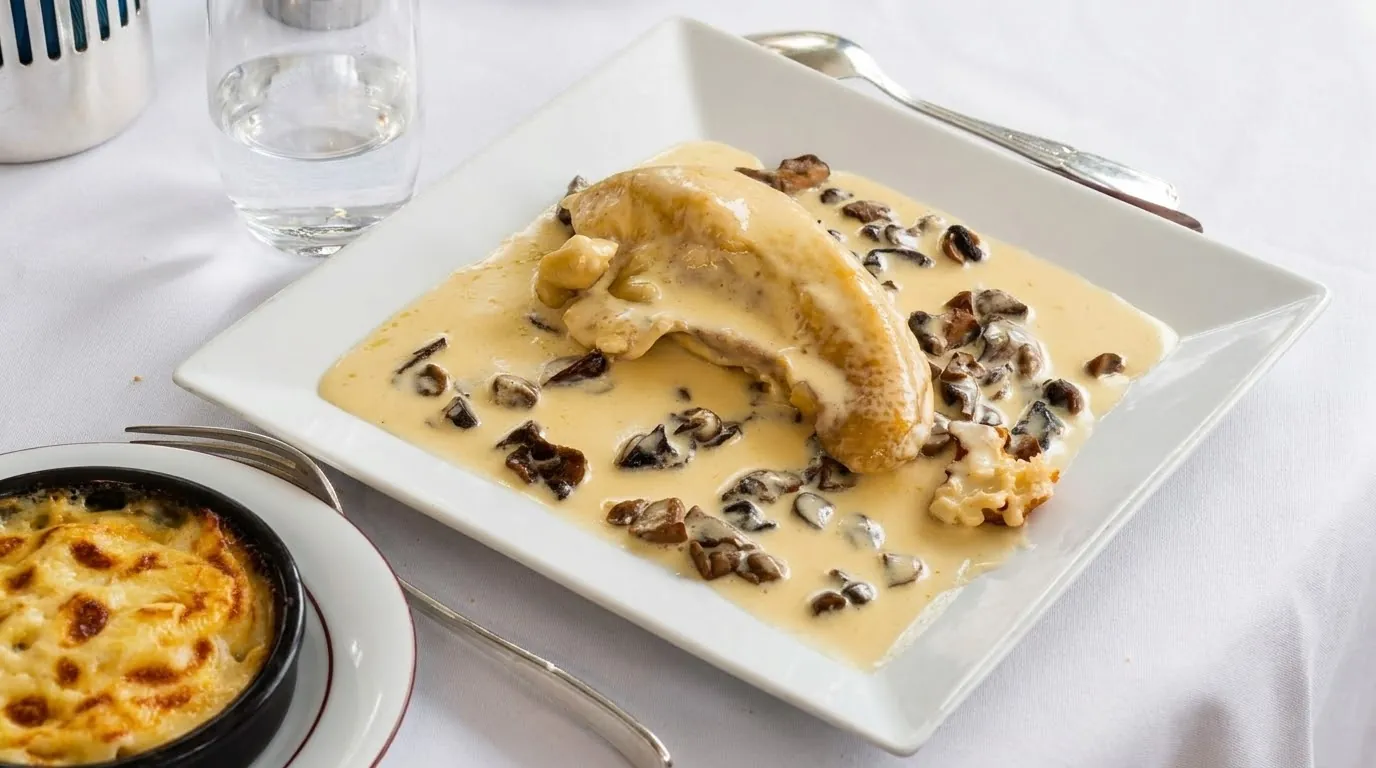
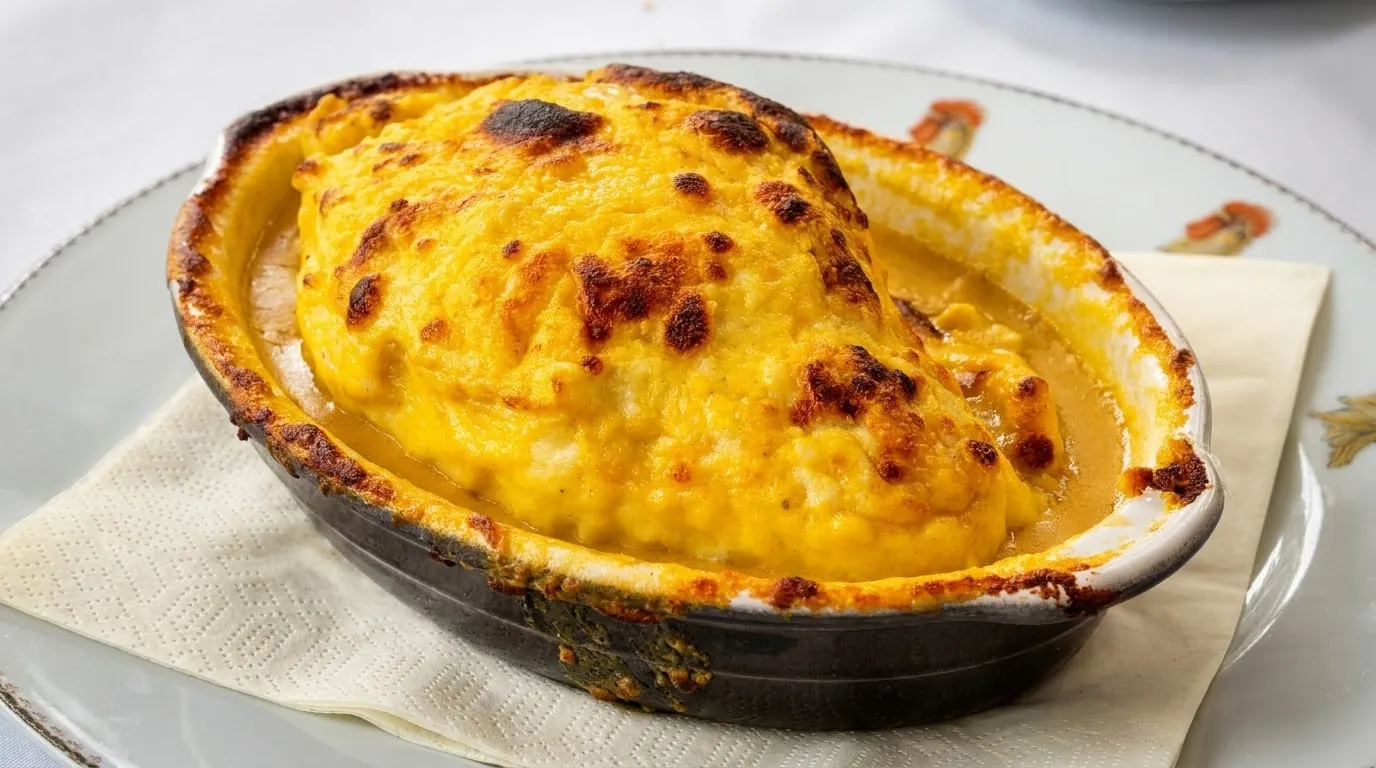
I ordered quenelle de brochet, a rich pike dumpling that’s one of the dishes most closely associated with Lyon. The waiter told me it was the best quenelle in France, and after tasting this dish at several restaurants in Lyon, I have to say he was right.
The restaurant sits at 166 boulevard de Brou, right across from the monastery’s church, and from its terrace you can see the glazed roof. Jean-Pierre Vullin has been cooking here since 1977, and the restaurant appears in the Michelin Guide in the classic cuisine category, as well as in the Gault & Millau guide.
The menu is the region’s must-have list: poularde de Bresse (a fattened hen) in a cream sauce with Savagnin wine from the Jura and morels, frog legs with parsley, river crayfish, and quenelle de brochet. You can also order the poularde “half mourning” style, with raspberry vinegar, or as half a roasted chicken on a spit with potato gratin and Comté from the Jura. This indulgence isn’t cheap: a poularde dish runs around 41 to 52 euros, and the market menu is 48 euros. But if you go for the simple menu, it’s not expensive either, and on my visit in October 2026 it cost 34 euros for a main course and dessert. The wine list is long and full of old bottles.
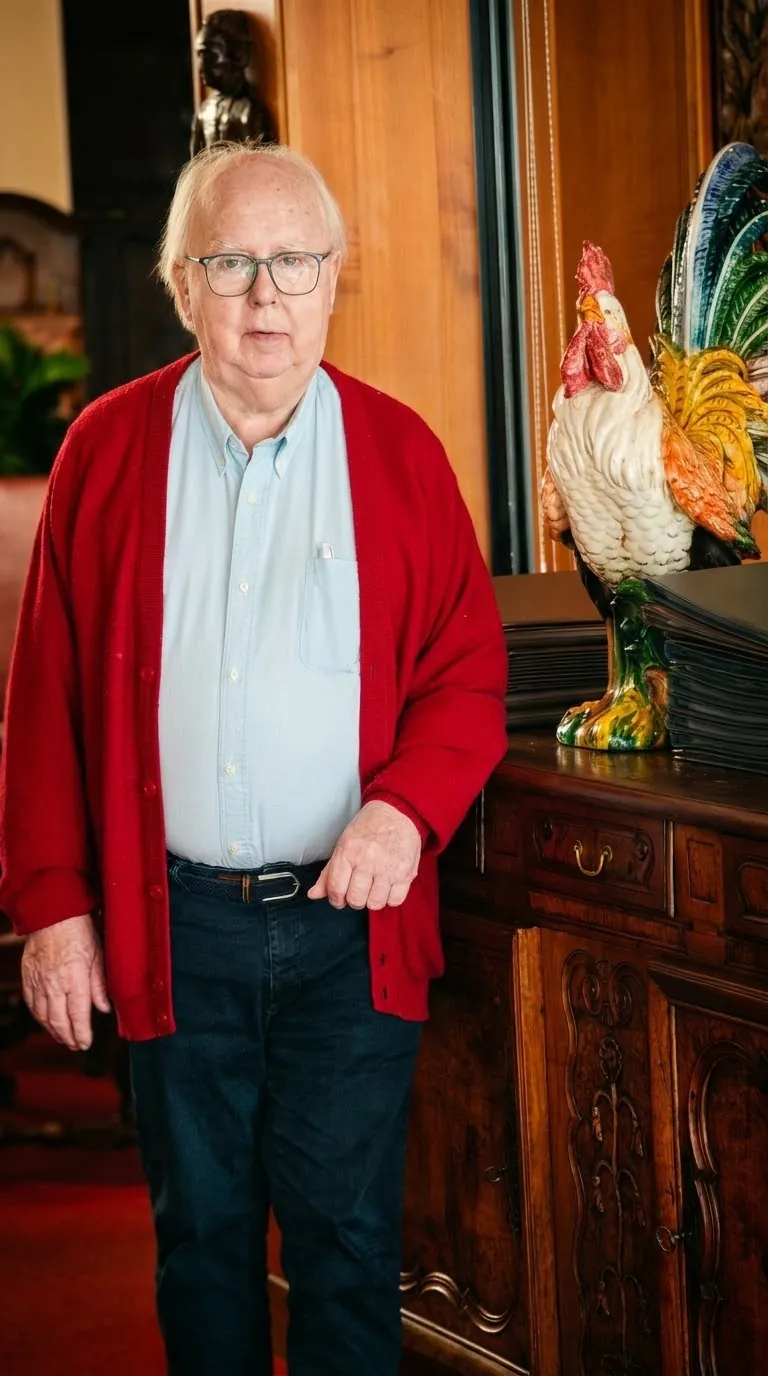
At the end of the meal I met Jean-Pierre Vullin, the owner and chef of the place, and he agreed to let me photograph him next to the rooster statue in the dining room. In short, this is a culinary experience that’s simply a must, and it’s one of the main reasons to come to Bourg-en-Bresse.
The dining room itself is completely classic, and it has a veranda with an electrically retractable roof. My recommendation is to book a table by the window in the evening, when the monastery is lit up from outside. Reserve ahead, especially on weekends, and check the weekly closing day before you go.
The restaurant is open Wednesday through Sunday, from 12:00 to 14:15 and from 19:00 to 21:30, and closed on Mondays and Tuesdays. Book a table by phone at +33 4 74 22 22 68 or through the restaurant’s official website, and you’ll find the exact location on Google Maps.
Place Bernard
My second address is at 19 place Bernard, on the first floor of the Hôtel de France, and it’s the brasserie of Georges Blanc (born 1943). The building is an impressive house from 1900, and the dining room has a fresco telling the story of the family dynasty. Michelin classifies it as traditional cuisine in the mid-range price bracket.
On the plate you’ll find exactly the regional repertoire: Bresse chicken in cream, frog legs, and quenelle de brochet Nantua style, meaning with a crayfish sauce. There’s a pleasant veranda that also doubles as a terrace. The place is open every day of the week, from 12:00 to 14:00 and from 19:00 to 21:30, which is a real advantage in a town where many restaurants close for a day or two midweek.
This is also the address I recommend for anyone who wants to taste the cooking of the Blanc family without leaving town and without the prices of Vonnas. The menu here is an elevated brasserie, not haute cuisine, and that’s exactly the point.
If you want to understand why the name Blanc shows up here at all, the explanation is 26 kilometers to the west, in the village of Vonnas. That’s where the family’s restaurant stands, holding Michelin stars continuously since 1929, a French record. Georges Blanc held three stars from 1981, and in March 2025 dropped to two. He also headed the interprofessional organization for Bresse chicken, so his connection to this bird isn’t just a marketing angle.
Book a table by phone at +33 4 74 45 29 11 or through TheFork, and you’ll find the exact location on Google Maps. The only days it’s closed are the evenings of December 24 and 25.
Brasserie Le Français
My third address is an institution of a different kind: a brasserie that’s been operating since 1897 at 7 avenue Alsace-Lorraine, whose high ceilings are listed on the supplementary heritage sites register. The dining room is furnished with large mirrors in early 20th-century style, and the atmosphere is Art Deco and lively, in just the right measure. The owner is Pierre Ramboz.
The menu combines classic brasserie dishes with local specialties, chief among them Bresse chicken. You’ll also find a Bressan salad with chicken liver and corn, cheeses from the Quintin dairy, and fresh frog legs in persillade. The hours are long, from the first coffee in the morning until evening, which makes this place a particularly convenient solution for a day when your schedule has fallen apart.
In winter the place is known for its seafood stand, which you can also take home with you, and in summer it closes for its annual vacation in August, so check ahead. Note that the most convenient parking is in the Verdun and Préfecture lots nearby. If you just want coffee, sit down and look at the ceiling. It’s about two hundred years old and it’s a registered landmark, not a ceiling you see every day in a café.
The brasserie is open Monday through Friday from 8:30 to midnight, and on Saturday from 8:30 to 16:00. It’s closed Saturday evening and all day Sunday, as well as during the annual August vacation. Reservations by phone at +33 4 74 22 55 14 or through the brasserie’s official website, and you’ll find the exact location on Google Maps.
Recommended hotels in Bourg-en-Bresse
Bourg-en-Bresse isn’t a classic tourist town, so its hotel market is pleasant and sensible: prices are reasonable, there’s no phenomenon of rooms getting snapped up months in advance, and most hotels are independent rather than part of a chain. The only question you need to answer before booking is where you want to sleep, near the monastery or in the town center. The distance between the two is about a twenty-minute walk, so it’s not a make-or-break decision, but it does shape your day.
Cit’Hôtel Logis de Brou
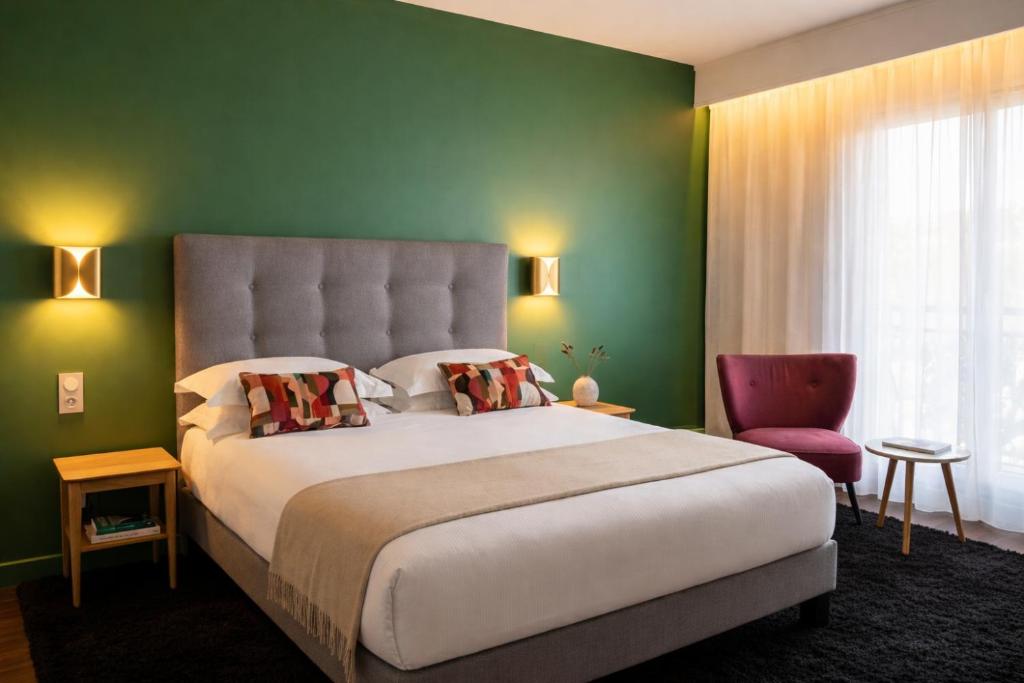
This is the option for those coming for the monastery. The hotel stands at 132 boulevard de Brou, about a five-minute walk from the monastery and facing the Hôtel-Dieu’s park, and it’s an independent three-star hotel with 30 air-conditioned rooms. Every room has a balcony, and some look out onto the monastery itself. There’s a small garden and a terrace where breakfast is served with local products, private parking as well as enclosed garages, and bikes can be left in a dedicated room. The town center and the train station are about a quarter hour’s walk away. A double room starts at around 90 euros.
Hôtel Le Griffon d’Or
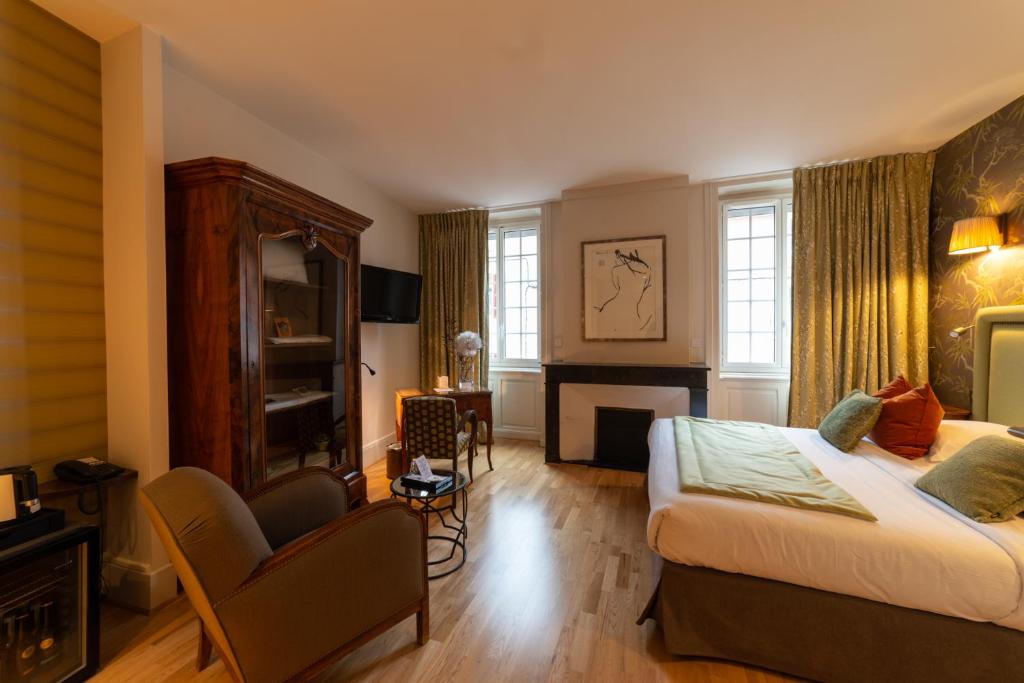
This is the choice for anyone who prefers character over being right next to the site. The hotel sits at 10 rue du 4 Septembre, in the town center and about 800 meters from the monastery, inside a building from 1701 that once served as a post house. It’s an independent, family-run three-star hotel with only 16 rooms, and each room has its own distinct atmosphere. On-site there’s a lounge with a billiard table, a bar, a terrace in the inner courtyard, and free access to a sauna and a fitness room. Breakfast is built on fresh, local products, some of them made on-site. A double room ranges from 135 euros for the classic category to 175 for the signature rooms, breakfast is 15 euros. Private parking is free, the enclosed garage comes at an extra charge.
Best Western Hôtel de France
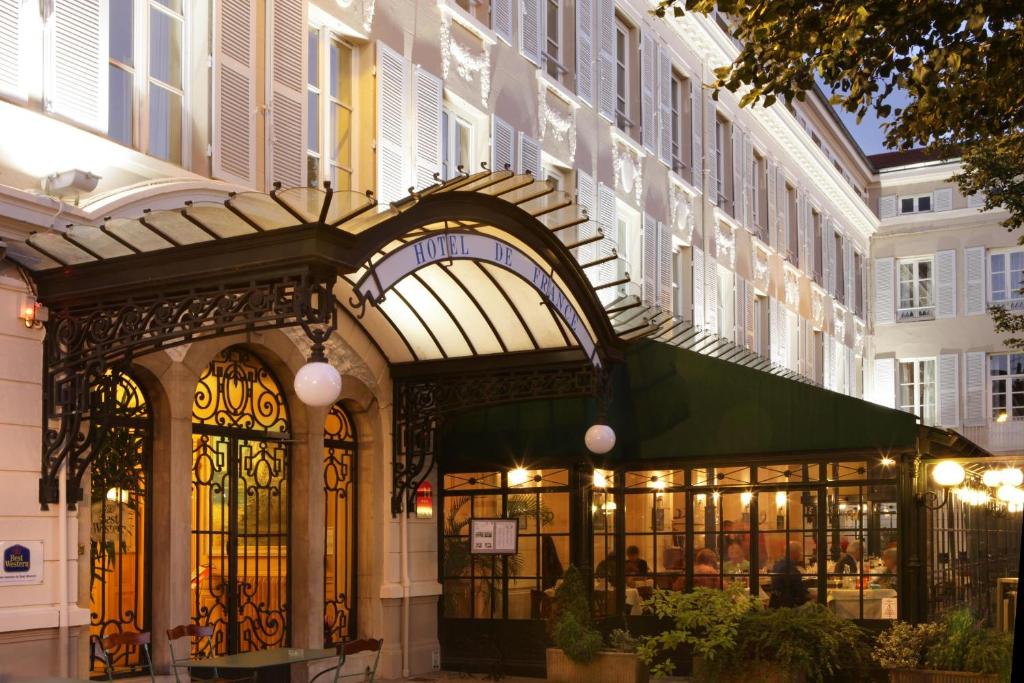
This is the practical choice for most people. The hotel is located at 19 place Bernard, at the foot of the Notre-Dame co-cathedral and just steps from the town center’s pedestrian street, in a renovated building from 1853. It has 44 spacious rooms with air conditioning, free Wi-Fi and a minibar, as well as a shaded courtyard and terrace. There’s private parking for a fee and a large public lot right across from it. The advantage that’s hard to overlook: the Place Bernard restaurant I mentioned above sits on the first floor of the hotel itself, and after a full day on your feet, that’s a real perk.
FAQ about Bourg-en-Bresse and the Monastery of Brou
How much time should I set aside for Bourg-en-Bresse?
One day covers the essentials comfortably: two to two and a half hours at the monastery, lunch, and an afternoon in the old town and the pharmacy. If you also want to explore the surrounding area, there’s enough material for a second day.
Can you take a day trip to Bourg-en-Bresse from Paris?
Yes, and fairly easily. A direct TGV train arrives in an hour and fifty minutes, and from the train station to the monastery it’s about a twenty-minute walk or a short ride on bus line 6. If you leave early in the morning, you’ll have time for the monastery, a proper lunch, and a stroll around the town center before heading back.
What’s the difference between Bresse chicken, poularde and capon?
They’re all the same breed and the same designation, and the difference is in age, sex and the way they’re raised. A poularde is a fattened hen, whose meat is fattier and more tender, and a capon is a castrated male raised for a longer period, intended mainly for the holiday season. You’ll see all three on menus in Bourg-en-Bresse, and the poularde is usually the gastronomic dish while the chicken is the everyday one.
Is the Monastery of Brou open all year?
Yes, every day of the year except three dates: January 1, May 1 and December 25. In summer it closes at 18:00 and in winter at 17:00, with last admission half an hour before closing. There’s no midday break.
Do you need to book tickets in advance for the Monastery of Brou?
It’s not mandatory, and you can buy tickets at the ticket office. I still recommend booking through the official website if you’re arriving on a summer weekend or during school vacations. On the other hand, for the Hôtel-Dieu pharmacy, booking ahead is an absolute must, since entry is only by guided tour and the number of spots is limited.
When is the best time to visit Bourg-en-Bresse?
May, June, September and October offer pleasant weather and fewer visitors. The third week of December is a completely different story: that’s when the Les Glorieuses de Bresse poultry competitions and markets take place, and the town fills up. If you’re coming for the food, that’s the date.
Is a visit to Bourg-en-Bresse suitable for kids?
It depends on their age. The church and the tombs generally hold the attention of children ten and up, and for younger kids the monastery has a dedicated play trail and workshops throughout the year. If you’re traveling with young children, combine your visit with the Bouvent leisure park on the edge of town, which has a lake, walking trails and a golf course. Note that strollers are allowed in the monastery, but dogs are not.
What else is there to see around Bourg-en-Bresse?
The fortified village of Pérouges is about 34 kilometers away and is one of the most beautiful in France. Vonnas, 26 kilometers to the west, is the Blanc family’s gastronomic village. Anyone interested in 20th-century history will find in the area the Museum of the Resistance and Deportation in Nantua, and the Izieu Children’s Home, which has become a memorial museum. Both are sites that deserve half a day each, and I wouldn’t try to squeeze them into the same day as Brou.
Related reading