
In short
- What’s there: A moat-ringed Renaissance château, a 21-meter trompe-l’œil painted gallery, and a frescoed ceiling where the great figures of the French court appear as the gods of Olympus.
- Status: A private château, inhabited by the same family since 1704, with the park protected as a historic monument since 1927.
- Getting there: About one hour fifty minutes by TER train from Paris-Bercy station to Tonnerre, then about a nine-minute drive, or about two and a half hours by car from Paris.
- Tickets: The interior can only be seen on a guided tour, 12 euros for adults, and an outdoor-only visit costs 5 euros.
- How long: An hour and a half to two hours, of which fifty minutes is the indoor tour.
- When: The season runs roughly from early April to early November, and the château is closed every Tuesday.
- And a bonus: Scenes from the 1964 film about Angélique, Marquise of the Angels, were filmed here, and an empty treasure chest from another film once came up out of the moats.
I didn’t plan to visit Tanlay. In October 2026, during my trip through Burgundy, I had a free day between Chablis and Tonnerre, and one morning someone at the village café told me there was a château twenty minutes away that looked like it was floating on the water. I drove over to see what it was, mainly because I didn’t have a better idea.
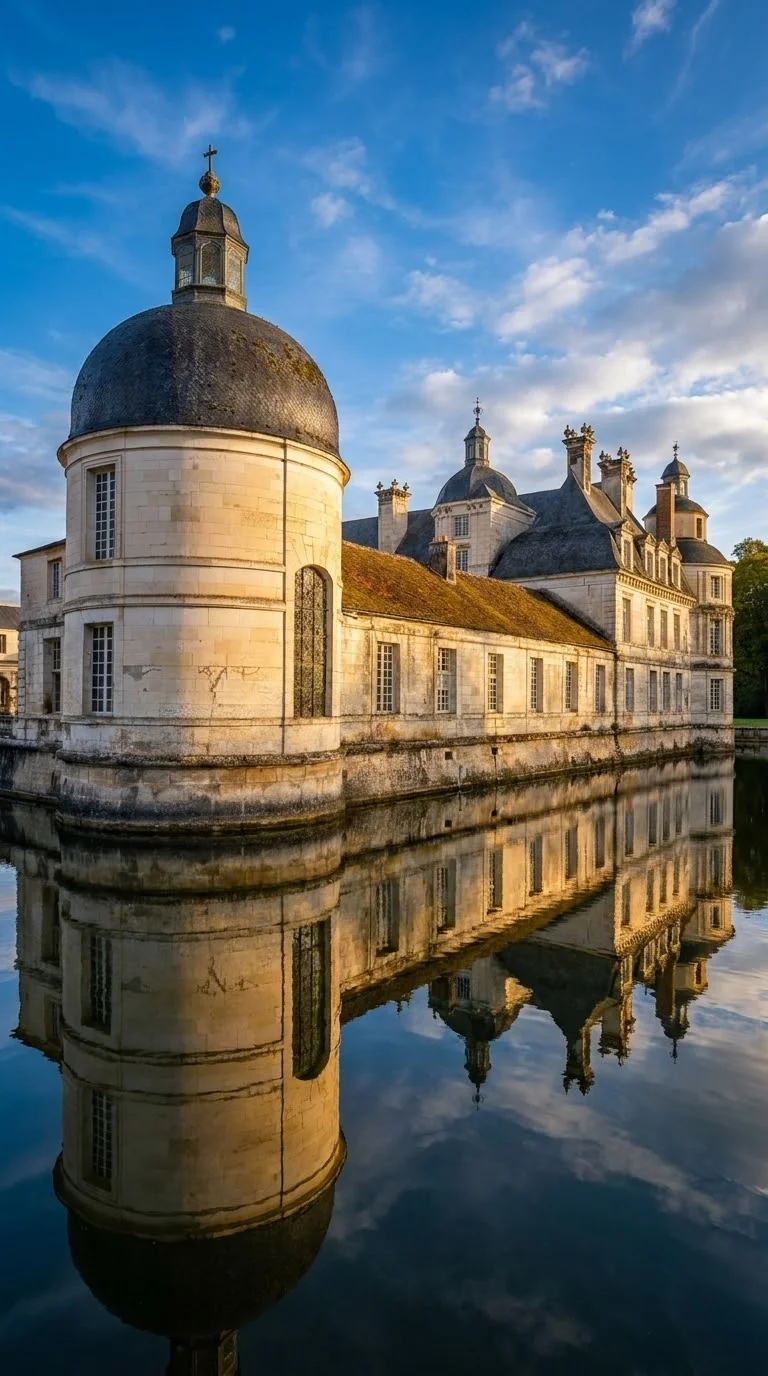
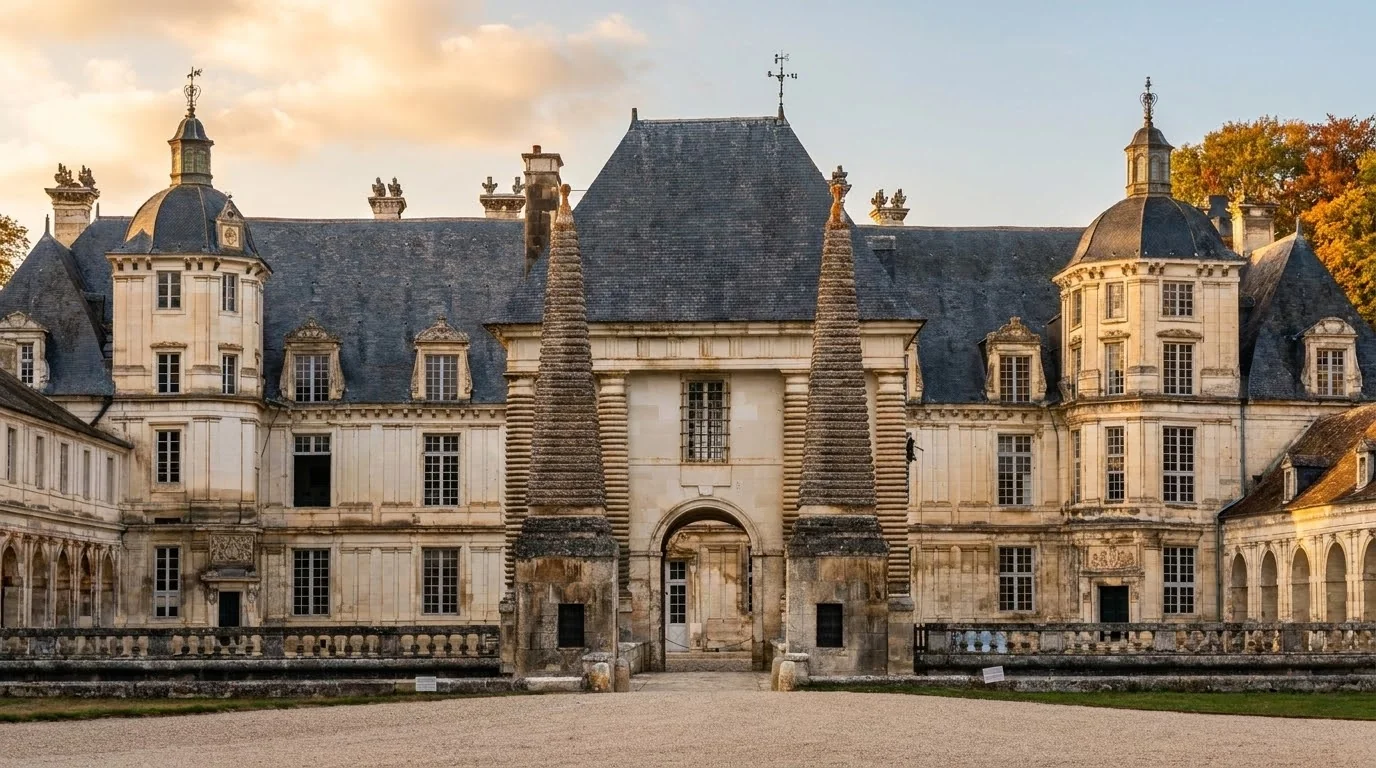
I arrived at the entrance bridge at the hour when the October light in Burgundy does the one thing it does best: turning pale stone a deep yellow and bouncing it back up from the moat. Two stone obelisks guard the bridge, behind them a perfectly symmetrical courtyard, and four round towers topped with dome caps. There are no giant ticket counters, no gift shop full of magnets, no line. There’s a bell, a guide, and a group of nine people who were waiting with me for the 11:15 tour.
I left fifty minutes later feeling like I’d accidentally stepped into a story I was supposed to already know. This château was once the headquarters of the Protestant leaders during the Wars of Religion, and on the top floor of one of its towers there’s a painted ceiling where the great figures of the French court appear as the gods of Olympus, half naked, each one holding a hint about which side he fought for. A 16th-century political cartoon, painted on plaster, in a room nobody really knows the original purpose of.
If you’re in Burgundy for the wine, Tanlay is the perfect cultural break between two wineries. If you’re there for history, this is one of the more interesting stops of the French Wars of Religion that nobody sends buses to.
First I’ll give you the practical information, because Tanlay isn’t a place you can just walk into at six in the evening and hope for a spot. Then what’s actually worth not missing, and after that the part I wrote this article for in the first place: the history. It’s long, it ends with the plot of a 20th-century film, and somewhere in the middle there’s a finance minister so hated that the French wrote about it.
Practical information for visiting Château de Tanlay
Opening hours, season and tours
The first thing you need to understand: you can only see the inside of the château on a guided tour. There’s no free visit inside, no audio guide, and if you arrive five minutes after the group has gone in, you wait for the next tour. The tour lasts about fifty minutes, and departures are at 10:10, 11:15, 14:15, 15:15, 16:15 and 17:15. The last entry is at 17:10.
The château is closed on Tuesdays, throughout the season. The outdoor areas, meaning the park, the moats, the stables and the grand canal, can be explored on your own from 10:00 to 12:30 and in the afternoon from 14:00 to 18:30, with the last entry to the outdoor areas at 12:00 and at 18:00. Note that the lunch break lasts about an hour and a half.

The season runs roughly from early April to early November (according to the regional tourist office, the 2026 season opened on April 5 and closed on November 3), so before you plan a half-day detour, check the exact dates on the hours and prices page of the official website. The tours run in French and English, and there are printed visitor booklets in eight languages, English among them.
Two more details worth knowing in advance. The château itself is not wheelchair accessible (the owners note that work is planned), but the park is. Dogs: inside only in a carrier, outside on a leash.
Getting to Tanlay
By train. The nearest train station is Tonnerre, about nine minutes’ drive from the château. From Paris, a TER train leaves from Paris-Bercy station heading toward Lyon, and the ride to Tonnerre takes about an hour and fifty minutes. It’s convenient to book tickets in advance through Omio, which brings together the train operators on one screen and saves you the hassle of the French website.
From there, here’s a tip I was glad to discover: a taxi service called Mobigo operates out of Tonnerre station, run by the French railways, and it takes you straight to the château. You need to book at least two days in advance and before 6 p.m., by phone at 03 80 11 29 29, and the price the owners list as a guideline is 3.50 euros per ride. Yes, that’s the price. I have no idea how they manage to keep it that low.
By car. From Paris the drive takes about two and a half hours via the A6 highway and the D965 exit, which leads straight to the château. If you’re coming from the south, take exit 21 toward Nitry, onto the D944 and then the D965. Chablis is twenty minutes from there, and Tanlay sits right on the region’s classic touring route.
Parking: the château has no parking lot of its own. You park in the village, and the designated bus spaces are across from the town hall building. In a village this size, that’s not a problem, even on a Saturday afternoon.
Guided tour from Paris. I looked and couldn’t find an organized day trip from Paris to Tanlay. This isn’t a place the tour industry has discovered, which is exactly why there aren’t crowds. If you don’t have a car, do it by train to Tonnerre and then taxi from there, and if you want to combine it with other sites in the area, you’ll need a car.
Tickets and prices
Prices for the 2026 season, according to the official website: a guided tour of the interior, which also includes the outdoor areas, costs 12 euros for adults. Children ages 10 to 15 pay 5 euros, and admission is free up to age 9. There’s a discounted rate of 10 euros for anyone showing the appropriate proof, for example a student ID or a ticket from Château d’Ancy-le-Franc or the “Route des Ducs” (Road of the Dukes).
Those who only want the outdoor areas pay 5 euros, and children under 7 get in free. You can buy tickets on site, in cash or by credit card, and also in advance through their online ticketing system. In the quiet season that’s not necessary, but on an August weekend it saves you the risk of the tour being full.
And speaking of wine, for groups (from 12 people) Tanlay offers a tour followed by a wine tasting in the château’s old kitchens, with Chablis Premier Cru and Chablis Grand Cru, local cheeses, jambon persillé (ham in jelly with parsley) or gougères (choux pastry puffs with cheese). You need to book this in advance, and it’s probably the nicest way to end the visit. You’ll find more on the wines themselves in Yossi Drori’s article about the wine route in Burgundy.
Where to stay near the château
There’s no hotel in Tanlay itself. There are a few small guesthouses within walking distance of the gate, and the owners keep an updated list of them on the accommodations page of the official website.
I personally stayed in Auxerre, about forty-five kilometers from the château, which is about a forty-minute drive via the N65 and then the D965. The hotel I picked there, Hôtel Les Maréchaux, is an intimate three-star hotel with a lovely garden and a pool, where every room is decorated in Empire style and named after one of Napoleon’s marshals. Auxerre is a town with a historic center, restaurants and hotels at every price range, and it’s a convenient base for the whole area, including Chablis and Tonnerre. I’ve gathered the rest of my hotel recommendations there in the article about Auxerre.
What not to miss in Tanlay
The League Tower and the ceiling nobody expects
This is the moment you come for. The tower known as the League Tower (tour de la Ligue) has two floors, and each one has a wall painting. On the lower floor there’s a vault painted in the style of the Pompeii frescoes, and among its decorations are marine motifs, which is why it’s believed this room served as the study of Admiral de Coligny. On the floor above, in the domed ceiling, the other thing awaits.
The guide turns off the lights, switches on a spotlight, and you look up and see the gods of Olympus. Jupiter on a cloud, Neptune with a trident and a white horse, Hercules with his club, Venus, Mercury, Vulcan running Cyclopes in a forge, and in the middle of all this chaos, a woman with two faces holding a key. There are no names, no captions, no explanation. Historians made all the identifications in the 19th century, and they’ve been telling them to visitors ever since.
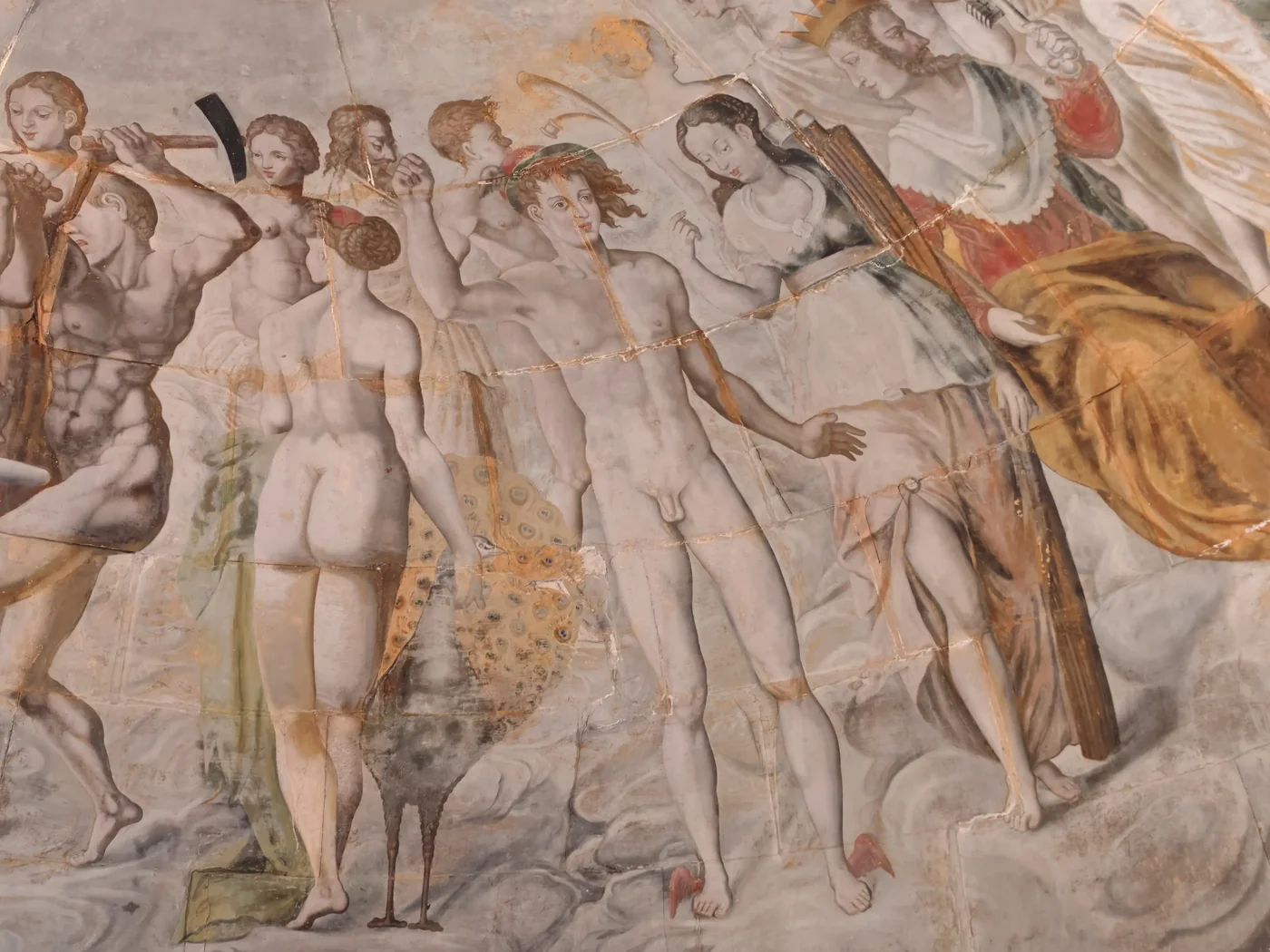
And then you notice that the right side of the painting has been erased. It’s simply gone. Five hundred years of wear, or a hand that decided whatever was there was better left out? I asked the guide and she said there’s no answer. I admit I liked that more than any answer she could have given me.
The painted gallery
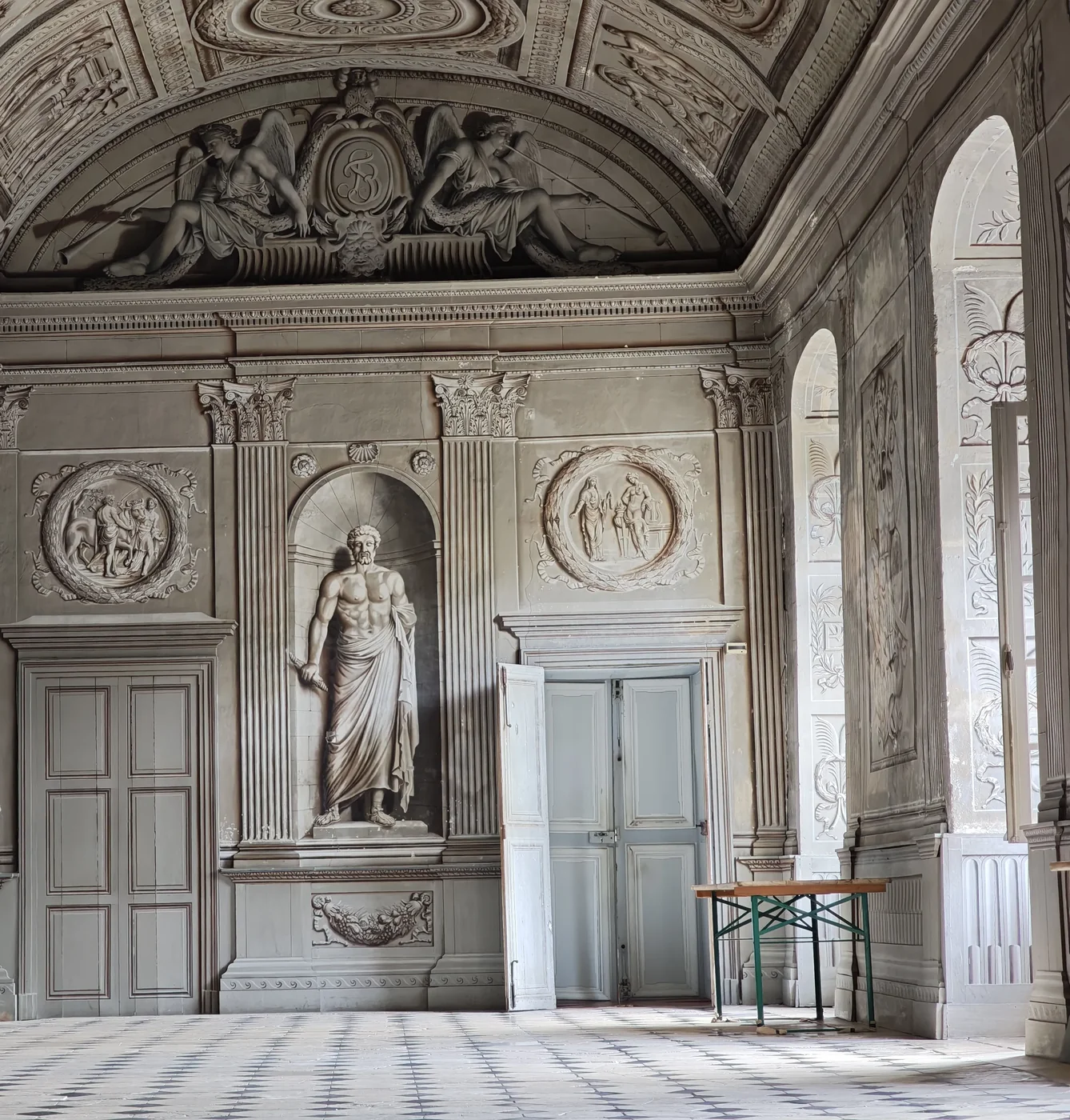
On the first floor of the château is the display gallery, twenty-one meters long, and everything in it is painted in trompe-l’œil (a painting technique that creates the illusion of real depth on a flat surface). The walls and the vaulted ceiling are covered in painted architecture, columns that don’t actually exist, and light that someone decided where it comes from. The gallery was painted by Rémy Vuibert.
The interesting thing about a gallery like this isn’t the admiration for the craftsmanship, which is genuinely impressive, but the moment you stop trying to figure out what’s three-dimensional and what isn’t. I stood there moving my head side to side, trying to find the angle where the illusion breaks. It doesn’t really break.
The nymphaeum, the grand canal and the park
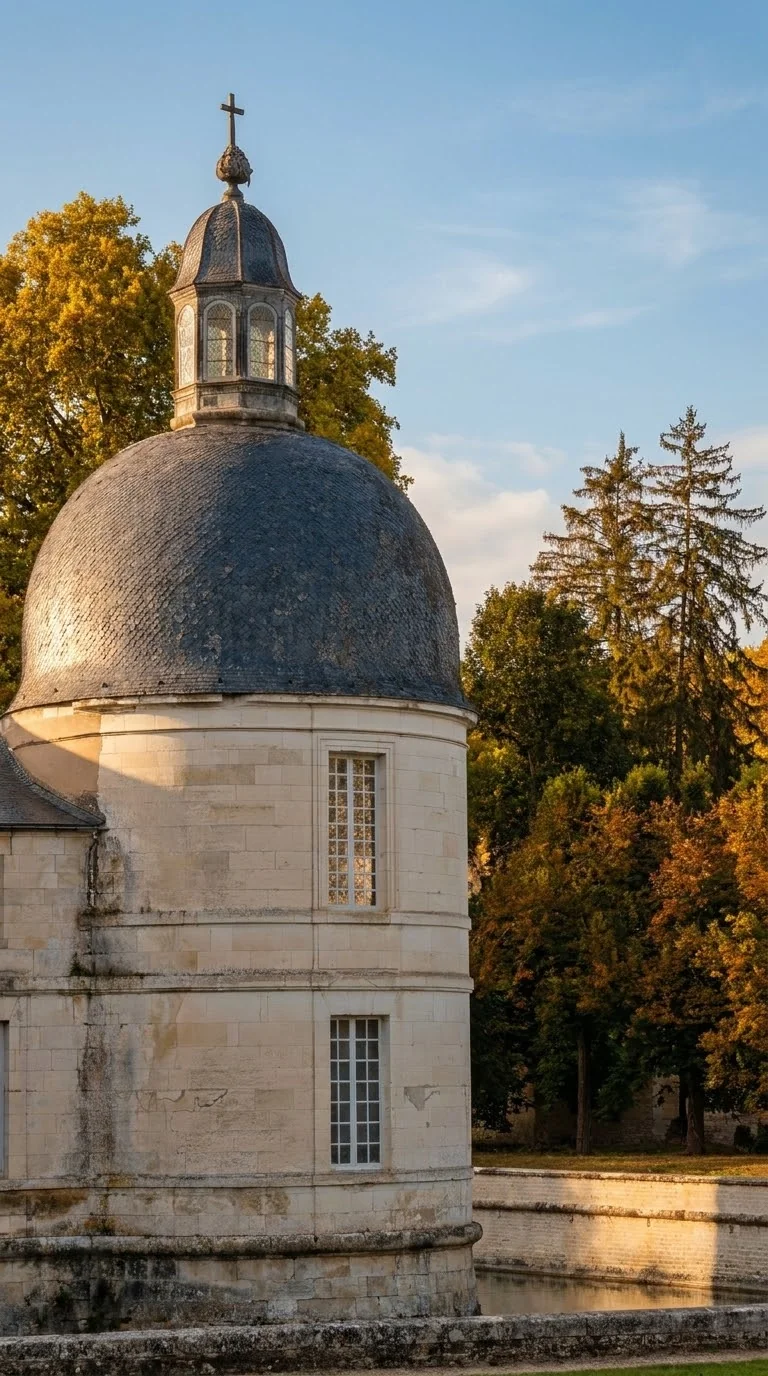
What remains of the park designed by architect Pierre Le Muet (1591-1669) is the grand canal, nearly 530 meters long, stretching from the château into the park in one straight line. The water is fed by a Renaissance-era nymphaeum, meaning a fountain set inside a grotto, what the French sometimes call a “water theater.”
I recommend doing the outdoor areas before the indoor tour, not after, for two reasons. One, once you come out of the ceiling in the League Tower, you won’t have patience left for a canal. Two, the morning light on the pale stone and the water is definitely worth the early start. In spring 2026, the back part of the park also opened to the public, with a facade and parterre that visitors hadn’t seen before, so even people who’ve visited Tanlay in the past will find something new there.
The Petit Château, the obelisks and the green courtyard
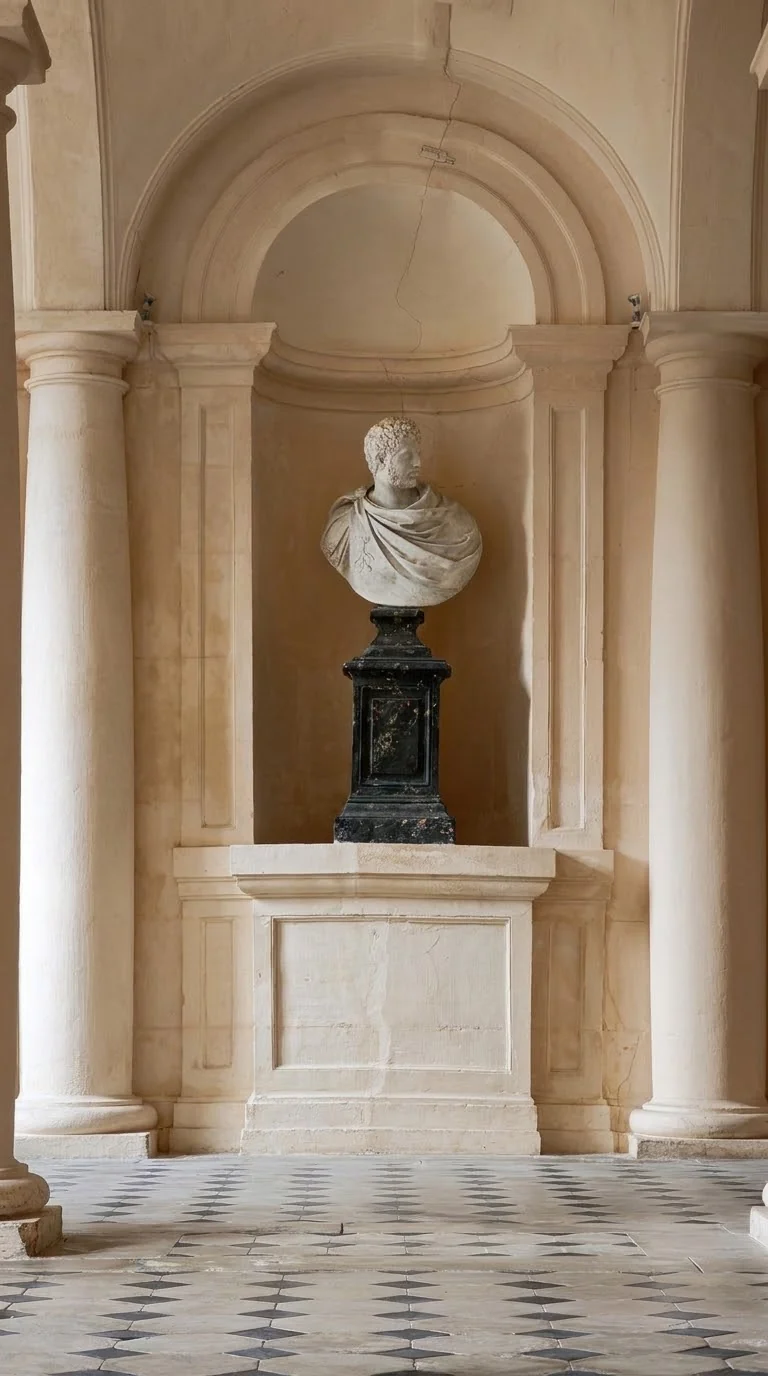
Between the village and the château stands the gatehouse, known as “the small château” (le Petit Château). It’s a grand single-story gateway with an attic, and above its entrance you can still see the grooves where the drawbridge door once moved. Anyone passing through it doesn’t yet reach the château itself but the green courtyard (la Cour verte), a courtyard enclosed on three sides by a high wall with a row of blind arcades.
The two obelisks on the entrance bridge, the wall of the green courtyard, the Gallery of Caesars (la Galerie des Césars) and the nymphaeum, all come from the Italian taste that was fashionable in France during those years. You’ll find the exact same language at the nearby Château d’Ancy-le-Franc, and that’s no coincidence, it’s one region and the same patrons.
The history of the Château de Tanlay
A fortress, an inheritance, and one woman who decided
Beneath the château you see today lie the foundations of a 13th-century fortress. Everything built above it starts with a single event: in 1533, Tanlay was passed by will to Louise de Montmorency (died 1547), sister of the Constable of France Anne de Montmorency (died 1567) and widow of Marshal Gaspard I de Coligny (died 1522).

Louise raised three sons on her own, and each of them became a central figure in the first stage of the Wars of Religion in France. Odet de Coligny (1517-1571) became a cardinal at fourteen. Gaspard II de Coligny (1519-1572) became Admiral of France. François de Coligny, seigneur d’Andelot (1521-1569), the youngest of the three, was the one who inherited Tanlay. Louise herself, a committed Calvinist, refused the help of a priest on her deathbed. All three of her sons moved to the Protestant side after her.
The younger brother who built a château he never finished
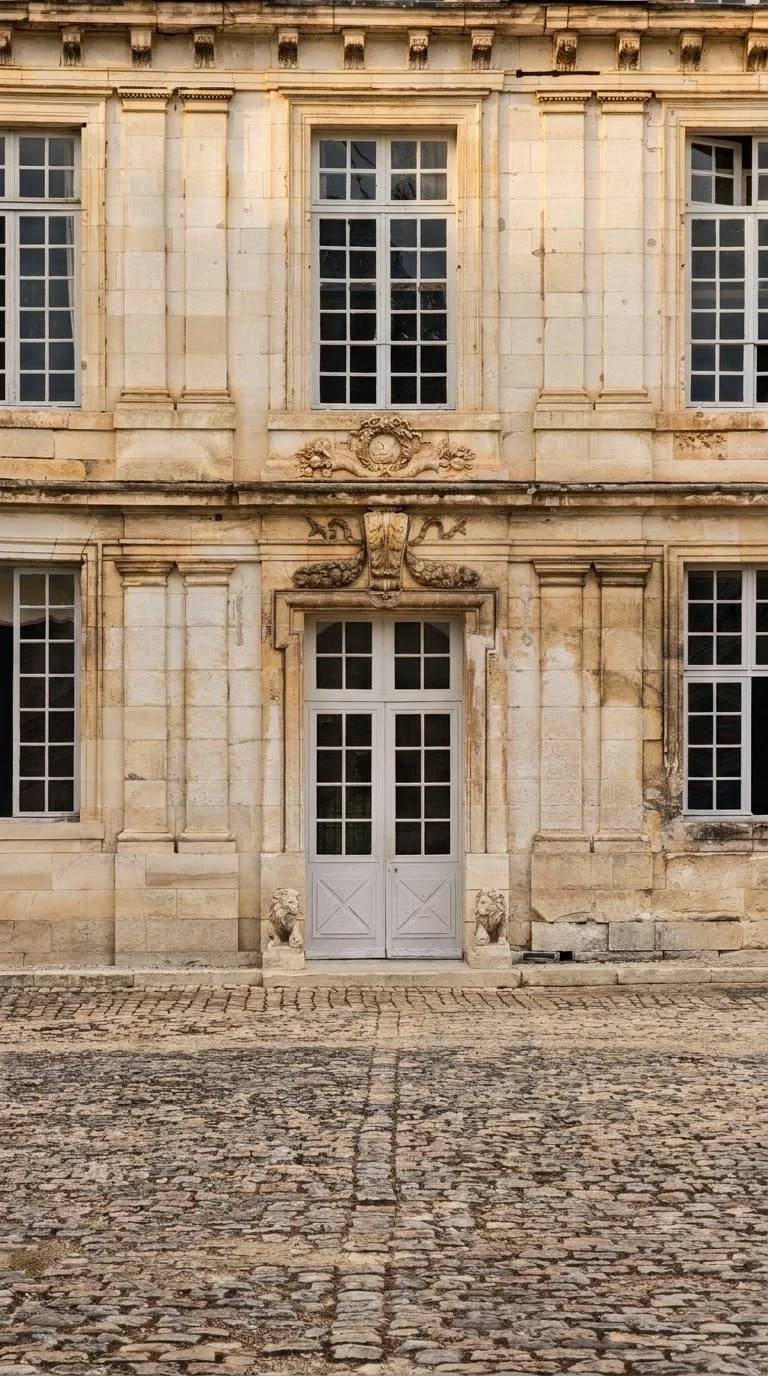
François inherited the estate in a battered state, and in the 1550s and 1560s he built a grand château in its place. In 1568 the work stopped, as the Wars of Religion overtook the building plans, and the château was left without the wing meant to close it off. François died in 1569, never seeing his plan completed.
If you think the youngest brother was the least interesting of the bunch, here is what came before the building work. François fought in Italy, was taken prisoner in 1552 and held in a castle in Milan, was freed in 1555, became colonel-general of the infantry, was captured again in 1557 at the Battle of Saint-Quentin, and managed to escape. In that same battle his brother the admiral was also captured and sent into captivity in Flanders, and it was to that captivity that François made sure to send him “the books from Geneva.” Gaspard read, thought it over, and emerged a Protestant in 1559.
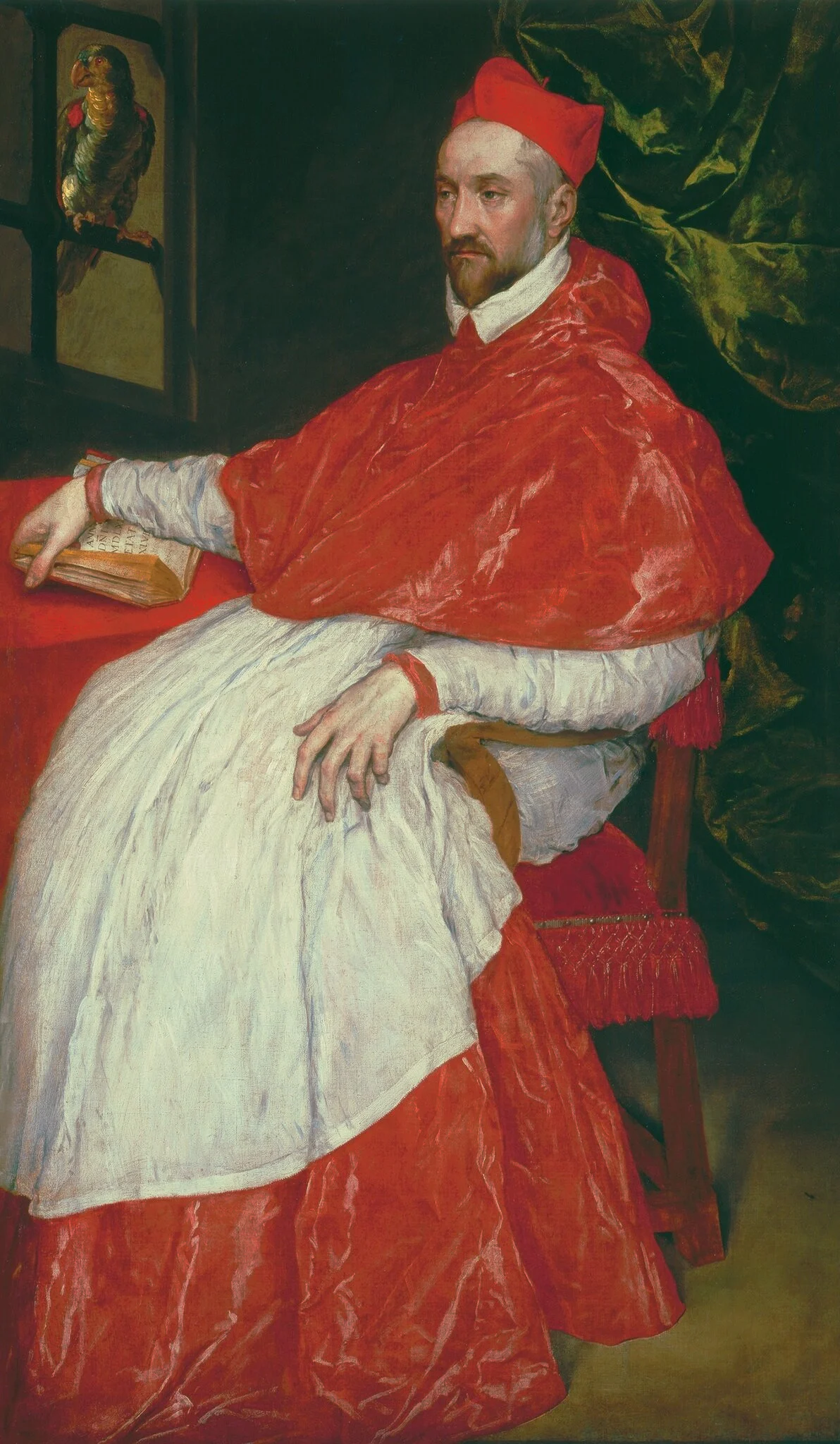
His other brother, Cardinal Odet, took an extraordinary path. He had been a cardinal since 1533 and Archbishop of Toulouse since 1534, patron of the poet Pierre de Ronsard (1524-1585), and the man to whom François Rabelais (died 1553) dedicated the fourth book of Gargantua and Pantagruel. He later drew close to the Reformation, broke his vow of celibacy, married, and continued to wear clerical dress. In 1563 he was excommunicated, in 1567 he fought alongside the Huguenots at Saint-Denis, and he met his end in exile in England, poisoned by a servant.
This household, then, was no quiet country family. It was a household of people the French crown was about to hunt down.
The Tower of the League: headquarters, legend, and a 19th-century denial
At the time when the Wars of Religion were just beginning, Admiral de Coligny chose Tanlay as a meeting place for Protestant leaders, and the regular guest was Prince Louis I de Condé (1530-1569). It’s worth understanding who this guest was: the younger brother of Antoine de Bourbon, King of Navarre (1518-1562), a prince of the House of Bourbon, and the first military leader of the Protestant camp in France. He was the one who led the Huguenots into their first war against the crown, until he was wounded at the Battle of Jarnac in 1569 and murdered after being taken prisoner. The house he founded went on to play a central role in French politics for two hundred and fifty years after his death. He came to Tanlay often because his own château at Noyers lay nearby. I wrote a whole article about this family: the Houses of Condé and Conti.
Tradition says these secret meetings took place in the tower, on the top floor, and that its round openings allowed the plotters to keep watch on the surroundings and scatter quickly if needed. A good story. But in 1845, Baron Claude-Étienne Chaillou des Barres (1784-1857) published a book about four châteaux in the area, in which he stated plainly that he did not believe it. In his view, the upper room was simply a room for leisure, and it was hard to imagine Protestant leaders plotting a revolt against the queen’s son while surrounded by nudes painted in every direction. The serious planning, he wrote, was done on the ground floor.
I have no way to settle the matter between tradition and doubt, but there’s another detail that complicates the picture: the tower’s name. “The League” in French history refers to the Catholic League, meaning the exact opposite side. Some sources write “the Protestant League” to get around the problem, and I haven’t been able to find an authoritative explanation for the name itself. A tower named after the enemy is a puzzle all its own.
The ceiling: who is hiding behind which god
There is a document about the ceiling itself, and that’s rare. In the château’s archive, a payment record survives showing that the admiral ordered a room built above his brother’s study, and paid a painter named Larme twenty livres and one sol for the work. The document was written in June 1568, so the paintings were finished by that date. The painter, according to that same source, was a painter of galleries, meaning he decorated the king’s warships, which makes sense: the admiral was in charge of France’s galleys.
What is painted there? According to the accepted interpretation, each god is a real person. Jupiter, on the cloud, holding the thunderbolts, is King Henri II (r. 1547-1559). Neptune, with his trident and white horse, is Admiral de Coligny. The muscular Hercules with his club is Cardinal Odet. Mercury, at the center, is Cardinal Charles de Lorraine (1524-1574) of the House of Guise. And Mars, in armor, is Constable Anne de Montmorency, that is, the uncle of the Coligny brothers, who remained Catholic while his nephews switched sides.
At the center of the scene is a woman with two faces, like the god Janus. One face is female and laughing, the other male and showing hatred, and in her hand is a key known as the key to the Temple of Peace. This is Catherine de’ Medici, surrounded by beautiful young women identified with what was called her “flying squadron,” those ladies of the court she sent out to gather information and influence men.
One of them, Louise de La Béraudière (1530-1586), known as “la belle Rouet,” was given a specific mission by Catherine: to win back for the Catholic side Antoine de Bourbon, King of Navarre. Antoine wavered between the two faiths his whole life, took part in Protestant ceremonies and was seen as a hope of that camp, but in 1561, between the promise of a senior post at court and a new mistress, he decided once and for all for the Catholic side. At the end of 1562 he commanded the Catholic army that laid siege to Protestant Rouen, was wounded there, and died in November of that same year, while his wife Jeanne d’Albret (1528-1572) remained a devoted Calvinist. He was, incidentally, the father of King Henri IV (r. 1589-1610). In the painting he appears behind Louise, blurred almost to the point of vanishing, and that, to me, is the ironic detail of the ceiling: the man who switched sides for a woman was painted as someone who had lost his own outline.
The Protestant side of the painting receives the symbols of peace, a dove on a shoulder and an empty quiver. The Catholic side receives the symbols of war, and in a forge Vulcan is shown ordering the Cyclopes to hammer at the anvil. Both sides share the same ceiling, one showing calm and the other raising weapons. Scholars have traced the inspiration for this idea to a hymn Ronsard wrote in honor of Henri II in 1555, in which the king receives his own Neptune and his own Mars, just as on the ceiling. Ronsard, as noted, was a close friend of the Coligny brothers.
Three years after the paintings were finished came the St. Bartholomew’s Day Massacre of 1572, and the admiral, the Neptune of the ceiling, was murdered in Paris.
From the son-in-law who continued the building to the finance minister France despised
François never finished building the château, and the work was carried on by his son-in-law Jacques Chabot, marquis de Mirebeau, who built the Coligny Tower and the Tower of the League, completing the small château in 1610. After that, the estate began to pass from hand to hand: in 1635 it came to Claude Vignier, first president of the Parlement of Metz, and in 1642 he sold it to the man responsible for Tanlay looking the way it looks today.
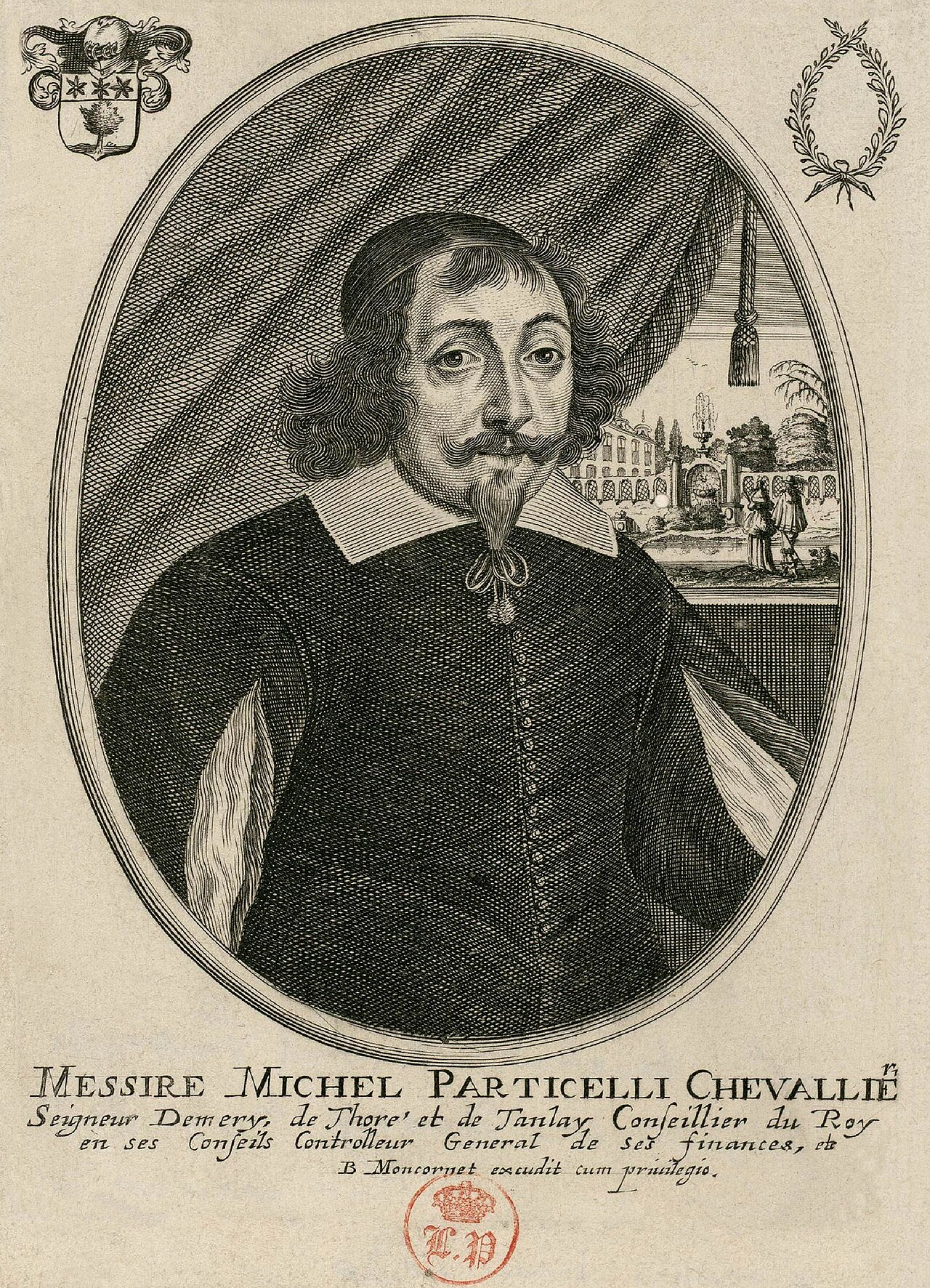
Michel Particelli d’Émery (1596-1650) was born in Lyon, the son of a banker from a family that originated in Lucca, Italy. He served as France’s ambassador in Turin in 1640, from 1643 held the post of comptroller general of finances, and from 1647 was surintendant des finances (superintendent of finances), meaning the senior official in charge of the crown’s money, working alongside Cardinal Mazarin (1602-1661). He raised money for the war against Spain through methods that turned his name into a dirty word: a tax on built property, a tax on “the wealthy,” and in 1646 the tariff decree, which imposed a levy on every good entering Paris, by land or by water, regardless of social class.
The common people hated him because he made them pay, and the nobles hated him because his reforms touched and hurt them financially too. In 1648, the clash with the Parlement of Paris led to the revolt known as the Fronde, and Mazarin dismissed him and sent him away to one of his own estates.
But even that didn’t calm things down. A source from the period says what truly enraged the French was the very idea that this man owned estates in France, and not because land was a rare commodity among the ruling class: Particelli was no French noble who had inherited land, but the son of an Italian banker who arrived in France without a fortune and bought estates with the money he himself had collected through taxes. In other words, the land he bought looked to the French like their own money. The estate to which he was exiled was Tanlay.
Just how toxic this name had become can be seen in a story found in 19th-century sources. Cardinal Richelieu (1585-1642) wanted to appoint him to a post in the treasury, and presented him to King Louis XIII (r. 1610-1643) under the respectable name “Monsieur d’Émery.” The king replied that he was glad it was this gentleman, because he had heard about a scoundrel named Particelli, and he had been afraid someone would try to talk him into appointing that man instead. Richelieu reassured him and said that the very Particelli in question had already been hanged, so to speak. “Good,” said the king, and signed the appointment of the man standing right in front of him. It’s an anecdote, not a record, but it shows how that name sounded to people of the time.
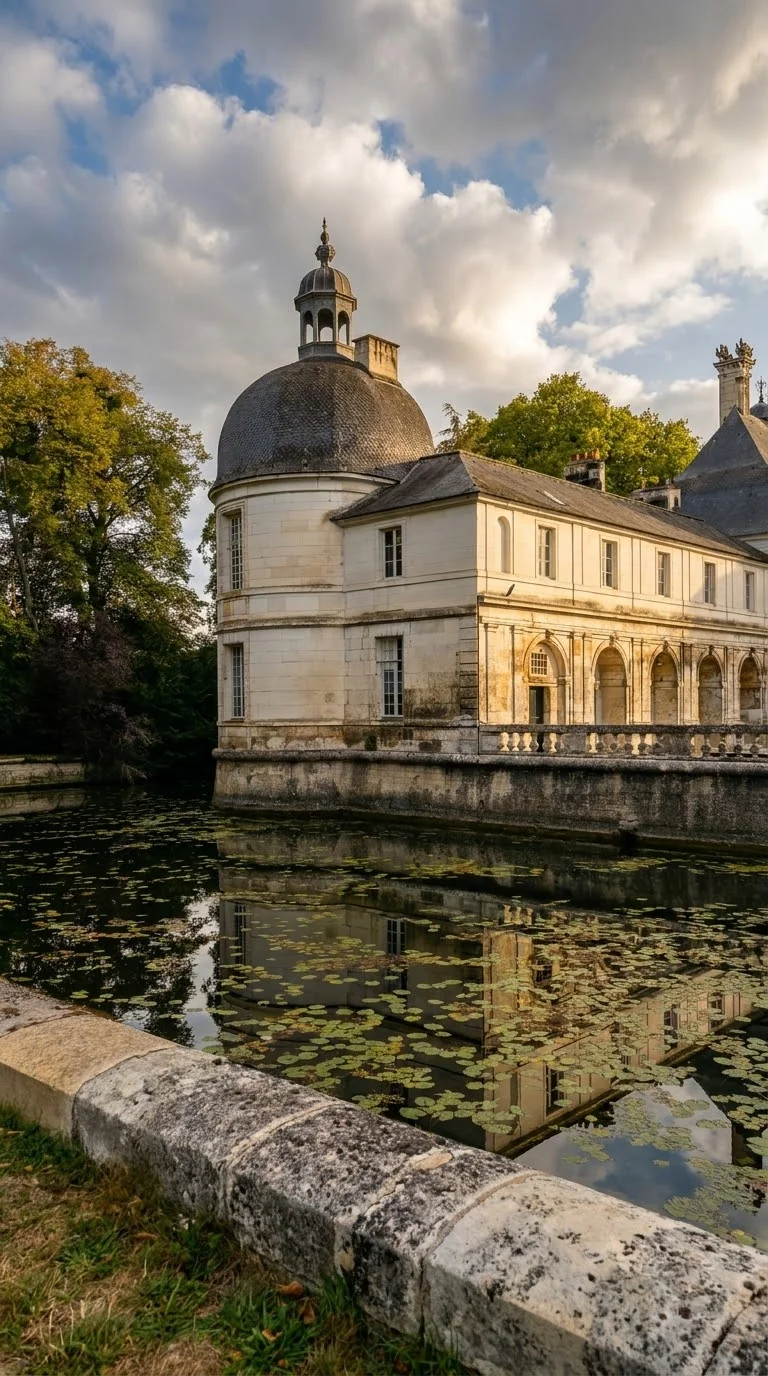
While Paris was cursing his name, the money flowed into Tanlay. Particelli entrusted the work to Pierre Le Muet, the architect who also built the Val-de-Grâce church in Paris, and between 1643 and 1649, the right side of the courtyard of honor, the wide moats surrounding the château, the stables, and the great canal in the park were all built. In those very same years in which he taxed every cart of wheat entering Paris, a half-kilometer-long canal was dug in Burgundy. He was reinstated to his post at the end of 1649 and died in Paris in 1650.
If this story sounds familiar, it’s because it repeated itself eleven years later in an even more extreme version. Nicolas Fouquet (1615-1680), who held the same post three years after Particelli’s death, built himself a palace at Vaux-le-Vicomte, and was arrested in 1661 on the orders of Louis XIV. The difference between the two men is that Fouquet ended up in prison and had his palace taken from him, while Particelli died in office and left Tanlay to his family. I wrote about Fouquet and the palace that brought him down in my article on Vaux-le-Vicomte.
Marquises, Heirs, and a Chain of Deaths
After his death, Tanlay passed to his son-in-law, Louis Phélypeaux de La Vrillière (1599-1681), who married Particelli’s daughter in 1635 and received with her a dowry of 336,000 livres. In 1671, Louis XIV raised Tanlay to the rank of marquisate in his honor.
In 1704, Phélypeaux’s grandson sold the estate to Jean Ier Thévenin (1647-1708), secretary to the king and governor of Saint-Denis, and in March 1705 he was confirmed with the title marquis de Tanlay. From then on began a chain of deaths. Jean Ier died in 1708. His son, Jean II, died in 1710. His grandson, Jean III, died in 1711 at the age of nine. The boy’s two sisters, Jeanne and Louise, could not inherit the title, since the marquisate passed only through the male line, so everything went to Jean Ier’s nephew, Jean IV Thévenin de Tanlay (died 1776), who was confirmed as marquis in June 1755. His descendants still hold the château today.
Three generations of owners were buried within three years, and the last of them was a nine-year-old boy. If this situation sounds familiar, it’s because in those very same years the royal family itself went through a similar tragedy: within three years, Louis XIV buried his son, two grandsons and a great-grandson, and for a moment it seemed he would have no heir left. I wrote a separate article about that son, the Grand Dauphin, which you can read here. At Versailles the question was who would rule France; at Tanlay, who would get the keys. But the solution was the same in both cases: a relative from a side branch stepping into the role.
The 18th and 19th Centuries: A New Face, and a Canal Reaching the Gate
In the 18th century, the family focused mainly on the interior, and much of the richness you see today in the walls, furniture and the carved fireplace dates from that period.
The great change of the 19th century was not made by the family but by the state. The Burgundy Canal, designed to connect the Seine basin to the Rhône basin, was dug over more than fifty years. Work on the Yonne side began in the 1770s, stopped during the Terror, and resumed in 1809 with the help of hundreds of Spanish, Prussian and Austrian prisoners of war held at Tonnerre. By 1826, the stretch up to Tanlay was already open to boat traffic, and in December 1832 the entire canal was opened. The lock (écluse in French) at Tanlay, number 90 on the Yonne slope, was started as early as 1812, and from 1879 it was lengthened to fit the dimensions of the new barges.
For the village, this was a revolution. Tanlay became one of fifteen canal ports, and the château, which until then had stood in a farming village, found itself on a national transportation route. Anyone arriving there today passes through a village with a small boat harbor, something that did not exist in the days of Coligny or Particelli. That same century also saw the first studies of the château: the 1845 book by Chaillou des Barres and the research by Eugène Lambert on Tanlay are the sources behind almost every identification of the figures painted on the ceiling of the League Tower.
The 20th Century to Today
The park was designated a protected heritage site (monument historique) by the French state in December 1927. During the 20th century, the château was held by the Comte de la Chauvinière, son of the ambassador Édouard de La Chauvinière and of Marguerite de Tanlay, and from there the château passed, as always, within the family.
Today it is run by Diane et Gérault de Sèze, who initiated a thorough restoration of the property. In 2024, they and the château received the grand prize of the Fondation Mérimée, Le Figaro magazine and “Propriétés Le Figaro,” a prize awarded once a year to a private owner for the preservation of a heritage site. At the same time, a book about the château was published by art historian Claude Mignot, a scholar of French classical architecture, and that is roughly Tanlay’s status in the French world: not a mass tourist site, but a site that people who truly understand the subject write books about.
Tanlay on Screen, Including the Chest in the Canal
In the spring of 1964, director Bernard Borderie arrived in Burgundy and filmed part of the scenes for “Angélique, Marquise of the Angels” (Angélique, marquise des anges), starring Michèle Mercier and Robert Hossein. The crew also worked during that same shoot at Fontenay Abbey, at a quarry in Marmagne, and at the Château de Marigny-le-Cahouët. At Tanlay, a scene was also filmed next to the great canal, and carriages galloped along the park’s avenue. In the eyes of many French viewers, Tanlay is the home of Geoffrey de Peyrac, Angélique’s beloved, even though it appears in the film only briefly. In the clip below, you can see exactly which moments of the film were shot at the château:
In the late 1960s, the château donned Napoleonic-era uniforms for a series called “Jean-Roch Coignet,” seven episodes based on “The Notebooks of Captain Coignet” (Les Cahiers du capitaine Coignet), which aired on French television between December 23, 1969 and January 3, 1970. Jean-Roch Coignet (1776-1865) was a farmer’s son who enlisted in 1799, went through sixteen campaigns and forty-eight battles without ever being wounded, and ended his career as a captain in the Imperial Guard. His memoirs are one of the best sources on the life of an ordinary soldier in Napoleon’s army, and he himself was born and died in the Yonne, a short drive from the château where his life was recreated on screen. The seven episodes are preserved in the French INA archive.
In 1976, Borderie returned to Tanlay with a series called “Those Fine Gentlemen of Bois-Doré” (Ces beaux messieurs de Bois-Doré), five ninety-minute episodes based on a novel by George Sand (1804-1876), which aired starting December 18, 1976. Some scenes were filmed in the painted gallery, and the plot involved a treasure hidden in the château’s moats. Actors jumped into the water and fought inside the moat. This is where the story the family still tells today comes in: when the moats were cleaned out a few years later, a chest rose up out of the mud. For a moment, they thought they’d found a treasure. It was the chest from the film, empty.
In the INA archive, the series is listed under the name Les Beaux Messieurs de Bois-Doré, and that’s also where the following clip comes from:
In the 2000s, carriages and gowns returned to Tanlay. In the 2004 television film “Julie, chevalier de Maupin,” directed by Charlotte Brandström and starring Sarah Biasini in the lead role, Pierre Arditi played the harpsichord in the great salon, though in practice the harpsichordist Jean-Patrice Brosse played in his place, made up and dressed in period costume, with only his hands filmed. In the summer of 2009, an entirely different marquise crossed the courtyard of honor: Anne Parillaud in the role of the Marquise de Brinvilliers, whose trial set off the Affair of the Poisons at the court of Louis XIV.
A French-language trailer for this film survives online, showing some of the battles and costumes from the production:
On filming days, the château is closed to visitors and the furniture is cleared out. The owners don’t complain, since each shoot brings the whole village back to life.
I left Tanlay in the early afternoon, and it took a few more kilometers of driving between the vineyards to understand exactly what I’d loved about the place: there is nothing in this château that’s trying to sell itself to you. If you’re planning a trip in the area and looking for more stops, vineyards, towns and churches, I’ve gathered it all on my Burgundy page.