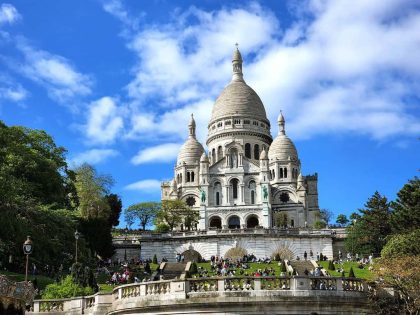
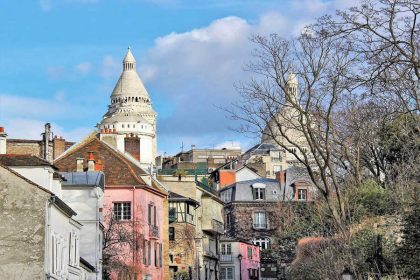
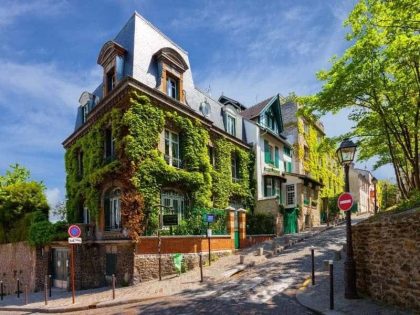
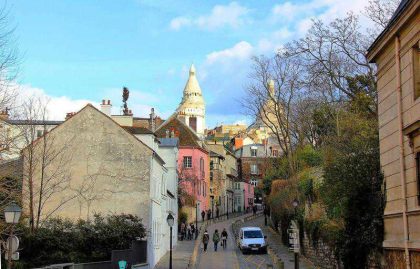
Montmartre is one of the most legendary and romantic neighborhoods in Paris (and maybe in the whole world), even though it’s not in the center. Its magic survives thanks to its winding cobblestone lanes and the wild bohemian life that flourished there in the 19th and 20th centuries. And of course, how could we forget the stunning view from the square in front of the Sacré-Cœur, a romantic panorama that maybe only the breathtaking view from the top of the Eiffel Tower in Paris can rival, with all the monuments of the city spread out below you.
On this page you’ll find everything you need to plan a fascinating visit, one that will leave you wanting more. I gathered for you my own walking routes, information on the must-see attractions, places to stay and some juicy bits of history.
In this article (shortcuts)
Map of Montmartre
Want to find your way around? Here is a map of the area to help you plan your route:
Practical information
Which arrondissement is Montmartre in?
Montmartre is in the 18th arrondissement of Paris. These are its boundaries:
- North: Rue Caulaincourt.
- East: the La Goutte d’Or neighborhood (a much less touristy area, and not the most pleasant one for visitors).
- West: Place de Clichy (a spot with quite a few nice restaurants, including the legendary Brasserie Wepler).
- South: officially the boundary runs along Boulevard de Clichy, but I would stretch it down to Rue de Châteaudun, where the church of Notre-Dame-de-Lorette stands. That way you also get to enjoy the Saint-Georges neighborhood and the Nouvelle Athènes.
How many days should you spend in Montmartre?
If you only want to visit the hill itself, half a day is enough. But if you want to combine the hill with the neighborhoods to the south, and maybe also the cemetery of Montmartre, I would recommend a full day in the area.
How do you get to Montmartre?
Metro
- Line 12: the only line that takes you straight into the heart of Montmartre (Abbesses and Lamarck-Caulaincourt stations). To start a walk from the south, get off at Notre-Dame-de-Lorette.
- Line 2: Pigalle and Blanche stations (near the Moulin Rouge).
- Line 13: Place de Clichy station.
Bus and funicular
- Bus: line 40 climbs the hill up to the Sacré-Cœur.
- Funicular (Funiculaire): goes up from Place Louise-Michel to the Sacré-Cœur (for the price of a regular metro ticket).
Why visit Montmartre?
The neighborhood is no longer as bohemian and edgy as it once was, but it offers a wonderful mix of village-style architecture, fascinating history, good food and legendary nightclubs. All of that, plus the view from the square of the Sacré-Cœur, makes it an excellent reason to visit.
Is Montmartre safe for tourists?
The touristy part of Montmartre (from the Moulin Rouge up to Rue Caulaincourt) is perfectly safe. On the other hand, the eastern part of the 18th arrondissement (the La Goutte d’Or neighborhood) and parts of the north are less pleasant, and I wouldn’t recommend that tourists wander around there, especially at night.
Recommended tours and self-guided walks
There are two main ways to explore Montmartre: on your own with the walking routes I prepared for you, or on a guided tour if you feel like treating yourself and getting some extra value:
🗺️ Explore on your own (my walking routes)
-

In the footsteps of the great artists
A fascinating walk among the homes, studios and haunts of Picasso, Van Gogh, Renoir and many others who lived and worked here.
-
In the footsteps of Amélie
A magical, nostalgic walk following the famous movie “Amélie”. Visit the café, the grocery store and all the filming locations.
-
A historical and food walk
A winning mix of history and tasty stops at selected bakeries and delicatessens in the neighborhood.
-
Moulin Rouge
Everything you need to know about the most famous cabaret in the world: its history, the dancers, and is a ticket to the show really worth it?
-
The Sacré-Cœur Basilica
The complete guide to the white church that towers over Paris: its controversial history, the stunning view and the secrets inside.
-
Musée de Montmartre
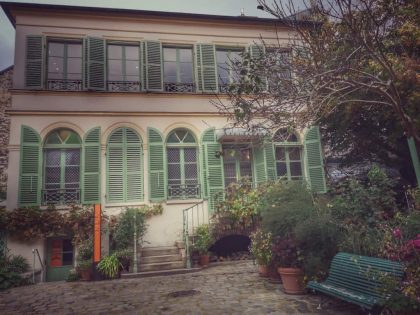
The most charming museum in the neighborhood, in an old house where Renoir and other artists lived, with gardens overlooking the vineyard.
-
Bateau-Lavoir
The story of the “laundry boat”, the shabby, legendary building where modern art was born and where Picasso worked.
🚩 Explore with a guide
More guided tours
Looking for more tours in Paris? Take a look at my list of recommended guided tours.
Recommended hotels and apartments in Montmartre
I left this part for the very end, because I don’t always recommend staying in Montmartre, since it’s far from the center of Paris. But if you’re “advanced Francophiles” and still want to stay in the area, here are a few hotels and apartments in the 18th arrondissement that are not bad at all (and some are even amazing):
🏨 Recommended hotels
My personal pick
Which place to stay suits you?
One short question, and I will pick out of the places I already checked and wrote about on the site the ones that fit the trip you are planning.
One moment, I am going over my recommendations to find what fits you…
🏠 Recommended apartments
-

Yuna Montmartre
An excellent aparthotel with stylish, well-equipped units. A great choice for families, or for anyone who wants to feel like a local in style.
-

Adagio Montmartre
The well-known aparthotel chain, in a great location on Place Charles-Dullin (right next to the Théâtre de l’Atelier). Practical, comfortable apartments.
-