

Until 1860, the hill of Montmartre was a small, quiet, and largely overlooked village north of Paris. Baron Haussmann, who led the planning and rebuilding of Paris in the second half of the 19th century, decided to fold it into the city’s boundaries, and that decision changed life on the hill for good. Before long, thanks to cheap housing, wild nightlife, picturesque charm, and stunning views, the hill became a bohemian hub for Paris’s greatest painters and artists, who led a free, creative, and turbulent life there.
Within a short time, the hill became the artists’ quarter of Paris. Painters and artists who lived and worked there included Vincent van Gogh, Pablo Picasso, Amedeo Modigliani, Henri de Toulouse-Lautrec, Salvador Dalí, Édouard Manet, Maurice Utrillo, Camille Pissarro, Henri Matisse, Pierre-Auguste Renoir, Edgar Degas, Raoul Dufy, Francisque Poulbot, and others.
Even though artists and intellectuals were drawn here by the “good life” that unfolded on the hill, most of them actually lived in poverty and hardship. Montmartre became so successful that rents rose significantly, and most of the artists who had lived here were forced to look for cheaper housing and drifted to the Montparnasse quarter in the south of the city. The large artist community undoubtedly left its mark on the hill, and even today you can feel the artistic, cultural atmosphere here, with its distinctive village-like charm still intact.
A note on the map: under the heading of each stop you’ll find its address, and every address is a link. Click it, and the place opens right away in Google Maps.
The Sacré-Cœur Basilica
35 rue du Chevalier-de-la-Barre
Our tour begins at the ANVERS metro station. Facing away from the exit, head north on Rue de Steinkerque, and before long, the white Sacré-Cœur Basilica will appear up the hill. It was consecrated in 1919 and is today one of the most recognizable symbols of Paris (even though locals never much cared for it, since to them it symbolized the crushing of the Paris Commune). The area around the basilica offers one of the most spectacular views in the city, and tourists flock here in droves.

If you’re in good physical shape, walk up the hill using the many staircases. If you’re in moderate shape, or you’d rather save your energy for the rest of the tour, you can take the funicular on your left for the price of a regular metro ticket.
From an artistic standpoint, the basilica’s facade is quite interesting. At its center stands a statue of Christ, considered the most important statue in the basilica, with equestrian statues of Joan of Arc and Saint Louis cast in bronze below it, the work of Hippolyte Lefebvre.
The basilica’s ceiling is decorated with the largest mosaic in France, covering about 480 square meters. It’s the work of Luc-Olivier Merson, created in 1922, and it depicts Christ in Majesty. Those of you in excellent physical shape are welcome to climb (for a fee) the 234 spiral steps up to the basilica’s dome, 130 meters high, which offers a wonderful 360-degree view over Paris and its surroundings.
If you’d like to read more about the basilica, feel free to check out our article on Sacré-Cœur.
Place du Tertre
Leaving the basilica, head west on Rue Azaïs toward Place du Tertre. Along the way, you’ll pass the small, ancient Église Saint-Pierre de Montmartre, standing in the shadow of Sacré-Cœur. The wife of King Louis VI is buried in this church (she founded a convent here), and its cemetery can only be visited one day a year.

Place du Tertre is the central square of the hill, best known for the artists who began displaying their work here as early as the 19th century. Today the square is filled with street painters, some specializing in colorful paintings of the hill, as well as portrait artists and caricaturists, along with cafés. Dozens of easels and palettes give the place a relaxed, free-spirited artistic atmosphere, and tourists flock here in droves.
The Dalí Museum
Near Place du Tertre, at 11 Rue Poulbot, stands a small museum with black walls and a dim atmosphere. This is the Dalí Museum, home to the largest collection of Salvador Dalí’s work in France. It displays 330 pieces by the Spanish surrealist artist, including odd sculptures, drawings, and antique furniture. The museum was renovated and reopened in 2018. If you’ve visited the Dalí museum near Barcelona, this collection will feel a bit modest by comparison.

You’ll find paintings, lithographs, drawings, sculptures, objects, and furniture here, including Dalí’s famous “lips” sofa. The museum is open daily from 10:00 to 18:00. For more information and tickets, click here
From the museum, go down the stairs leading from Place du Calvaire to Rue Gabrielle, and turn right to reach Place Émile-Goudeau.
Le Bateau-Lavoir
Le Bateau-Lavoir, located in Place Émile-Goudeau, is a quiet, unassuming spot that most tourists in Paris never notice, but it carries a fascinating artistic history. The name translates to “the boat washhouse,” so called because the building was rickety, dirty, and rocked back and forth like an old ship.

The building was once a piano factory, and later served as a commune for writers and artists. It gained fame at the turn of the 20th century, and its wild days are described in many books. Living conditions there were fairly rough, with residents sharing a single water tap and a handful of beds. A number of artists lived in the building starting in 1890, including Picasso, Modigliani, Kees van Dongen, and Matisse. It’s where Picasso painted “Les Demoiselles d’Avignon” in 1907, the work that heralded the beginning of Cubism. The rickety building burned down in 1970, and after being rebuilt, it went on housing artists’ apartments and studios.
If you’d like to read more about this place, feel free to check out our article on Le Bateau-Lavoir.
Retrace your steps toward Place du Tertre, go down Rue Norvins to Place Marcel-Aymé, where a fascinating story awaits you on the wall.
The Man Who Walked Through Walls
Paris, 1943, in the middle of World War II, French writer Marcel Aymé wrote a short story called “Le Passe-Muraille” (“The Man Who Walked Through Walls”). The story’s hero, Dutilleul, is a minor government clerk of 43 who suddenly discovers he has a supernatural power: he can walk straight through walls.

When a new deputy director at his office starts disturbing his peace with new rules and procedures, Dutilleul uses his power for all kinds of pranks, from tormenting the deputy director to small jokes and mischief. Before long, Dutilleul finds himself pulled into crime, diamond and bank heists, fleeing the police, and romantic entanglements. When he’s caught and thrown behind bars, he simply uses his power and walks out of jail with ease.
It all comes to an end one bright day when he swallows a headache pill, and this small, seemingly harmless pill has a side effect that cancels out his ability to pass through walls. The pill kicks in exactly as he’s halfway through one of the walls, and he gets stuck inside it forever. The wonderful sculpture was created by the well-known actor and artist Jean Marais.
A Window That Is a Work of Art
As you leave the small square with the man in the wall, take a moment for a bit of nostalgia at the building across the street, at 1 Avenue Junot. It’s a small building that houses a theater (Théâtre Lepic), and it has a round window, mysterious and unusual, that looks like a fine, original piece of art in its own right.

This is one of the most photographed and most beautiful windows in Paris.
With your back to the window, Rue Girardon stretches in front of you. After a very short walk, you’ll reach the striking statue of Dalida.
The Dalida Statue
The singer Dalida, of Italian descent, was born in 1933 in Cairo, and in 1954 was crowned Miss Egypt. Her turbulent life included many romances, among them one with France‘s President François Mitterrand, and another with actor Alain Delon, with whom she recorded the hit “Paroles, Paroles,” a huge international success. Dalida took her own life in 1987 at the age of 54. Her statue, standing in the square that bears her name, has become a pilgrimage site for her fans. The sculpture is the work of artist Alain Aslan.
If you’d like to read more about her, I invite you to read Dr. Orna Lieberman’s lovely article Dalida Forever.

Facing the statue, go down the charming Rue de l’Abreuvoir, with its stunning view toward the basilica. At the end of the street stands the pink café, one of the most famous cafés on the hill. Glance to your left and you’ll see the cabaret “Le Lapin Agile” (The Nimble Rabbit). Many of the hill’s artists used to spend their time at this legendary cabaret, whose name was coined by the painter and caricaturist André Gill, who painted the rabbit jumping out of a cooking pot on its facade.
Once you’ve taken in the old building that houses the cabaret, retrace your steps a few paces down Rue des Saules and turn left at the first turn.
The Musée de Montmartre
To connect with the history of the hill, a short visit to the Musée de Montmartre at 12 Rue Cortot is worthwhile. The museum overlooks the hill’s tiny vineyard, right nearby. This building, the oldest in the neighborhood, once served as a meeting place and studio for artists including Renoir, Utrillo, and Dufy. Today the museum gives visitors a vivid, faithful look at life during the bohemian era, tracing the history of Montmartre from its days as a monastery right up to the present. Inside you’ll find paintings, posters, prints, objects, lithographs, and antique documents, as well as collections of works by Toulouse-Lautrec and Modigliani, and the studio of painter Suzanne Valadon.

One room is devoted to the French can-can, and another holds a reconstruction of the Café de l’Abreuvoir, where many artists used to sit and drink. Don’t miss the museum’s beautiful garden. Open daily from 10:00 to 18:00.
If you’d like to read more about the museum and get historical and practical information, I highly recommend our article on the Musée de Montmartre on the site.
Leaving the museum, head back to Rue des Saules, turn right onto Rue Norvins, and then immediately left onto Rue Lepic, one of the most interesting streets on the hill.
Le Moulin de la Galette
At 77 Rue Lepic, you’ll find one of the two remaining windmills in Montmartre. Built in 1622, the mill now houses a famous restaurant called Le Moulin de la Galette. It once served as a cabaret and a popular dance hall. Many artists used to visit, and Renoir went further still, immortalizing the mill in a painting that became world-famous, “Bal du moulin de la Galette,” now on display at the Musée d’Orsay.

Further along the street, at number 54, Van Gogh lived from 1886 to 1888, in a third-floor apartment that belonged to his brother. At the building’s entrance, you’ll find a plaque marking the fact that Van Gogh once lived there.
Keep heading east down Rue Lepic, which becomes Rue des Abbesses, until you reach Place des Abbesses, where you’ll find the Wall of Love.
The Wall of Love
The Wall of Love, or more precisely the “I Love You” Wall, has stood since 2000 in a small garden near the ABBESSES metro station. The wall, measuring 10 meters long by 4 meters high, is made of 612 blue ceramic tiles bearing the phrase “I love you” in more than 200 different languages, including Hebrew and Yiddish. The idea came from Frédéric Baron, who wanted to express his love for his wife this way.

The execution was carried out by artist Claire Kito. Frédéric Baron collected the phrases over the course of more than two years. The Hebrew letters appear on the wall several times, both in Hebrew and in Yiddish. Baron admitted that a few errors had crept into the various languages, but for him, that was a minor detail that didn’t detract from his distinctive creation. Above the wall is a female figure in a blue dress.
If you’d like to read more about this wall, feel free to check out Ruti Shimoni’s article Montmartre, the Wall of Love and the mystery of the woman on the wall, in the hidden garden.
Head back west along Rue des Abbesses to Avenue Rachel, where you’ll find the entrance to the Montmartre Cemetery.
Montmartre Cemetery
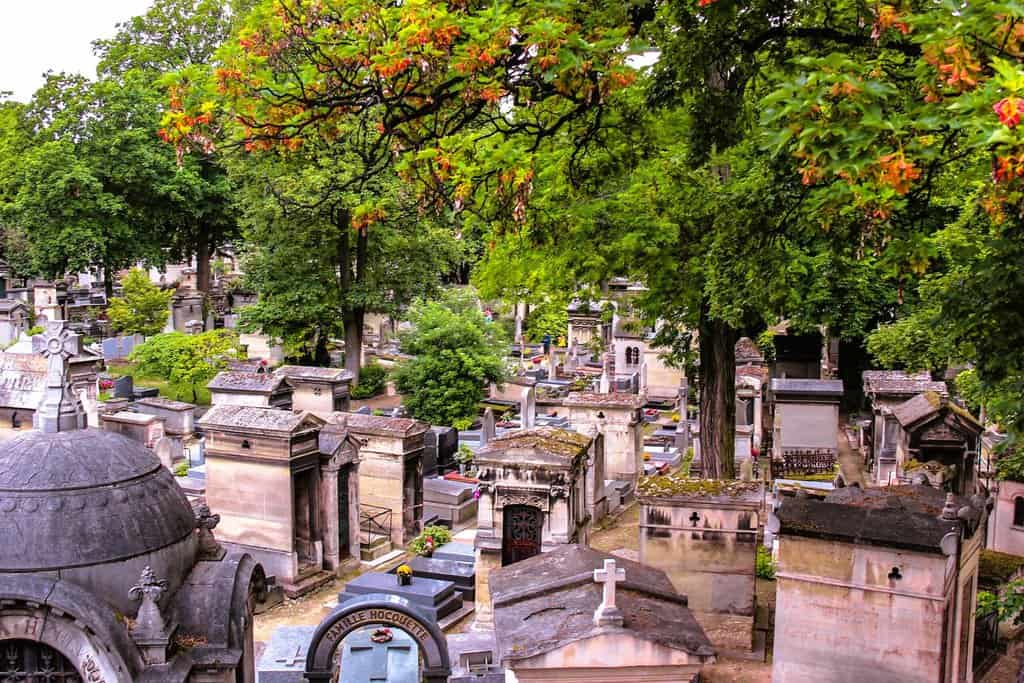
Montmartre Cemetery is the third-largest in Paris (after Père Lachaise and Montparnasse). The site was once a gypsum quarry. Many great artists who died from the early 19th century onward are buried here.
Among those buried here are Émile Zola (this is his original grave, though his ashes were later moved to the Panthéon), composer Hector Berlioz, composer Jacques Offenbach (who composed the famous can-can melody), German poet Heinrich Heine, filmmaker François Truffaut, singer Dalida, painter Edgar Degas, writer Alexandre Dumas fils, actress Jeanne Moreau, La Goulue, the can-can dancer who was the “queen” of Montmartre and Toulouse-Lautrec’s leading model, painter Gustave Guillaumet, Nissim de Camondo, singer France Gall, and her husband, musician Michel Berger.
This melancholy place is steeped in memories of the lively, bustling Montmartre of those days. If you’d like to read more about it, feel free to check out our article on Montmartre Cemetery.
Leaving the cemetery, head toward Place de Clichy, then turn left onto Boulevard de Clichy. Before long, you’ll see the Moulin Rouge on your left.
The Moulin Rouge

One of the most famous nightclubs in the world is the Moulin Rouge, the venerable and celebrated club that opened in 1889 near Place Blanche. Today it hosts the famous French can-can shows, where dancers kick their long legs high in the air, dressed in sparkling costumes, surrounded by lavish sets. The show includes computerized lighting, a variety of effects, and a touch of magic.
Many stars performed here in the past, such as Maurice Chevalier and Josephine Baker. Painter Toulouse-Lautrec was a regular at the club during its heyday in the Belle Époque. Lautrec used to paint the main performance hall and the club’s dancers in wild, colorful scenes. In 2001, a musical film called Moulin Rouge! was released, centered on the club’s story in the 19th century. The film was a huge success and gave a major boost to the old cabaret’s public profile and renewed popularity.
If you’d like to read more about this place, feel free to check out our Moulin Rouge page.
And that brings our tour to a close. I hope you enjoyed it. If you’d like to learn more about Montmartre, feel free to check out our Montmartre page on the site.
More Walking Tours in Montmartre
You’ll find them, along with plenty more recommendations and useful travel information, on our Montmartre travel guide page.
Related reading
