

On March 26, 2017, something remarkable happened in the French art world: in the town of Nogent-sur-Seine, about 100 km southeast of Paris, the first and only museum in the world dedicated to the works of the brilliant sculptor Camille Claudel (1864-1943) opened its doors.
The museum covers a long creative period, from 1880 to 1913, that is, from Camille’s 16th birthday to her forced hospitalization when she was about fifty years old. The museum’s stunning display includes around two hundred sculptures, about fifty of which are Camille Claudel’s own work.
The Camille Claudel Museum: Practical Information
The museum is located at 10 Rue Gustave Flaubert in Nogent-sur-Seine.
You can get there by direct train from Gare de l’Est in Paris. The trip takes 55 minutes.
It’s about a 10-minute walk from the train station to the museum.
The museum is open every day except Mondays, starting at 10:00.
Admission: 8-10 euros. Reduced ticket: 4.50-6 euros. Free for visitors up to age 26. Free admission on the first Sunday of every month.
The History of the Museum
In 1876, the Claudel family moved into a house in the historic center of Nogent-sur-Seine. The family lived there for three years because of the father’s work. When Camille was 12, she met a local resident there, the well known and successful sculptor Alfred Boucher (1850-1934). His support turned out to be crucial for her future. Camille took her first steps in sculpture as a self-taught artist, making her first clay figures. Camille’s father asked Boucher to assess her work. Boucher quickly noticed her enormous artistic potential and convinced her father to let her take sculpture lessons. That is how Boucher became her first teacher. He taught her the basics of sculpture and gave her important professional advice. In fact, he took her under his wing and encouraged her father to nurture this talent.
Today’s Camille Claudel Museum is an expansion of a museum created in 1902 by the sculptors Paul Dubois (1829-1905) and Alfred Boucher (1850-1934). As such, it also includes collections and works by its founders and by other sculptors from that period.
The museum was first established on the first floor of the “château,” an old house bought by the town that stood in the middle of a public garden. It gradually expanded, and in 1905 an old shed nearby was renovated and turned into a sculpture gallery. The space was designed to hold even monumental works, such as Joan of Arc by Paul Dubois.
During World War II, the museum was looted, and there is no information about many of the works from the original collection. The building eventually resumed its role in 1974, but it mainly displayed archaeological finds. The sculpture gallery did not reopen until 1995.
In 2003, a major exhibition of Camille Claudel’s works was organized in Nogent-sur-Seine. The exhibition was an extraordinary success: about 40,000 visitors came in just three months. This dazzling success sparked the idea of expanding the Dubois-Boucher museum to include a significant collection of Camille Claudel’s work. The town began acquiring Camille’s pieces. In 2008, Reine-Marie Paris, granddaughter of Paul Claudel (Camille’s brother), and the researcher Philippe Cressent agreed to sell the town the collections they had assembled over many years of intensive research. That same year, the town purchased the house where Camille Claudel had lived with her parents and added several nearby buildings to it. This paved the way for the creation of the Camille Claudel Museum, into which the Dubois-Boucher museum’s collection was merged. The museum today has 15 exhibition rooms.
The Exhibits and Activities
The museum’s collections today are organized mainly around the artistic lineage and artists of Nogent-sur-Seine, sculpture techniques, the depiction of movement, and more. Rodin’s studio and Camille’s many works round out a journey through more than half a century of high quality, original French sculpture.
The whole collection offers a broad technical and artistic panorama of the world of sculpture at the end of the 19th century and the beginning of the 20th. The sculptures illustrate one of the most productive periods of French sculpture. Camille’s works let you discover her personality and the special stages and aspects of her artistic career. This perspective shows just how much Camille Claudel belonged to her era while also standing out within it in an original and profound way. This is, in fact, the largest and most important collection of her work in the world, and it is displayed in the very town where her enormous talent was born and developed.
The museum offers many rich and varied experiences: permanent and temporary exhibitions, guided tours, audio guides, conferences, screenings, lectures, concerts, live performances, hands-on learning for children, school tours, a special program for families that works for both young children and adults at the same time, creative workshops, and more.
Works in the Museum

More than a quarter of the Camille Claudel works on display at the museum were cast in bronze by the art dealer Eugène Blot (1857-1938), who owned a large and influential gallery in Paris. For several years in the early 20th century, he served as Camille’s exclusive agent and caster (and it is no coincidence that the author of these lines is Eugène Blot’s great-grandson). Blot’s work made it possible to spread Camille’s pieces widely. Their collaboration was crucial to the survival of Camille’s work, especially given the destruction she inflicted on her own sculptures during moments of crisis and distress.
Among Camille’s many works on display at the museum, cast by Eugène Blot, a few stand out as especially famous worldwide:
The Mature Age (L’Âge mûr)
The sculpture was first shown in plaster at the Salon of 1899. This magnificent piece has a powerful presence and radiates quality, wonder, and a sense of the extraordinary. Camille shows off both her artistic mastery and her remarkable creativity. The tension between the figures is at its peak, the composition here is flawless, every gap between the figures has meaning, every space has a role, and every angle and diagonal has its own sense. The artist deals here with the passage of time, with old age, and with death.

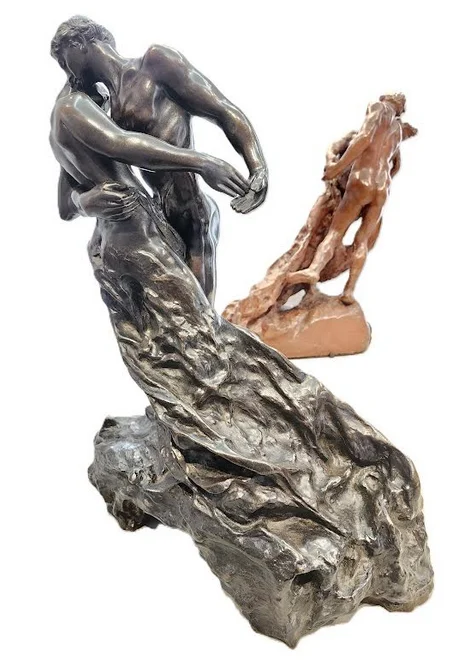
The Waltz
This is one of Camille’s most famous works. The sculpture was first shown in 1893 at the Salon on the Champs-Élysées and was a great success. It is a stunning piece, full of movement and sensuality. The couple of passionate dancers likely symbolize the dazzling love affair between Camille and Rodin. Camille began working on The Waltz in 1889, when her relationship with Rodin was still passionate. It seems that Camille’s feelings for Rodin somehow gave her great inspiration in creating The Waltz.
Surrender
The original sculpture was created in 1888 and was very successful. It was originally called ‘Sakuntala.’ A marble copy Camille made that same year, called Vertumne et Pomone, is on display today at the Musée Rodin.
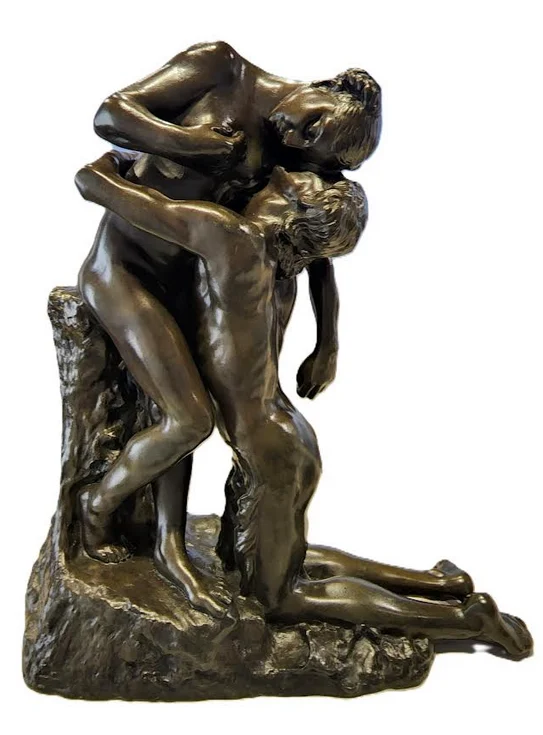
The bronze version is called ‘Surrender.’ It sometimes appears under the name ‘Abandonment’ or ‘Yielding,’ but the title Surrender fits much better what you see in the sculpture: a man kneeling and supporting a standing young woman. The young woman appears to be giving herself completely and surrendering into the man’s arms. You can also read the piece as the moment of reunion, where the lover begs Sakuntala for forgiveness.
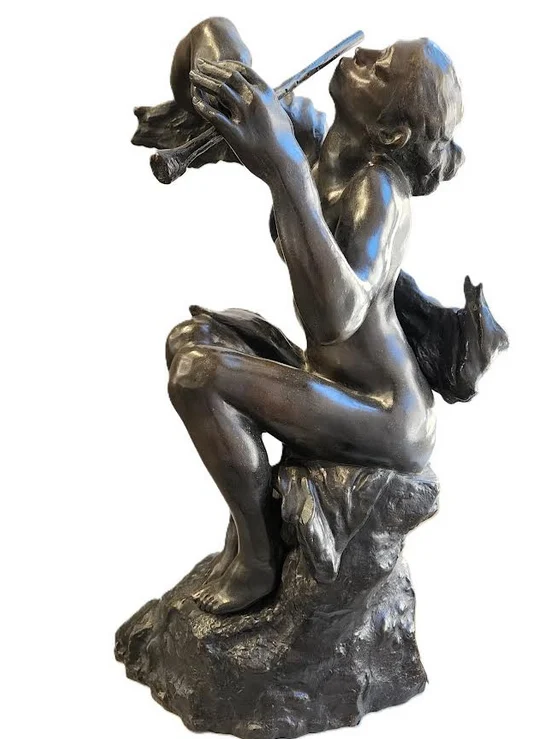
The Flute Player
The sculpture ‘The Flute Player’ is one of Camille’s last works. It depicts a sensuous young woman sitting on a rock or a tree stump, her hips emphasized by her crossed legs. She plays the flute with her right hand, her thin and striking fingers at work, her head raised, bringing her lips close to the flute without quite touching it. The scene gives the viewer room for musical flight and imagination. The breath leaving her lips accompanies her movements in a kind of musical drift. She gives herself completely to the music.
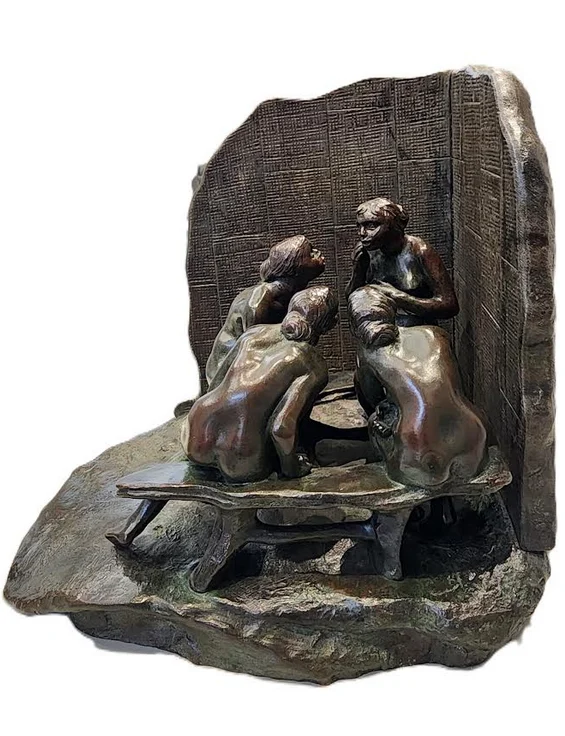
The Gossips (Les Causeuses)
When the museum’s director was asked which of Camille’s works was her favorite, she answered without hesitation: The Gossips. It is one of Camille’s most moving sculptures, depicting four women huddled together in conversation. The original marble version of The Gossips was created by Camille in 1893. It was received with enthusiasm at a major exhibition held in 1895 on the Champ-de-Mars and put Camille in the spotlight. The bronze version on display at the Camille Claudel Museum was created in 1905.
Other stunning works by Camille are on display at the museum. Among others worth mentioning: Wealth, The Beggar Woman, Dawn, Deep in Thought, and Dream by the Fireside.
Want to Read More About Camille Claudel?
I recommend reading Dr. Orna Liberman’s piece, The Gold and the Clay, which has detailed information about the fascinating and unusual life of this great artist, sharp analysis of some of her greatest works, and even a walking tour in her footsteps starting from her arrival in Paris.
FAQ
When did the Camille Claudel Museum open?
What period of Camille Claudel’s life does the museum cover?
Who built the modern expansion of the Camille Claudel Museum?
Related reading