If you’ve already spent a few days in Paris and feel like a change of scenery, somewhere with no history, no churches, no ancient art and no stories of kings, but with striking modern architecture and a different take on 21st-century Paris, I invite you on a half-day excursion to the La Défense district.
This is Paris’s Manhattan, just outside the city limits, west of the 17th arrondissement and the Bois de Boulogne, and it’s home to the largest skyscraper business district in Europe. It has been called one of the most ambitious urban planning projects in the world: a world of tomorrow’s architecture and business.
The office towers, 40 stories and higher, are radically different from the old buildings of classic Paris. You’re actually walking on a massive pedestrian esplanade, with the roads, parking garages and rail lines running underneath. The place has also been described as a giant “concrete stage” built over the main highway. And of course, the district is also a convenient, well-connected residential neighborhood.
Construction began here in the 1960s in an ultra-modern style. The district’s name goes back to the war of 1870, when French troops fiercely defended the area against Prussian attacks. Today, close to 200,000 people work here, many of them for the largest companies in France, which have their offices in the district.
You can reach the district by metro line 1 or RER line A. Get off at La Défense Grande Arche station.
The Grande Arche

Rising above everything is a giant hollow cube of white marble and glass: the Grande Arche (the Great Arch). From its top, you get a breathtaking view of the city from a height of 110 meters. The arch’s inner dimensions are symbolic: 100 meters by 100 meters, exactly like the Cour Carrée of the Louvre Museum. The canvas stretched inside the arch’s enormous opening represents a large cloud.
The arch has 4,000 windows and 35 floors. To give you a sense of its size: if it were just 6 meters taller and wider, it could hold the entire Notre-Dame Cathedral. According to another version, it could already fit the cathedral as it is.
The arch was designed by the Danish architect Johan Otto von Spreckelsen, built in the 1980s, and inaugurated in 1989 to mark the bicentennial of the French Revolution. It became a symbol of President François Mitterrand’s vision of progress in the 1980s.
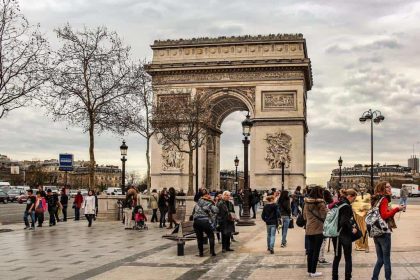
The shape of the arch represents a window open to the world. It houses government offices and private companies. In under a minute, one of four glass elevators takes you up to a wonderful panoramic viewpoint on the roof. Every year, press photography exhibitions are held on the rooftop terrace. But you don’t have to go all the way up: even from partway up the arch’s steps, you can see the royal axis of Paris, which runs in a straight line to the Arc de Triomphe, through the Champs-Élysées, Place de la Concorde and the Tuileries Garden, and ends at the small Arc de Triomphe du Carrousel and the nearby Louvre.
The La Défense shopping mall

At the foot of the skyscrapers beside the Grande Arche stands the giant “Les Quatre Temps” shopping mall (now Westfield Les 4 Temps), one of the largest in the Paris region, with over 300 stores. Opened in 1981, it has several floors of clothing stores, electronics, restaurants, cafés, movie theaters and boutiques.
Quatre Temps is an excellent spot if you’re looking to shop. It really has everything, including a huge Auchan supermarket spread over two floors: groceries on the first, and on the second a large department with toys, shoes, sporting goods, books, clothes, computers, phones, bags and much more, all at relatively low prices. Most of the big international chains are here too, including a large two-floor C&A store with fairly cheap prices.
At lunchtime, when the district’s workers take their break, the place gets quite crowded, especially the mall’s restaurants, which serve thousands of employees at once.
The CNIT center
The CNIT, the “Center for New Industries and Technologies,” also known as the Palais de la Défense, is a uniquely shaped building that looks like an upside-down seashell. It’s also a shopping center, with several luxury stores and a large FNAC branch. This was the first building constructed in La Défense, opening back in 1958. It stands out for its sheer size and bold, distinctive architecture, and it has gone through several major renovations over the years. The structure rests on just three support points, connected to each other underground.
The esplanade

Between the La Défense and Esplanade de la Défense metro stations, you’ll find the colorful esplanade named for General de Gaulle, lined with a variety of modern sculptures, some of them by famous artists such as César, Joan Miró, Raymond Moretti, Alexander Calder, and the Israeli artist Yaacov Agam (born 1928), whose work here is a vibrant fountain that combines color and water.
The esplanade continues the historic axis that stretches from the Louvre Museum all the way to the Grande Arche. As you walk along it, you’ll pass dozens of giant towers, some of them clad in colored glass that beautifully reflects the surroundings. The towers house the offices of close to 1,000 companies, some of them among the leading names in the French and global markets.

Related reading