

If you have already visited the old town of Lyon and discovered some of the most beautiful and distinctive buildings from the Middle Ages and the Renaissance, now is the time to discover a slightly more modern Lyon. Don’t worry, I don’t mean anything like La Défense in Paris, but rather a neighborhood that will remind you of 17th-century squares (like Place Vendôme) combined with the boulevards and buildings of Haussmann’s Paris.
As you’ll see here too, you’re in for a wealth of architectural gems, paired with culinary treasures, so get your legs and your stomach ready, and let’s get going :-).
Walking Route in the Presqu’île
Map of the Route
I put together a map of all the places you’ll visit on this walk. I recommend clicking on it to open the map in full screen so you can see exactly where you’re headed next.
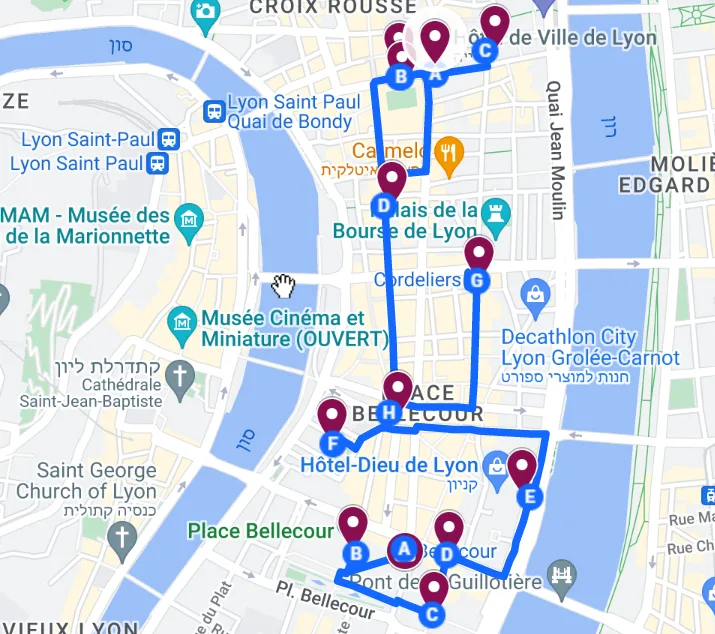
Now that you know how to use the map, take metro line A or D (depending on where you’re staying in Lyon) and get off at the Bellecour station, right at the square with the same name. That’s where our walk begins.
Place Bellecour
This square was built at the start of the 18th century, but nothing from the square that Louis XIV built has survived. Who do we have to thank (or blame) for that? The French revolutionaries, of course, who decided that because it was a royal symbol, it had to be destroyed (which makes it the only square that was demolished during the French Revolution).
But the history of this square doesn’t actually start with Louis XIV. It goes back much further. In Roman times there was a boat landing here, and later a garden and vineyard that belonged to the Archbishop of Lyon. Since “beautiful garden” in Latin is Bella Curtis, the name gradually evolved into Bellecour.

As I mentioned, in 1708 Louis XIV built a massive square here, considered today the third largest in Europe, with a statue of the king on horseback at its center. The statue was replaced with a guillotine during the French Revolution, and the square’s name was changed to “Place de la Fédération”.
Napoleon rebuilt the square in a neoclassical style (you can see this in the eastern and western façades), but when the Bourbons returned, so did the statue of Louis XIV, recreated in 1825. Below the statue of Louis XIV you’ll find two more statues, one representing the Rhône river and the other the Saône river. Next to them is a statue of a lion, which symbolizes the city of Lyon (Lion in both French and English).
What else will you find in this square?

First, you’ll find the local tourist office here, where you can get useful information about Lyon (in case you still have questions after reading my Lyon guide). But just as important, you can take a photo with the statue of the legendary chef Paul Bocuse (1926-2018), and that alone is worth the visit.
The second spot in the square worth stepping into is the Voisin chocolate shop, located at the edge of the square, right across from the tourist office. It’s a chocolate shop chain with a history going back to 1897, and it has several locations around the city. So if you’re in the mood for something sweet in Lyon, this is one shop worth visiting.

Place Antonin Poncet
This square is named after Antonin Poncet (1849-1913), a famous surgeon who worked at the Hôtel-Dieu hospital. In the square you’ll find a bell tower, a remnant of a 17th-century hospital that was torn down in 1934 to make way for Lyon’s post office.

Once you step inside this building, you’ll discover that in France, even a purely functional building like a post office can be remarkably impressive (take a look at the wall paintings showing how the mail is distributed to every corner of the globe).
The Old Hospital of Lyon (Hôtel-Dieu)
This grand, imposing building, which no longer functions as a hospital, began construction in the 12th century to house the city’s poor and sick. In the 17th century it was expanded with two added towers, and in the 19th century a dome and an impressive façade were added.
Fortunately for us, the hospital emptied out, and today you’ll find a small food market, restaurants, cafés and a fashion store here. In short, a celebration of shopping, style and architecture all in one place.

If you’d like to stay amid all this beauty, you can book a room at the InterContinental hotel on the grounds. It’s an incredibly indulgent five-star hotel with everything you’d expect from a hotel of this caliber (spa, excellent service, and so on).

The hotel is home to Epona, the restaurant of chef Mathieu Charrois, serving traditional Lyonnaise food with a modern touch. At lunch you can enjoy a daily set menu for just 32 euros (as of September 2022), a very reasonable price for this level of food.

And one last thing…

If all this shopping has left you craving a bit of culture, I highly recommend stepping into the Baroque chapel that once belonged to the hospital.
There you’ll find no shortage of art pieces and paintings from the 17th century, as well as the relics of more than 600 different saints (or so it’s claimed). Impressive!

The Museum of Illusions, Lyon
Right next to the chapel of the Hôtel-Dieu, a new branch of the Museum of Illusions opened in 2021 (the original branch is in Paris).
What exactly is the Museum of Illusions?

It’s a museum founded by Lesly, a Jewish woman living in France, and her partner, and it’s entirely dedicated to optical illusions.
You’ll find a “window” that’s actually a floor, creating the illusion that you’re “hanging” from it, holes your head can poke through, a tunnel that makes you feel like it’s spinning, and plenty more tricks. Highly recommended if you’re traveling with kids.
Opening hours: Every day from 10:00 a.m. to 8:00 p.m. On Thursdays, Fridays and Saturdays, the museum stays open until 10:00 p.m.
Link to the museum’s website 😊
By the way, if you’re hungry, let me recommend the Italian restaurant Casa Nobile, right across from the museum. I got the tip from the museum’s manager (a nice Italian guy from Sicily who knows a thing or two about Italian food), and it really was good.
I had pasta with fennel and chorizo sausage there, along with a cannoli, and both were excellent. A great option if you need a quick break from Lyon’s otherwise outstanding food.

By the way, the restaurant doesn’t take reservations, and in the evening I saw a pretty long line there, so keep that in mind.
Link to the restaurant’s website
Théâtre des Célestins
This impressive theater is named after a Célestins monastery that once stood here. The theater itself was built in 1877 but burned down a few years later. Fortunately, it was decided to rebuild it from scratch, relying entirely on the plans of the original theater, so it looks exactly as it did when it first opened to the public.

Today it’s considered the second most important comedy theater in France (after the Comédie-Française), and if you love theater and your French is good, you can check out what shows are running through this website. If French theater isn’t your thing, take a look at the periscope that peeks into the theater’s parking garage. Without a doubt it’s the most beautiful parking garage I’ve ever seen, and odds are it’s the most beautiful one you’ll ever see too.
By the way, if you’re in the mood for an excellent meal at a Michelin-starred restaurant, you’ll be happy to find Monsieur P in the square, the restaurant of chef Laurent Poulard, where I had a wonderful meal on September 20, 2022.

Rue de la République
We all know Baron Haussmann (1809-1891), the man who tore down old Paris and turned its dark, ancient alleys into grand boulevards, squares and gardens. But how many of you have heard of Claude-Marius Vaïsse (1799-1864)?

This man, rightly nicknamed “the Haussmann of Lyon”, was the prefect of Lyon, and just like Haussmann, he decided to tear down the slums of the city center and build grand boulevards in their place.
The clearest result of his work is Rue de la République, which today functions as Lyon’s main shopping street. Here you’ll find a long row of grand 19th-century apartment buildings that will remind you of their counterparts in Paris. Some of these buildings have plenty of decorative details, so it’s definitely worth looking up, you might just find a nice surprise.
Place des Jacobins
The name “Place des Jacobins” reminds every history lover of the murderous political faction responsible for no shortage of severed heads during the French Revolution.

But truth be told, the square is actually named after a monastery of Benedictine monks that once stood here, and it has nothing to do with the Revolution at all.
As with Rue de la République, here too we clearly see the work of Vaïsse, who created for us a spacious square with a fountain at its center, topped with four statues of famous artists born in Lyon:
- Hippolyte Flandrin (1809-1864), a famous painter who painted, among other things, the walls of the Church of Saint-Germain-des-Prés in Paris.
- Gérard Audran (1640-1703), a French painter known for his engravings.
- Guillaume Coustou (1677-1746), an 18th-century French sculptor, some of whose greatest works, including the Marly Horses, can be found at the Louvre Museum in Paris.
- Philibert Delorme (1514-1570), one of the most famous Renaissance architects in France (if not the most famous of them all). Among other things, he built many of the structures in Lyon’s old town, and of course the Château de Fontainebleau.
Place des Terreaux and the Lyon City Hall
The square, with its odd name, stood in Lyon as far back as the Middle Ages and was named for the muddy ground (terreaux) on which the city’s soldiers used to train. Later it became a market where pigs were sold, and today it is the city’s main square and home to the Hôtel de Ville, Lyon’s city hall.

Just like the famous Hôtel de Ville in the City of Light, this one is also a very large and impressive building, more than 400 years old. The original building was constructed under Louis XIII, and some say it was even bigger than the one in Paris, but it burned down during the reign of his son, Louis XIV, and was rebuilt. You’ll find an impressive bell tower with four bells and a very striking facade.
The square where the city hall stands became a fashionable square in the 18th century, with quite a few cafés where you can stop, have a coffee, eat a Lyonnaise pastry and continue your walk.
The Bartholdi Fountain
When you visit the square, take a look at the large, impressive fountain. It was built by Frédéric Auguste Bartholdi (1834-1904), better known for the Statue of Liberty he built for the Americans, replicas of which you can find near the Eiffel Tower and the Luxembourg Gardens.

The fountain was originally commissioned by the city of Bordeaux, but after running into financial trouble, the city had to give it up, and in 1892 it ended up in Lyon instead. That’s why, even though the fountain stands in Lyon, it actually depicts an allegory of the Garonne River, which flows through Bordeaux.
The Palais des Beaux-Arts de Lyon
In the same square as the Lyon city hall, you’ll find the city’s fine arts museum. A Benedictine convent once stood here, built during the 7th century, where quite a few noblewomen of France were educated. The palace we see today, which houses the museum, was built during the 17th century.

The man who turned the building into a museum was none other than Napoleon Bonaparte, who had already turned another palace (the Louvre) into a museum. You’ll find a truly impressive collection here, including ancient Egyptian art alongside paintings by Monet, Picasso and other major artists.
I visited the museum in September 2022 and enjoyed it a great deal. The wealth of exhibits is enormous, second only to the Louvre Museum in Paris. My recommendation is to spend about an hour and a half there each time, so you can really enjoy the exhibits without getting “art poisoning”.

You can buy tickets at the museum ticket office, but if you’re spending several days in Lyon and want to visit multiple museums and use the city’s public transportation, I recommend buying the Lyon City Card, which will let you into all the city’s museums and give you free use of all public transportation.
- Address: 20 Place des Terreaux
- Open days and hours: Open daily except Tuesdays, from 10:00 to 18:00.
- More information: available on the museum’s official website.
The Lyon Opera House
The opera house was built in the early 19th century, but it has gone through quite a few changes and upgrades since then. The most significant change took place during the 20th century, when the authorities decided to expand the opera building and announced an architectural competition, asking architects to submit their plans.

The winner of the competition was the architect Jean Nouvel (born 1945), known to us from the Institut du Monde Arabe in Paris and the Louvre Abu Dhabi. Jean Nouvel kept the neoclassical facade of the building and the grand salon on the first floor, but beyond the facade, all you’ll find is an ultra-modern opera house.
Is it beautiful or not? Think it over while sipping a drink on the “Les Muses” rooftop bar, built on top of the opera house.
If you’d like to know what shows await you when you’re in Lyon, and get information about the lovely bar upstairs, you can do so through this website.
Saint-Nizier Church
True, this church’s facade isn’t especially impressive, but don’t just walk past it. This church, which was once a Roman temple, became a Christian house of worship in the 5th century and was rebuilt between the 14th and 16th centuries.

Inside you’ll find understated, elegant beauty, and of course a chance to sit and rest from your walk so far.
Pentes de Croix Rousse
This neighborhood, associated with Lyon’s silk industry, sits on a hill north of Place des Terreaux, which we just visited. I have to say I wasn’t all that impressed with this neighborhood, and it felt to me like “Montmartre on a budget.” That said, I’m pretty sure shopping lovers will find a row of vintage shops here, and food lovers won’t be left out either, so I’ll write a few words about the place.

My suggestion is to climb the pedestrian path called Montée de la Grande Côte, both to burn off the calories you’ll have accumulated during your visit to Lyon (and there will be plenty) and for the view you’ll get once you reach the top of the hill.
On the way up, you’ll pass quite a few traboules (passageways between buildings, very characteristic of old Lyon), and I can’t write about every single one. But since you’ve come this far, here’s one traboule you can’t skip.
Cour des Voraces
This is one of the most famous traboules in Lyon, and you can enter it through a gate at 9 Place Colbert. I promise that once you step inside, you’ll feel like you’ve walked into an Escher drawing 🙂

Voraces was the name of an association whose main goal was improving the working conditions and wages of silk industry workers. So it’s no surprise that they were behind the revolt of the silk workers, known as the Canuts, who became a model of proletarian revolution in the writings of Karl Marx.

In my opinion, this is the least attractive traboule I saw in Lyon, and if it weren’t for its historical value, I wouldn’t bring you here. The place feels pretty neglected and uninviting, so I’ve decided to call it Cour Dégueulasse (disgusting courtyard) instead of its original name, Cour des Voraces.
Maison des Canuts
And speaking of silk industry workers, if the history of the silk industry interests you, you can visit the Maison des Canuts and learn how silk was made.
Address: 10-12 Rue d’Ivry
Opening hours: open Tuesday through Friday, 10:00-13:00 and 14:00-18:00
More information: available on the museum’s website.
The Roman Amphitheater
This is without a doubt the main tourist attraction of the area, built back in the year 19 CE. “Amphitheater” means two half-circle arenas joined together, and here the residents of Lugdunum (the name the Romans gave Lyon) got to enjoy plenty of shows featuring ludi (performers) and gladiators.

And speaking of gladiators and entertainment, this amphitheater is remembered in Christian history as the place where quite a few Christians were served up as a “business lunch” to wild beasts, during the year 177 CE. Some claim that if you come here at midnight, you can hear the ghosts of the martyred saints crying out to God to save them.
Marché alimentaire de la Croix-Rousse
You can’t finish a visit to one of Lyon’s neighborhoods without eating something, right?
This market, located on Boulevard de la Croix-Rousse, is considered the best produce market in Lyon. It’s open every day except Monday, from morning until noon, and you’ll find all the best local produce there (cheeses, vegetables, and of course various kinds of offal, which “star” in quite a few dishes of Lyonnaise cuisine).
Unfortunately, I happened to visit the area on a Monday, so I don’t have any photos of the place to show you, but feel free to take a look at this video to get an idea:
Enjoy your meal!
Where to stay for exploring the Presqu’île
If your budget allows, I highly recommend staying at the Inter Continental, which I wrote about in this article. If you’re looking for a good hotel at a somewhat lower price, I recommend Mercure Lyon Centre Saxe Lafayette, where I stayed back in September 2022 (the hotel is about a ten-minute walk from the Presqu’île).
If there’s no room at either of these hotels, check out this article, where you can find more recommended hotels in the area.
Related reading