

Today you’re going to walk through about 1,000 years of history and discover medieval and Renaissance Lyon. In “Old Lyon” you’ll find buildings, churches and streets built by wealthy merchants who made their fortunes trading between the Italian peninsula and France.
The sheer architectural wealth you’ll encounter there makes this neighborhood the largest Renaissance district in France, second in size in all of Europe only to Venice. So it’s no surprise that UNESCO declared “Lyon‘s” Old Town a World Heritage site.
Before we start our tour, let me highly recommend reading my article on the history of Lyon. I’ll tell you a bit about each building we pass along the way, but the article I’m pointing you to will give you the general historical background and help it all make sense.
Since I don’t know where you’ll be staying in Lyon, let’s get on the same page and start our tour outside the Vieux Lyon – Cathédrale Saint-Jean metro station (for those coming from outside the neighborhood, that’s line D).
Made it? Great! Step out of the metro and let’s get going!
The walking route through Vieux Lyon

As you’ll see, some of these spots are very close to each other, while others are a bit farther apart. To save myself some writing, I won’t tell you how to get from point to point, since the map above will do that for you easily. Instead, I’ll tell you a bit about each place you’ll reach, so you have some background on what you’re about to see.
Saint-Jean Cathedral
This impressive church is dedicated to John the Baptist, and it took about 300 years to build (much like Notre-Dame Cathedral in Paris). That’s why you’ll see a mix of building styles here, from Romanesque all the way to Gothic. Since it’s the seat of the Archbishop of Lyon, it’s also the most important church in the city.

On the facade of the church you’ll find about 300 medallions depicting stories from the Old and New Testaments. For example, next to the main entrance you can find the story of Noah and the ark, or the story of Adam and Eve. Notice that many of the angels above the main entrance are missing their heads. That’s the work of German mercenaries who captured Lyon together with French Protestants during the Wars of Religion in the 16th century.

Before you go inside, don’t miss the side doors of the church either. There you’ll find fantastical creatures that have nothing to do with the Bible at all, including monsters, knights and more. The purpose of these carvings was to give the masses a kind of “fantasy book” that would draw them into the church, at a time when most people couldn’t read or write. But since these weren’t “educational” or part of the Old or New Testament, they were placed off to the sides.

One of the high points in the history of this church is the coronation of Pope Clement V (reigned 1305-1314), which took place here. But it’s an event that quite a few medieval residents probably wanted to forget, since during the ceremony a wall collapsed and the crowd ran for their lives. In the panic that followed, the pope fell, and one of the gems from his crown fell off and disappeared. So if you spot a precious stone between the pews, feel free to give the Vatican a call…

What else will you find inside the cathedral?
There’s no question that the most interesting thing in the cathedral is the 14th-century astronomical clock, which shows the positions of the moon, the sun, the stars and the Earth. Like Saint-Germain-des-Prés in Paris, this church is going through a long restoration process, with part of it already restored and part still waiting. As you walk through, pay attention to the side chapels on the south side and the beautiful stained-glass windows there, some of which have survived since the 13th century (!).

The Archaeological Garden
Not far at all from the cathedral is the Archaeological Garden. Here you’ll find the remains of some of the oldest churches in Lyon, namely Saint-Croix and Saint-Étienne (the latter was built during the 4th century CE, shortly before Christianity became a legal religion).

You’ll also find here remains of a baptistery, located outside the church. The reason for this is that people who had not been baptized could not enter the church, so in most cases baptisteries were located outside the cathedral (the most famous example, of course, is in Florence, with the famous doors by Ghiberti and Pisano).
Maison du Chamarier
A “chamarier” was a kind of justice of the peace who handled commercial matters during the 16th century. He also collected taxes during the various fairs held in Lyon, and that’s how he got quite rich, since any amount he managed to collect beyond the required quota went straight into his own pocket (a similar tax collector grew rich this way and built the mansion that would later become the Musée Picasso in Paris).

If you manage to get inside, don’t miss the ceiling, where you’ll find a lovely fresco. Also, don’t miss the well, which served as a status symbol in the Middle Ages. If you had a well in your courtyard, you didn’t have to fetch water from the river, which was often polluted, so only the wealthy could enjoy a steady supply of clean water. That’s why a well was a status symbol.

Before you move on, check out the pâtisserie called Bruno Saladino, right across the way. It specializes, among other things, in pralines, and I highly recommend ordering a brioche with pralines there. You’ll thank me. Your dietitian, maybe not so much. Also, if by chance the gate to the courtyard is open, try sneaking in to discover a gorgeous courtyard designed by none other than one of the great architects of the Renaissance, Philibert de Lorme.
And one last thing: if you’d like to buy scarves or anything else made of silk, you’ll find, right next to the pâtisserie, a very cute shop with, among other things, an original weaving loom on display!

Maison des Avocats
You’ve reached one of the most photogenic spots in Lyon, so it’s no surprise you’ll find plenty of photos of this building on all kinds of Instagram accounts. When you arrive here, you’ll feel like you’ve jumped for a moment into Renaissance-era Italy, since the Italian architectural influences are visible in every corner.

In the 14th century, an inn stood on this spot, and to this day you can see in the courtyard the opening through which the carriages used to enter. During the 16th century, the place became a law school, where lawyers studied their craft, which is how it got its name.

Today it’s a museum dedicated to cinema and miniatures (Musée Cinéma & Miniature). The museum was created by an interior designer named Dan Ohlmann, who came to Lyon from Paris. His hobby was building miniatures, and after an exhibition of his miniatures was a great success in Lyon, it was decided to create a permanent museum for them.

You’ll find tiny structures there, built by the artist down to the smallest detail, alongside all sorts of artifacts from Hollywood films, including Batman’s mask. I visited and enjoyed every minute. I highly recommend the museum, especially for parents visiting Lyon with their kids.

You can buy tickets at the museum’s box office, but if you’re spending a few days in Lyon and want to visit several museums and use the city’s public transportation, I’d recommend getting the Lyon City Card, which gives you entry to all the city’s museums, plus unlimited use of all public transportation.
- Address: 60 Rue Saint-Jean
- Opening days and hours: Open daily, 10:00-18:30. Last entry at 17:30.
- More information: available on the museum’s website.
Done visiting the Museum of Cinema and Miniatures and feeling hungry?
Let me recommend a fantastic bouchon called Les Lyonnais, not far from there at all. You’ll eat traditional Lyonnaise food there, and I highly recommend trying the chicken liver cake (Gâteau de foies de volaille). I strongly suggest booking ahead, since this is a very popular restaurant.
Link to the restaurant’s website
La Longue Traboule
If Paris has its covered passages, Lyon has its traboules (Trabules). The word traboule comes from the Latin “trans ambulare,” meaning “to pass through houses,” and that’s exactly what you’ll find here.

In the past, people used the traboules as a shortcut to reach the river, where the poor could fetch their own water (the wealthy, as mentioned, enjoyed a private well). Those who needed the river for purposes other than drinking were workers in the silk industry, which is why a number of silk workshops were located there.
There are around 100 traboules in Lyon, but many of them are closed. Luckily, the longest and most impressive one is open to the public.
You’ll find the entrance to the traboule at 54 Rue Saint-Jean, not far at all from the Maison des Avocats. All you need to do is open the gate and walk the length of the traboule until you reach Rue du Boeuf.

I don’t know how you’ll feel, but to me it felt like stepping into a medieval prison (maybe it was the bars, maybe it was the dimness). But once you get used to it, you’ll be able to appreciate the charm of the place.
By the way, since the traboules aren’t accessible, suffer from low lighting and high humidity due to their proximity to the river, you’ll be happy to know that you can rent an apartment there long-term at very reasonable prices, in case you ever feel like living in historic Lyon 🙂
La Tour Rose
To reach La Tour Rose (which isn’t exactly a tower), you need to enter a small traboule at 16 Rue du Boeuf (not far at all from the exit of the previous traboule you visited).

It’s actually a stairwell with tall windows, and right nearby you’ll find Maison Brochier, Lyon’s famous silk shop.
If you visit the area during silk season, you’ll find silkworms crawling around on a small table. For those of us who, like me, aren’t exactly fans of worms and bugs, it’s a less than charming sight, but nature lovers and the curious among you might actually enjoy it.
Musée Gadagne
Paris has the Musée Carnavalet, and Lyon has its smaller, not-free little brother: the Musée Gadagne, located at 1 Pl. du Petit Collège. If you love history as much as I do, I highly recommend you don’t miss it.

Here you’ll learn about more than 2,000 years of Lyon’s history, from ancient Roman times right up to today. Unlike the Musée Carnavalet, this isn’t a particularly large museum, and you can finish your visit in under an hour.
As you walk through the museum, you’ll discover that the building was constructed by an Italian merchant family named Gadagni, who “frenchified” their name once they became permanent residents of Lyon, calling themselves Gadagne. That reminds me of something similar that the most famous French Baroque composer of the 17th century did, when he changed his name from Giovanni Battista Lulli to Jean-Baptiste Lully.
Right next to this museum, you’ll find another one dedicated entirely to puppet theater. I’m sure both you and your kids will enjoy it, especially the final part of the visit, where you can put on a little show yourselves using some of the puppets on display.

As with the previous museum, you can buy tickets at the museum’s box office, and here too I recommend coming armed with the Lyon City Card, which will get you into this museum and the rest of the city’s museums.
If history isn’t really your thing, I’d still suggest stepping inside just to enjoy the museum’s beautiful courtyard. You can also take the elevator up to the fourth floor (for free) and reach a nice rooftop spot where you can grab a drink or two while taking in the view over Lyon’s old town from above.
- Address: 1 Pl. du Petit Collège
- Open days and hours: Wednesday to Sunday, 10:30–18:00 (last admission at 17:30).
- More information: available on the museum’s website.
Looking for a good restaurant near the Musée Gadagne?
Let me highly recommend the restaurant Cabaretier. It’s a bouchon serving fantastic Lyonnaise fare (try the nose salad and sausage), and it’s run by a man and a woman (I honestly don’t know if they’re a couple or not) who both have a great sense of humor and a good mood to match. Here too, I strongly recommend booking ahead, or you might end up disappointed.
Link to the restaurant’s website
The main courthouse of Lyon (Palais de Justice)
During the Middle Ages, the counts of Forez lived here, and during the Renaissance the site became a royal palace. In the 19th century, the old palace was demolished, and on its ruins, in 1842, Louis Pierre Baltard (1764-1846) built a courthouse in the Neoclassical style.
If the name Baltard sounds familiar, that’s thanks to his son, Victor Baltard (1805-1874), the man who made it into the history books for the Église Saint-Augustin in Paris and, of course, for the City of Light’s famous wholesale market, Les Halles.

The facade of the building is made up of 24 columns, and behind them you’ll find a recurring motif on the wall: the fasces (Faschio). The fasces is a bundle of rods with an axe at its center, and since ancient Roman times it has stood as a symbol of unity (after all, you can easily snap a single stick, but bundle several sticks together and they become very hard to break).
Since King Louis Philippe (r. 1830-1848) was looking for a unifying symbol, it’s no surprise that he and his successors adopted the fasces, which is why you’ll find this symbol on quite a few public buildings across France. Another person who adopted the fasces was Italy’s ruler, Benito Mussolini, who named his movement “fascism” after this very bundle of rods.
The building still functions as a courthouse to this day, and if you happen to visit while a trial is underway, you might manage to step inside and see the impressive main hall. Try to picture “the Butcher of Lyon,” Klaus Barbie (1913-1991), standing trial here. He served as the head of the Gestapo in the city (you can read more about him in my article on the history of Lyon).
Rue des Trois Maries
The slightly odd name of this street comes from a Provençal legend about three Marys who arrived in Provence from the Holy Land after the death of Jesus:
- Mary Salome, mother of Saint James
- Mary Jacobe, aunt of Jesus
- and Mary Magdalene, who might very well have been Jesus’s wife or his lover
The street is named after them because at number 7 there’s a broken statue depicting these three saints. Take a look at the building where the statue sits too, it’s well worth a glance or two.

At number 6 you’ll find a traboule that leads to Rue Saint-Jean. To get in, you’ll need to ring the bell and push the heavy gate open. If you manage it, you’ll find the view is well worth the effort 🙂
One last thing: take a look at the steps in the traboule’s courtyard and you’ll notice some holes in them. No, they’re not housing for baby mice, but most likely a way to drain water when the river overflows its banks.

If you have a better theory about why those holes are there, I’d love to hear it 🙂
Place de la Baleine
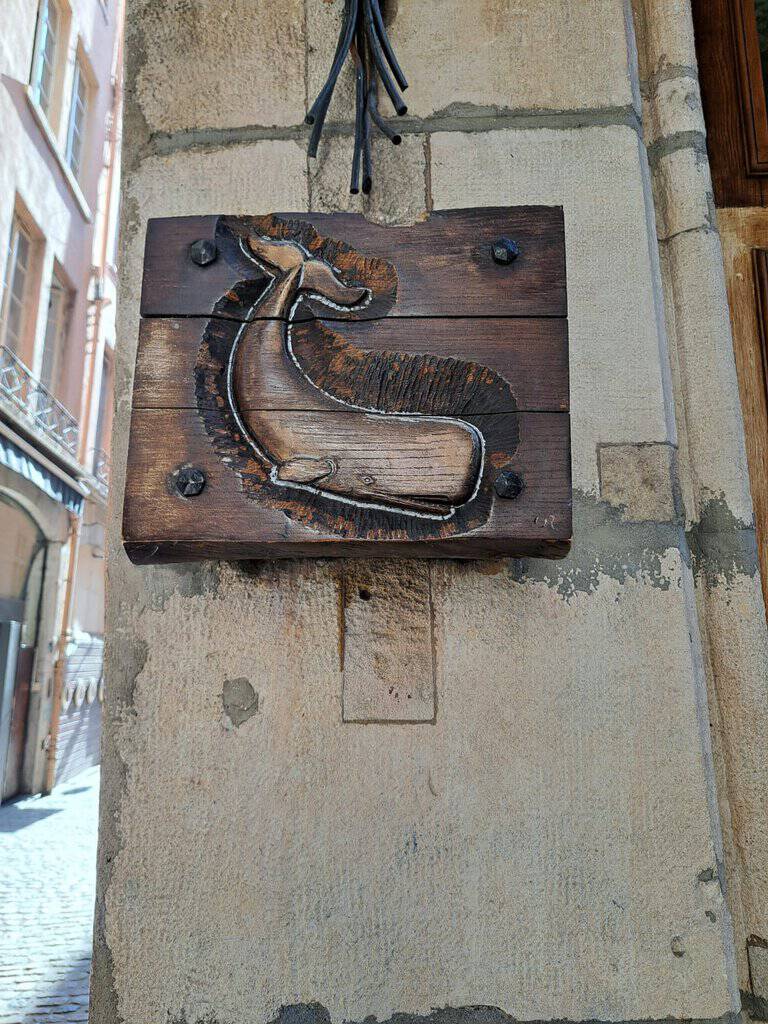
“Baleine” means whale in French, so you could call this square “Whale Square.” The name, so they say, comes from a wooden sign that once hung there, and starting in the 16th century, this square hosted the trade fairs that made Lyon such a wealthy city.

What I did find in the corner of the square is a very famous ice cream shop called Terre Adelice. All the ice cream you’ll eat there is homemade, and you can even find unconventional flavors like tomato and basil (so whoever asked for pizza-flavored ice cream and didn’t get it, here you go 🙂 ).
Another spot worth knowing about, if you’re looking for a place to have lunch or dinner, is the restaurant Aux Trois Maries, named after the nearby street.
The service there was a bit slow and inefficient, but the wonderful onion soup I had there made up for all the restaurant’s sins :-).
Place du Gouvernement
A charming square lined with four-story buildings. As you’ll see, each building is completely different from the next, and I’d point your attention to the small tower with two parallel doors. Don’t let the square’s pastoral look fool you though. This used to be a place where people were put to death (much like the square where Paris’s Hôtel de Ville now stands).
The most impressive building on this square is the Hôtel du Gouvernement, built in the 15th century. This is where the king’s representatives lived, appointed to govern the city on his behalf. The king himself stayed here too, whenever he came to Lyon (often on his way to the Italian peninsula).

You can walk into the building, which leads to a small traboule. I recommend climbing the stairs to see the courtyard and the stables, where the king’s horses were once kept. You can continue down the stairs and eventually come out by the river, but note that you won’t be able to get back in unless you know the code. So if you’re traveling with someone, make sure one of you holds the door open while the other one checks outside.
Place du Change
This is Lyon’s elegant version of a currency exchange street (back when getting foreign currency wasn’t exactly simple).
Most of the stalls from Lyon’s various trade fairs were set up here, and this is naturally where money changed hands. The money changers, most of whom came from the Italian peninsula, sat on benches outside, and since the Italian word for bench was “banco,” that’s how they came to be called “bankers.”

However, sitting on a bench in the heat, the cold and the rain wasn’t particularly comfortable, so they decided to build a structure on the square called the “Loge du Change,” which is the main building here today. What sets it apart is that it was, at the time, the only building with four facades, so I recommend walking all the way around it to enjoy each one.
These days, the gods of money no longer work here, since the banking business has moved elsewhere in the city. Instead of money and bankers, you’ll find a Protestant church here.
La Maison Thomassin
This is one of the oldest houses still standing in the city today (construction began in the 13th century).

As you can see, it was built in the Gothic style, and during the 15th century it got a facelift and took on its name, La Maison Thomassin, after the Thomassin family, one of Lyon’s most important families, who grew rich from the silk trade.
If you’re lucky, you’ll be able to step inside the courtyard, painted entirely in red. It’s quite a sight.
Rue de la Juiverie
This is where Lyon’s ancient Jewish community lived during the Middle Ages, until they were expelled from the city in the 14th century.
Today you’ll find artisans of all kinds there, and one of the most famous is a watchmaker who named his shop at number 20 after a film shot right there, called “L’horloger de Saint-Paul.” Here’s the trailer for that film:
At number 8 on the same street, you’ll find another famous building called the Hôtel de Bullioud. If you manage to get into the courtyard, you’ll discover a gorgeous Renaissance structure, built by one of the great architects of the French Renaissance, Philibert Delorme (c. 1514-1570).

Looking at the building, you can clearly see the inspiration the architect drew from his trip to the Italian peninsula, and you can also spot the same architectural brilliance that would later define his most famous work, the Château de Fontainebleau.
Maison Henri IV
This house is named after Henri IV (r. 1589-1610), and all because he stayed there… for one night.

Looking at it from Rue de la Juiverie, it doesn’t look all that impressive, but if you turn left at the end of the street and head up, you’ll find, around the corner, a very impressive staircase topped by a protome (a bust) of the king.

If you’d like, you’re welcome to climb the “Montée des Carmes Déchaussés” (the staircase of the barefoot Carmelites), named after monks who used to climb these stairs barefoot on their way to their monastery, which no longer exists. Once you reach the top, you’ll be able to look out over the Croix-Rousse neighborhood and other parts of Lyon.
Église Saint-Paul
If you retrace your steps to the Place des Terreaux and pass the Saint-Paul metro station, you’ll arrive at the church of the same name.
This is a very old church, standing here since the 6th century (!). As you’ll see, most of the church is a mix of Gothic and Romanesque styles, though renovations carried out during the 19th century added some more modern parts as well.

Inside the church you’ll find beautiful stained glass windows and an impressive fresco of Saint Paul falling off his horse as Jesus suddenly appears before him (which led him to convert to Christianity).
And with this church, we end our walking tour. Go find yourself a good restaurant or a nice café to rest at. You’ve earned it, fair and square :-).
Where should you stay if you want to explore Lyon’s old town?
In my opinion, the ideal hotel for a perfect introduction to the old town is Cour Des Loges, where I stayed in September 2022.

This is a luxurious hotel with impeccable service, housed in a former 15th-century convent and offering every indulgence you could want, including a spa. It’s located on Rue de Boeuf, one of the most central streets of the old town, and it will let you do what I did: explore the city in small bites, then head back to the hotel to rest and unwind.
This hotel has two main drawbacks. The first is its price, which isn’t low, and the second is that between October 2022 and May 2023 it will be under renovation, so you won’t be able to stay there. In that case, let me give you two pieces of advice:
- Go to the hotel’s page, click on its address, and see which hotels are nearby. These hotels will enjoy the same location, and if they suit you and have a rating of 8 or higher, book them.
- If you can’t find a hotel in the old town, it’s worth looking for one in the Presqu’île, which is just across the river. If you stay near the river between Place Bellecour and Place des Terreaux, you can get there in about a 10-minute walk. If you’d like to stay there, you can find a list of recommended hotels in the article recommended hotels in Lyon that I handpicked for you.
Related reading