

The Luxembourg Gardens, spanning roughly 60 acres (24 hectares), form the largest green space in the heart of the Left Bank in Paris. They are the result of complicated decisions made across tangled generations, and they probably would never have come to be if King Henri IV (r. 1589-1610) had not been assassinated. In 1780, right after the decision to open the gardens to the general public, they became an instant sensation, drawing thousands of visitors.
At the top of the gardens’ list of “regulars” are the students from the various faculties of the Latin Quarter, who come to soak up the magical, relaxed atmosphere. The gardens quickly became the most popular park in Paris: the ideal spot for a lunch break or a picnic, the ultimate Parisian park.
Why do I love the Luxembourg Gardens so much?
These gardens are my favorite spot in Paris. They are the most elegant gardens in the City of Light. To me, they capture the essence of French landscape architecture. I visit them every time I’m in Paris, to soak up the special atmosphere and just to find some peace, since life here moves at an unhurried Parisian pace, far from the frantic rhythm of the city beyond the fence. I recommend you don’t miss the garden’s many different features. It has earned a special place in the hearts of countless Parisians and visitors alike, so give it a few hours of your time.
Everyone can find their own interest, activity, or little corner of paradise here:
- If you’re a traveler looking for a stunning, attractive, and pleasant spot, you’re in the right place.
- If you’re a student at one of the Left Bank’s universities looking for some peace and quiet before your next exam, the Luxembourg Gardens are the ideal spot.
- If you’re parents traveling with kids looking for a way to let them burn off some energy, these gardens have plenty to offer your children.
- If you love music, you’ll find a variety of free concerts open to the public here.
- If you’re an athlete looking for a pleasant place to run, you’re in good hands. And if you want to get away from the city’s bustle while staying right at its heart, this is the place for you.
- If you’re in the mood for a bit of tennis, chess, bridge, or pétanque, you’ll always find a worthy opponent ready for a match.
- If you just feel like catching some sun on a clear day, or recharging before continuing your day’s sightseeing, there’s no more pleasant spot.
- If you love sculpture, the Luxembourg Gardens are paradise for you.
- If you’re a “bookworm” who wants a quiet, central spot to sit and read, feel free to settle comfortably into one of the hundreds of green iron chairs scattered around the gardens, which have kept their current design since 1923.
- And if you simply want to admire beautiful gardens and buildings, you are absolutely in the right place at the right time, because in the Luxembourg Gardens, it’s always the right time.

The History of the Luxembourg Gardens
It all began after the death of King Henri IV, when his widow, Marie de’ Medici (1575-1642), decided to leave her residence at the Louvre. She was still enamored with the Boboli Gardens and the Pitti Palace in Florence, where she had spent her childhood, and longed for a similar palace in Paris. In 1612, she bought the estate of the Duke François de Luxembourg, along with several neighboring properties. The architect Salomon de Brosse (c. 1571–1626) built her the palace, and the queen asked the famous painter Peter Paul Rubens (1577-1640) to paint a series of works depicting her life with her late husband (you can see these paintings today at the Louvre Museum). In 1624, the rectangular, Italian-style Médicis Fountain was built next to the palace. Tall sycamore trees shade it. The mythological figures on the fountain were added later, by the sculptor Auguste Ottin (1811–1880), in 1866.
It’s a shame Marie de’ Medici didn’t get to live in the palace or enjoy the gardens for very long. She was exiled from France in 1631 after rebelling against her son, Louis XIII (r. 1610-1643), and died in 1642 in the city of Cologne, in what is now Germany. Because the palace had no “owner” for a long stretch, the gardens grew wild, and they inspired some of the finest paintings by Jean-Antoine Watteau (1684-1721). Over the years, the palace went through several incarnations: in the early 18th century, it was home to the Duchess de Berry, Marie Louise Élisabeth d’Orléans (1695-1719), daughter of the regent Philippe d’Orléans (1674–1723) (not to be confused with Madame du Barry (1743–1793), the mistress of Louis XV (r. 1715-1774)). Under her, the palace became something of a den of debauchery, where the duchess used to bring her lovers (the gossips of her time claimed one of them was her own father).
During the French Revolution, the palace became a prison where many nobles were held before being transferred to the Conciergerie, and from there to the guillotine. In World War II, it was seized by the Germans and used as the headquarters of the Luftwaffe.
Today it serves as the seat of the French Senate, the upper house of parliament. The gardens, too, went through several changes and were redesigned by Jean-François Chalgrin (1739–1811) in the 19th century, and they have more or less kept their current form and character ever since.
The Luxembourg Gardens today
These amazing gardens change dramatically with the seasons. They shift in shape, atmosphere, and color depending on the time of year, which is why I highly recommend visiting them in every season. Each season has its own shades and character, but bottom line, the garden is beautiful and striking year-round. In bloom or in the midst of autumn leaves, the beauty is almost hard to believe. You have to see it again and again. In spring and summer, you’ll find a spectacular, colorful flower display, while in autumn the fall foliage is breathtaking.
For many years, the gardens have drawn in Parisians and visitors from around the world alike. Here you can watch locals in their natural habitat, meet French families out for the day, and spot couples in love strolling among the chestnut trees. Most of the gardens are carefully designed in the classic French style, with straight lines and strict symmetry, reflecting the French idea that man controls nature. Other parts of the garden are laid out in a less manicured English style, which leaves room for natural growth. It’s no surprise, then, that these gardens have inspired dozens of literary works and films.
More than 100 impressive, striking statues are scattered throughout the garden, on the terraces, along the paths, and on the lawns. Some are statues of the queens of France, which gives the place a rather regal look. Other statues depict famous figures from the arts and politics, wild animals, and even a miniature replica of the Statue of Liberty. There’s no doubt that these spectacular gardens have become even more attractive and sought-after than the lovely Tuileries Garden, their “rival” on the Right Bank, located between the Louvre Museum and Place de la Concorde.
A perfect spot for a day out with kids in Paris (and with adults too)
The Luxembourg Gardens are without a doubt one of the best and most enjoyable places to take kids in Paris. Napoleon once dedicated the garden to the children of Paris, and they’ve taken that seriously, enjoying it for more than a hundred years since. The kids who flock here in droves can enjoy a wide range of attractions and facilities: a puppet theater, modern playgrounds divided by age group, pony rides, and more. The main attraction centers on the lovely octagonal pond in front of the palace, where kids can happily sail small, colorful sailboats.

Adults, whether local residents or occasional visitors, can spend hours having a wonderful time playing chess, bridge, pétanque, and tennis. When the weather is nice, these facilities are packed for most of the day, and the atmosphere is fantastic. During the Romantic era, the Luxembourg Gardens were a favorite destination for famous artists, poets, philosophers, and writers. Even today, looking at these radiant gardens, it’s easy to understand why. Ernest Hemingway (1899–1961) once said that as a penniless young writer struggling to make ends meet, sometimes starving, he used to come to the gardens, wait for moments when the guards’ attention wandered, and catch pigeons for his dinner.
The gardens also host many cultural events: several times a year, rotating photography exhibitions are displayed along the garden’s gilded fences. Visitors can also enjoy free exhibitions at the local gallery, and of course, you can visit (for a fee) the highly regarded rotating exhibitions at the Musée du Luxembourg, one of the city’s important museums, which opened its doors in 1750 and is considered the first museum in France. Music lovers can enjoy original, free concerts open to the public, held on a round bandstand set in the middle of the garden, which locals call “the musical kiosk”.
There are several other attractions scattered throughout the wonderful gardens: in the southern part of the garden, extensive orchards grow 300 different varieties of apples and pears, and nearby stands an old beehive, set up here in 1856, where bees produce honey that’s sold to the public every year in late September. The spot also serves as a school for beekeepers, where you can take lessons on the subject. In the southeastern part of the garden are the only two large lawns in the entire space where you’re allowed to walk. On nice days, when it’s warm, or even when the sun only peeks out between the clouds, you’ll find sunbathers here in large, cheerfully packed numbers. A jogging path runs around the entire garden. Many Parisians take advantage of it, especially on weekends but on weekdays too, to keep off a few extra pounds.
A walking tour of the Luxembourg Gardens (so you don’t miss a bit of this beauty)
We’ll actually start our tour just outside the gardens, at the Port-Royal station (RER B line), and you’ll soon see why.
In place of a map: under the heading of each stop, you’ll find its address, and every address is a link. Click it, and the spot opens right up in Google Maps.
Jardin Marco-Polo: the southern part of the Luxembourg Gardens
The original Luxembourg Gardens extended all the way to the area around Port-Royal station. In the 19th century, Rue Auguste Comte was built, cutting through the gardens, which created a new garden named after Marco Polo, even though historically it’s an integral part of the Luxembourg Gardens.
In this charming garden (or perhaps it would be more accurate to call it an avenue), you’ll find a row of statues representing the different parts of the day (morning, noon, evening), created in the 19th century by several artists. I also highly recommend not missing the lovely fountain by Carpeaux, Jean-Baptiste Carpeaux (1827-1875), also from the 19th century.

A view of the Luxembourg Palace
Continue north through the Jardin Marco-Polo, cross Rue Auguste Comte, and enter the Luxembourg Gardens through the gate. As you keep heading north along the tree- and flower-lined avenues, remember that the Luxembourg Gardens are like a municipal theater where the set changes with every season. So, several times a year, the lawns are replaced, seasonal trees are brought in large pots, and flowers are planted.
When you reach the end of the avenue, you’ll see the southern facade of the Luxembourg Palace, added in the 19th century by the architect Alphonse de Gisors (1796–1866).
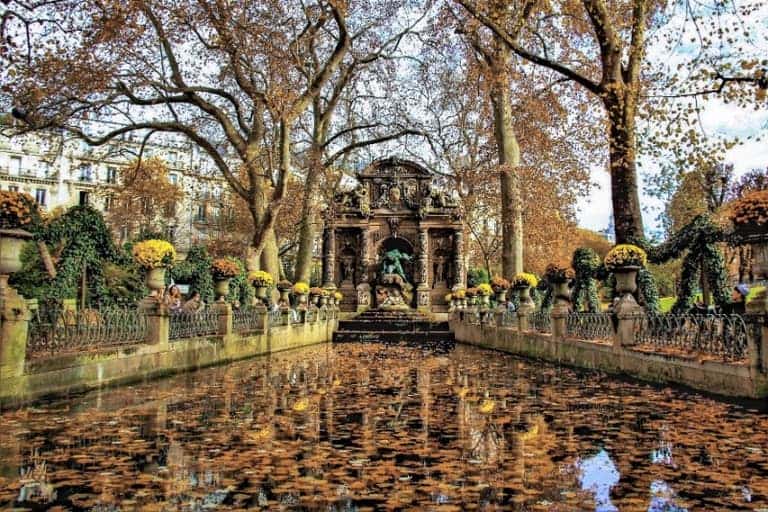
From there, head toward the Médicis Fountain mentioned earlier, and exit the gardens onto Rue de Médicis. Along the way, you’ll see a statue of Henri Murger (1822–1861), who wrote about Parisian bohemian life in the first half of the 19th century, and whose stories inspired the opera by Giacomo Puccini (1858–1924) “La Bohème”. Don’t worry, the tour isn’t over, we’re heading right back in.
The café at the Luxembourg Gardens: hunting ground of Paris’s most notorious serial killer
After leaving the Luxembourg Gardens, walk south along the fence and enjoy the rotating photography exhibits (this tradition started in 2000 with an exhibition by Yann Arthus-Bertrand). Once you’ve enjoyed the photos, enter the Luxembourg Gardens through the first entrance you see.
Walk along the tree-lined path until you reach a small building where various musical ensembles play in spring and summer. There’s a café next to the building. This was the hunting ground of Henri Désiré Landru (1869-1921), one of the most notorious serial killers in French history, if not the most notorious.

Between 1914 and 1919, Landru used to place ads in the personals sections of newspapers. In these ads, he presented himself as a financially stable widower with connections in Paris high society, looking for a financially stable widow for a second marriage. Since World War I was raging at the time and widows were not in short supply, he had no shortage of “dates” either. Landru would meet his victims for a first date at this very café. After a few weeks of making the women fall for him and gaining access to their assets, he would murder them and burn their bodies in a furnace he built outside Paris.
Landru was finally caught in 1919, after the sister of one of his victims managed to incriminate him. Following a trial that lasted two years, Landru was executed in Versailles. Over the course of his career, he murdered 10 women and one young man (the son of one of his victims).
The “selfie statue” and statues of important women from history
Right next to the café we mentioned, you’ll find a statue of an actor reciting lines from a text. If you look closely, you’ll surely think it’s a statue of someone taking a “selfie” with some old-fashioned cell phone 🙂

And speaking of statues, if you look west, you’ll find 20 statues of important women from French history, arranged in a kind of semicircle. Nineteen of these statues depict real women (most of them queens of France). One statue, however, depicts Clémence Isaure, a mythological figure who, according to legend, created a medieval poetry competition in which winners were awarded flowers made of gold.
The pond at the Luxembourg Gardens: where Hemingway and Gertrude Stein met
Go down the steps toward the pond facing the palace’s southern facade. As mentioned, this is one of the favorite spots for Paris’s children, and here they love to sail their boats.
This is where Gertrude Stein and Ernest Hemingway first met, a meeting that marked the start of a wonderful friendship. Gertrude Stein loved coming here every day for the view. Hemingway, on the other hand, loved walking in this area because he was constantly hungry, and the cooking smells from restaurants, which distracted him and caused him no small amount of grief, never reached this far…
The Statue of Liberty
Continue west until you get very close to the exit onto Rue Guynemer. On your right, you’ll see a replica of the Statue of Liberty, donated to the garden in 1910 by Frédéric Auguste Bartholdi (1834–1904), the creator of the original statue.

You can also see, not far from here, an obelisk that serves as a monument to the composer Jules Massenet (1842–1912), known today for his famous opera Manon.
The end of the tour: the gardening school and beehives of the Luxembourg Gardens
Verger du Luxembourg, near rue Guynemer
Continue south, parallel to Rue Guynemer, until you reach the garden’s southern fence. Here you’ll find a charming building from 1867, called the Pavillon Davioud, named after its architect. It was originally a café, but today it’s a gardening school. Right next to the gardening school, you’ll find beehives, where future beekeepers come to learn.
This is where our tour ends, and you’re welcome to hop on the metro or keep exploring the 6th arrondissement. I really hope you enjoyed it.
How do you get to the Luxembourg Gardens, and what are the opening hours?
The Luxembourg Gardens sit along Boulevard Saint-Michel in the 6th arrondissement and stretch along Rue de Vaugirard. You can get there via the Odéon metro station or the Luxembourg RER station. The gardens are open daily from 7:30 a.m. until half an hour before sunset. The park wardens’ whistles signal when the gates are about to close.
Want to stay near the Luxembourg Gardens?
You’ll find excellent hotels in the following arrondissements:
- The 5th arrondissement (western part)
- The 6th arrondissement
- The 14th arrondissement (southern part)
If you’re actually looking for a vacation rental, you can find some recommended apartments in these exact same neighborhoods:
A few words about Yoel Thamanlis
Yoel is a Francophile who currently lives in Israel. Besides being a journalist, he’s also a photographer, and if you’d like to enjoy his beautiful photos of Paris, feel free to check out Paris Through the Zoom. If you’d like to read the articles he’s published on the site, click this link.
Related reading
