

Yair Garbuz, in his classic book “Paris Tel Aviv, Tel Aviv Paris,” takes up the question of what should be the first thing you show someone who has never visited Paris (or as he called it, “the right of first sight”).
His answer to this important question is to take those “virgins of Paris” to the Pont des Arts and remove their blindfolds there, so that the view that unfolds before them is the very first sight they see of the city. I completely agree with Mr. Garbuz, though I would add one small piece of advice. It’s best to do this “first look” ceremony after dark, since that’s when the wow effect is at its best.
Look west, and there’s the Eiffel Tower, sparkling with its golden light. Glance east, and you’ll see the Pont Neuf at its finest. Turn your gaze north, and before you stands the Louvre Museum, radiating grandeur. And finally, look south, where the most impressive sight of all awaits, at least in my opinion: the building of the Institut de France, home today to the French Academy.
Today I want to tell you the story of the Institut de France (along with the Nesle Tower that preceded it) and the Pont des Arts, which together make up that panoramic view of Paris that I so recommend, both for those visiting Paris for the first time and for seasoned Francophiles. Along the way, starting in the Middle Ages, we’ll discover what the site used to look like, what that Academy is that earned such a magnificent home, and what makes this wooden bridge, where we’re standing to enjoy the “right of first sight” of Paris, so special.
The History of the Institut de France and the Pont des Arts
The Nesle Tower
The spot where Yair Garbuz suggested we stand and look out over the banks of the Seine is considered today a very romantic spot, but in the Middle Ages, the kings of France saw it mainly as a place of prime strategic importance.
The Seine cuts through Paris and once served as an important trade and transportation route. But that same river also served as a route for invasion. The first to use it this way were the Vikings, who laid siege to Paris during the 9th century, and had it not been for the courage of Odo (Eudes, 860-898), Count of Paris, they would have captured the city as well.

During the reign of King Philip II, known as Augustus (r. 1180-1223), the Vikings had already become distant history, while this time the threat to Paris came from the English.
To fortify the Seine and protect Paris from the English, it was decided to build two formidable watchtowers. On the right bank stood the Louvre, while on the left bank rose the Nesle Tower (Tour de Nesle).
But the English were slow to arrive, thanks to Philip II’s victory at the Battle of Bouvines in 1214, where they lost most of their lands in France. As a result, over the years the tower lost its defensive function and became a residence. In 1308, King Philip IV (r. 1285-1314) bought the tower from its owner, Amaury de Nesle, and gave it to his sons and their wives. Big mistake!
The women used this tower to meet their lovers, and this affair ultimately led to the fall of the Capetian dynasty and the outbreak of the Hundred Years’ War. It’s a long and fascinating story, which you can read in depth in Dr. Orna Liberman’s fascinating article, The Nesle Tower Affair: Adultery at the Royal Court.
The Queen Who Threw Her Lovers from the Top of the Tower
One of the legends that surrounded the tower in the centuries that followed, as can be read in the writings of Brantôme (Pierre de Bourdeille, seigneur de Brantôme, 1540-1614) and of the famous poet François Villon (1431-1463), tells of a queen who lured passersby up to the Nesle Tower and, after a night of love, ordered them put in a sack and thrown into the Seine.
That queen, according to legend, was Jeanne de Burgundy (Jeanne de Bourgogne, 1292-1330), wife of King Philip V (r. 1316-1322), who was the second son of King Philip IV. Jeanne was accused of being involved, alongside the wives of the future kings Louis X (r. 1314-1316) and Charles IV (r. 1322-1328), in acts of adultery at the Nesle Tower, but when Philip V came to power he forgave her, and after his death she inherited the tower.
François Villon mentions Queen Jeanne in his famous poem Ballade des dames du temps jadis (“Ballad of the Ladies of Times Past”). It tells of a young man named Buridan, whom the queen managed to lure up to the tower. When he was thrown into the river, he fell, luckily, onto a boat that happened to be passing by at that exact moment, saving his life. Buridan didn’t simply vanish into the pages of history. He went on to study and eventually became rector of the University of Paris.
He didn’t learn his lesson and kept chasing women afterward too, which got him into a duel with none other than the future Pope Clement VI (r. 1342-1352)…
The Duke of Berry Turns the Nesle Tower into a Magnificent Palace
In 1380, the Nesle Tower and the estate attached to it became the residence of the Duke of Berry (Jean, duc de Berry, 1340-1416), the younger brother of King Charles V (r. 1364-1380) and uncle of King Charles VI (r. 1380-1422).

The duke made his mark in history for two main reasons. The first was his love of peace and his attempts to prevent the civil war between the supporters of the House of Burgundy and the House of Orléans (attempts that failed, as you can read in the article The Murder on Rue Barbette).
The second reason the duke’s name became famous was his love of culture and art.
The duke left us the “Très Riches Heures,” a kind of prayer book for every hour of the day, decorated with beautiful, colorful paintings that stand among the highest achievements of Gothic art.
In this book you can see the magnificent Hôtel de Nesle, which the duke built next to the tower. The palace had 4 turrets, 5 arches, and a bridge that crossed the Seine, connecting it to the spot where today you’ll find the Square Honoré-Champion.

So it’s no surprise that when the Duke of Bedford (John of Lancaster, 1st Duke of Bedford, 1389-1435) conquered Paris, he decided to seize the palace and house his most honored guests there.
The Palace of the Institut de France
Cardinal Mazarin’s Legacy
The golden age of the palace and the tower ended with the Hundred Years’ War, and both fell into neglect over time. Still, they survived until the 17th century, when Cardinal Jules Mazarin decided to establish there the “Collège des Quatre-Nations” (College of the Four Nations), intended to provide an excellent education to young nobles from four territories recently annexed to France (Flanders, Alsace, Roussillon, and the small papal state in the Provence region).

The job was given to the famous architect Louis Le Vau (1612-1670), who at the time was working on the southern wing of the Louvre’s Cour Carrée. On his suggestion, the college was built on the Left Bank, directly across from the new wing where the king was supposed to live. The idea, of course, was to let the king admire the magnificent building from his window, but this never came to be, since the king had already moved to the Palace of Versailles.
Construction of the college began in 1662 and was completed in 1688, about sixteen years after the great architect’s death. Even before work began, the cardinal decided to turn the magnificent building Le Vau had designed into a kind of memorial to himself. That’s why he bequeathed his enormous library to the building and even ordered it opened to the public twice a week.
After his death, a magnificent tomb by the sculptor Antoine Coysevox (1640-1720) was erected there, placed in the college’s beautiful chapel, beneath the dome. During the French Revolution, Mazarin’s tomb was removed from the chapel, but fortunately it escaped destruction, and after a long stay at the Louvre, it returned to its rightful place in the chapel of the Institut de France.
The college Mazarin built became a great success, and during the 17th and 18th centuries it educated some of the most famous scientists of the era, such as the chemist Antoine Lavoisier (1743-1794) and the mathematician Adrien-Marie Legendre (1752-1833).
During the Revolution, the College of the Four Nations was abolished, along with a long list of other educational institutions. At first, its building was used as a prison, where about 650 people were held, including Dr. Guillotin (Joseph-Ignace Guillotin, 1738-1814), inventor of the guillotine, and the painter Jacques-Louis David. In the building’s magnificent chapel sat the “Committee of Public Safety,” responsible for running the war against anyone who had fallen out of favor with the regime (nobles, members of rival factions, and so on), and quite a bit of blood was spilled over the decisions made there…
After the Revolution ended, the site served temporarily, until the founding of the Paris School of Fine Arts, as a residence for many artists, including that same Jacques-Louis David, who returned to the site as a free man and set up a studio there.

In 1806, after construction of the Paris School of Fine Arts (École des Beaux-Arts) was completed, the painters moved there to teach and work, while the French Academy moved into the now-empty rooms, where it remains to this day. Since the Academy is one of the most important institutions when it comes to French culture, allow me to pause the story for a moment and write a few words about it.
The Academy, Guardian of the French Language
In 1539, King Francis I (r. 1515-1547) decided that the French language would replace Latin as the official language of France. This decision, issued in the town of Villers-Cotterêts, was of course very important, but it did not resolve the question: what exactly is the French language?
It’s worth remembering that the kingdom of France as we know it began developing slowly from the 10th century onward, and at first it included little more than the Île-de-France region and parts of the Loire Valley. Over the years, various provinces were added to the kingdom, such as Brittany or Provence, and as a result the subjects of the king of France spoke a jumble of languages and dialects. On top of that, even the language spoken at the royal court had no single standard, so the same words could be written in many different ways, which created quite a bit of confusion.
It was Cardinal Richelieu (Armand Jean du Plessis, 1585-1642), France’s all-powerful prime minister, who decided to solve this problem. In 1635, he established the French Academy, made up of 40 “immortals,” chosen for the position for life, whose job was to create a single standard for the French language. This academy also served, among other things, as the inspiration for the Academy of the Hebrew Language, founded after the establishment of the State of Israel.

This is a very conservative institution, which has fought every attempt to simplify the French language and make it a bit easier to learn (the last big battle it fought was against Education Minister Jacques Lang’s 1991 attempt to make French grammar a little more humane and easier to learn). This conservatism shows up first and foremost in the identity of the Academy’s members, who have traditionally been chosen from people who never strayed from the beaten path, while groundbreaking thinkers like Émile Zola never managed to be accepted into this prestigious institution.

Beyond that, the Academy excluded women from its ranks for many years, but that changed in 1981, when the writer Marguerite Yourcenar (1903-1987) managed to do the impossible and was admitted to the Academy in 1987.
But let’s go back for a moment to the 17th century, since four more academies were founded in the wake of the French Academy:
- The Academy of Fine Arts (Académie royale de peinture et de sculpture): founded in 1648, dealing with painting, sculpture, and the other arts.
- The Academy of Inscriptions and Belles-Lettres (Académie des Inscriptions et Belles-Lettres): founded in 1663, dealing with research in the humanities (history, literature, and so on).
- The Academy of Sciences (Académie des sciences): founded in 1667, dealing with research in the natural sciences (chemistry, physics, mathematics, and so on).
- The Royal Academy of Architecture (Académie Royale d’Architecture): founded in 1671, dealing with the theory and study of construction and architecture.
For years, the academies were housed in the Louvre Palace, much of which emptied out after the royal court moved to the Palace of Versailles. For example, the Academy of Sciences was housed in the king’s own living quarters. There, where Louis XIV used to sleep, you could find an elephant skeleton, a stuffed camel, and a row of organs floating in jars full of alcohol.
All this came to an end in 1806, when the academies left the Louvre and the French Academy moved into the building of the College of the Four Nations, where it remains to this day.
The Pont des Arts (Bridge of the Arts)
The Louvre? Check. A magnificent building right across from it, home to the Academy? Check. All that was missing was a bridge to connect the two and make it easy and simple to cross between these two beautiful monuments.
Napoleon ordered this bridge built, and it was truly revolutionary, since it was the first bridge in Paris built from iron. Construction began in 1802, and within about two years pedestrians were already crossing it, paying one sou for the pleasure. And the truth? They paid gladly, both because of its location, which, as mentioned, let you easily hop between the 1st and 6th arrondissements of Paris (and back), and because of the view from it, which I already described at the start of this article.

As you can see in the photo above, today’s Pont des Arts looks a lot like the original bridge, but there’s one big difference. The original bridge had 9 arches, while today’s has only 7. The reason is that having so many arches made the passages under the bridge fairly narrow, which meant that quite a few boats collided with the pillars and damaged them. Add to that the damage the bridge suffered during the First and Second World Wars, and you’ll understand why, during the 1980s, it had to be rebuilt from scratch.
The new Pont des Arts opened in 1984 and was nearly identical to the original, except for the number of arches, which dropped to 7, to make it easier for boats to pass underneath. Parisians were happy to come back and stroll on the bridge, and everything went back to normal. But then a new blow hit the bridge.
From the Bridge of the Arts to the Bridge of Locks and Back
If there were a Nobel Prize for romance, I’d recommend giving it to the first person who put a lock engraved with his beloved’s name on the bridge railing and threw the key into the Seine. On the other hand, if there were a Nobel Prize for bad taste, I’d give it to the second person who did the same thing, and to everyone who followed.
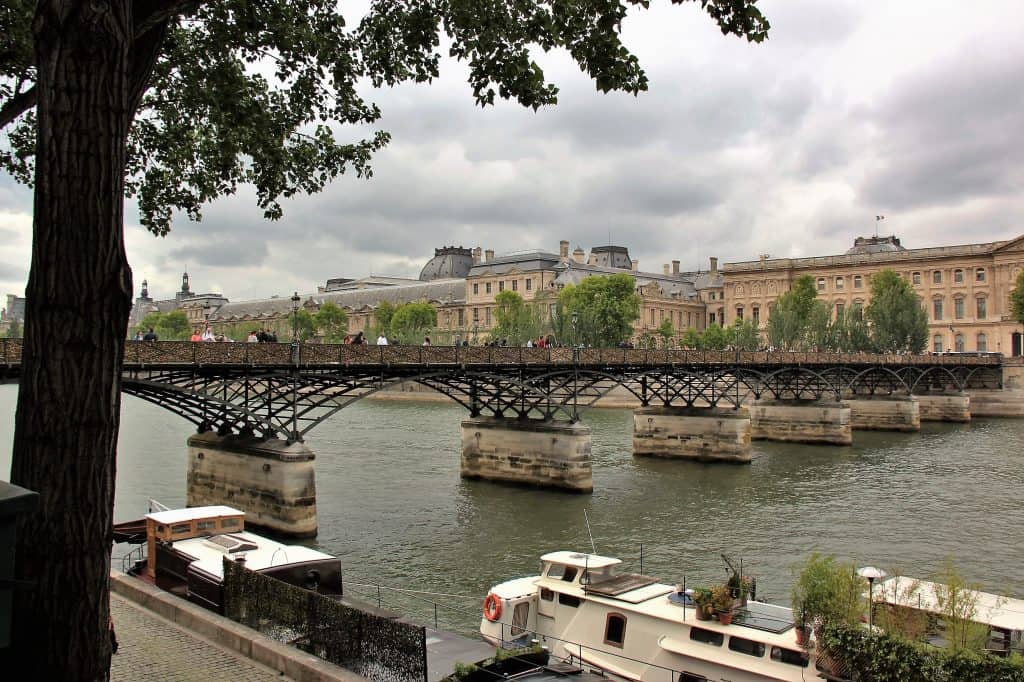
The lock epidemic began in Paris in 2008, and it’s worth remembering that it wasn’t born there, but was imported into the City of Light, like a few other troubles such as the Black Death or the McDonald’s chain. Over the six years that followed, the bridge’s railings were covered with about 700,000 locks, and eventually, in 2014, one of the bridge’s railings collapsed into the Seine.
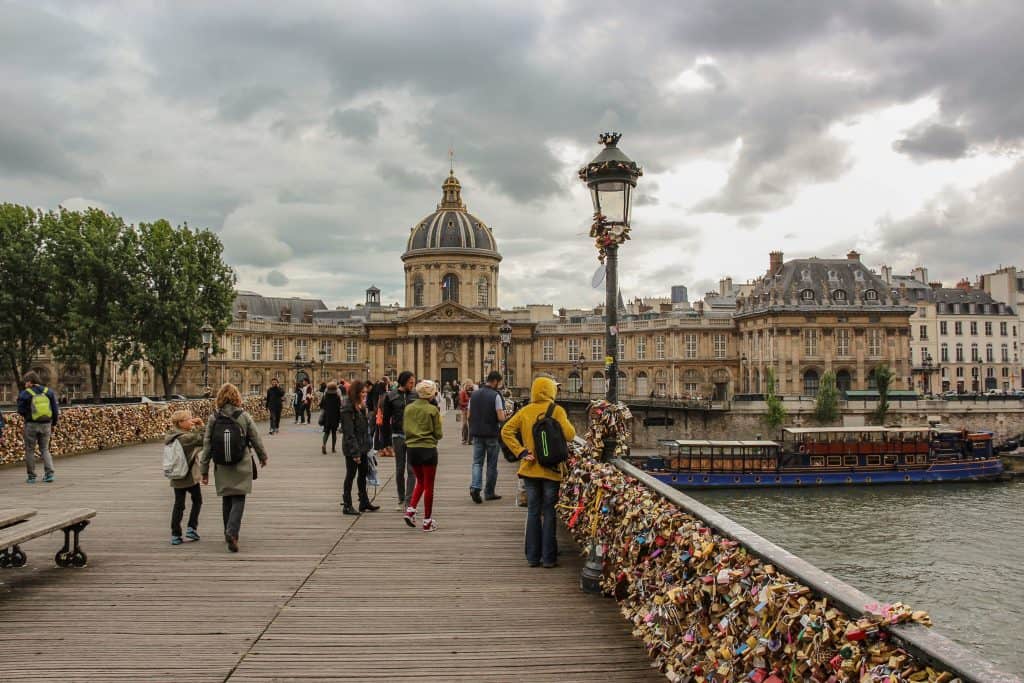
To my great relief, the city of Paris reacted quickly and effectively. The bridge was closed temporarily, the railings were removed, and new, transparent ones were put in their place, on which it’s impossible to hang locks. Instead, you can hang photos and paintings on these new railings, which means you’re guaranteed a new exhibition every time you visit the City of Light. The bridge finally lives up to its name: the Bridge of the Arts!

And the locks? Unfortunately for me, but fortunately for everyone who was and still is looking for the “bridge of locks,” they haven’t completely vanished from our lives. If you really insist, you can still find them near various bridges, such as the Pont Neuf or the Pont de l’Archevêché, and even on top of Montmartre, next to the Sacré-Cœur!

Today, the Pont des Arts serves as a kind of open stage for quite a few musicians who perform there for the enjoyment of passersby. They’re joined by painters, who sit there for hours painting the magical view from the bridge.
And finally, at almost any hour of the day, you’ll find plenty of young people and couples in love there, who no longer put locks on the bridge but simply stand on it and kiss, “to keep the language fresh and the tongue clear,” as Yair Garbuz wrote. As you can see, the French Academy isn’t the only one working on that. 🙂
The Pont des Arts and Its Surroundings: Travel Information
Our historical journey ends on the Pont des Arts, and now comes the part where you’ll probably want some practical information to help you plan your next trip to Paris.
Don’t worry! I’ve got that covered too. 🙂
How do you get to the Pont des Arts?
In my opinion, the best way is to take line 1 to the Louvre-Rivoli metro station and walk from there to the bridge (about a five-minute walk).
We’re standing on the bridge, enjoying the view. What’s next?
Since the bridge connects the 1st and 6th arrondissements, you can go explore either one. You’ll find a list of attractions, walking routes, and other useful information about each of these arrondissements in the following two articles:
Can you visit the Institut de France palace?
Unfortunately, you can only visit the palace itself during the “European Heritage Days” (JOURNÉES DU PATRIMOINE), held on the third weekend of September. However, you can definitely go into the magnificent chapel where Cardinal Mazarin is buried and visit under its dome every Saturday between 10:00 a.m. and 6:00 p.m.
If you’d like to get a preview of what’s waiting for you there, feel free to check out this video:
Is it worth staying near the Pont des Arts?
The short answer is: absolutely! There aren’t many more central locations in Paris that let you easily hop between the Right Bank and the Left Bank and back. Beyond that, the streets behind the Institut de France are very lively, with plenty of galleries and restaurants close by.
Here are a few excellent hotels (though not cheap) not far from the bridge:
If you’re looking for somewhat cheaper hotels (even if they’re a bit farther from the bridge), feel free to check out the article Recommended hotels in the 6th arrondissement. If what you really want is a vacation rental, check out the article Vacation rentals in the 6th arrondissement.
Every bridge, as they say, has two sides, so you can also stay in the 1st arrondissement and be close to the bridge, although since the Louvre takes up the entire bank across from the bridge, you won’t be as close to it as you would be staying in the 6th arrondissement. So if you decide to stay in the 1st arrondissement and be close to the bridge, let me recommend these hotels (which are also a bit cheaper than those on the Left Bank):
- Sweet Inn – Amiral de Coligny
- Relais Du Louvre (a very pleasant place, where I’ve personally stayed)
If you’re looking for more places to stay in the 1st arrondissement, you can find them in the articles Recommended hotels in the 1st arrondissement and Vacation rentals in the 1st arrondissement.
The romantic view from the Pont des Arts has made us suddenly hungry. What now?
Don’t worry! As I mentioned in the previous section, heading south from the Pont des Arts and the Institut de France toward Saint-Germain-des-Prés, there are plenty of excellent restaurants, so chances are you won’t go hungry. You can find more information about them in the article Recommended restaurants in the 6th arrondissement.
Related reading
