

Rue des Francs-Bourgeois is without a doubt one of the most charming streets in Paris, thanks to the string of grand mansions lining it and the fact that the boutiques here mostly ignore the custom of closing on Sundays, which keeps the street lively even on weekends. If you walk along this street and reach the corner of Rue des Archives, you’ll spot a stunning mansion from the early 18th century, with a small, medieval-looking tower beside it. This mansion has a story with all the ingredients of a good movie: violence, sex, more violence, and more sex. Today I’ll tell you that fascinating story.
Hôtel de Clisson: The Bloody Middle Ages
The mansion was originally built in 1371 for the military man Olivier de Clisson (1336-1407) and was initially named after him. Clisson became famous in French history as a close friend of kings Charles V (r. 1364-1380) and Charles VI (r. 1380-1422), and as the commander of the French army (and later as Constable of France).

The mansion he built was actually a fortified house, incorporated into the line of the Wall of Charles V. The only surviving part of the original 14th-century structure today is the fortified gate facing Rue des Archives, marked by two striking, pointed towers.
Being an important man, Clisson gathered no shortage of enemies, and in 1392 Pierre de Craon (1345-1409), a servant of the Duke of Brittany, tried to assassinate him in a dark Paris alley. Clisson survived by a hair’s breadth and set off with King Charles VI to hunt down the would-be killer.
During the hunt, Clisson and the king entered a forest and came across a leprous beggar, who shouted at the king, “Don’t go into the forest, you will be betrayed.” The group ignored him and kept going, but the king’s nerves were already frayed after the encounter. A few hours later, while they were walking through the woods, one of the servants accidentally dropped his lance, and the king, startled, lost his mind and attacked his companions.
From that moment on, the king’s sanity never fully returned, and he went from being known as “Charles the Beloved” to “Charles the Mad.” The courtiers blamed Olivier de Clisson for the disaster, and he was forced to leave his mansion in Paris and flee to Brittany, where he eventually made peace with the duke and ended his life a very wealthy man in 1407.
By the way, what survives of Clisson’s mansion today is the gate and its two towers at 58 Rue des Archives, and they’re one of the stops on my walking tour of the 3rd arrondissement.
Hôtel de Guise: The Renaissance, the Wars of Religion, and Flying Lovers
Over the years the mansion changed hands several times, until in 1553 it was purchased by François de Lorraine (1519-1563), Duke of Guise, and his wife Anne d’Este (1531-1607). The powerful and wealthy Guise family dramatically expanded and transformed the building in the Renaissance style, and the mansion, known at the time as the “Hôtel de Guise,” became the epicenter of the extremist Catholic League during France’s Wars of Religion. According to historical records, it was within these walls that the plot leading to the brutal St. Bartholomew’s Day massacre of 1572 was hatched.
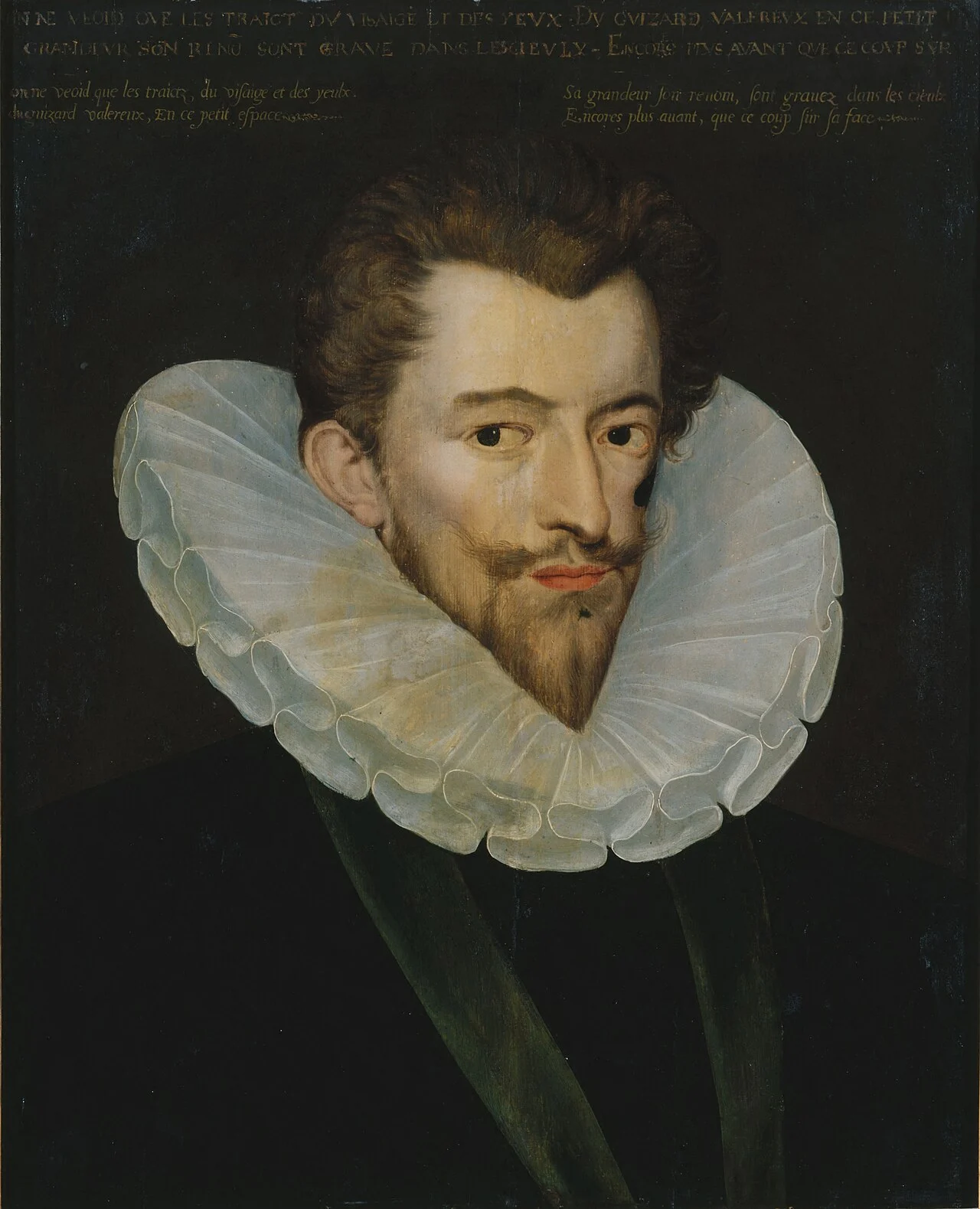
The most famous resident of the mansion at the time was Henri I (1550-1588), nicknamed “Scarface” (le Balafré) for the enormous scar that marked his face after he was wounded in battle in 1575. Henri was the leader of the Catholic League and one of the claimants to the throne of France. A gifted politician, he quickly won the favor of Parisians by making a habit of greeting and chatting with ordinary people in the street.
Since the 1570s and 1580s were among the most turbulent periods in the history of Paris, the duke kept the Gothic tower facing Rue des Archives for military reasons (and we get to enjoy its beauty today as a result). Another tower belonging to the same mansion, which stood at the corner of Rue des Archives and Rue des Quatre-Fils and no longer exists, played a rather less ordinary historical role.
In 1578, Henri I caught his wife Catherine de Clèves (1548-1633) with her lover, Monsieur de Saint-Mégrin (1554-1578), and without a second thought, he threw the lover off the top of the tower into the street. The lover, unfortunately, did not know how to fly, and the duke’s soldiers finished the job on the street with a few sword blows. Like his wife’s lover, Henri I also did not die a natural death: in 1588 he was assassinated on the orders of King Henri III (1551-1589) at the Château de Blois.
During the 17th century, the Guise family remained one of the wealthiest families in France, and its sons became important patrons of the arts in Paris. Alongside the turbulent political history, the mansion also served as a brilliant cultural court, hosting creators such as the playwright Pierre Corneille (1606-1684). One of the most important composers to benefit from the Guise family’s money was Marc-Antoine Charpentier (1643-1704), who lived in the mansion until 1688 and began writing there his famous Te Deum, which you can still hear at the start of every Eurovision Song Contest.
The Hôtel de Soubise and the French National Archives: The Royal Mistress Who Saved the Day
In 1696, the last of the Guise family died, and the division of their treasures marked not only the end of the family but the beginning of a period of decline for the Marais. The mansion too began to deteriorate, and after being sold to the Portuguese embassy, it was turned into a gambling den. And yet the mansion hadn’t said its last word, because within a few years it would become one of the most impressive mansions in the Marais, all thanks to a royal mistress.

Anne de Rohan-Chabot (1648-1709), who married her relative François de Rohan, Prince of Soubise (1630-1712), was one of the most beautiful women at the court of King Louis XIV (1638-1715).
Naturally, the king couldn’t ignore her beauty and began courting her relentlessly. So when the Prince de Soubise and his wife went looking for a place to live in Paris, the king offered to buy them the crumbling Guise mansion (purchased in 1700) and build them, at his own expense, a magnificent new one.
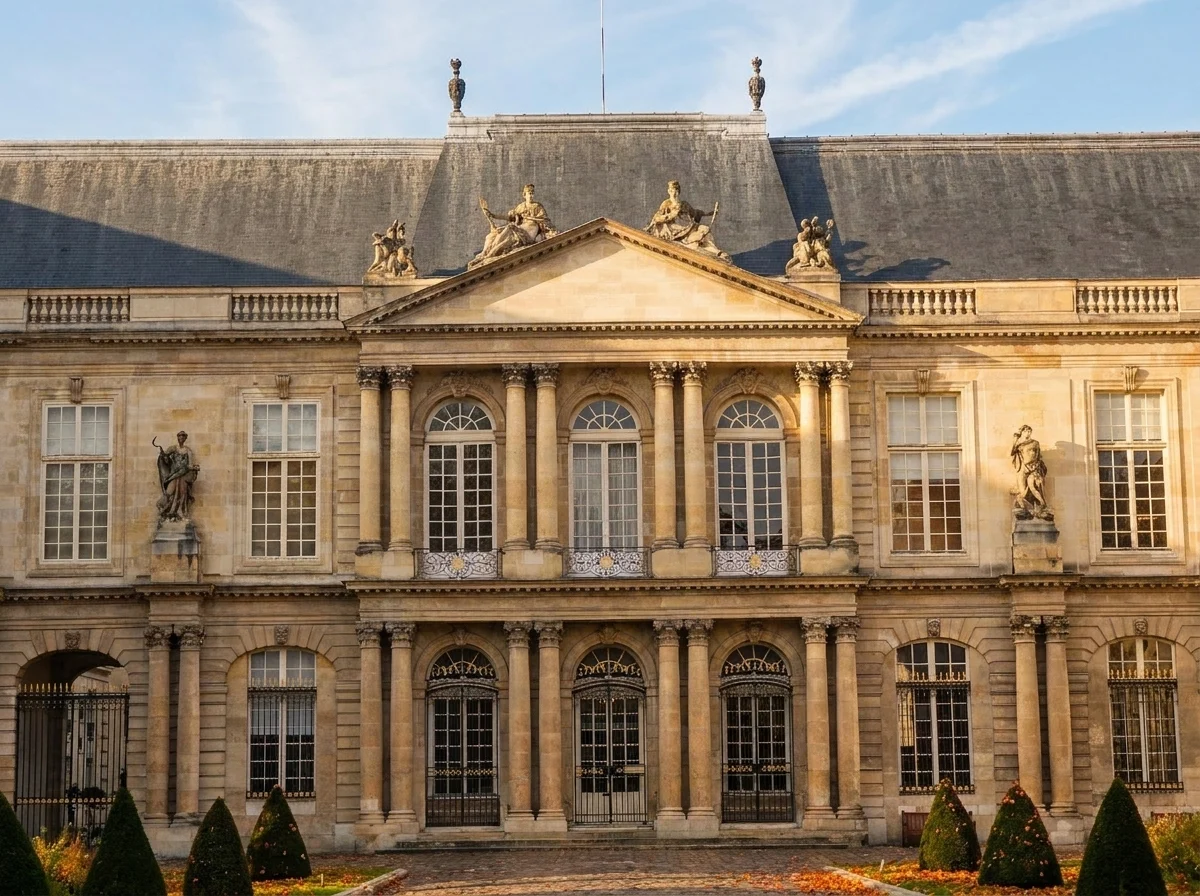
Unlike the Duke of Guise, who had lived there before him, the Duke of Soubise wasn’t bothered by his wife’s romantic adventures (including the fact that their youngest son looked suspiciously like Louis XIV), and he chose to simply overlook the royal affair. And so, on the ruins of the Guise mansion, the new and magnificent mansion was built, known today as the Hôtel de Soubise.
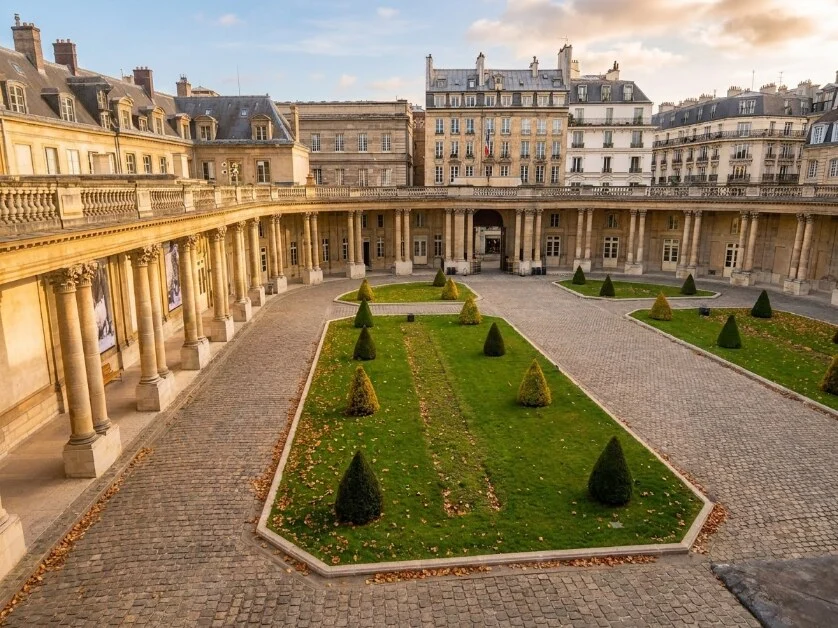
The young architect Pierre-Alexis Delamair (1675-1745) was hired for the job, and he was the one who reversed the direction of the entrance and created the monumental Cour d’honneur surrounded by columns that we see today (he took his inspiration from the colonnade Bernini built in front of St. Peter’s Basilica at the Vatican). “Kind souls” joked that while the king provided the wood (a pun on the “horns” the king gave the duke), the duke’s friends provided the stones, meaning they were laughing at him behind his back.
The mansion’s great artistic transformation came in 1732, when Hercule-Mériadec de Rohan-Soubise (1669-1749), François’s son, remarried the 19-year-old Marie-Sophie de Courcillon (1713-1756). To impress her, he hired the celebrated architect Germain Boffrand (1667-1754) to redesign the interiors in the lavish French Rococo style.
During the 18th century, the mansion was home to Charles de Rohan, Prince de Soubise (1715-1787), a close friend of Louis XV (1710-1774), who became famous not only as one of France’s most hapless generals (and he had plenty of competition for that title) but also for the famous onion sauce that still bears his name today. During the French Revolution, the mansion was seized from the Soubise family, looted by revolutionaries, and used as a gunpowder storehouse, while lottery ticket stalls were set up in its gardens. The mansion was saved thanks to Napoleon, who decided on March 6, 1808, to purchase the building and house the Imperial Archives there (which later became the National Archives).
From the Empire to Today: From a Document Warehouse to an Open Museum
So what happened to our magnificent mansion once it became France’s official paperwork kingdom in 1808? Well, it kept growing. Throughout the 19th century, more and more buildings were added to the complex to hold France’s ever-expanding history.
In 1867, under the reign of Napoleon III (1808-1873), the Marquis Léon de Laborde (1807-1869) decided there was no reason to hide all these treasures from the public, and he founded the “Musée des Archives” there, displaying rare historical documents to the public for the first time.
Over the years, the archive accumulated millions of documents, including records of the French Revolution, both World Wars, and even the original manuscript of General Charles de Gaulle’s (1890-1970) famous appeal of June 18, 1940. By the time the place was practically bursting with history, a vast, state-of-the-art archive center opened in 2013 in the suburb of Pierrefitte-sur-Seine.
But don’t worry, the Hôtel de Soubise wasn’t left orphaned. It still houses the archives of the Ancien Régime (before the Revolution), the notarial records of Paris, and of course continues to function as a living, breathing museum. (If you ask me, those papers got to live in a nicer mansion than most Parisians today.)
Touring the Mansion: What’s Hidden Inside the Hôtel de Soubise?
Today, the mansion serves as the home of the French National Archives Museum (officially opened in 1867). But don’t let the word “archive” fool you into thinking it’s a dusty, dull room of paperwork: the interior design is a breathtaking showcase of French Rococo architecture. Here’s what I recommend not missing as you wander through the mansion’s rooms:
The Prince’s State Apartments (Ground Floor)

The ground floor was designed as the prince’s living quarters and features a somewhat more restrained, “masculine” design compared to the floor above.
- The Prince’s Oval Salon (Salon ovale du Prince): This space is decorated in delicate white and lilac-gray tones. It’s adorned with impressive plaster reliefs by Lambert-Sigisbert Adam (1700-1759) representing “History.” Above the doors you’ll find paintings by major artists such as Carle Vanloo (1705-1765) and Jean Restout (1692-1768). (Fun fact: during the days of the Paris Commune in 1871, this grand room was temporarily turned into a clinic.)
- The Prince’s Bedroom (Chambre du Prince): It retains its original wood paneling. The room is decorated with four paintings depicting the loves of the gods, including works by Pierre-Charles Trémolières (1703-1739).
- The Small Cabinet (Petit Cabinet): An intimate space that served as a closet room. It includes beautiful blue medallion plaques by François Boucher (1703-1770), depicting “The Hunt” and “Fishing.”
The Princess’s State Apartments (First Floor)

The upper floor is the highlight, representing the peak of decorative splendor and refinement of the Louis XV era. Here Boffrand created a series of rooms designed to glorify the hostess during her cultural salons.
- The Princess’s Oval Salon (Salon de la Princesse): The pinnacle of French Rococo art. A space combining huge mirrors set within wide arches, gilded plasterwork, and a stunning blue ceiling. The highlight here is the set of eight panels decorated with paintings by Charles-Joseph Natoire (1700-1777) from 1738, depicting the myth of Psyche and Cupid. You simply have to stand there and stare.
- The Princess’s Ceremonial Bedroom (Chambre d’apparat): A room decorated with white and gilded wood panels. The gilded plaster medallions depict the romantic adventures of Jupiter (apparently the princess liked bold themes). In the bed alcove hang two famous pastoral paintings by François Boucher (1703-1770).
- The Hall of the Canopy (Salle du Dais): Originally served as an entrance hall. Today it displays remarkable historical furnishings, such as serving tables once used in the buffet of the Revolutionary Tribunal during the Reign of Terror of the French Revolution.
The Hidden Treasures: Documents That Will Change How You Think About History
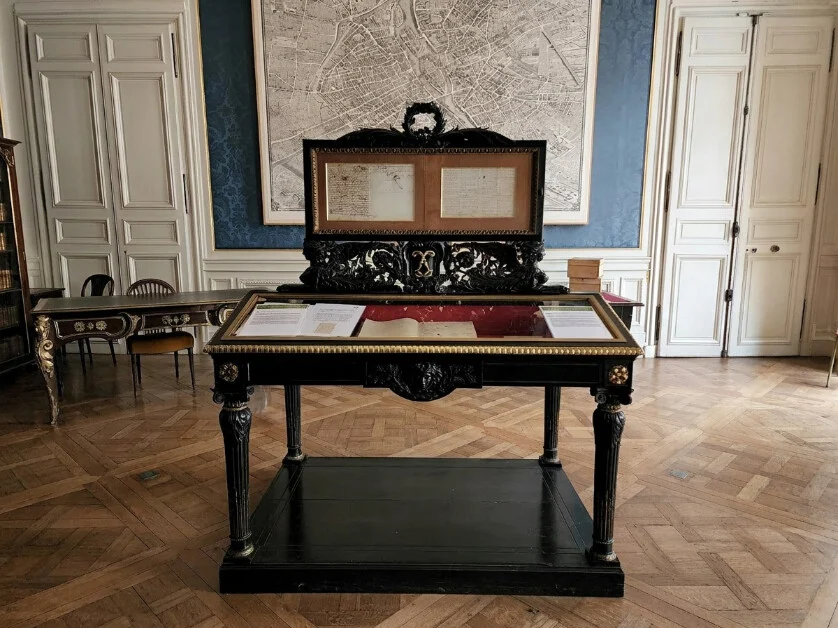
Beyond the decor, the museum hosts permanent exhibitions of unique original documents that shaped France and the world. Among them:
- The Royal Papyrus: signed by the Merovingian king Clotaire II (584-629) in the year 625 CE (the oldest document in the archive!).
- The Iron Cabinet (L’Armoire de Fer): a sophisticated steel safe built in 1790 to protect the nation’s most important documents (it can only be opened using three different keys, each held by a separate official). Although it isn’t always directly accessible, it preserves, among other things, the first standard meter and kilogram measures.
- Revolutionary items: the writing desk attributed to Maximilien Robespierre’s (1758-1794) final watch, the original iron key to the Bastille fortress, and the “infernal machine” (Machine infernale) built by Giuseppe Fieschi (1790-1836), intended to assassinate King Louis-Philippe I (1773-1850) in 1835. In short, everything that makes for fine French drama! And sometimes there are even rare temporary exhibitions, such as a display of the wills of Napoleon (1769-1821) and Victor Hugo (1802-1885).
The Green Gem: The Gardens of the Hôtel de Soubise and Its Neighboring Mansions

If the mansion’s interior is breathtaking, wait until you step outside. Behind the stone facades hide gardens that form a hidden green lung in the heart of the Marais, spread across a huge area of around 10,000 square meters.
These gardens have gone through many changes over the course of history, but in 2008 the French Ministry of Culture launched a comprehensive landscape restoration project led by landscape architect Louis Benech (b. 1957). The restored gardens opened to the public in 2011. In fact, it isn’t a single garden but a sequence of historic gardens belonging to the neighboring mansions, together forming the complex:
- The Garden of the Hôtel de Rohan (Jardin de l’hôtel de Rohan): a formal, classical-style garden originally designed by the royal gardener André Le Nôtre (1613-1700). It features a wide central lawn surrounded by shaded rows of plane trees (platanes), recreating the monumental perspective that once connected the mansions.
- The Garden of the Hôtels d’Assy and de Breteuil (Jardin des hôtels d’Assy et de Breteuil): a romantic, 19th-century-style urban garden, preserving a small pond and an artificial stream created in 1848. Here you’ll find an Indian horse chestnut tree (Aesculus indica), the only one of its kind in Paris,, estimated to be around 150 years old, next to stunning Chinese wisteria shrubs.
- The Garden of the Hôtel de Fontenay (Jardin de l’hôtel de Fontenay): includes two gloriettes made of intricate wooden latticework. The lawn here follows a landscaping pattern called “Mille-fleurs” (a thousand flowers), a mosaic of grasses and wildflowers that gives the space a rustic feel in the middle of the city.
- The Garden of the Hôtel de Jaucourt (Jardin de l’hôtel de Jaucourt): designed as a sweet, agricultural-cultural orchard, with deciduous fruit trees (pears, apples), Japanese persimmon, and strawberry trees. An ideal spot for reading a book (or just taking a light afternoon nap).
By the way, right next to the National Archives complex, on Rue des Archives, you’ll find the Museum of Hunting and Nature, housed in the only aristocratic mansion designed by François Mansart that has survived completely intact.
Practical Information (How, How Much, and Why)
Visiting the Hôtel de Soubise and its gardens is one of the most rewarding cultural experiences in Paris, especially since most of the complex is open to the public free of charge, year-round. So you don’t miss it on your next trip to the Marais, here are all the important details. Just remember, as you walk the street, to look up every now and then, in case a lover happens to fall on you…
- 📍 Exact address: the mansion is located at 60, rue des Francs-Bourgeois, in the 3rd arrondissement of Paris. The main entrance to the gardens is through the Cour d’honneur of the Hôtel de Soubise (turn right at the end of the row of columns).
- 🚇 Getting there: the closest metro stations are Rambuteau (line 11), Hôtel de Ville (lines 1 and 11), and Saint-Paul (line 1). You can also take bus lines 29 and 75.
- 🕒 Museum opening hours: Mondays, Wednesdays, Thursdays, and Fridays from 10:00 to 17:30. On weekends (Saturday and Sunday) from 14:00 to 17:30. The place is closed on Tuesdays, as well as on public holidays (January 1, May 1, December 25).
- 🌳 Garden opening hours: the gardens are open every day! During spring and summer (March to October), from 8:00 a.m. to 8:00 p.m. During fall and winter (October to March), from 8:00 a.m. to 5:00 p.m.
- 💶 Costs: admission to the permanent collections, the state apartments, and the historic gardens is completely free, with no need to book in advance! For temporary exhibitions, there may be a small fee of 5 to 8 euros, and a guided tour of the mansion costs around 8 euros per person.
- ♿ Accessibility: the archive’s management has invested heavily in accessibility. The ground floor and gardens are fully wheelchair accessible via a ramp. The site also offers tactile tours (with touch devices), hearing aids for the hard of hearing, and printed guides in Braille.
Related reading
