

The Marais is a large neighborhood spread across two arrondissements (the 3rd arrondissement and part of the 4th arrondissement), so it’s very hard to fit the whole neighborhood into a single route. If you’ve never been to the Marais before, read the Marais: a walking tour of the most charming neighborhood in Paris, where you’ll find most of the main attractions.
If you’re looking for a more advanced route, let me give you one in the western part of the Marais, bordering Rue Beaubourg. Along the way, you’ll discover a number of charming spots located west or east of that street. Most of them, I believe, won’t be familiar to you (except maybe the Centre Pompidou and the Paris city hall), and I hope this route will give you, especially if you’re one of the more advanced Francophiles among my readers, a historical, architectural and culinary treat.
Instead of a map: under the heading of each stop you’ll find its address, and every address is a link. Click it, and the place will open right away in Google Maps.
The walking route through the western Marais
I put this route together while I was staying in Udi’s apartment at 12 Rue Simon Le Franc. It’s a highly recommended place, both for its central location and for how well it’s equipped (air conditioning, very comfortable beds, and more). So it makes a great starting point. If you happen to be staying there, all you need to do once you’re out the door is walk to Rue Beaubourg until you reach the exit of the Rambuteau metro station. Everyone else is welcome to get there on line 11.
Made it? Let’s start our walk!
Le Défenseur du Temps (The Defender of Time)
Whether you’re staying in the apartment I recommended or you just came out of the Rambuteau metro station, walk to the street with the same name and cross Rue Beaubourg. Keep going a little further until you reach Rue Brantôme, named after a writer and adventurer who took his name from the charming town of Brantôme. Ignore the ugly buildings, walk into the street, and go a short distance until you spot this strange clock, called “Le Défenseur du Temps” (the Defender of Time).

This is a mechanical statue made of copper and steel. Three times a day the clock comes to life, and for about a minute you can watch a battle between the crab, the dragon and the bird that make up the clock, representing the sea, the earth and the sky. If you like, the statue depicts the struggle of the Defender against the air, the earth and the water, represented by wild creatures.
If you’d like to read more about this fascinating clock, I invite you to check out Amiram Tsabari’s excellent article Le Défenseur du Temps: a surprising attraction in an unattractive neighborhood in central Paris.
The Centre Pompidou
Retrace your steps, and as you come out onto Rue Rambuteau, you’ll see the Centre Pompidou right in front of you, in all its glory (or its ugliness, depending on who you ask). There’s no doubt it’s one of the most controversial buildings in Paris, but if you love modern art, you simply have to visit.

If modern art isn’t really your thing, I still recommend going into the museum and heading up to the restaurant on the top floor (no ticket needed for that).

What opens up in front of you is a breathtaking view of the City of Light. I promise you that photographers among you will have a field day with the view from there. Here’s an example of a Parisian sunset I photographed in September 2022.
If you want to read more about the Centre Pompidou, I highly recommend the article Yoel Thamanlis and I wrote together: The Centre Pompidou: the complete guide for everyone who loves the place (and those who don’t).
To buy admission tickets for the exhibitions on display at the Centre Pompidou, head over to the museums page.
The oldest fountain in Paris
rue Saint-Martin, at the corner of rue de Venise
Right across from the entrance to the Centre Pompidou, where Rue Saint-Martin meets Rue de Venise, you’ll find a fountain called Fontaine Maubuée (the fountain of the bad laundry), the oldest fountain in Paris still standing today.
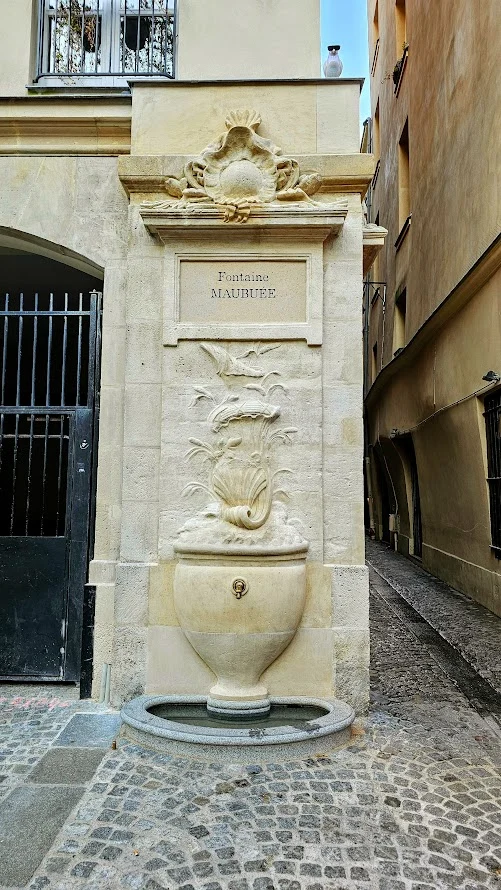
This fountain was built in 1392 by King Charles VI (r. 1380-1422), and it got its name because of the not-so-great water that flowed there, which wasn’t suited for doing laundry.
During the 18th century, the famous architect Jean Beausire (1651-1743) renovated the old fountain and added rococo elements to it. During the 20th century, a statue of a pigeon wearing sunglasses was also added to the fountain :-).
This fountain became part of local legend in the 15th century when it was mentioned in a poem by François Villon (1431-1465), “Le Testament”.
Église Saint-Merri
After you’ve looked at the old fountain (if you’re lucky, it’ll even be running), head to Rue Saint-Martin, one of the oldest streets in Paris, dating back to Roman times, and go to number 78.
Welcome to Église Saint-Merri, one of the most beautiful and least known churches in Paris. Despite its Gothic structure, it’s not actually a medieval church but a 16th-century one, and large parts of it, such as its grand entrance, date from the 19th century.

The name Merri isn’t a corruption of the name Marie, but rather the name of a saint called Mederic, who was the bishop of the city of Autun in Burgundy and who died while visiting Paris in exactly the year 700.
I highly recommend going inside the church and enjoying its beautiful stained-glass windows, paintings and sculptures. Once you’re done visiting, head back out to Rue Saint-Martin and continue on toward Rue de la Verrerie.
Rue de la Verrerie
This is another very old street, which got its name (the street of glassware) because the glassmakers who created the stunning stained-glass windows of Paris’s churches (including those of Sainte-Chapelle and Notre-Dame Cathedral) lived and worked here. The man who invented playing cards in the 14th century also lived on this street, and if you’d like to read more about him, check out the article Between stained glass, playing cards, love letters and a ladder.

After that, head to 76 Rue de la Verrerie, where you’ll find the entrance to the presbytery (the place where the priests who served the church lived). Take a look at these two charming cupids above the window.
Tour Saint-Jacques
Walk along Rue de la Verrerie until you reach Rue Nicolas-Flamel. The street is named after Nicolas Flamel (1330-1418), who made his fortune selling books and became one of the wealthiest people in Paris. He invested that wealth in intensive study of alchemy and the search for the philosopher’s stone, but also in charity and donations.

Looking ahead, you’ll see a remnant of one of the projects Nicolas Flamel funded: the Tour Saint-Jacques, the only surviving structure from the Église Saint-Jacques-la-Boucherie. If you’d like to read a bit more about this tower, check out Amiram Tsabari’s article Tour Saint-Jacques.
Before we continue our walk, if you’d like to find another trace of Nicolas Flamel’s activity, you can do so at 49 Rue de Montmorency, where you’ll find “Nicolas Flamel’s House.” Despite its name, this isn’t the house where he actually lived (that house probably stood on the street named after him), but rather a shelter where poor people lived. Today this building is considered the oldest house in Paris.
Rue Saint-Bon: the old Jewish quarter
Retrace your steps back to Rue de la Verrerie and continue east until you reach Rue Saint-Bon.

This street is considered one of the most “Jewish” streets in the area, thanks to the many Jews who lived here. A large number of those who lived here were involved in money lending and pawnbroking.
This street entered the history books when, in 1377, servants of the Duke of Berry (Jean de Berry, 1340-1416), known to us for his beautiful “Book of Hours,” arrived here. The duke, who never quite managed to keep a balanced budget, had to pawn some of his silverware with the Jews who lived here in exchange for a loan.
The Jews were expelled from France about 15 years later. Did they ever get to see the money they had lent the duke? We’ll never know…
Hôtel de Ville and BHV
place de l’Hôtel-de-Ville, and 52 rue de Rivoli
Walk to the end of Rue Saint-Bon and you’ll reach Rue de Rivoli. Turn left and before long you’ll see Paris’s city hall, the famous Hôtel de Ville.

The building you see today was built in the 19th century, after the previous building was burned down by the Paris Commune in 1871. Both the building and the square beside it have a long and fascinating history, so I recommend pausing here for a moment to read the article Hôtel de Ville: because even Paris’s city hall needs a palace.
Continue along Rue de Rivoli and you’ll reach the BHV, one of the most important department stores in Paris. Here’s a short video showing you what you can find there.
Honestly, beyond the shopping and the fact that there’s also an excellent rooftop, this department store has quite an interesting story behind it too. It all starts in 1856, when Empress Eugénie (Eugénie de Montijo, 1826-1920), the wife of Napoleon III, was riding in her ornate carriage along the eastern part of Rue de Rivoli, which her husband had paved.
Suddenly, one of the horses started to panic, and there was a real danger that the empress would fall from the carriage. This was a genuinely life-threatening situation, because about 14 years earlier something similar had happened to the eldest son of King Louis Philippe (r. 1830-1848), whose head struck the pavement, killing him.
Luckily for her, a small-goods peddler named Xavier Ruel (1822-1900), who happened to be passing by, lunged at the empress’s horse and managed to calm it down. The empress, whose life had just been saved, wanted to thank the brave peddler and declared that from then on she and her friends would shop only from him.
As a result, Xavier became a very wealthy man, and with the money he earned, he opened a department store called Bazar Napoléon (to thank the empress for her generous support of his business). After the Second Empire fell in 1870, he changed the store’s name to BHV (an abbreviation of Bazar de l’Hôtel de Ville), and that’s the name we still know it by today.
L’église des Billettes
From Rue de Rivoli, turn onto Rue des Archives and continue to number 22. That’s where, in 1290, the house of a Jewish man named Jonathan once stood. Like the Jews of Rue Saint-Bon, he was also involved in moneylending and pawnbroking. One woman, who had pawned some of her clothes with him, claimed that he demanded she bring him the Host she received at Église Saint-Merri in exchange for her clothes.
According to her account, Jonathan cut the Host with a knife until blood burst out of it, then threw it into a pot of boiling water. As a result, the Host supposedly began to rise into the air, and the woman fled the house screaming in terror. Jonathan the Jew was brought before a church tribunal and sentenced to death at the stake. His house was torn down, and a small chapel was built in its place, called “La Chapelle des Miracles” (the Chapel of Miracles).

The chapel became a church, which passed through several monastic orders until it became the church of the brothers of the Billettes order, which is how the church got its name. The medieval church was demolished and replaced in the 17th century by a Baroque church, but its charming cloister survives to this day and serves as an exhibition hall (important note: as of November 2023, the cloister is closed for renovations).
The church was closed during the French Revolution, and later, when it reopened, it was handed over to the Protestants, so today it’s an Anglican church. As you pass by, peek inside and look for concert posters. If you’re lucky, there might be a concert happening in the coming days, and if so, I highly recommend buying a ticket, because the acoustics there are quite good.
Hôtel de Soubise
60 rue des Francs-Bourgeois (and the gate of the Hôtel de Clisson at 58 rue des Archives)
Continue north on Rue des Archives until you reach the junction of Rue des Archives, Rue Rambuteau and Rue des Francs-Bourgeois.

Right in front of you, you’ll see a tower from a medieval mansion. This is a remnant of the Hôtel de Clisson, built in the 14th century for the war minister of Charles VI. To read more about that war minister, check out the article Clisson: the butcher, Muscadet wine and the madness of King Charles.
If you turn right onto Rue des Francs-Bourgeois and then immediately left, to pass through the gate in the wall, you’ll reach the Hôtel de Soubise, the grandest mansion in the Marais, built in the early 18th century on the ruins of the Hôtel de Clisson.
This magnificent mansion also has a fascinating story that’s well worth knowing, so I recommend reading the article Hôtel de Soubise: when lovers started flying.
After visiting the mansion and its gardens, head back out to Rue des Francs-Bourgeois and walk to Rue Rambuteau.
Rue Rambuteau
This street is named after Claude-Philibert Barthelot de Rambuteau (1781-1869), who served as prefect of the Seine (that is, head of the Paris region’s administration) under King Louis Philippe. The street is a kilometer long, and it was the first street carved through the old alleys of Paris, well before Napoleon III and Baron Haussmann “patented” the idea.
We won’t walk the full length of the street, only the stretch between Rue des Archives and Rue Beaubourg, because that’s where you’ll find quite a few interesting culinary spots. Here are a few examples:
Le P’tit Mousse

An excellent seafood restaurant that looks, on the inside, like a fisherman’s cottage, and makes you feel like you’re right on the shore. You’ll find platters of the freshest seafood here, paired with wines chosen by the owners.
Address: 9 Rue Rambuteau
Open days and hours: Tuesday to Friday, 5:00 p.m. to midnight. Saturday and Sunday, noon to midnight. Closed on Mondays.
Pain de Sucre

A well-established and highly regarded pâtisserie that’s been around since 2004, turning out wonderful cakes, but also excellent quiches if you’re looking for something savory instead. If you’re also after bread and pastries, you’ll be glad to know that right next to the entrance of Pain de Sucre, the owners also run a bakery where you can find baguettes, pain au chocolat and more.
There’s no doubt this is a highly respected and iconic spot, and it’s absolutely worth trying one of the cakes in the display case. But further down the street you’ll find another bakery/pâtisserie that I personally love quite a lot. So I’ll leave it up to you whether to hold back and keep walking, or not :-).
Address: 14 Rue Rambuteau
Open days and hours: Thursday to Monday, 10:00 a.m. to 8:00 p.m. Closed on Tuesdays and Wednesdays.
Artisan de la Truffe Marais

This is a restaurant that specializes in dishes made with truffles, that divine mushroom capable of elevating any dish. I had a chestnut cream soup with truffle there that was nothing short of heavenly, though the pasta dish that followed was just average.
The takeaway? Skip the pasta and just enjoy the soup, and since this isn’t exactly a cheap treat, I highly recommend using the TheFork app when booking a table, since you can sometimes get up to 50% off the menu at lunchtime.
Address: 19 Rue Rambuteau
Open days and hours: Sunday to Thursday, 11:00 a.m. to 3:00 p.m. and 6:00 p.m. to 10:30 p.m. Friday and Saturday, 11:00 a.m. to 11:00 p.m.
Chez Meunier

This is the pâtisserie/boulangerie where we used to buy our bread every morning, and in my personal opinion it’s one of the best in Paris (even though, to my surprise, it only got a 3 out of 5 rating on Google). Beyond wonderful baguettes, you’ll find a whole range of pastries here, including an especially sinful croissant that’s dipped in liquid chocolate and nuts, then left to cool so it forms a wonderfully crisp shell.
In short: one of my warmest recommendations.
Address: 18 Rue Rambuteau
Opening hours: Every day, 7:00 a.m. to 10:00 p.m.
Jardin Anne Frank
Have you finished walking down Rue Rambuteau without resisting the temptation, and bought a few pastries? Now looking for a pastoral spot to eat them? Continue along Rue Rambuteau to Rue Beaubourg (where our walk began) and turn north. A few steps from there, on your right, you’ll find the entrance to the garden named after Anne Frank, the young Jewish girl of Dutch origin whose diary became one of the symbols of the Holocaust.

There, next to a small apple orchard, a few cherry trees and an intimate pocket of Parisian beauty, I’ll leave you to yourselves (with the pastries, or without them).
Looking for more information about the Marais?
If this walking route makes you want to explore more of the Marais, or maybe even consider living there, I highly recommend checking out The Marais: the complete traveler’s guide. Beyond the fascinating history of the neighborhood, you will find more walking routes there, along with hotels and apartments in the Marais. In short, everything that will help you get to know this charming neighborhood better.
If you want to continue north, I also wrote an advanced walking route in the northern Marais, which starts right by the gate of the Hôtel de Clisson.
Related reading
