

The Marais is split by Rue Saint-Antoine into the central Marais, home to most of its famous treasures (Place des Vosges, Musée Carnavalet and so on), and the southern Marais, which is less known but just as charming.
The goal of this walk is to give you a taste of both parts of the Marais in one day. It can’t possibly cover everything this lovely neighborhood has to offer, so I definitely recommend coming back, if only to explore its northern part too. In my experience, it’s a fairly intense route that can take a full day. Wear comfortable walking shoes and plan a few stops along the way so you don’t end up exhausted.
Instead of a map: under the heading of every stop you’ll find its address, and every address is a link. Tap it and the place opens right away in Google Maps.
The central Marais
A walk along Rue Saint-Antoine
place de la Bastille, and the Hôtel de Sully at 62 rue Saint-Antoine
We start at Place de la Bastille and walk along Rue Saint-Antoine until we reach the statue of Beaumarchais. Right behind the statue is the pricey Lenôtre pâtisserie, which anyone with a sweet tooth will be happy to peek into. Across the street you’ll see a pretty Baroque church, Sainte-Marie-des-Anges (Temple du Marais), where the famous French finance minister Nicolas Fouquet (1615-1680) is buried. Today the church serves the Protestant community of the Marais, so it’s open only during services.
Keep going along Rue Saint-Antoine and look at the lovely building at number 21. This is the Hôtel de Mayenne, built mostly in the early 17th century, as you can tell from the red bricks that decorate it. The building has a bloody history: among other things, a close friend of King Henri III (r. 1574-1589) lay dying here from wounds sustained in a nearby duel (the king ordered the street to be covered with straw so the noise of the carriages wouldn’t disturb him).
Today the building houses a school, and if you happen to come in September, during the European Heritage Days, you’re in for a pleasant surprise. The students, dressed as if they’ve stepped straight out of the 16th century, take visitors on a tour of the mansion and tell its story.
Continue along the same street, and after the Hôtel de Sully you’ll see a tall facade with a gilded clock in the middle. This is the church of Saint-Paul-Saint-Louis, built by the Jesuits in the 17th century, with a painting by Delacroix inside. Entry is free, and it’s worth stepping in for a few minutes.

Continue west along Rue Saint-Antoine until you reach the Impasse Guéménée. Victor Hugo (1802-1885), the greatest French writer of the 19th century, lived on Place des Vosges and used this alley to slip out of his house unnoticed and hurry to his mistress on Rue du Petit-Musc, across Rue Saint-Antoine.
Keep going in the same direction and on your right you’ll see the main entrance to Place des Vosges, used by ambassadors and royal processions that stopped in the square on their way to the Louvre. Still, I recommend you carry on first and step into the Hôtel de Sully, at 62 Rue Saint-Antoine (you can read the story of this mansion here). You’ll find a lovely courtyard and a gift shop with a ceiling from the days of Louis XIII.
Place des Vosges
From the courtyard of the Hôtel de Sully, head out to Place des Vosges and take in the beauty of its buildings, built in the early 17th century. Stroll around the square to see its boutiques, galleries and cafés. Look out especially for number 6, the house of Victor Hugo, now a free museum about his life, and number 9, home to the famous gourmet restaurant L’Ambroisie. If you’re lucky with the weather, sit for a while in the lovely garden, watched over by the statue of Louis XIII.
Once you’ve had your fill of Place des Vosges, leave the square by Rue des Francs-Bourgeois and turn left right away onto Rue de Turenne. At number 14, behind the railings, you can see what the inner courtyards of the Place des Vosges houses look like. Most of them are private and closed to the public.

Carry on and turn onto Rue de Jarente. Here you’ll find a charming fountain in the “fishmonger’s alley” (a reminder of the small market that once stood here). And speaking of markets, turn left on Rue de Jarente into the small, lovely Place du Marché-Sainte-Catherine. Enjoy the quiet and maybe have a coffee (the square is especially charming at night).

The Musée Carnavalet and around it
After the square, head back to Rue de Jarente. Keep going, turn right on Rue de Sévigné and walk on until you reach the Musée Carnavalet, which I wrote about here. I highly recommend going into this free museum and discovering the fascinating history of Paris (a visit takes about an hour to an hour and a half, not counting temporary exhibitions).

When you’re done with the Musée Carnavalet, continue west along Rue des Francs-Bourgeois, the main street of the Marais, and enjoy both the boutiques along it and the mansions, some of which you can peek into (for example the Hôtel Lamoignon, which once housed the historical library of Paris). Along the way there are a few interesting places worth a short detour before you come back to the main route.
For food, I recommend L’Éclair de Génie at 14 Rue Pavée, which sells wonderful éclairs. Art lovers should visit the Musée Cognacq-Jay at 8 Rue Elzévir, with a great collection of 17th- and 18th-century art. Also take a look at a tiny alley called Impasse des Arbalétriers (the crossbowmen’s alley), where Louis d’Orléans (1372-1407) was most likely murdered.

The Jewish quarter of Paris: Rue des Rosiers and the Pletzl
rue des Rosiers, and place Saint-Paul
After an éclair or two, it’s time to turn onto Rue des Rosiers, the main street of the Jewish quarter of Paris (to be fair, the city has several Jewish neighborhoods, but this is the most famous one). Jews arrived here in the 19th century and settled on this street and the ones around it, because at the time the Marais was a poor neighborhood and housing was cheap. In recent decades Rue des Rosiers has changed a lot: the famous Goldenberg deli was hit by a terror attack in 1982 and later closed, and falafel shops, boutiques and of course the famous Miznon restaurant opened on the street. Still, if you walk past the old Goldenberg deli and use your imagination, you can almost picture Louis de Funès dancing there as Rabbi Jacob.
The Hôtel de Rohan and the Hôtel de Soubise
60 rue des Francs-Bourgeois, and 87 rue Vieille-du-Temple
If you started in the morning, I’m guessing you’re hungry by now and want lunch at one of the many restaurants in the area. My suggestion: skip dessert, and when you’re done, walk to 14 Rue Rambuteau and buy a cake or two at one of the pâtisseries there. Then retrace your steps a little to the corner of Rue des Francs-Bourgeois and Rue des Archives and eat your cakes in the gardens of the Rohan-Soubise mansions, recently opened to the public.

The southern Marais
The church of Saint-Gervais-Saint-Protais
Once you have rested and admired the gardens behind the Rohan-Soubise mansions, it’s time for the second half of the walk: the southern Marais. Take Rue des Archives south to the Hôtel de Ville. Admire the city hall, rebuilt after it burned down in 1871, and then walk to Place Saint-Gervais, just east of it, and step into the church of Saint-Gervais-Saint-Protais. It’s a lovely church, begun at the end of the 15th century.
It’s less famous than Notre-Dame and Saint-Eustache, but beyond its beauty, it holds an important place in music history: for about 200 years it was the workplace of the Couperin family, known for the sacred music they wrote. Here is one of the heavenly pieces François Couperin (1668-1733) wrote:
When you have finished admiring the church (and if you’re lucky, you’ll hear its 17th-century organ being played), leave by the back door toward Rue des Barres. Here you can photograph the Gothic parts of the church to your heart’s content and even have a coffee in the lovely old square.

Rue François-Miron and the southern Marais
From Rue des Barres head north to Rue François-Miron and turn east. On this street you’ll find some of the oldest houses in Paris, including the Hôtel de Beauvais, which belonged to the woman who took Louis XIV’s virginity, and which I’ve written about before.
From the Hôtel de Beauvais turn south and pass the Hôtel d’Aumont at 7 Rue de Jouy, a lovely piece of Baroque architecture. It was built by two of the most famous architects of the 17th century, Le Vau and Mansart, and since it houses a court today, getting inside isn’t easy. Its stunning facade more than makes up for it, though, and will definitely give your camera a workout.

When you’ve taken your photos, continue south to Rue des Nonnains-d’Hyères to see the lovely garden of the Hôtel de Sens. Walk around the garden to 2 Rue du Figuier to see the 15th-century facade of this historic mansion, one of the oldest in Paris. It was the setting of a tragic love affair involving Queen Margot and two lovers, which I’ve written about before.

From the Hôtel de Sens walk along Rue de l’Ave-Maria and Rue Saint-Paul to the Village Saint-Paul. A palace once stood here, and King Charles V (r. 1364-1380) moved into it in the 14th century. Today you’ll find charming courtyards full of boutiques and cafés.

If your legs can still carry you, go on to 12 Rue Charles-V. Behind the gate, which is usually locked, is the house of the Marquise de Brinvilliers (1630-1676), the notorious poisoner of the 17th century, whom you can read about here.

From Rue Charles-V turn onto Rue du Petit-Musc, whose name is a corruption of “Pute y muse” (loosely, “the whores loiter here”, a hint at what used to go on in this street). At number 26 there’s a bakery that has been here since 1844, where Victor Hugo’s mistress once worked. This is where the walk ends. Buy yourself a croissant. You’ve earned it.
Practical information
I’ve gathered everything you need, including more walking itineraries, hotels, apartments, recommended restaurants and more, in the article Le Marais: the complete travel guide. If you’re looking for something specific about the neighborhood, have a look at the articles below (the Marais spans two arrondissements, the 3rd and the 4th, so every topic has two articles).
Recommended hotels in the Marais
I’ve stayed at all four of these hotels myself, and all of them are in the Marais or on its edge, within walking distance of the route.
-
I stayed here!

Hôtel De Nice
★★★Don’t let the vintage look scare you off. A boutique hotel with excellent service and a reasonable price in one of the best locations in Paris.- In the thick of it: a perfect location in the heart of Le Marais
- Great price: excellent value for the area
- Keep in mind: dated vintage decor (for fans of the genre)
-
I stayed here!
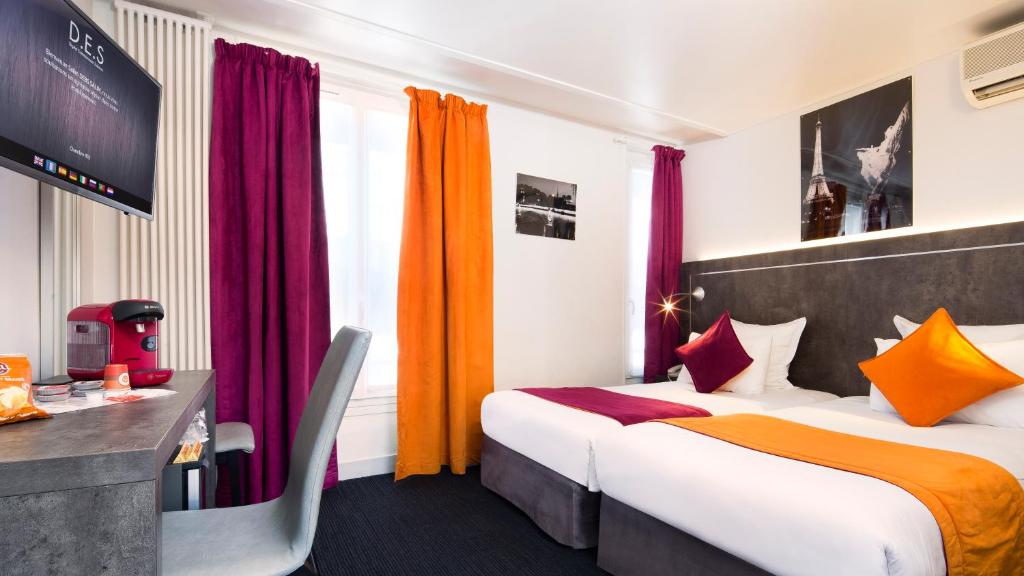
Hôtel du Plat d’Etain
★★★A very popular hotel with modern, air-conditioned and clean rooms, in a handy location on the border between Le Marais and République.- Clean and comfortable: modern, well-kept rooms
- Handy location: right between Le Marais and République
- Keep in mind: the street itself is a bit less “classic Paris”
-
I stayed here!
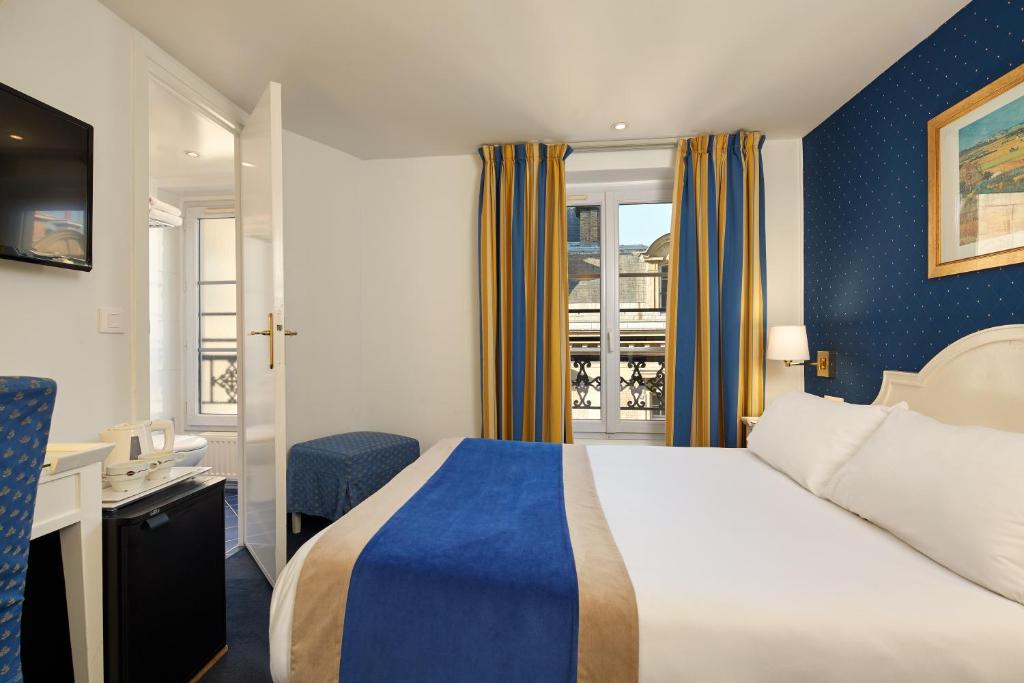
Austin’s Arts Et Metiers
★★★A strategic location near Le Marais and Les Halles, a short walk from the Centre Pompidou. An excellent choice if you want a great location at a fair price.- Close to everything: a strategic location near Le Marais
- Good morning: a rich, tasty breakfast
- Keep in mind: some rooms may get street noise
-
I stayed here!

Meslay Republique
★★★A basic, very clean hotel that offers great value for money. It sits right next to Place de la République and its excellent public transport.- Getting around: right by Place de la République (a major metro hub)
- Value: excellent value for money
- Keep in mind: a basic hotel with no frills
The Marais is a wonderful place to stay, both for its pleasant atmosphere and its central location. If you’re looking for recommended hotels in the neighborhood, have a look at these articles:
- Hotels in the 3rd arrondissement (northern Marais)
- Hotels in the 4th arrondissement (southern Marais)
Vacation apartments in the Marais
Udi, who rents out vacation apartments in Paris, has 3 apartments in one building on Rue Simon-le-Franc, less than a minute’s walk from the Centre Pompidou. I’ve stayed in two of them several times. They get booked fast, so check availability as early as you can.
-
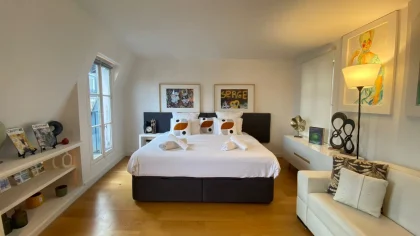
Apartment 1 near the Pompidou
An apartment in a simply perfect location, a few steps from the Centre Pompidou. You’ll find thoughtful modern design alongside old-world charm, and it makes a perfect base for couples or small families who want to experience the Marais up close. No wonder that every time I come to Paris I try to get this apartment (sadly, often without success, because it gets booked very fast).
Nearest metro station: Rambuteau
- A historic building with an elevator (rare!)
- Fully equipped, with the metro close by
- The western Marais is fairly busy
-
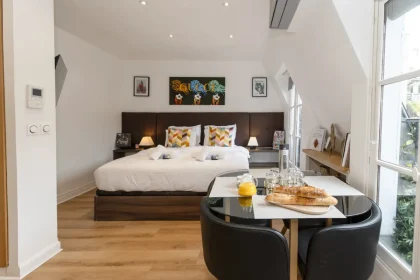
Apartment 2 near the Pompidou
In the same building as the previous apartment, this one is a perfect fit for a small family looking for comfort in the middle of everything. A smart, well-designed space that uses every square meter to make you feel at home, right by the best cafés and boutiques of the neighborhood.
Nearest metro station: Rambuteau
- Cheaper than the larger apartment in the same building
- Ideal for a small family
- Smaller floor space
-
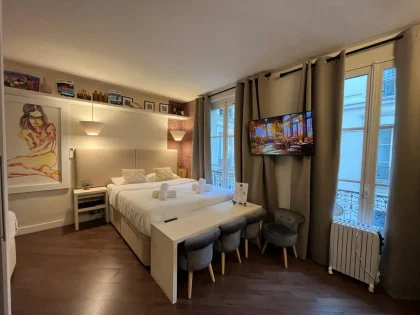
Apartment 3 (studio)
The smallest apartment in the building that holds the two apartments above. An intimate, bright and tastefully designed studio, with an open space that combines a well-equipped kitchenette with a romantic atmosphere, so you feel like a local from your very first day in the city.
Nearest metro station: Rambuteau
- Just right for a couple or a couple with a child
- Central location in a sought-after building
- One room (studio)
If you prefer vacation apartments, have a look at these articles:
- Apartments in the 3rd arrondissement (northern Marais)
- Apartments in the 4th arrondissement (southern Marais)
Attractions in the Marais
This walk covers a few of the main attractions, such as Place des Vosges, but there are several more that didn’t make it into the route and are well worth a visit. You’ll find them in these articles:
Related reading
