
Le Procope sits on a small, elegant street in the 6th arrondissement of Paris, close to Odéon and the heart of Saint-Germain-des-Prés. If Café de Flore and Les Deux Magots represent the Paris of Sartre and de Beauvoir, Le Procope belongs to an older Paris: the Paris of the Enlightenment, the Encyclopedists, the French Revolution and the philosophical debate that was just finding its way to the public stage.
This is the place most closely associated with Voltaire as a coffee drinker (he was addicted to the stuff, as you’ll see), a polemicist and a man of the Enlightenment. It wasn’t just a café he visited, it was one of the clearest symbols of the culture Voltaire is considered to represent so well: wit, anti-clericalism, scientific curiosity, a belief in the power of reason, and a deep, sharp and cynical hostility toward institutionalized stupidity.
This article is part of a series I’ve dedicated to the historic cafés of Paris, and here the spotlight is entirely on Le Procope: its history, its atmosphere, up-to-date practical information and, of course, my honest recommendations for a visit.
- Address: 13 Rue de l’Ancienne Comédie, 75006 Paris
- Opening hours: Sunday–Thursday: 12:00–00:00; Friday–Saturday: 12:00 to 1:00 a.m. A separate coffee lounge is open without reservation Sunday–Thursday, 15:00–18:00
- Phone: 0033 1 40 46 79 00
- Getting there by public transit: Metro lines 4 and 10, Odéon station
- Reservations: I recommend booking ahead, especially on weekends and during the tourist season
- Official website: procope.com
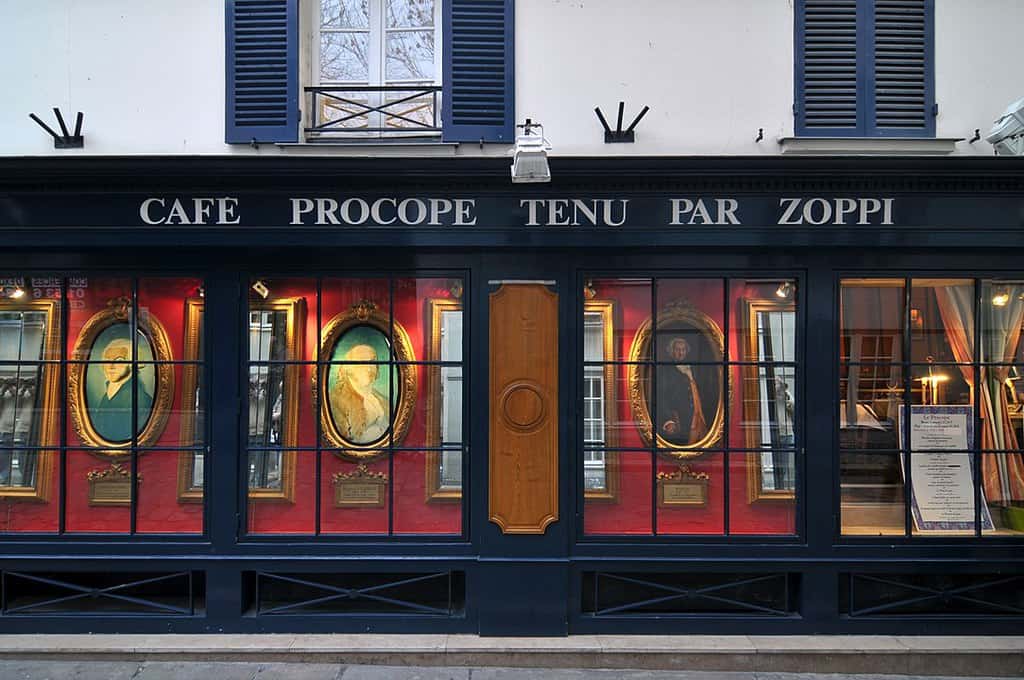
History
Le Procope opened in 1686, founded by Francesco Procopio dei Coltelli, a Sicilian who brought a new culture of coffee, ice cream, sorbet and more elegant service to Paris. At a time when coffee was still seen as a foreign, exotic drink (its first public introduction to French audiences had flopped), Le Procope made it part of refined urban life. The timing was perfect. Shortly afterward, the Comédie-Française theater opened nearby, and the street became a natural hub for actors, playwrights, critics, aristocrats and writers.
That’s how one of the most important arenas of 18th-century Paris came to be: not a private aristocratic salon, but an urban space where writers and politicians could meet, argue, shape ideas and test their power in public. In the 18th century, Le Procope became one of the places most closely identified with the French Enlightenment. Voltaire, Rousseau, Diderot and d’Alembert were all connected to it. Later, American revolutionary figures like Benjamin Franklin and Thomas Jefferson sat there too, alongside figures of the French Revolution.
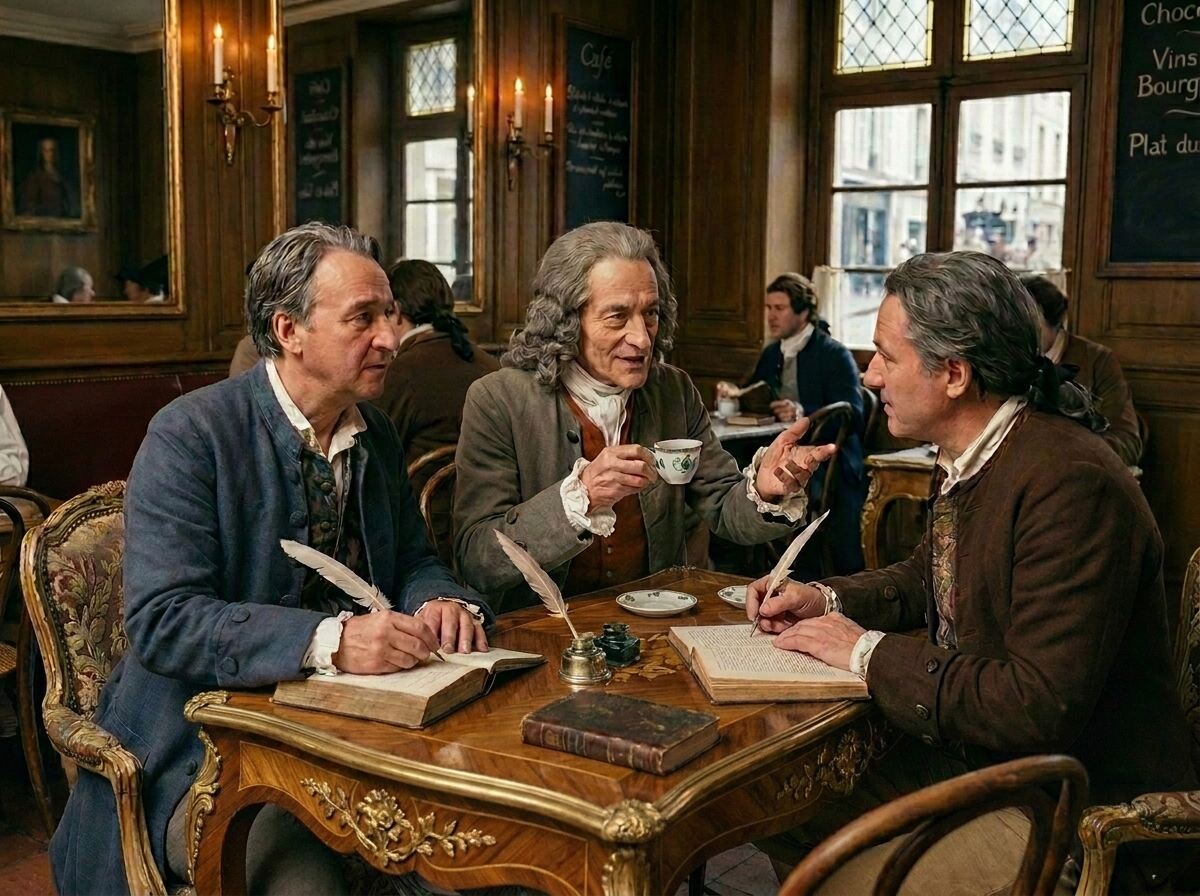
Character and atmosphere
The atmosphere at Le Procope is very different from that of the more modern cafés in Saint-Germain. It’s not just sidewalk seating next to a wide storefront window. Le Procope has an almost museum-like character: decorated walls, chandeliers, portraits, mirrors, historic rooms, and a sense of institution and space that reminds the visitor they’re not just sitting down for a meal, but dining inside a centuries-old French story.
Famous figures
The central name is of course Voltaire, but around him gathers an entire map of 18th-century thought and statecraft. Jean-Jacques Rousseau, Denis Diderot, Jean le Rond d’Alembert, the Marquis de Condorcet, Benjamin Franklin, Thomas Jefferson, Maximilien Robespierre, Georges Danton and Jean-Paul Marat are all linked to the story of this place.
A Parisian scene
The most famous episode tied to this place is Voltaire’s legendary habit of drinking enormous quantities of coffee, sometimes mixed with chocolate. The exact numbers belong to legend, but the story rings true in a symbolic sense: it captures Voltaire as a man of pace, output and extreme intensity, matching exactly the world of the Enlightenment that grew up around him.
The café today
Le Procope is still open, but it operates mainly as a historic brasserie-restaurant rather than a classic intellectual café. The experience today is more like a French restaurant with a museum consciousness, rather than lingering for hours with a cup of coffee that’s now really just set dressing.
Le Procope suits a thoughtful visit. Don’t expect bohemian spontaneity here. Think of it as a well-preserved historic site. The best way to experience it is to walk through the rooms, pay attention to the historic details, and sit down for a meal or an afternoon coffee.
Getting there
The most convenient station is Odéon, a very short walk from the café and served by metro lines 4 and 10. You can also arrive from Mabillon or Saint-Germain-des-Prés. From Notre-Dame, it’s about a 15-minute walk through the Left Bank and the Saint-Michel area.
A visit pairs well with the nearby Cour du Commerce Saint-André, and with the two legendary cafés of Saint-Germain, Café de Flore and Les Deux Magots, both within walking distance.
What to order
Since Le Procope is now mainly a restaurant, the right visit is a proper lunch or dinner, not just a quick coffee. Among the historic dishes, consider the coq au vin, the joue de bœuf braisée (slow-braised beef cheek), or the ravioles du Dauphiné. If you’re after something lighter, go for the French onion soup, escargots, beef tartare, or a dessert like crème brûlée or mille-feuille. Ordering a coffee or a chocolate-coffee dessert fits especially well with the Voltaire myth and his devotion to coffee.
FAQ about Le Procope
What are Le Procope’s opening hours?
Is Le Procope still a café or a restaurant?
Who were the famous people associated with Le Procope?
What should I order at Le Procope?
Is Le Procope a tourist trap?
Le Procope is part of another series I’ve written about the legendary cafés of Paris. For all the other addresses and the full list, head back to the main article on the historic cafés of Paris.
Related reading
