

Two figures carved from exotic wood, and a fabric shop that gave its name to a café. Les Deux Magots stands in the Place Saint-Germain-des-Prés, across from the ancient church that gave the neighborhood its name, and it is a landmark in its own right in the mythology of the Left Bank: a street corner where literature, tourism, fashion, journalism and Parisian tradition all meet under the same awning.
This article is part of a series I’ve dedicated to the historic cafés of Paris, and in it we dive into the place itself: history, atmosphere, up-to-date practical information and, of course, my real recommendations for your visit.
- Address: 6 Place Saint-Germain-des-Prés, 75006 Paris
- Opening hours: every day, from 7:30 a.m. to 1:00 a.m.; weekend and holiday brunch from 10:30 to 15:30
- Phone: 0033 1 45 48 55 25
- Getting there by public transport: Metro line 4, Saint-Germain-des-Prés station; another option is Metro line 10, Mabillon station
- Reservations: available on the official website, recommended during busy seasons
- Official website: lesdeuxmagots.fr
Les Deux Magots stands in the Place Saint-Germain-des-Prés, directly across from the ancient church that gave the neighborhood its name. This isn’t just an address next door to Café de Flore; it’s a landmark in its own right in the mythology of the Left Bank, a street corner where literature, tourism, fashion, journalism and Parisian tradition all meet under the same awning.
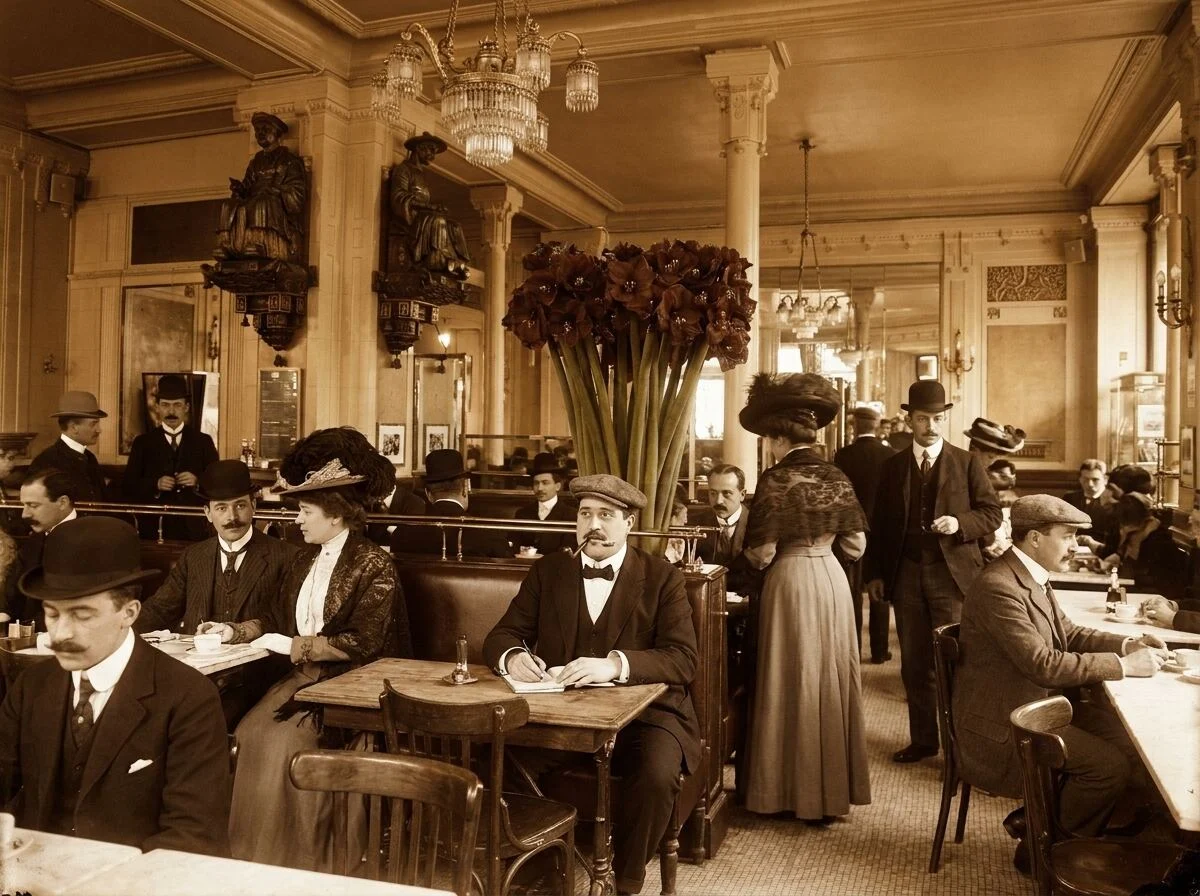
The name, which sounds a little unusual to a European ear, comes from two East Asian wooden figures, the magots, which are still on display inside the café today. Before it became a café, the place was a shop selling fabrics and decorative objects that carried this same name. Over the years the figures remained as a kind of historic talisman, a small trace of an earlier chapter in the address’s life. The official website notes that the café has operated here since 1884, and that the two figures are the source of both its name and its visual identity.
History
Les Deux Magots opened in 1884, at a time when Saint-Germain-des-Prés was beginning to shed its image as a quiet, church-bound neighborhood and become a hub of intellectual life, publishing, galleries, literary journals and literary gatherings. If Le Procope belongs to the Paris of the eighteenth century, Les Deux Magots embodies the Paris that came later: a modern, fast-moving, international city, where the intellectual becomes a recognized public figure, bordering on a cultural icon.
In 1914 the café came under the management of Auguste Boulay, and later became a family business associated with the Mathivat family. The fact that it remained a family operation for so many years is one of the reasons it managed to keep its continuity, its reputation and its distinctive style, even as the crowd around it changed completely: from poets and surrealists, through philosophers and theater people, to today’s travelers looking for a taste of the legend.
Character and atmosphere
This is a café built for watching: an open elegance, a view onto the square, a constant flow of waiters, tightly packed tables, seating facing an ancient church. Anyone who sits on the terrace becomes, in a way, part of the scene they’re picturing in their mind: a cup of coffee, a wicker chair, a short conversation, an open book, and the church across the way standing as a quiet witness to the whole scene.
Famous faces
The list of names associated with Les Deux Magots is a long one. Among the figures linked to it are Guillaume Apollinaire (1880-1918), Louis Aragon (1897-1982), André Breton (1896-1966), André Gide (1869-1951), Jean Giraudoux (1882-1944), Jacques Prévert (1900-1977), Fernand Léger (1881-1955), Pablo Picasso, Ernest Hemingway, James Joyce (1882-1941), Albert Camus (1913-1960), Boris Vian (1920-1959), Jean-Paul Sartre (1905-1980) and Simone de Beauvoir (1908-1986).
A Parisian scene
The founding of the Prix des Deux Magots in 1933 is a cornerstone in the institution’s story. The prize was created as a response to the Prix Goncourt, which some literary circles saw as too academic. The first winner was Raymond Queneau (1903-1976) for his novel Le Chiendent. It’s an almost perfect Parisian scene: not a speech at the Académie, but a prize born out of a café, a conversation and a literary circle.
Books, memories and stories
The official website of Les Deux Magots notes that it was here that Simone de Beauvoir wrote Les Mandarins, the novel for which she won the Prix Goncourt in 1954. The most public episode associated with the place is a surrealist one: André Breton and his friends came here looking for a stage on which to hold forth on “common sense,” on the bourgeoisie, and on the limits of the imagination.
The café today
Les Deux Magots is still open, and today functions as a mix of literary café, Parisian restaurant and site of pilgrimage. The official website lists long opening hours, from 7:30 a.m. to 1:00 a.m. In the morning, the place is ideal for coffee, a pastry or a light bite facing the square; by lunch and in the evening it becomes a busier restaurant. On weekends, holidays and during peak hours, a special brunch is served, from 10:30 to 15:30.
How to get there
The simplest way is to take the metro to Saint-Germain-des-Prés on line 4, then walk a short distance to the square. You can also arrive via Mabillon on line 10, which works well if you’re coming from the Saint-Sulpice, Odéon or Latin Quarter area. The visit pairs well with the nearby Café de Flore, with Rue Bonaparte, and with wandering through the galleries and bookshops of the neighborhood.
What to order
The most symbolic choice is the café’s famous hot chocolate, or a coffee with a dessert on the terrace. If you’re coming for a meal, you can choose from Burgundy escargots, smoked salmon, beef tartare, beef filet, fish of the day, king prawn risotto, veal blanquette, and desserts like warm tarte tatin and profiteroles.
If this is your first time, order a hot chocolate, a coffee, or one good dish on the terrace, and focus on the overall experience. Les Deux Magots isn’t a place you measure only by what’s on the plate; you’re also paying for the square, for the figures on the pillar, for the literary prize, and for the pleasant feeling that you’re taking part, for a moment, in a long-standing Parisian ritual.
FAQ about Les Deux Magots
What are the opening hours of Les Deux Magots?
What can you eat at Les Deux Magots?
What’s the difference between Les Deux Magots and Café de Flore?
Do you need to book a table in advance?
Who were some of the café’s famous visitors?
Les Deux Magots is another stop on the mythical map of Parisian cafés. For all the other addresses, and the full itinerary of the walk between Sartre, the Flore and the Closerie, you can head back to the main article on the historic cafés of Paris.
Related reading
