

Parisian café culture isn’t just about roasted coffee beans, a pastry that melts in your mouth, or a table looking out at a stunning facade. For centuries (and still, to no small degree, today) the Parisian café was the very fabric of urban life: a meeting place, a stage for debate, an unofficial office, a public living room, and sometimes a literary and political microcosm all at once. Unlike the private home, which was closed off and more status-bound, the café created a space in between: intimate yet public, ordinary yet steeped in prestige, open to everyone yet identified with those who knew how to turn sitting there into an art form, whether figuratively or literally.
The power of the Parisian café comes from the combination of three intertwined elements: location, pace, and visibility. It’s usually set along a major urban axis, a boulevard, a square, or a transit hub, close to a theater, a newspaper office, a university, or a publishing house. It allows for a long stay in exchange for a relatively modest order, and above all, it turns whoever sits there into part of the city’s show. In Paris, sitting in a café isn’t a break from the bustle of the street. It’s a redefinition of the street, through more elegant means.
A Bit of History
Coffee arrived in Paris as early as the mid-seventeenth century, but the first real attempt to open a café there didn’t come until 1672, by Pasqua Rosée. That attempt didn’t spark an urban revolution right away. That only happened a few years later, with the arrival of the famous and scandalous Café Procope (Café Procope, or Le Procope). Gaps and later changes in its operation mean it can’t claim perfect continuity, but it’s hard to overstate its importance as a cornerstone in the formation of the modern Parisian café.
And indeed, between the eighteenth and twentieth centuries, thanks to the success “the pilot” enjoyed, the idea spread across the entire city. During the Enlightenment, philosophers, encyclopedists, and revolutionaries sat in the cafés. In the nineteenth century, they were joined by writers, journalists, painters, and art critics. In the early twentieth century, cafés became hubs of the avant-garde, modernism, and bohemian life. And after World War II, they became an inseparable part of the mythology of existentialism, the Left Bank, and Saint-Germain-des-Prés.
The language changed with every era, but the structure stayed the same: a small table, a coffee, a newspaper, a notebook, a cigarette, and a sense that the great ideas of the time weren’t born only in academia or in parliament, but also between cups, waiters, and side conversations. Despite the serious image this might conjure up, it’s worth stressing the social side of it: the Parisian café was never a “workroom”. It was a social stage. The writer who wrote there, the philosopher who argued there, the painter waiting for a meeting with a patron or an editor, all of them took part in a space of display where culture was created in full view of others.
Geography matters just as much as the big names. Saint-Germain-des-Prés is linked with philosophers, editors, poets, and the Left Bank. Montparnasse is tied to artists, immigrants, modernists, and an international bohemian crowd. The Opéra area and the Grands Boulevards bring to mind the journalists, theater people, high society, and literature of the nineteenth century. And the historic cafés around the Palais-Royal evoke the Paris of the Enlightenment, chess, debate, and revolution.
Each neighborhood produced a different kind of café: intellectual, artistic, political, journalistic, aristocratic, or bohemian. Many of these cafés still operate today in a kind of ongoing dialogue before our eyes, caught between past and present. Some have closed and survive only as a memory, an address, or an anecdote. Others are still active, but they also function as cultural pilgrimage sites. You’ll find tourists there, cameras, high prices, and, some would argue, a certain contrived artificiality. And yet, their power hasn’t faded, and to this day they remain a destination for lovers of culture and history, or simply curious travelers.
Now that we’ve gotten this far, it only makes sense to open the list of cafés in this article with Le Procope. Not necessarily because it’s among the oldest and most famous names in the history of the Parisian café, but because it embodies the moment when the café stopped being a culinary novelty and became a true urban institution: a place where Paris (and, in time, the whole world) thinks out loud.
Le Procope
13 Rue de l’Ancienne Comédie, 75006 Paris, official website of Le Procope
Le Procope, on Rue de l’Ancienne Comédie in the heart of Saint-Germain-des-Prés, is considered the oldest café in Paris. It opened in 1686 and is linked to generations of thinkers, from Voltaire and Rousseau to the revolutionaries of France. Today it operates mostly as a historic brasserie-restaurant, but it still keeps a distinctly museum-like atmosphere.
Read the full article on Le Procope: history, opening hours and what to order »
Café de Flore
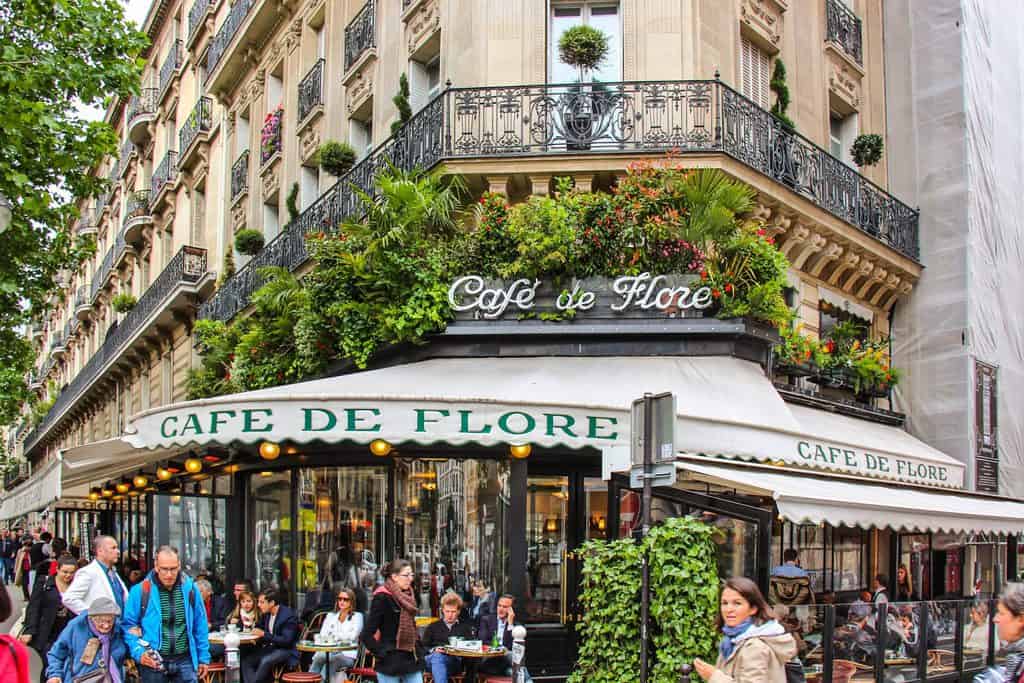
172 Boulevard Saint-Germain, 75006 Paris, official website of Café de Flore
Café de Flore, on the corner of Boulevard Saint-Germain and Rue Saint-Benoît, is one of the addresses most closely tied to literary Paris of the twentieth century. From Guillaume Apollinaire (1880-1918) and the Surrealists to Jean-Paul Sartre (1905-1980) and Simone de Beauvoir (1908-1986), it became the unofficial headquarters of existentialism.
Read the full article on Café de Flore: history, opening hours and what to order »
Les Deux Magots
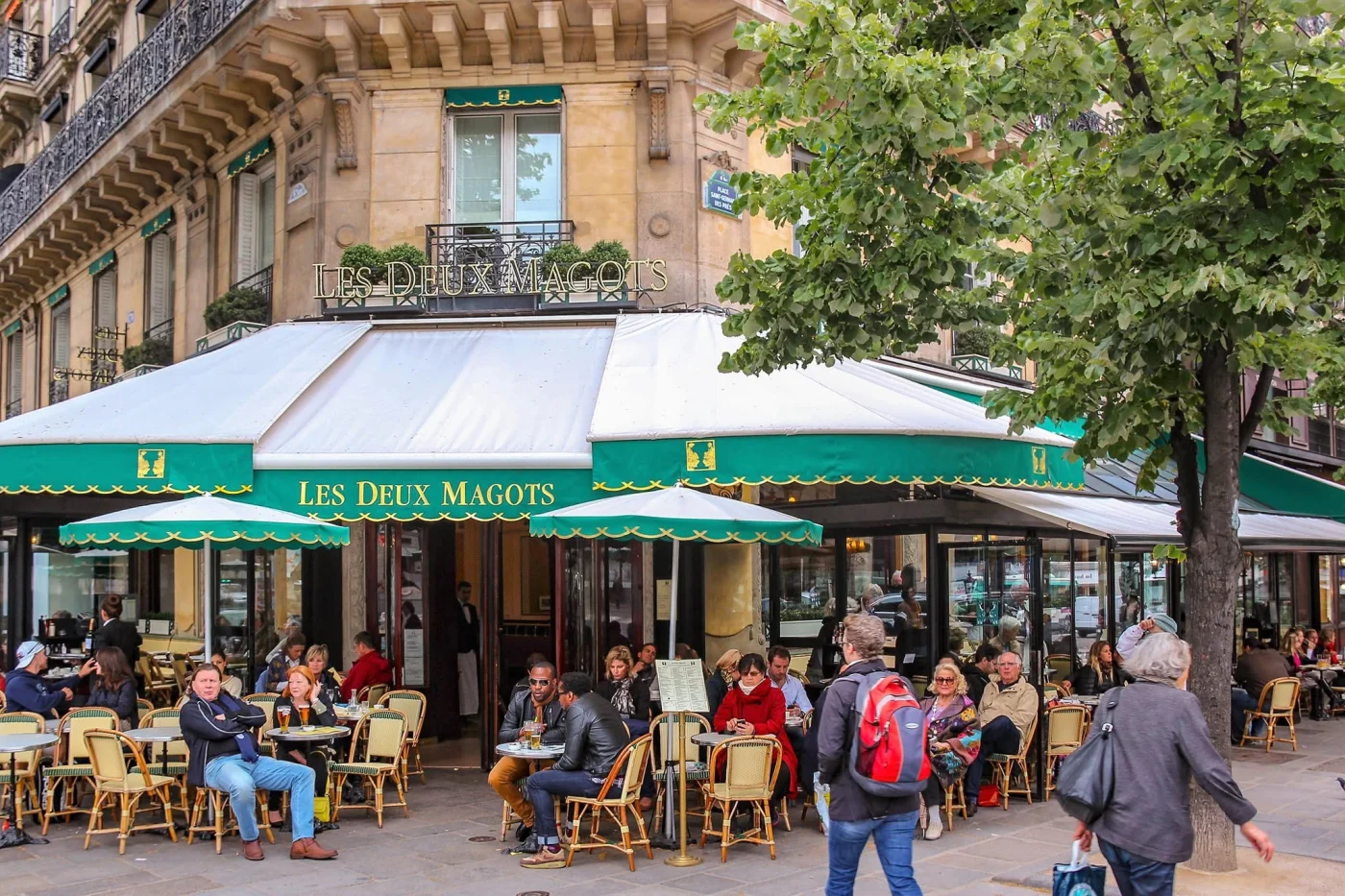
6 Place Saint-Germain-des-Prés, 75006 Paris, link to the café’s website
Les Deux Magots sits on Place Saint-Germain-des-Prés, facing the ancient church that gave the neighborhood its name, and holds its own as a landmark in the mythology of the Left Bank. The Prix des Deux Magots, founded there in 1933, along with names like Apollinaire, Hemingway, and Simone de Beauvoir, turned it into a genuine literary institution.
Read the full article on Les Deux Magots: history, opening hours and what to order »
La Closerie des Lilas

171 Boulevard du Montparnasse, 75006 Paris, website of La Closerie des Lilas
La Closerie des Lilas sits at the edge of Boulevard du Montparnasse, right at the border of the 6th arrondissement and the doorstep of bohemian Montparnasse. The place is mostly associated with Ernest Hemingway (1899-1961), but also with Voltaire, Baudelaire, Apollinaire, and Picasso, who all came before him.
Read the full article on La Closerie des Lilas: history, opening hours and what to order »
One Last Sip
So here is where the journey begins: from Voltaire’s Procope and the great minds of the Enlightenment, through Sartre, de Beauvoir, and Saint-Germain’s Flore, to a long list of cafés where Paris learned to turn conversation, writing, and city life into an art form of its own. Walking between the cafés of Paris is a journey between addresses more and less famous, between places still open for business and those that live on only in memory, tracing a cultural map of a city where even a cup of coffee can carry an entire history with it.
Related reading
