
Paris cafe culture didn’t start with Café de Flore, but it’s hard to find a single address that sums it up better. The little street corner between Boulevard Saint-Germain and Rue Saint-Benoît, in the heart of Saint-Germain-des-Prés, grew over the twentieth century from a neighborhood café into the address where some of the defining chapters of modern French philosophy and literature were written. This isn’t just a famous address, it’s a genuine cultural landmark.
This article is part of a series I’ve put together on the historic cafés of Paris, where we dive deep into each one. This time, the spotlight is on the Flore: what the café looks like today, the history behind it, how to get there and what’s worth ordering (no promises about the full menu, let alone the bill).
- Address: 172 Boulevard Saint-Germain, 75006 Paris
- Opening hours: Daily, no closing day, from 7:30 a.m. to 1:30 a.m.
- Phone: 0033 1 45 48 55 26
- Getting there by public transport: Metro line 4, Saint-Germain-des-Prés station (a very short walk from there); another option is metro line 10, Mabillon station
- Reservations: No advance reservations, seating is first come, first served
- Official website: cafedeflore.fr
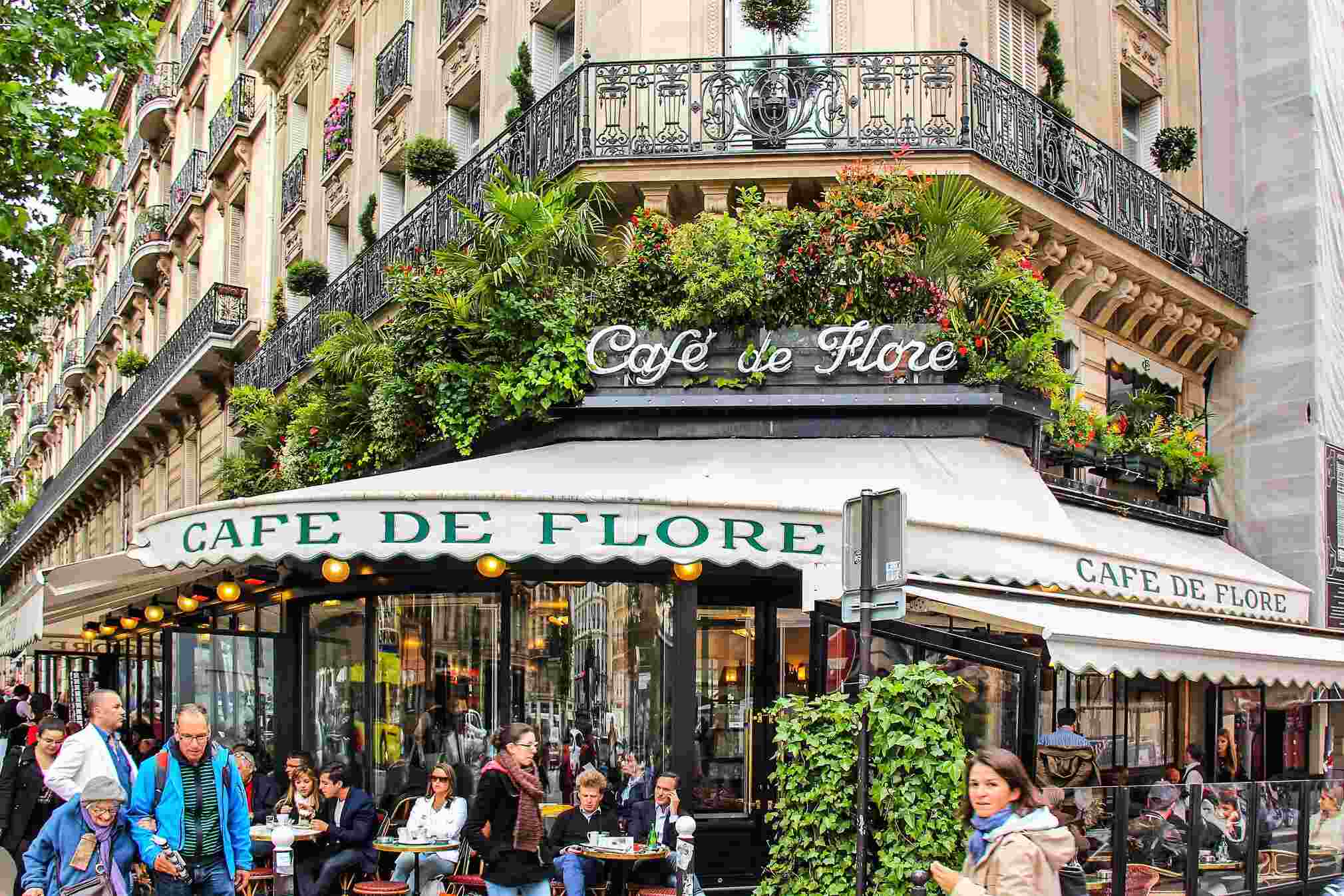
Café de Flore sits in the heart of Saint-Germain-des-Prés, at the corner of Boulevard Saint-Germain and Rue Saint-Benoît, on the Left Bank of Paris. It’s one of the addresses most closely tied to the literary Paris of the twentieth century: not a culinary institution, but a cultural landmark where simply sitting down at a table became, to no small degree, an intellectual statement.
History
The café opened at the end of the nineteenth century (most likely in 1887), during the Third Republic. Its name comes from Flora, the Roman goddess of flowers and spring, whose statue once stood in the area. From its earliest days, the place drew a range of leading figures from Parisian intellectual society: writers, editors and thinkers. But its great fame was built mostly during the twentieth century.
At the start of the century, the place became tied to various literary and political circles. Guillaume Apollinaire (1880-1918), one of the central figures of modernist poetry in France, turned it into something like a permanent office; poets, editors and avant-garde figures gathered around him. Later, the Flore became linked to the worlds of Dada and Surrealism (a term Apollinaire coined), especially to names like André Breton (1896-1966), Louis Aragon (1897-1982) and Philippe Soupault (1897-1990). As significant as that early period was, it was the 1940s and 1950s that turned the place into an international legend, when Jean-Paul Sartre (1905-1980) and Simone de Beauvoir (1908-1986) made it the unofficial headquarters of existentialism. From there, the image of the Parisian café spread not just as a place to drink, but as an institution where whole movements of thought were born.
Character and atmosphere
The atmosphere at Café de Flore rests on an interesting tension: on one hand, it’s a very elegant café, almost archetypal, with a green awning, red seating, mirrors, small tables and classic French service. On the other hand, its history isn’t purely aristocratic, it’s also bohemian, argumentative and literary.
In its glory days, the café wasn’t a place for quiet solitude, but a stronghold of conversation and debate. Its history is bound up with people who wrote, talked, argued, met students, editors, mistresses, rivals and readers. Whoever sat there wasn’t just drinking coffee, they were taking part in a cultural scene. In this sense, the Flore embodies the old-fashioned idea of the Parisian intellectual well: someone who thinks in public, writes in public, and runs their intellectual life as part of an ongoing urban theater.
Famous figures
The figures most closely identified with the place are Jean-Paul Sartre and Simone de Beauvoir, but they were only the most famous, most visible front of a much wider circle. Before them, as mentioned, the café was tied to Guillaume Apollinaire, André Breton, Louis Aragon and the literary avant-garde movements of the early twentieth century.
Later on, the café was frequented by Albert Camus (1913-1960), Raymond Queneau (1903-1976), Boris Vian (1920-1959), Marguerite Duras (1914-1996), Pablo Picasso (1881-1973), Alberto Giacometti (1901-1966), Juliette Gréco (1927-2020), as well as figures from the worlds of film, fashion and photography. The Flore didn’t belong to a single school of thought, however important. That’s part of the secret of its pull: it served as a meeting point between philosophy, literature, painting, journalism, politics, fashion and nightlife. It was a café for writers, but also for people who wanted to be seen near writers.
A Parisian scene
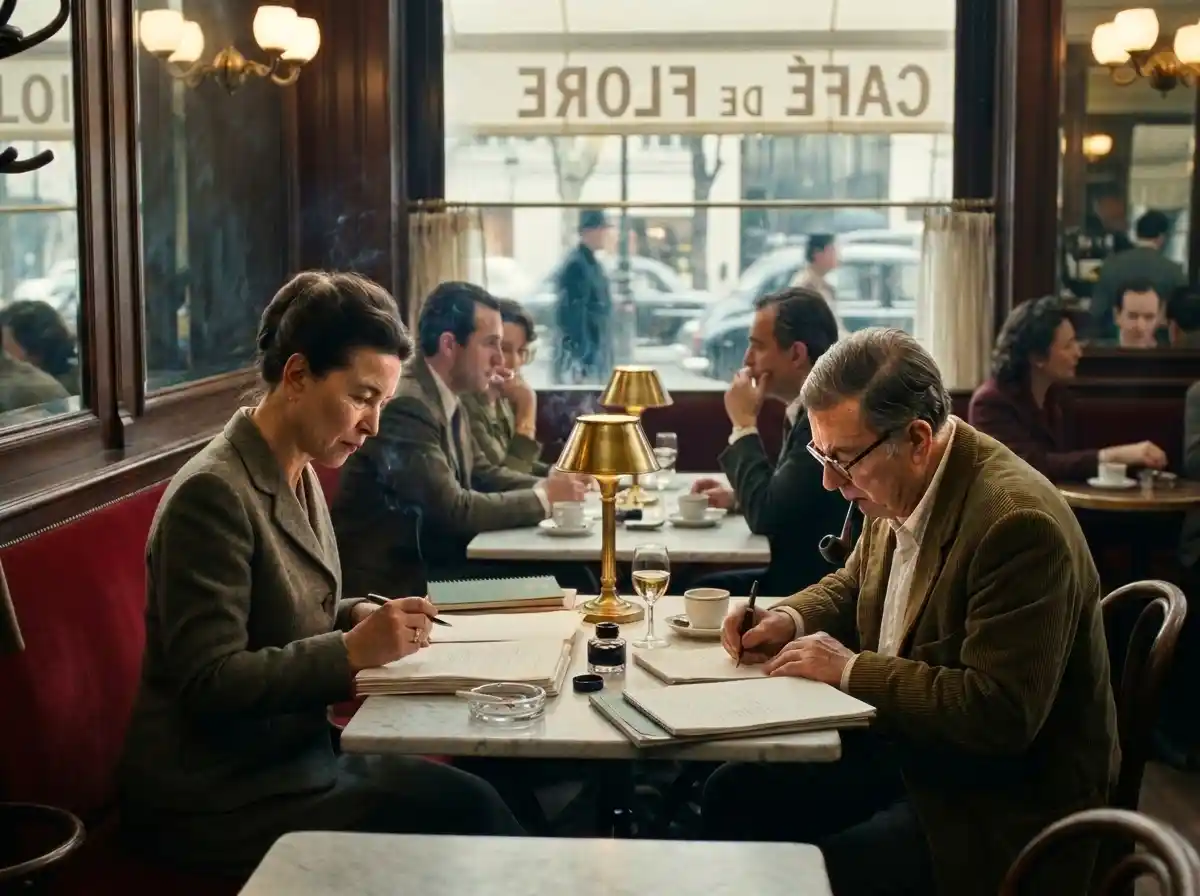
The central episode in the café’s history is its transformation into a kind of daily office for Sartre and de Beauvoir. During the German occupation and the years that followed, when apartments were cold and often unsuited for long hours of work, the café offered heat, a table, coffee, newspapers, and above all, a social stage. Sartre and de Beauvoir would sit there for hours on end. De Beauvoir worked on her writing, while Sartre met students, admirers, actors, editors and political allies.
Ideas born in the German libraries of Husserl and Heidegger took on a Parisian shape here: less academic, more public, more dramatic. Existentialism became not just a philosophical method but a way of life, complete with a regular table, cigarettes, coffee, open novels, politics, and conversations that ran late into the night.
Books, memoirs and stories
Café de Flore appears again and again in memoirs and writing about Saint-Germain-des-Prés. It shows up in the story of postwar Paris, in biographical works on Sartre and de Beauvoir, and in the mythology of the Left Bank as a space where intellectual life was never separate from public life.
It’s hard to understand the legend of philosophical Paris without picturing the Flore as a constant backdrop: a small table, a cup of coffee, a stack of papers, and the sense that every private conversation was woven into the sweep of history. A rich storytelling tradition also surrounds Apollinaire and the Surrealists, the café is remembered as one of the places where modernist poetry moved off the page and into public discourse.
Other figures
Alongside the central names, it’s worth mentioning André Malraux (1901-1976), Jacques Prévert (1900-1977), Jean Cocteau (1889-1963), Truman Capote (1924-1984), Ernest Hemingway (1899-1961), Françoise Sagan (1935-2004), Yves Saint Laurent (1936-2008), Catherine Deneuve (b. 1943), Brigitte Bardot (b. 1934), Serge Gainsbourg (1928-1991) and others. Some were regulars, others passed through or are simply associated with the era when the place became a required stop for the cultural elite.
The café today
Café de Flore is still open, but it lives in the tension between being a working establishment and a mythological site. It’s open every day, takes no advance reservations, and draws tourists, Parisians, fashion people, journalists, writers, curious visitors and others who come mostly for its historical aura. Prices are high and the experience can feel more ceremonial than intimate, but that’s actually part of the appeal. You don’t come to the Flore to discover some secret café, you come to sit inside a historical legend that’s fully aware of itself.
The design keeps to a conservative Parisian look: small tables, a highly recognizable facade and tight seating. During busy hours the place can feel touristy and loud, so the best time to visit is usually in the morning or during off-peak hours, when you can grab a seat by the window or outside.
How to get there?
The easiest way is by metro, to Saint-Germain-des-Prés station on line 4. From there it’s a very short walk. Another option is Mabillon station on line 10, which works well if you’re coming from the Left Bank or the Latin Quarter. From Notre-Dame or Île de la Cité, it’s a pleasant 15 to 20 minute walk along the Left Bank.
The visit pairs well with the Saint-Germain-des-Prés church, with the nearby Les Deux Magots, with Rue Bonaparte, with the Saint-Sulpice church, and with wandering through the galleries and bookshops of the neighborhood.
What to order?
The most classic order is actually the simplest: a coffee, a hot chocolate, a croissant or a light breakfast, seated outside or by the window. If you want something more closely identified with the place, consider the Welsh Rarebit, a cheddar and beer toast in a rich, fairly heavy version. A lighter and more traditional option is the Croque Monsieur Spécial Flore. For anyone who prefers familiar French cuisine, there’s also French onion soup, quiche lorraine, steak tartare, duck confit, cheeses and desserts like crème brûlée or tarte Tatin.
My practical advice: don’t come very hungry, and don’t judge the place by its price-to-portion ratio. At the Flore, you’re also paying for the location, the history and the ritual. The right way to visit is to order one good dish, or a coffee and a dessert, sit without rushing, and let your imagination do the rest.
Frequently asked questions about Café de Flore
What are the opening hours of Café de Flore?
How do you get to Café de Flore by public transport?
Can you reserve a table in advance?
What’s the connection between Sartre, de Beauvoir and Café de Flore?
What should you order on a first visit?
Café de Flore is just one stop, even if one of the most central, on our journey through the legendary cafés of Paris. For all the other cafés, the history behind them and what’s worth ordering at each one, you can head back to the main article on the historic cafés of Paris.
Related reading
