
There are passages in Paris that every lover of the city knows, the ones that have become legendary: the magnificent Galerie Vivienne or the bustling Passage des Panoramas. But let me tell you a little secret. There’s another passage, more intimate, remarkably elegant, that I’m especially fond of for its calm and its timeless beauty.
This is a place you have to search for. You slip away from the bustle of a busy street like Rue Jean-Jacques Rousseau, step through a rather unassuming archway, and suddenly, silence. The noise of the city fades, the light softens, and you feel like you’ve stepped into a time capsule. That’s exactly what happens when you discover the Galerie Véro-Dodat.
This isn’t just another one of Paris‘s covered passages. It’s a hidden treasure, an architectural gem that tells a fascinating story of ambition, art, drama and a stunning modern revival. The passage, ideally placed between the Louvre and the lively Les Halles neighborhood, manages to keep an atmosphere of calm and intimacy that has nearly vanished from the world.
I invite you on a journey back in time, to discover with me the story of this gallery: a story of two bold butchers, commercial genius, a tragic actress and the red soles that breathed new life into it.
The butchers’ gamble: a commercial revolution in 1826
The story of the Galerie Véro-Dodat begins, surprisingly, not in some noble palace but in a butcher’s shop. In 1826, two shrewd entrepreneurs, Benoît Véro and François Dodat, who had made their fortune selling meat and sausages, spotted a golden opportunity. They weren’t aristocrats, but men of the rising bourgeois class, with a sharp eye for business.
Their genius lay in the location. They understood that a covered, elegant shortcut between the fashionable Palais-Royal area, the entertainment center of Paris, and the Les Halles neighborhood, then the city’s main and busiest market, would be a dazzling success. But they had another winning card, the real secret to their success.
Right across from the gallery’s entrance on Rue Jean-Jacques Rousseau stood the offices and central station of “Messageries Laffitte et Gaillard,” the largest and most important stagecoach company in France. This fact completely changed the character of the passage. While most other passages in Paris were built for the flâneur (the leisurely Parisian stroller), Véro-Dodat became a lively waiting station for voyageurs (travelers).

This target audience, waiting for their coach, was a captive and affluent crowd, and the shops in the gallery adapted accordingly. Restaurateurs like the famous Monsieur Bontoux opened their doors in the early morning hours, offering delicacies suited for travelers. This dependence on stagecoach traffic was the gallery’s great source of strength, but also its fatal weakness. Success was immediate and dazzling, but once the railway was invented and the age of the stagecoach declined under the Second Empire, the gallery’s fortunes declined too, and it sank into obscurity.
The art of illusion: an architectural masterpiece
Véro and Dodat weren’t satisfied with a winning location; they wanted to sell an experience. They hired the architect François-Jacques Delannoy (1755-1835) to create a space that would radiate prestige, sophistication and timeless elegance in a neoclassical, Pompeian style. Every architectural detail in the gallery was designed not just for beauty, but as a clever business strategy.
The most striking element is, without a doubt, the marble floor, made of black and white tiles arranged in a diagonal diamond pattern. This isn’t a random choice. The diagonal pattern creates an optical illusion of depth and perspective, making the passage, which is only 80 meters long, look much longer and more impressive. The ceiling, which combines glass panels with landscape paintings and allegorical figures, and the uniform, elegant shop fronts arranged along a precise horizontal line, also contribute to the illusion of scale and order.

At the entrance from Rue du Bouloi stand two statues that are a genuine statement of intent: Hermes, the god of commerce, with his winged helmet and caduceus, and Hercules, wrapped in the skin of the Nemean lion, a symbol of strength and labor. This choice is no accident. It celebrates the values of the rising bourgeoisie: commercial initiative and hard work. The entire architecture is, in effect, a business plan cast in stone and marble, a testament to the vision of two butchers who understood how to sell a dream.
Echoes in the arcade: actresses, caricatures and Parisian life
In its heyday, the Galerie Véro-Dodat was more than just a shopping center. It was a miniature stage for the cultural and political drama of Paris.
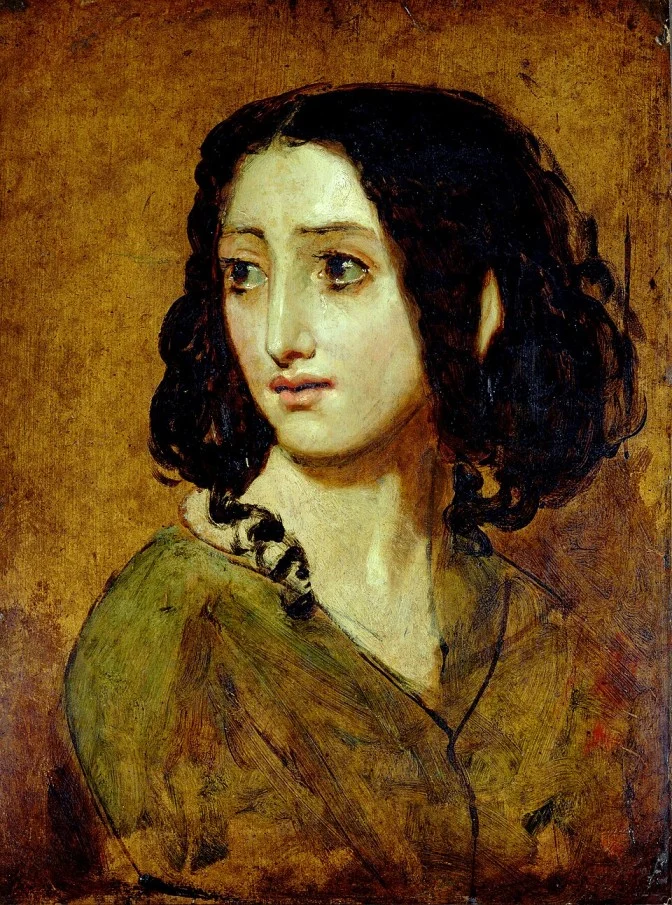
Between 1838 and 1842, an apartment above the passage was home to the most famous tragedienne of the era, Rachel Félix (1821-1858). I like to imagine her, the star of the Comédie-Française, returning home at night through the quiet passage, the echo of her footsteps on the marble floor, after yet another performance that was met with thunderous applause.
At the same time, on the ground floor, stood the shop of the print seller Aubert, publisher of two of the most important and daring satirical newspapers of the era, “Le Charivari” and “La Caricature.” His shop window displayed, for sale and for viewing, the sharp political caricatures of artists like Honoré Daumier (1808-1879), who spared no one in his mockery of the authorities and the hypocrisy of high society.
This combination, an icon of the cultural establishment living upstairs alongside a hub of subversive satire downstairs, turned the small passage into a unique arena where high art and political critique met. The same wealthy bourgeois who might have been the butt of Daumier’s caricatures walked right past Aubert’s shop window on their way to the luxury boutiques. It’s a secret story of Paris, one that reveals the cultural and political tensions of the July Monarchy.
Gérard de Nerval’s last night
Alongside the glamour and the satire, the passage also carries a darker, more tragic memory. It’s tied to the last night in the life of one of the greatest and most tormented poets of the Romantic era, Gérard de Nerval (1808-1855).

Nerval, a tormented soul who struggled his whole life with melancholy and madness, found refuge in the passage. He was a regular at the “Café de la Galerie” and also at the “Café de l’Époque,” known as one of his favorite haunts.
On the freezing night of January 25, 1855, Nerval drank his last cup of coffee at the “Café de la Galerie.” From there, he walked out into the Parisian cold and continued on his final journey. The next morning, he was found hanged from a railing on a drainpipe on the shabby Rue de la Vieille-Lanterne, near Place du Châtelet. Ever since, whenever I walk across the cold marble floor, I can’t help but think of the poet’s last steps, a shadow of genius and despair who drank his final cup in this magnificent arcade on his way to his death.
From obscurity to red soles: a modern renaissance
As mentioned, the rise of the railway and Baron Haussmann’s urban revolution condemned the Galerie Véro-Dodat, like many other passages, to long years of decline and obscurity. But its story wasn’t over. In 1997, the gallery underwent a thorough and extensive renovation that restored its original splendor, uncovering the ceiling paintings once again and polishing the marble floor.
But the spark that ignited its modern renaissance came in the shape of red soles. Shoe designer Christian Louboutin (born 1963) chose this quiet, elegant gallery to open not only his flagship store for women, but also his very first men’s boutique in the world. This choice turned the 19th-century passage into a pilgrimage site for fashion lovers from every corner of the globe, giving it a new, prestigious identity.
Exploring Véro-Dodat: my personal guide
So what should you do? How do you experience the magic of this place? Let me take you on a personal tour. Unlike other passages, the atmosphere here is calmer, almost meditative. This is a place to savor the small details.

Temples of fashion
You can’t talk about Véro-Dodat without mentioning Christian Louboutin. His two stores, one for women at the entrance from Rue Jean-Jacques Rousseau and another for men, are the gallery’s anchor of prestige. Even if you’re not planning to buy anything, the carefully designed shop windows are a work of art in themselves.
Keepers of the craft
The passage is also home to artists and craftspeople. Keep an eye out for the shop of the luthier, a maker and repairer of stringed instruments, and for the shops specializing in antique dolls (where the famous shop of Robert Capia once stood) or home decor. These are shops where tradition and craftsmanship are still at the center of things.
Treasures of art and antiques
Several art galleries and antique shops add to the refined atmosphere of the place. It’s the perfect spot to find an old print, a painting or a unique design piece.
A refined break
At the end of your walk, I highly recommend stopping at the brasserie Restaurant Véro-Dodat. Sitting there with a cup of coffee or a glass of wine, watching the passersby under the glass ceiling, is the perfect way to soak up the atmosphere of the Belle Époque and feel the pulse of history.
A timeless refuge
The Galerie Véro-Dodat is more than just a covered street. It’s a testament to Paris’s remarkable journey: from a pragmatic commercial venture serving stagecoach travelers, through years of obscurity, to its rebirth as a haven of modern prestige.

For me, this is one of the most special places in the city. Not just for its beauty, but for its intimacy. This is a place where history isn’t put on display like a museum exhibit. It breathes, it lives, and it whispers stories to anyone willing to listen. I urge you, dear Francophiles, on your next visit to the City of Light, to seek out this secret. Let yourself get lost for a moment, walk across the marble floor, and feel the echoes of a different Paris. Laissez ce passage vous raconter son histoire, let this passage tell you its story.
Practical information for the Galerie Véro-Dodat
- Address: Entrances at 19 Rue Jean-Jacques Rousseau and 2 Rue du Bouloi, 1st arrondissement, Paris.
- Getting there: Metro: Palais Royal – Musée du Louvre station (lines 1, 7) or Louvre-Rivoli station (line 1).
- Opening hours: The passage is open Monday through Saturday, from 7:00 a.m. to 10:00 p.m. Closed on Sundays (note that individual shop hours may vary).
- What not to miss: The stunning perspective created by the marble floor, the statues of Hermes and Hercules at the entrance, and the shop windows of Christian Louboutin.
- The Francophile’s tip: Come on a weekday morning to experience the place at its most peaceful. Combine your visit with a stroll through the nearby Palais-Royal gardens for a perfect Parisian afternoon.
Related reading
