

The task I took on when I started writing this article is a brutal one. Almost impossible. How can I pick out 10 chosen statues and abandon and neglect thousands of others that are no less deserving? How do you choose the ten greatest out of an endless selection?
To make things easier for myself and narrow down the options, I decided this article would only cover statues placed in public spaces: parks, gardens, squares and streets of the city, not ones kept with due honor inside museums.
Since the mid-19th century, Paris has been gradually turning into an open-air sculpture museum. That wonderful, fascinating process has never stopped, and it continues right up to today. For example, in 2019 Paris gained a huge, controversial environmental sculpture by the American sculptor and painter Jeff Koons (born 1955). The sculpture was placed on the plaza behind the Petit Palais and is called “Bouquet of Tulips.” I loved feeling tiny standing at the feet of this impressive piece. I didn’t choose it as one of my ten picks, but it certainly deserves to lead and decorate this article as its cover image.
Among the statues below there is no internal ranking, so the order in which they appear has no significance.
The list of must-see statues in Paris
The Mouth of Truth
A marble statue stands in the eastern part of the Luxembourg Gardens in Paris, dating from 1871. It has an Italian name: La Bocca della Verità (The Mouth of Truth). The sculptor is Jules Blanchard, and his work refers to a Roman legend according to which you can’t pull your hand out of the mouth of the Statue of Truth unless you’ve never told a lie. When you’re at the Luxembourg Gardens, put yourself to the test. In my case, my hand came out quite easily.
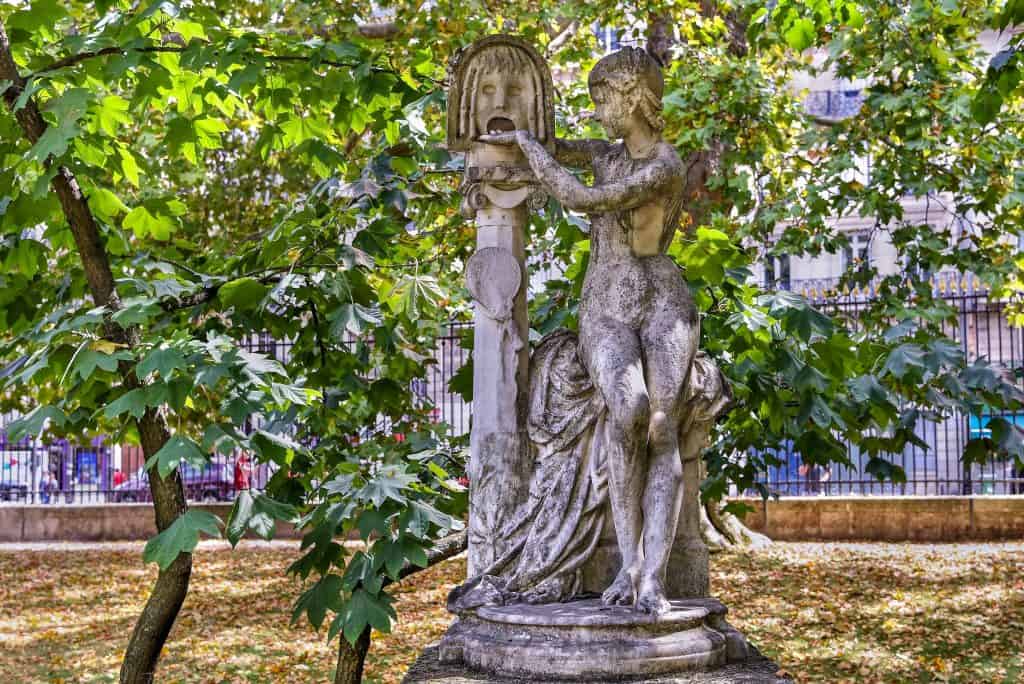
A great scene that illustrates this idea appears in the film Roman Holiday (1953), starring Audrey Hepburn (1929-1993) and Gregory Peck (1916-2003), who have fun testing each other’s past lies next to the original statue in Rome.
Listening
The moving statue by Henri de Miller (1953-1999) stands in Place René Cassin, in the renovated garden of the Forum des Halles. The statue is called Écoute. In Hebrew this could be translated as “listen” or “pay attention.” But maybe it isn’t a command at all, just “listening.”
The story behind the statue is brilliant: it tilts its ear toward the ground. Listening to the earth, looking up to the sky. It’s a reminder of the sounds and bustle that once filled the huge Les Halles market that stood here. The statue listens to the underground noises of Paris, to the echoes from deep within the earth, to the sounds of passersby in the massive shopping center, and to the trains running beneath.
This is one of my favorite statues in Paris, and it moves me every time I walk past it. A charming statue, a wonderful spot, a pleasant garden all around. It’s always nice to come back and pair it with a visit to the nearby, stunning Church of Saint-Eustache.
Voltaire
Voltaire was the pen name of François-Marie Arouet, a French philosopher and writer. He was one of the leading figures of the Enlightenment and believed literature was a way to drive social change. His cynical, satirical and philosophical writings expressed his contempt for Christianity, intolerance and tyranny. The wonderful statue of Voltaire by the sculptor Léon Drivier was placed in 1962 in a small, modest and slightly hidden garden called Square Honoré Champion, in the 6th arrondissement of Paris, at the end of Rue de Seine, very close to the river.
Honoré Champion (1846-1913), after whom the garden is named, was a bookseller and publisher who lived on Rue Jacob until he died suddenly of an embolism at age 67 in 1913. He has a beautiful grave in Montparnasse. His publishing house still exists today.
The Greek Actor
At one of the exhibitions I held, I called a photo of this statue “the world’s first selfie.” That was obviously a joke. In reality, this is a statue called The Greek Actor, made of bronze, standing in the Luxembourg Gardens near the rectangular Medici Fountain, built in the Italian style. This wonderful statue is the work of the sculptor Arthur Bourgeois.
The statue was inspired by Greek theater and shows a young man learning his next role, text in hand and a mask on his forehead. In the background, on the right side of the image, stands the impressive and important Panthéon.
Joan of Arc
Joan of Arc (c. 1412-1431), also known as the Maid of Orléans, was a French military leader who played a key role in liberating France from English occupation during the Hundred Years’ War in the 15th century. She’s considered a French national hero. She was executed in 1431 at age 19.
Joan of Arc has been commemorated through a great many statues. Her golden statue, showing her on horseback, was created by the renowned sculptor Emmanuel Frémiet, whose many important statues are scattered across Paris. The statue stands at Place des Pyramides, near the Louvre Museum, since 1874. A striking, powerful statue, and there was no question it belonged on this list.
Churchill
Winston Churchill (1874-1965) was a British politician and statesman. After a long career as an army officer, war correspondent, writer, historian and politician, Churchill rose to power. He served as Prime Minister in two terms, from 1940 to 1945 and again from 1951 to 1955.

Winston Churchill’s striking statue in Paris stands in front of the Petit Palais, in the 8th arrondissement, on Avenue Winston Churchill, which leads from the Champs-Élysées to the Pont Alexandre III. The base of the statue reads “We shall never surrender.” The statue is relatively new, from 1998, and was created by Jean Cardot. A wonderful statue.
Winged Muse
We’re back in the Luxembourg Gardens. Near the entrance from Boulevard Saint-Michel, on a wide lawn among colorful flowers and tall trees, stands a very impressive statue that deserves a place on this list. The statue shows a winged muse embracing the chest of the poet Leconte de Lisle (1818-1894), considered the father of the Parnassian school of French poetry.
In 1873 he was appointed assistant chief librarian of the Luxembourg Palace library, and in 1886 he was elected to the French Academy, taking the seat of Victor Hugo, who had died a few months earlier. The statue was unveiled in 1898 and is the work of Denys Puech.
The Statue of Diana
Just like the Luxembourg Gardens, which earned three spots on my list of ten, the royal Tuileries Garden also has an impressive collection of high-quality, fascinating outdoor statues, some of them nudes. Of all the statues in the Tuileries, my favorite is the statue of Diana with her hound.

This is a perfect marble statue in a perfect setting with an equally perfect backdrop. Called La Statue de Diane, it was created by the sculptor Edmond Lévêque in 1866 and placed in the Tuileries Garden in 1872.
The Walker Through Walls
On the wall at Place Marcel Aymé in Montmartre stands a wonderful statue with a fascinating story. During World War II, the French writer Marcel Aymé (1902-1967) wrote a short story called “The Man Who Walked Through Walls” (Le Passe-Muraille).
The hero of the story is Dutilleul, a minor government clerk, who suddenly discovers he has a supernatural power: he can walk through the walls of buildings. When the new deputy director at his office starts disrupting his peace with new rules and procedures, Dutilleul uses his power to torment the deputy director, for fun and for small pranks. Before long, he’s drawn into a life of crime, robbing jewelers and banks, evading police, and having love affairs. When he’s finally caught and thrown behind bars, he simply uses his power and walks out of prison with ease.
It all ends one bright day when he swallows a headache pill, and the small, seemingly harmless pill has a side effect that stops his ability to pass through walls. The pill kicks in exactly as he’s on his way out through one of the walls, and he’s left stuck inside it. The wonderful statue was created by the renowned actor and artist Jean Marais (1913-1998).
By the way, this statue is also included in the Montmartre walking tour I created for you.
The Thinker
For the last statue in this article, I’m breaking my own rule that all the chosen statues would be in public spaces. I simply couldn’t resist, and I had to include The Thinker by Auguste Rodin (1840-1917). I felt this list would be incomplete without it. It’s my favorite statue in the world. The statue is displayed in the sculpture garden of the Musée Rodin in the 7th arrondissement. You’ll have to pay a small admission fee for the gardens to see it, but it’s absolutely worth it.
The sheer amount of energy radiating from this statue is immense. Rodin himself once explained: “What makes the Thinker think is that he thinks not only with his brain, with his furrowed brow, his distended nostrils and compressed lips, but with every muscle of his arms and back, his legs, with his clenched fist and gripping toes.” Perfect.
Looking for more interesting things to see in Paris?
Here are a few articles by Yoel that can help you:
- Recommended places in Paris: the ten attractions you can’t miss
- 15 parks, gardens and forests in Paris you need to know, by Yoel Thamanlis
- 17 romantic spots in Paris where you might want to ask “will you marry me?”, by Yoel Thamanlis
Related reading
