

When you visit the garden of the house of Honoré de Balzac (1799-1850) in the 16th arrondissement and look down below, you’ll spot a grand palace called the Hôtel de Lamballe. Today it’s the Turkish embassy, but the palace has a long story behind it, one that includes lavish balls, an owner who met her death torn apart by a mob, and even a psychiatric hospital where more than a few notable people were treated.
Since we sadly can’t visit this palace in person (not even on European Heritage Days), and can only admire it from a distance, let me tell you its story, so we can at least pay it a virtual visit.
The Palace of Marie Antoinette’s Best Friend
The hillside of Passy drew aristocrats for centuries before Passy became part of Paris. So it’s no surprise that as early as the 15th century, there was already an aristocratic estate here, built on the foundations of a monastery that had stood there during the Middle Ages.
The estate’s location, not far from the Seine, made it prime real estate, and over the centuries that followed, a long line of nobles lived here, each one expanding the estate, adding new wings and, of course, tending to a beautiful park right along the riverbank.
One of the most famous people to live at the estate in the early 18th century was Antonin Nompar de Caumont, duc de Lauzun (1633-1723).
This duke, who had previously lived at the Hôtel de Lauzun on Île Saint-Louis, decided in 1701 to move in, first as a tenant and later as the owner.

He arrived there at age 72 with his young wife, who had been 15 when they married (he, a young man of 63, by comparison). Since he was, to put it mildly, an unpleasant person (read the article on the Hôtel de Lauzun and you’ll understand why), his wife hoped her husband would die soon and leave her a young widow. Unfortunately for her, she had to wait 31 years before her 91-year-old husband finally agreed to depart this world.
When the duke died, his widow decided to sell the palace, and it passed through several hands until 1783, when it was sold for 110,000 livres to the princesse de Lamballe, Marie-Thérèse-Louise de Savoie-Carignan (1749-1792), who gave the palace its name.

A Good Little Savoy Girl
Before we continue the story of the palace, it’s worth saying a few words about the princesse de Lamballe, and how a fight over inheritance led her toward her horrific end.
The princess was born Marie-Thérèse-Louise de Savoie-Carignan, a descendant of the dukes of Savoy and the kings of Sardinia, who would, in the 19th century, unify Italy and become its kings. Marie-Thérèse was a charming girl with a good nature, a proper “good Savoy girl,” raised in a convent and devoted to prayer and charity.
Here we need to jump quickly from Turin, where Marie-Thérèse lived, straight to France, where the duc de Penthièvre, Louis de Bourbon, duc de Penthièvre (1725-1793), lived. This duke, the illegitimate grandson of Louis XIV and one of the wealthiest men in Europe, had a problem. His son and heir, the prince de Lamballe, was an extreme womanizer who, before even turning 20, had already visited the finest brothels of Paris and slept with the capital’s finest theater actresses.

The duke wanted to set his son straight, so when he heard about that “good Savoy girl,” he decided she’d make the ideal match for his son.
Since he was, as mentioned, the grandson of Louis XIV and a very wealthy man, he didn’t have to work too hard to convince Marie-Thérèse’s father to give his daughter’s hand to the prince de Lamballe. In 1767, the princess arrived in Nangis, where a lavish wedding was held.
But the princess couldn’t compete with the actresses of Paris, and soon after, she was abandoned for an unknown actress he fell for, even selling his wife’s diamonds to cover his mistress’s debts. In return, that actress gave him a gift of her own: a fatal venereal disease. So in 1768, just a year after the wedding, the prince de Lamballe died, leaving his wife a widow at 19.
His widow inherited not only her husband’s fortune but also his venereal disease, having contracted it during one of their few attempts to produce an heir. The duc de Penthièvre, taking pity on his son’s widow, invited her to the Château de Rambouillet and summoned the finest doctors to try to cure the princess. Their efforts succeeded and the disease retreated, though its marks remained on the princess’s unfortunate body.

In 1769, Louis-Philippe, duc de Chartres and future duc d’Orléans (1747-1793), decided to marry Marie-Adélaïde de Bourbon (1753-1821), sister of the late prince de Lamballe and one of the heirs to the duc de Penthièvre’s vast fortune. Without knowing it at the time, that very marriage would lead to the tragic end of the princesse de Lamballe 23 years later.
Best Friends
The same year the duc d’Orléans married the sister of the late prince de Lamballe, his widow arrived at the royal court. Just as before, the princess was a small pawn controlled by larger forces, this time the daughters of Louis XV, who were looking for a bride to “calm” their womanizing father, and concluded that the princesse de Lamballe was the perfect person for the job (sound familiar?).
Luckily for the princesse de Lamballe, Louis XV found himself a “new toy” in the form of the Comtesse du Barry and decided he had no interest in marrying again. This spared the princess the fate of being the small, betrayed wife, but because of her status, she remained at the king’s court. A year later, a new princess arrived at court, one who shared quite a few similarities with the princesse de Lamballe. Both were pawns in the hands of courtiers and diplomats, and both had come from abroad as strangers to the French court.

I mean, of course, Marie Antoinette (1755-1793), an Austrian princess forced to marry, at age 15, the crown prince of France (the future Louis XVI) in order to strengthen the Franco-Austrian alliance. After the wedding, she found herself among nobles, most of whom were hostile to her out of jealousy or because of her origins. And here, in this “nest of vipers,” she found the princesse de Lamballe, who, like her, was a foreign princess and a small pawn in a game of giants. This shared fate quickly made the two women close friends.
With the friendship came rewards, and after Marie Antoinette became queen of France in 1774, the princesse de Lamballe received the prestigious position of superintendent of the queen’s household. To stay relatively close to the royal court on one hand, but also to the City of Light on the other, the princesse de Lamballe decided to buy the palace in Passy in 1783, since it sat right on the road between Paris and Versailles.
The princess came to this grand palace, with its stunning garden that stretched all the way to the Seine, whenever she wanted to escape the intrigues of the Versailles court. Right next door lived her father-in-law, the duc de Penthièvre, at the Château de Boulainvilliers (later demolished, with the Jardin du Ranelagh, among other things, built on its ruins). Together they devoted themselves to charity and good deeds, while at the same time, lavish balls were held in the gardens of the Hôtel de Lamballe along the banks of the Seine.
Murder by Messenger
All this idyll shattered in 1789, six years after the princesse de Lamballe bought her palace. The French Revolution broke out in Paris, and Marie Antoinette quickly realized that the old world was gone, and that France had become a dangerous place.

The princesse de Lamballe stayed with the queen until 1791, when Marie Antoinette tried to flee eastward with her family and was arrested in the town of Varennes. The princesse de Lamballe fled to London and managed to arrive there safely.
The queen and the princess continued to write to each other, and in many of these letters, the queen insisted that the princess stay in England, since the situation in France was only growing more dangerous. But one day in 1792, a letter arrived from Marie Antoinette, urgently asking the princesse de Lamballe to return to France.
Since the princesse de Lamballe was a loyal friend, she didn’t hesitate for a moment and boarded a ship for France. But when the princess arrived in Paris, she was arrested and taken to the La Force prison, located in the heart of the Marais (not far from the Jewish quarter).
On September 3, a makeshift tribunal was held at the prison, and the princesse de Lamballe was required to swear an oath accepting the values of the Revolution. The princess agreed to that, but she was then asked to condemn and curse Marie Antoinette, and that, she would not do. As a result, the judges sentenced her to death. As she was being led to the courtyard, a mob attacked her and murdered her in a horrifying manner (quite a few accounts even claim she was raped and her breasts were cut off).

The mob wasn’t satisfied with the horrific murder: they cut off the princess’s head, placed it on a pike, and marched north to the Temple fortress (today the site of the town hall of the 3rd arrondissement). They went there specifically because the royal family (Louis XVI, Marie Antoinette and their two children) was imprisoned in that fortress. When they reached a spot not far from the window of Marie Antoinette’s room, they raised the pike with the princesse de Lamballe’s head, and the horrified queen saw the severed head of her dear friend.
But the story of the princesse de Lamballe’s death isn’t as simple as it looks, and honestly, it reads more like an Agatha Christie detective novel, in which the real killer is someone else entirely. Like Hercule Poirot, let me draw your attention to a small but important detail that appeared earlier in our story: the sister of the prince de Lamballe married the duc d’Orléans and stood to inherit half of the duc de Penthièvre’s enormous fortune.
Why only half? Because the princesse de Lamballe, who had an excellent relationship with the duc de Penthièvre, was set to inherit the other half. The duc d’Orléans, who was no pauper himself (he had, after all, built the first shopping arcade at the Palais-Royal and made significant sums of money from it), wasn’t satisfied with just half the inheritance.
The duke, who also wanted to inherit from Louis XVI and become king of France himself, funded all the monarchy’s opponents and placed them under his protection. These were the very people who led the French Revolution, which, as mentioned, caused the princesse de Lamballe to flee to England.

But as long as the princess sat safely in England, the duke couldn’t get his hands on her money or the future inheritance. So he forged Marie Antoinette’s handwriting and signature and wrote a letter demanding the princess come to Paris. From there, everything worked like clockwork. The princess arrived in France, was imprisoned and murdered by a mob that had been incited for years through pamphlets, printed under the duc d’Orléans’s direction, filled with vicious lies about Marie Antoinette and the princesse de Lamballe (some even claimed the queen and her dear friend had a lesbian relationship).
Now that the princesse de Lamballe was dead, all the duc d’Orléans had to do was wait for the duc de Penthièvre’s death, which came in March 1793 (surprisingly, he died of natural causes rather than on the guillotine, unlike many nobles of the time). Two months earlier, Louis XVI had been executed (after the duke voted in favor of the death penalty), and it seemed the duke’s plan to become ruler of France was about to come true.
But “the Revolution, like Saturn, devours its own children,” and during the Reign of Terror, the duc d’Orléans’s status changed quickly. From one of the leaders of the Revolution, he became a suspected traitor after his son, who served as an officer in the revolutionary army, joined General Dumouriez in an attempt to reach an agreement with the Austrians, enemies of revolutionary France.
The duc d’Orléans was arrested in April 1793 in Marseille, and in November of that same year he was transferred to the Conciergerie, where he was sentenced to death and executed at Place de la Concorde (then called “Place de la Révolution”). By the way, he never got to enjoy the inheritance money, since it went to his wife, who outlived him by about 30 years.
High Society’s Madhouse
After the princesse de Lamballe’s murder, the palace passed from hand to hand until 1846, when it became the psychiatric clinic of Dr. Esprit Blanche (1796-1852). Dr. Blanche studied medicine in Paris and decided to devote his life to treating psychiatric conditions.
Dr. Blanche opened his first clinic in 1826 on the heights of Montmartre, in a city villa that had already served as a madhouse in the late 18th century. If you’d like to hear the story of that building, feel free to watch this short video.
As mentioned, about 20 years after founding his clinic in Montmartre, where he achieved considerable success thanks to the humane treatment method he developed for mental illness, Dr. Blanche decided to move to a larger location and chose the Hôtel de Lamballe, in part because of its beautiful park. There too, Dr. Blanche achieved success that reached the ears of King Louis-Philippe of France, who thought so highly of the doctor that when he had to flee Paris during the 1848 revolution, he made a point of asking his coachman to stop by the Hôtel de Lamballe so he could bid Dr. Blanche farewell.
In 1852, Dr. Esprit Blanche died, and his place was taken by his son, Dr. Émile Blanche (1820-1893). Like his father, Dr. Émile Blanche believed in treating his patients as humanely as possible. What’s more, Dr. Blanche, who lived in the same place as his patients, ran a literary salon at his home that drew the cream of Parisian society, and he even allowed his patients (those not in a psychotic state) to attend the salon, in an effort to connect them as much as possible with the outside world.
Among his most famous patients were:
The poet Gérard de Nerval (1808-1855)
Gérard de Nerval was hospitalized both at the earlier clinic in Montmartre and at the one in Passy. Sadly, the treatment helped him only temporarily, and he eventually hanged himself from a street lamppost in Paris.
The Jewish musician Fromental Halévy (1799-1862)
One of France’s most famous opera composers (known to the general public for the opera La Juive) used to play the piano in Dr. Blanche’s salon while hospitalized there. His wife, the sculptor Léonie Halévy (1820-1884), was also a patient at the same clinic. Their daughter Esther died in 1866 under mysterious circumstances, shortly after spending about two weeks visiting her mother at the clinic.

After hearing the news, the mother accused her other daughter, Geneviève, of murdering her sister. That same Geneviève would later become the wife of the famous Jewish musician Georges Bizet (1838-1875), composer of the opera Carmen.
Later, after being widowed and remarrying the banker Émile Straus, Geneviève became a celebrated society hostess and one of the models for the Duchesse de Guermantes in Marcel Proust’s famous novel series “In Search of Lost Time.”
The writer Guy de Maupassant (1850-1893)
Maupassant is considered one of the greatest French writers of the second half of the 19th century, and a master of the short story. He contracted syphilis, whether from his father, who passed the disease on to him, or from one of his mistresses, and the disease began to affect his mental health.
In 1892, his sanity deteriorated, and he attempted to take his own life. As a result, he was committed to Dr. Blanche’s clinic, where his condition only worsened. It’s said that the last text the writer ever wrote was “Today Guy de Maupassant has become a monster.”

Guy de Maupassant died on July 6, 1893, and was buried at Montparnasse Cemetery. Dr. Émile Blanche, who had treated him, died about two months later and was buried in the family plot at Passy Cemetery.
From Gestapo Headquarters to the Turkish Embassy
After Dr. Blanche’s death, part of the estate’s land was sold off and Avenue de Lamballe was built on it (as a result, the mansion’s gardens no longer reach the Seine). The mansion itself changed hands several times and fell into increasing disrepair. In 1921, it was bought by the fighter pilot Count de Limur (André Marie Adrien de Limur, 1890-1971), who decided there was no point trying to restore it, and instead demolished it and built a perfect replica of the structure. As a result, most of the mansion you see today dates from the 20th century (only a small part from the 17th century survived).
During World War II, the German occupation forces seized Hôtel de Lamballe and handed it over to the Gestapo. While writing this article, I couldn’t find information about what happened at Hôtel de Lamballe during that period, but it’s safe to say it wasn’t the Gestapo’s main headquarters, since that was located on Avenue Foch (also in the 16th arrondissement, like Hôtel de Lamballe).
Surprisingly, the Gestapo left Hôtel de Lamballe more or less as they found it. In 1944, the niece of Turkey’s ambassador to France was walking around the neighborhood and came across Hôtel de Lamballe. She fell in love with the building and its garden and suggested to the ambassador that it become Turkey’s embassy in France. After negotiations, the building was purchased by the Turks in 1945, and in exchange, the French received another mansion in Ankara.

The Turkish embassy has occupied the site ever since, and unfortunately there’s no way to visit it (in its current state, I wouldn’t recommend visiting even during European Heritage Days, when the place is open to the public).
All I can do is hope that one day Erdogan meets the fate of the Princesse de Lamballe or the end of Guy de Maupassant, and that Turkey gets a leader who is less of an antisemite. Then, perhaps, we could celebrate the occasion and raise a glass of Champagne in the mansion’s lovely gardens, which have seen so much “action” over the past 400 years.
Bonus: Dalida’s First Apartment
Dr. Orna Liberman added some interesting information. Very close to Hôtel de Lamballe is Rue d’Ankara, named for its proximity to the Turkish embassy. The embassy’s main entrance is at number 16, avenue de Lamballe:

There is also a side entrance at number 17, rue d’Ankara:
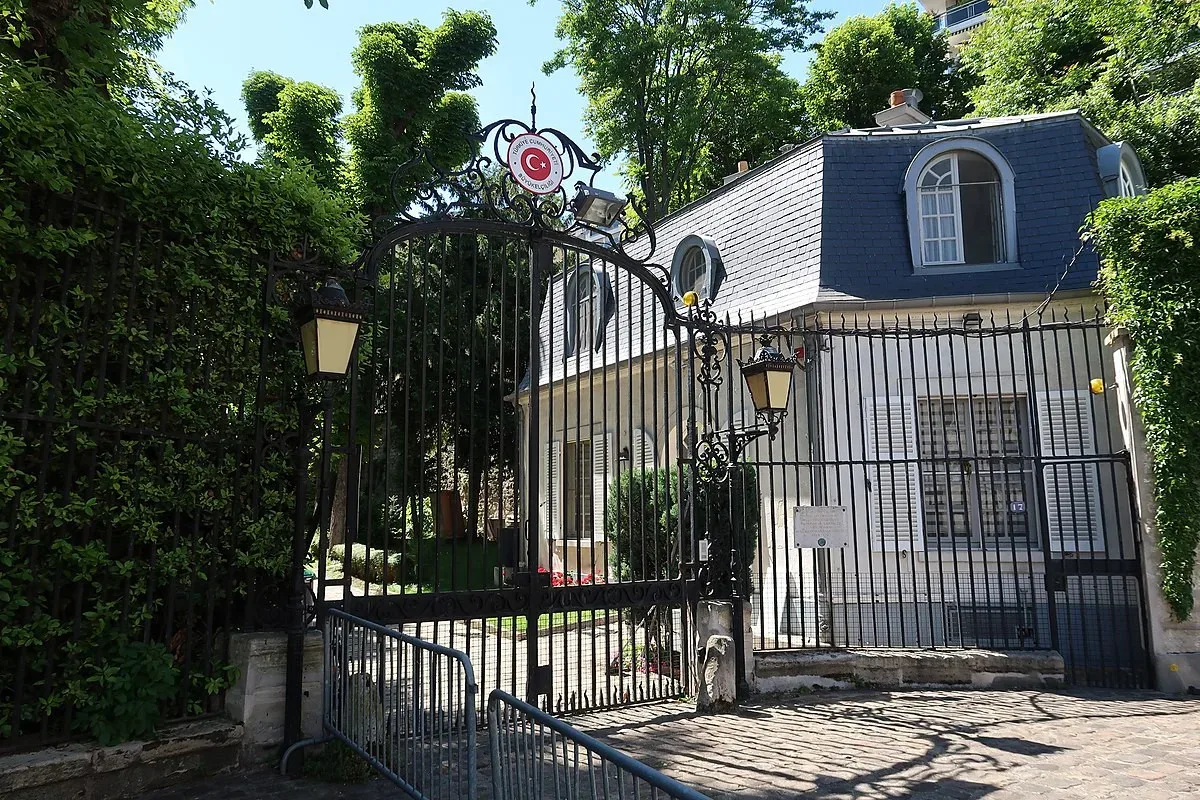
At number 7 on that same Rue d’Ankara, in an elegant building from the 1940s, the singer Dalida bought her first apartment, a two-level penthouse. You can see the building, including the balcony, on the left side of the “Hôtel de Lamballe” photograph, above the mansion itself.
Dalida lived in this apartment with Lucien Morisse, the man who made her a star. After they separated, Dalida left him the apartment, and he lived there with his third wife and children until, at age 41, he died by suicide with a gunshot. If you’d like to read more about Dalida and Lucien’s love story, as well as all of Dalida’s fascinating life, feel free to check out Dr. Orna Liberman’s article, Dalida Forever.
In this video (thanks, Orna), you can see inside the apartment, designed by the gifted singer and decorated with treasures she brought back from her travels around the world:
FAQ
Who was the Duc de Lauzun and what was his connection to Hôtel de Lamballe?
Who bought the mansion in 1783 and how did it get its name?
In which arrondissement of Paris is Hôtel de Lamballe located?
Related reading
