The Musée Marmottan Monet sits at the western edge of the Jardin du Ranelagh. On my way to the museum, I always stop for a quick moment by the statue of La Fontaine, one of the garden’s sculptures, to admire it again and marvel at how vividly it captures the fable of the crow and the fox. On the way back, when I’m not in a rush and my head is full of what I just saw, there’s more time to relax in the pleasant garden and take in all its statues.
The Jardin du Ranelagh was originally part of the park of the Château de la Muette, where a hunting lodge once stood. The lodge was later expanded into the private mansion that is now the Musée Marmottan Monet. The history of the château, the park, and the museum is told in detail in the article A visit to the Musée Marmottan Monet.
Le Jardin du Ranelagh: a romantic Belle Époque atmosphere
Three avenues named after three artists (Prud’hon, Raphaël, and Ingres) cross the wide, triangular Jardin du Ranelagh, which feels like several gardens in one. Many embassies and international institutions sit in the neighborhood, some facing directly onto the garden, so plenty of diplomats pass through here.
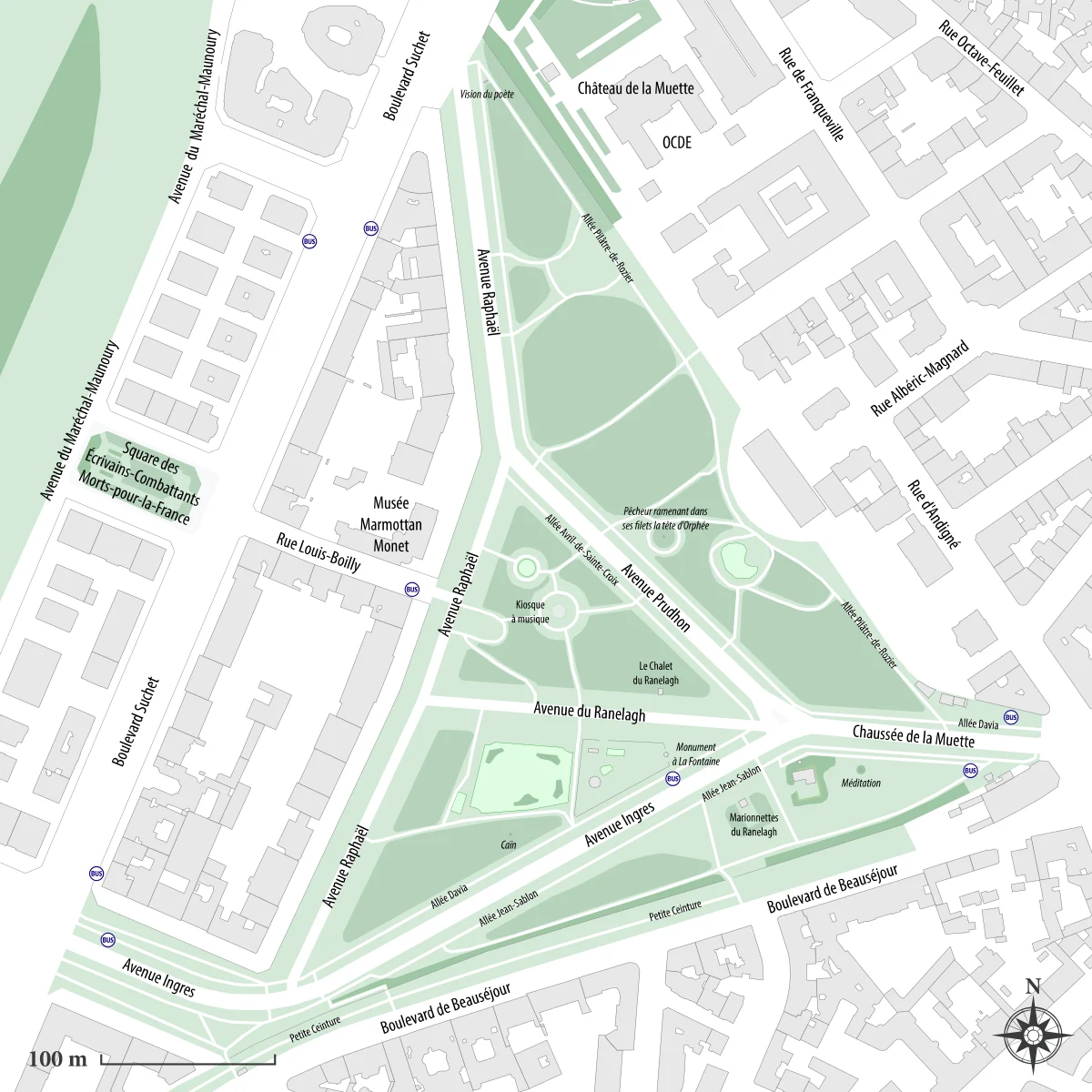
Map of the Jardin du Ranelagh triangle. Source: Wikimedia. Public domain.
The streets and lanes around the garden let you admire bursts of architectural creativity, grand private mansions, and picturesque houses. On Avenue des Chalets, literally “avenue of the cottages,” a private street that can still be visited on a guided tour, you’ll see ten picturesque two-story villas with pointed roofs. The villas were built for 19th- and 20th-century bourgeois families who wanted a home with character.
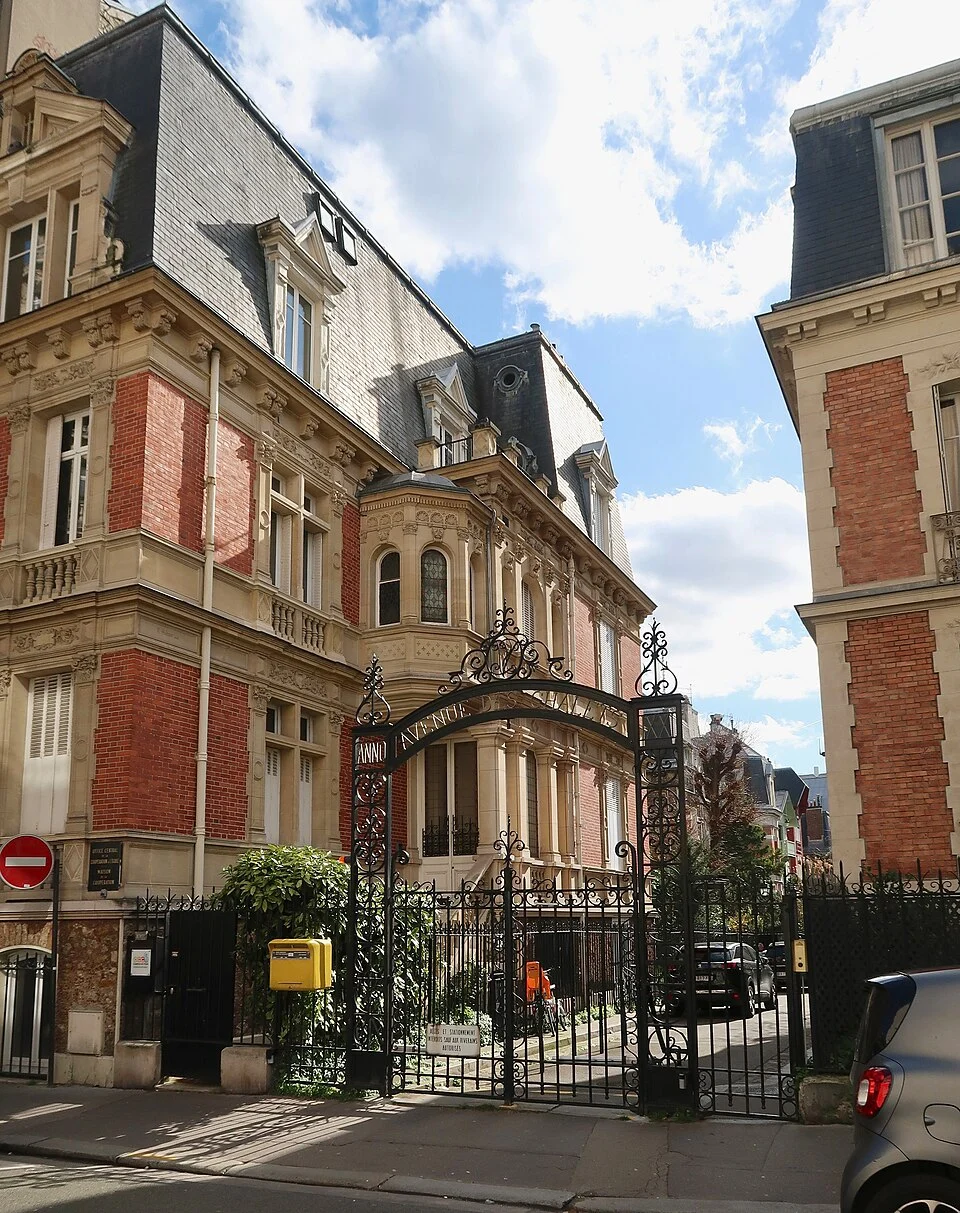
The entrance to the avenue. Source: Wikimedia. Public domain.
Villa de Beauséjour, literally “lane of the pleasant stay,” is another private street. Its residents have included the garden’s designer, Adolphe Alphand, and the singing duo Michel Berger and France Gall. But the real attraction is a set of Russian houses that came from the 1867 World’s Fair. The houses were sold and moved here, and the site is now a listed historic landmark.
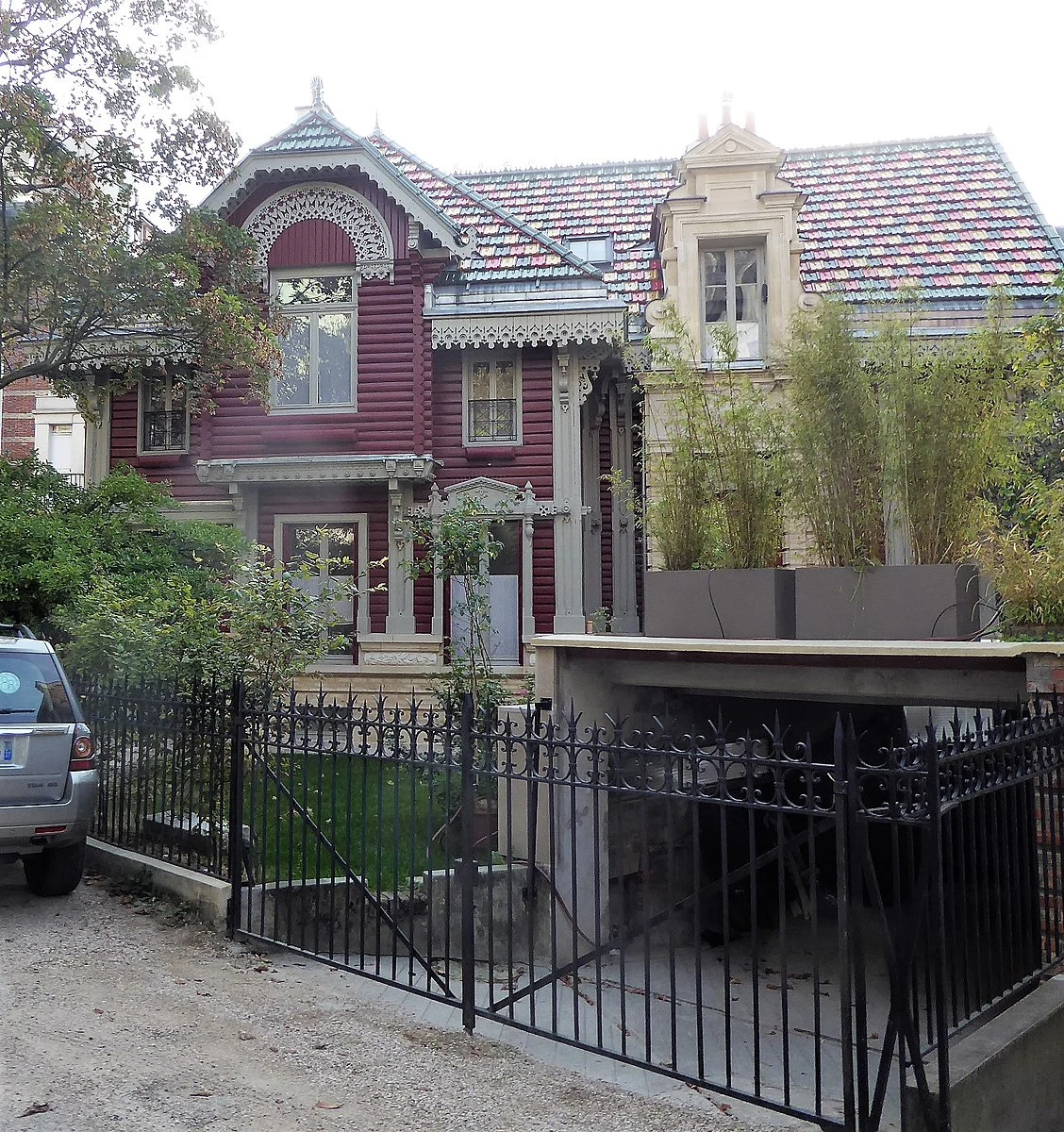
One of the Russian houses. Source: Wikimedia. Public domain.
The garden is planted with many trees, some common and some rare. The rare ones stand out for their great age, close to two hundred years old, and their impressive height, around thirty meters. In spring, the blossoms of the chestnut and Judas trees are spectacular.
You can sit on a bench or right on the lawns (most of them allow it), let the museum visit sink in, daydream (which is usually what I do), get lost in a book, or scroll on your phone. There’s also fitness equipment and table tennis for adults, bike paths, and playgrounds for kids in the three corners of the triangle. There’s even a pétanque court.

Starting in March, concerts of all kinds take place in the garden, under the dome of a blue bandstand. The big draw for kids is the famous puppet theater of the Jardin du Ranelagh, which opens at the start of spring.
Another unique attraction is a hand-cranked vintage wooden carousel that has been running for a hundred and fifty years (in a way, time really does stand still in the Jardin du Ranelagh). The only other one like it is in the Luxembourg Gardens. Each child gets a small wooden stick and tries to catch rings with it as the carousel spins. When all the rings have been caught, the carousel stops and the round ends. The child who caught the most rings is crowned the winner.
The ring game on a carousel has its roots in ancient military tournaments of sword-wielding horsemen. Starting in the days of Louis XIV, the game became popular at the royal court, and Marie Antoinette had a colorful carousel in her English garden at the Petit Trianon in Versailles, where mythological creatures took the place of horses.
You can also take rides on a pony or a donkey, or, more comfortably, in a yellow carriage. The Jardin du Ranelagh is a little slice of paradise for children and adults alike.
Why Ranelagh: the original London model
The garden is named after Lord Ranelagh, who created the Ranelagh Gardens in the Chelsea district of London. Even after the gardens passed into other hands, they kept the name of their original owner, and it’s thanks to them that Lord Ranelagh is still remembered. Richard Jones, Lord Ranelagh (1641-1712), was an Irish earl who built a career in the Irish Parliament and later in the English Parliament, from which he was expelled in 1703 for pocketing a considerable sum from the treasury.

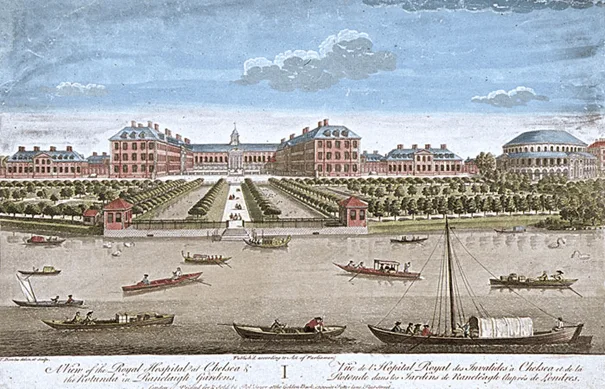
Lord Ranelagh was known for his wild lifestyle and his passion for both women and men. He also loved building, houses and gardens alike, both for his own use and for the public. He took part in founding and running the Royal Hospital Chelsea, a home for British army veterans that still operates today; four hundred pensioners live there, still wearing the red army uniform. Near the Royal Hospital, Lord Ranelagh also built his own home, Ranelagh House, and its grounds, the Ranelagh Gardens.
Lord Ranelagh’s house was torn down in 1805, but the gardens remain and are now part of the grounds of the veterans’ home. At the end of May, these gardens become a sought-after destination when they host the Chelsea Flower Show. People come from all over the world for this celebration of sight, smell, and taste (there are even edible plants). For safety reasons, the number of visitors is limited to 157,000.
The lawns of the veterans’ home come alive with a rainbow of colors and shapes, and the gardens turn into a wonderland. The show features not only rare flower varieties but also garden designs drawn from different parts of the world and different periods in history.
There’s even a Jewish thread in the story of how the Ranelagh gardens changed hands: one of their owners and designers after Lord Ranelagh was Solomon Rieti, a member of the Italian Jewish banking family Rieti, named after the city of Rieti in central Italy.
This distinguished family, whose lineage can be traced back to the 14th century, produced not only philanthropist bankers but also scholars, rabbis, artists, doctors, lawyers, and other public figures. The most famous among them is Benjamin Disraeli, who was the son of Maria, daughter of Rebecca Rieti (1742-1798), niece of Solomon Rieti.
In 1741 the Ranelagh Gardens were bought by a corporation that turned them into a public venue, hosting balls and masquerades for an admission fee. At the center of the complex stood a round building with a Rococo-style dome, heated by a fireplace in winter and equipped with an organ, where fine concerts were held.
The famous Venetian landscape painter Canaletto, who spent about ten years in London starting in 1746, painted the gardens and the interior of the concert hall twice, in 1754.
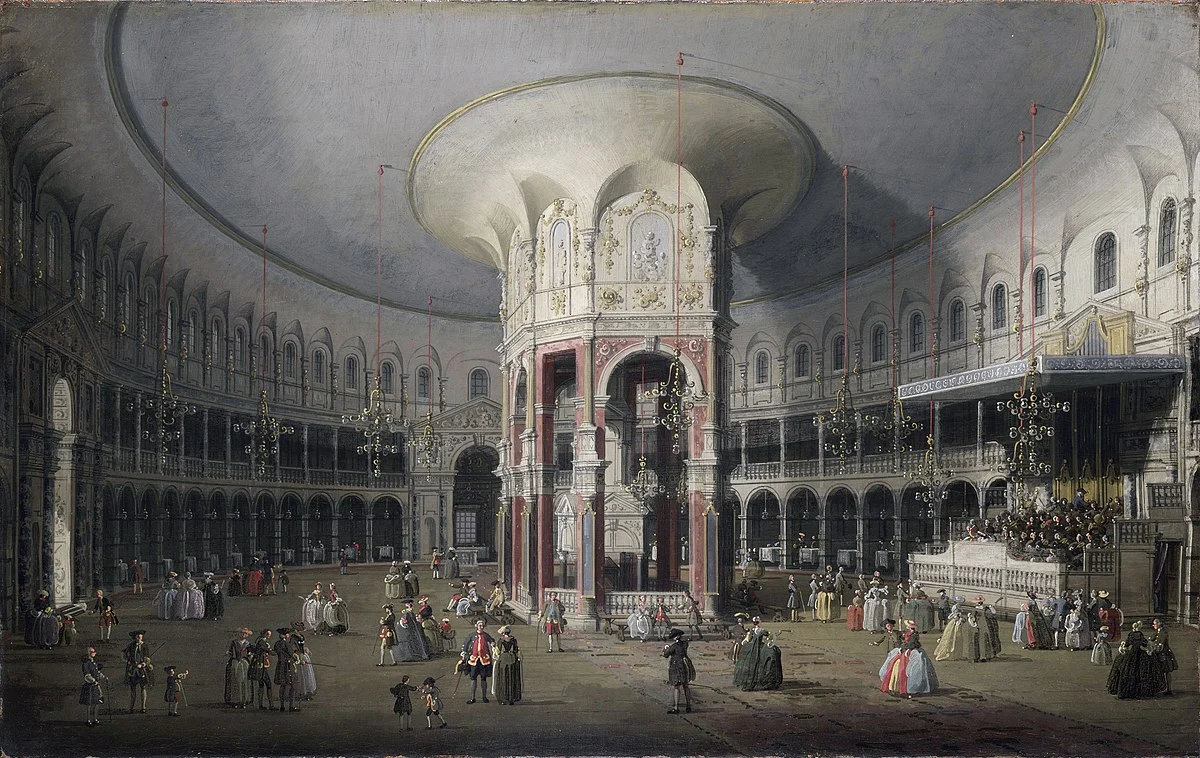
Canaletto, the Rotunda of the Ranelagh Gardens. Source: Wikimedia. Public domain.
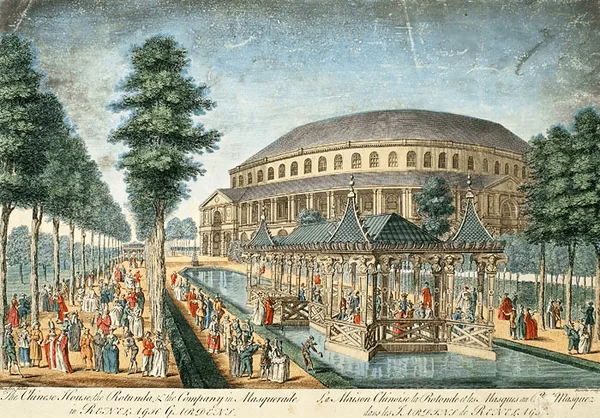
The Ranelagh Gardens were further enriched with a Chinese pavilion over an ornamental canal and winding walking paths. All of London, nobles and commoners alike, flocked there to dance under the open sky, listen to concerts under the dome of the rotunda (in 1765, a nine-year-old Mozart performed there), have fun, and find partners.
The masquerade balls, until then the exclusive domain of aristocrats, opened up to other segments of the population as well. The Ranelagh Gardens, which took the name Ranelagh Pleasure Ground, became famous across the world. Note that the mastermind behind turning the private gardens into a paid public entertainment venue was not Lord Ranelagh himself, but the corporation that bought the place.
Credit goes instead to its members, among them the manager of London’s Theatre Royal, Drury Lane, and Sir Thomas Robinson, a statesman, architect, and extravagant, free-spending garden designer.
Robinson, who was well connected in high society, was put in charge of the entertainment, and his social connections contributed a great deal to the venture’s success. He even bought himself a house near the gardens and used to invite hundreds of guests to breakfasts and lavish balls. Here is what the complex looked like in the 18th century, up close and from afar, based on engravings by Thomas Bowles:
Monsieur Morissan, the Frenchman who copied the English model on a smaller scale
The dazzling success of the London venue stirred the ambitions of Monsieur Morissan (Sieur Morissan), a painter, interior designer, and fireworks maker in the king’s service. After obtaining a license, he opened “Little Ranelagh” (Le petit Ranelagh) in 1774, a Parisian imitation of the great London original, designed by the entrepreneur himself: a fenced garden for dancing, on land that had been part of the park of the Château de la Muette, with paid admission, a café, and a restaurant.
The opening ball on July 25, 1774 ended with fireworks, as did every dance evening that followed. Chroniclers of Paris from that period briefly mention an unpleasant episode that soured Monsieur Morissan’s mood: the license he had received was arbitrarily revoked by an authority higher than the one that had granted it. They don’t say how the problem was resolved. And this would not be the only obstacle in his path.
I can picture him, bent by the cruel, hidden hand of history, knocked down, giving in and then holding his head high by turns. Here he is, as the Revolution breaks out, forced to tear down his life’s work; here he is, rebuilding it as the Directory rises to power; here he is, pleading with a unit of Russian soldiers who raided his gardens when Paris surrendered, begging them not to cut down his trees for firewood. He simply sent them off to the nearby Bois de Boulogne instead…
In 1783 the way the dance business was run changed. A corporation of a hundred people, known as the “subscribers,” put up an annual sum to rent the venue, and each of them had the right to sell tickets to their acquaintances.
All the city’s nobles and fashionable women flocked to the garden. The pleasure-loving Count of Artois, Louis XVI’s younger brother, was a regular visitor. The young count, who would later become Charles X, used to bring his sister-in-law, Marie Antoinette, along on his many outings. On one occasion he even showed up at “Little Ranelagh” accompanied by none other than the queen herself. Urban legend, or historical fact?
Either way, there’s no denying the place’s royal flavor. Guests entered the ballroom through an entrance decorated with Corinthian columns and topped with a dome. On the left was a cloakroom for swords, canes, and hats; on the right stood Madame Morissan in her well-stocked shop, selling refreshments of every kind. The ballroom itself, supported by Ionic columns, was surrounded by a raised gallery lined with sofas and mirrors, which guaranteed a good view of the dancers. Daylight poured in generously through twenty-two windows set into the ceiling, and in the evening the hall was lit by lamps and chandeliers.
Several cafés served visitors to the garden. The most sought-after, the café right next to the ballroom, was run by the owner of the place, Monsieur Morissan. When the Revolution broke out in 1789, Monsieur Morissan and his partners went bankrupt (the public dances were no longer bringing in enough money), but they reopened in style once the Directory took power, six years later.
When the European allies who had united against Napoleon and defeated him entered Paris, on March 30, 1814, Russian, Cossack, and Ukrainian soldiers took over the entertainment venue. The ballroom became a stable and later a hospital. On June 3 the allies left Paris. In 1818 a violent storm destroyed the buildings of the dance complex. After repairs, the garden reopened as a public dance hall. Around 1830 the place enjoyed some success, though it had lost its former glamour.
In 1848 its story finally came to an end. Baron Haussmann’s massive, historic project to expand and renovate Paris drove the last nail into the coffin of “Little Ranelagh,” the life’s work of Monsieur Morissan, now forgotten in the 16th arrondissement of Paris.
The sound of violins and the rustle of skirts faded away, but in 1860 a beautiful park, commissioned by Baron Haussmann and designed by the engineer and garden specialist Adolphe Alphand, was inaugurated on the site. And today, on nice days, music can be heard here again, at the concerts held under the dome of the blue bandstand. Classical music or heavy rock, famous bands or unknown ones: anything goes.
The statues in the Jardin du Ranelagh
The tribute to Jean de La Fontaine by Alphonse Dumilâtre
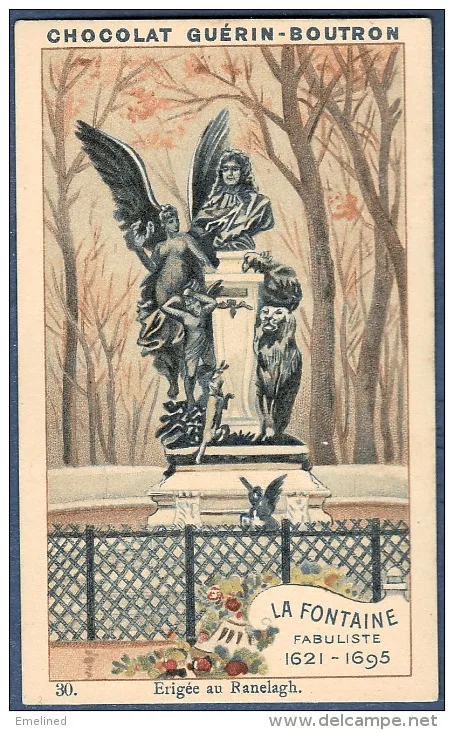
In 1889, a giant monument by Alphonse Dumilâtre was shown at the Universal Exposition, featuring not only the crow and the fox but also a lion, a snake, a cat, sheaves of wheat, two doves, and larks. Alongside all of these stood two winged allegorical figures: Glory and Love. 3,610 kilograms of bronze!
The masterpiece, which rose to a height of seven meters, was moved to the Jardin du Ranelagh in 1891 but was sent to be melted down in 1942. That was the end of a work that owed its existence to the great efforts of the public committee for promoting La Fontaine’s work. The committee’s acting president was Sully Prudhomme, future winner of the Nobel Prize (1901), a poet who held seat number 24 at the Académie, just under two hundred years after his colleague La Fontaine.
The vice president was Dr. Henri Marmottan, then mayor of the 16th arrondissement, brother of Jules, the owner of the private mansion that today is the Musée Marmottan Monet. Among the supporters on the committee were Victor Hugo and the education minister of the time, Armand Fallières. It took seven years to raise the funds through public donations and by holding concerts and exhibitions.
The City of Paris covered the rest. Today the monument can only be seen in photographs, but the original base, by Frantz Jourdain (the architect who designed the Samaritaine department store), still stands in the garden, and on it you can still read, carved in stone: This monument, erected thanks to public donations with the support of the State and the City of Paris, was inaugurated on July 26, 1891.
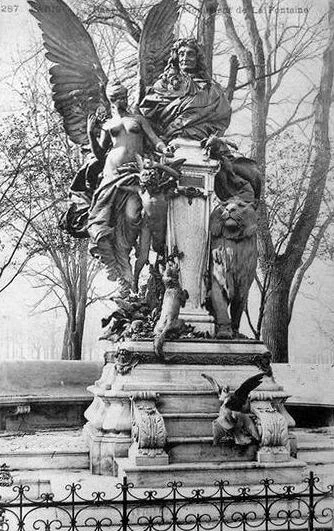
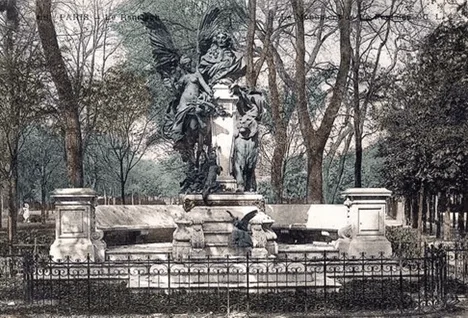
Interestingly, Guérin-Boutron (1775-1942), a successful chocolate maker of the time, included with its products series of picture cards on the history and culture of France. The cards are highly sought after by collectors and still sold today, and one of them shows Dumilâtre’s statue:
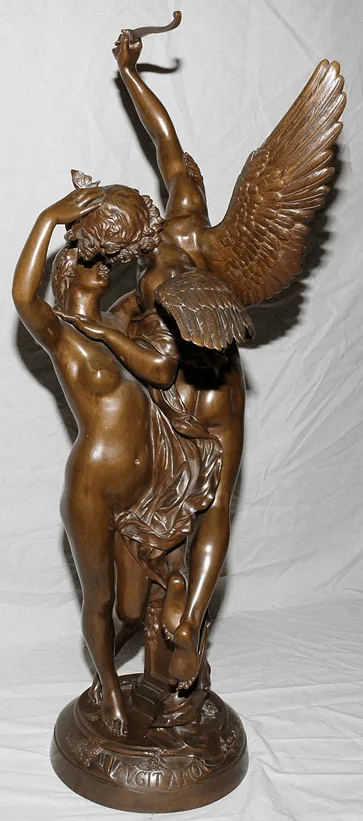
Another bronze statue, “Fleeting Love” (L’Amour fugitif) from 1877, by Ernest Damé, was also sent to be melted down in 1942 and no longer exists:
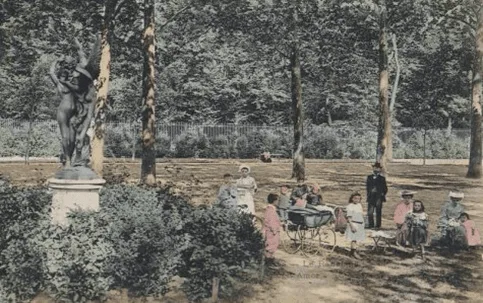
The tribute to Jean de La Fontaine by Charles Correia
Charles Correia was born in 1930 in Portugal but came to France with his parents at the age of one and went on to become a very successful sculptor. He was one of the few French sculptors of his time who made a living from his art. In 1988, during a visit to his homeland, he was killed in an accident.
The giant, figure-packed monument by the sculptor Alphonse Dumilâtre, which was sent to be melted down by the Vichy government during the Nazi occupation, has been replaced by a simpler monument designed by Correia. This statue, also in bronze like its predecessor, was placed in the Jardin du Ranelagh in 1984 and shows Jean de La Fontaine with just the crow and the fox.

The crouching fox looks up hungrily at the round piece of cheese in the crow’s beak. The crow, bent down toward the fox below, listens with pleasure to the flattering words coming from its mouth. In another moment the vain crow will drop the cheese from its beak, falling victim to the cunning fox, who knows exactly which buttons to push to trap its prey.
The piece of cheese becomes a kind of payment the crow is forced to make to the fox. And as if that weren’t enough, Jean de La Fontaine puts the moral of the fable right into the fox’s own mouth. The lesson is worth the price, the fox sneers at the embarrassed crow, piling humiliation upon humiliation.
The statue is arranged in three tiers, which perfectly captures the power dynamics between the characters. The one presiding over it all, pulling the strings, is the fable’s own author, Jean de La Fontaine, a master of countless tricks. He’s the one who chose, from the material his predecessor Aesop provided, the fables he wanted to rework as he saw fit. He’s the one who maneuvered his characters and put words in their mouths. He’s the one who, through his choice of words and his crafting of literary devices and overall structure, worked many tricks on his readers, both obvious and hidden, guiding them toward understanding the fable while also, in the process, outwitting royal censorship. Below him stand the two opposing figures: the crow above, on the statue’s base (in the fable, as we know, it enjoys the advantage of height, perched on a tree), and the fox below.
The crow’s position of power, both in terms of space and ownership of the coveted object, flips completely, without the crow ever saying a single word. The crow goes from ruler to ruled, without any physical violence, simply through the wit and persuasive power of its rival, who turned disadvantage into advantage.

Other interesting statues
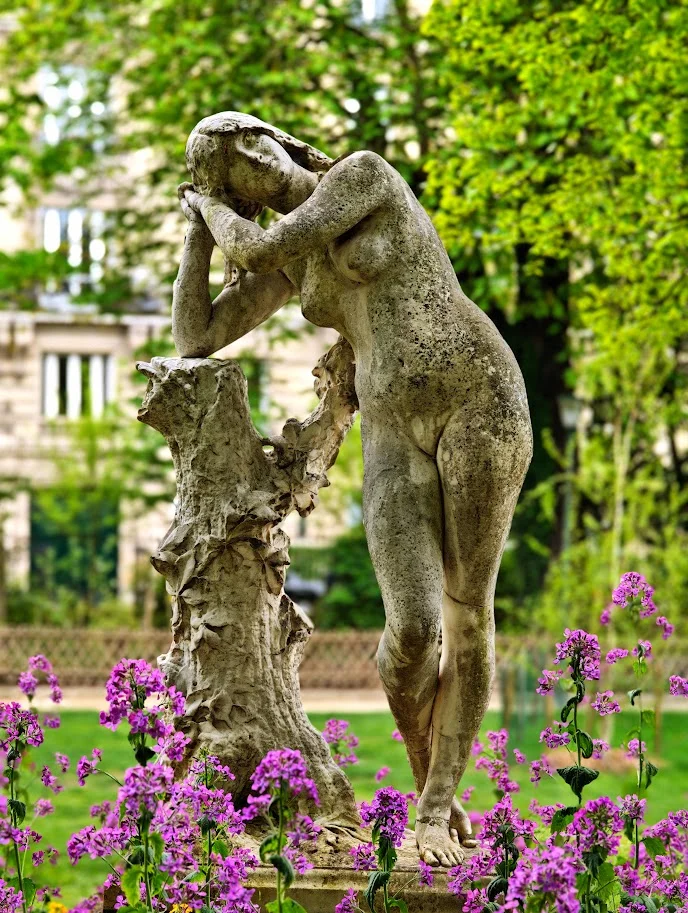
Another sensual statue, calmer this time, in marble and far less unsettling than the “Fleeting Love” we saw earlier, is “Méditation,” created in 1882 by the well-known sculptor Tony Noël:
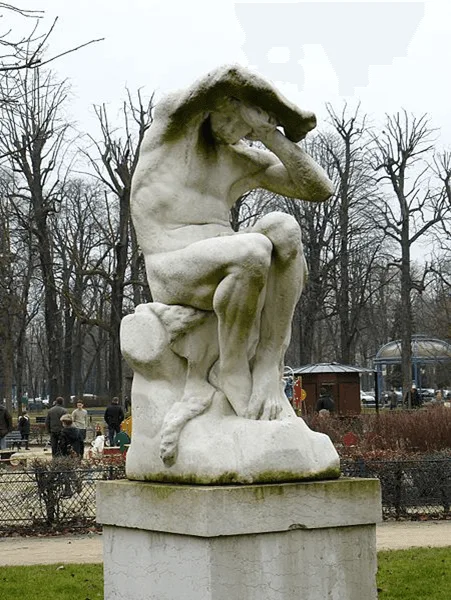
The marble statue “Cain” (Caïn), 1871, by Michel-Joseph Caillé, brings back a sense of menace by showing Cain trying to hide, the way criminals do:
A marble relief by Georges Bareau, depicting the vision Victor Hugo had while writing his great collection of poems “La Légende des siècles” (“The Legend of the Ages”), continues to tell the story of humanity. The relief is called “La Vision du poète” (“The Poet’s Vision”). On the left is the poet, whose face resembles Hugo’s own; on the right is the wall he saw before him, a tangled, somber mosaic of all kinds of figures rising from the depths up to the sky.
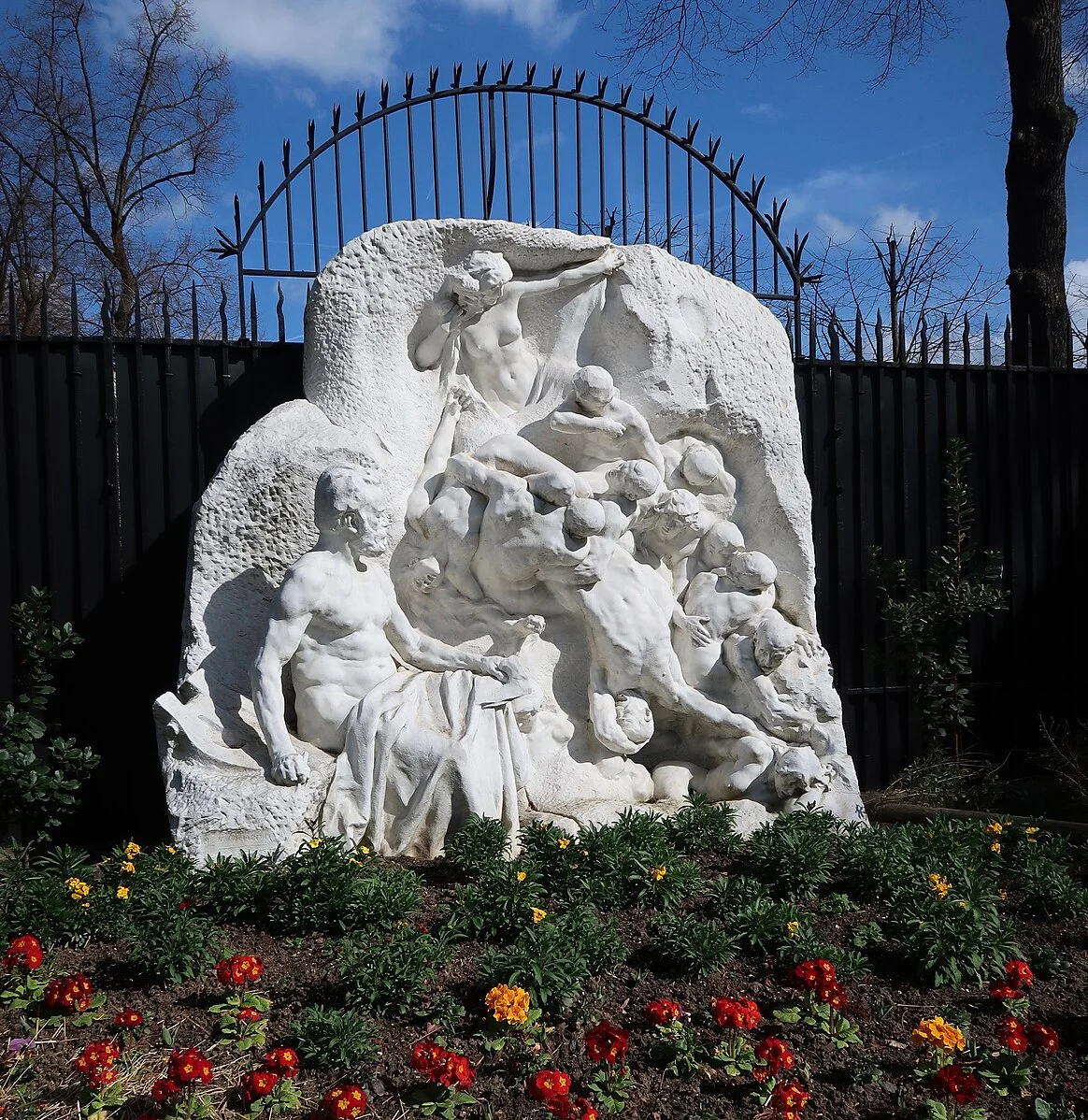
Georges Bareau, The Poet’s Vision. Source: Wikimedia. Public domain.
This marble relief, created by the sculptor Bareau in 1902, captures Hugo’s own words in the preface titled “La Vision d’où est sorti ce livre” (“The Vision from Which This Book Emerged”), 1877:
I had a dream: the wall of the centuries appeared before me.
(…)
A chaos of beings, rising from the abyss to the firmament!
J’eus un rêve: le mur des siècles m’apparut.
(…)
Chaos d’êtres, montant du gouffre au firmament !
The relief was created, as mentioned, by the sculptor Georges Bareau, commissioned by the City of Paris for the centennial celebrations of Hugo’s birth. The work sat in the city’s storerooms for quite a while and wasn’t placed in the Jardin du Ranelagh until 1985.
And just as the poet draws images from his imagination out of humanity’s story, somewhere between myth and history, so too the fisherman pulls up in his nets the severed head of Orpheus, the greatest musician and poet of Greek mythology. This scene is immortalized in the 1882 marble statue by Léon-Eugène Longepied, called “Pêcheur ramenant dans ses filets la tête d’Orphée” (“Fisherman Pulling Up the Head of Orpheus in His Nets”):
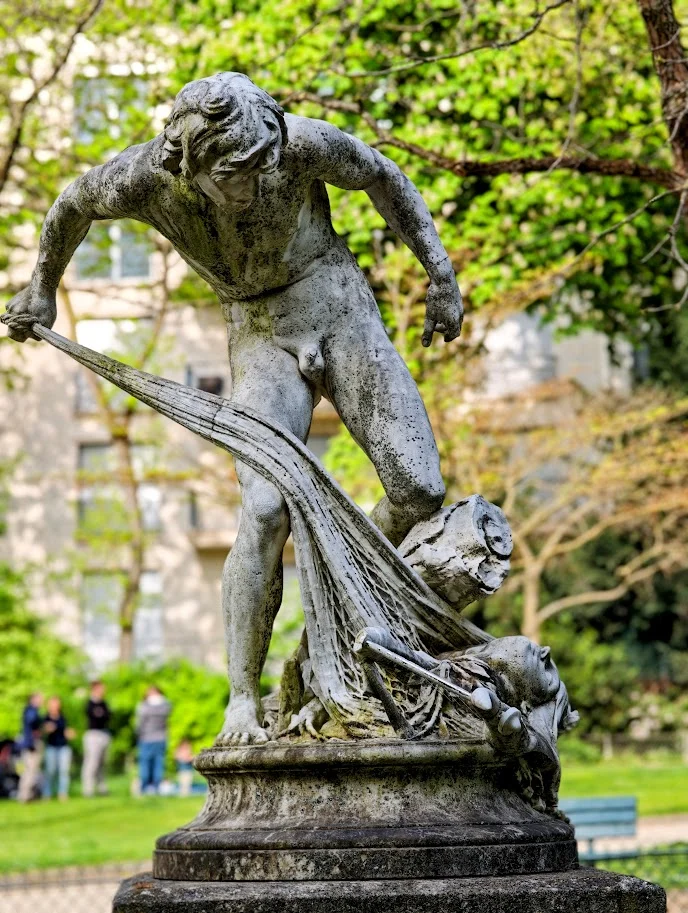
Just as Cain murdered his brother out of jealousy, the priestesses of Bacchus murdered Orpheus out of jealousy over his total devotion to Eurydice. In a frenzy of bloodlust, the drunken priestesses also killed their own husbands, and in their fury they tore Orpheus’s body to pieces after he had rejected their advances and threw his head into the Hebrus River (known today as the Evros).
The severed head, together with the singer’s magical lyre, a gift from the god Apollo, drifted on the river’s currents and reached the shore of the island of Lesbos. There’s some comfort in the rest of the legend, which tells how the song of a nightingale rises eternally from Orpheus’s tomb, built in a cave, and from the statues that depict him. The artist’s eternal soul goes on playing and singing even after his death, renewing nature and awakening love. Death has no power over the goodness of music.
Want to stay about a fifteen-minute walk from the Jardin du Ranelagh?
You can rent a spacious apartment on Avenue Paul Doumer, where Zvi Chazanov (the Francophile) stayed in April 2025. It’s a fully furnished, luxurious apartment from which you can head out and discover the charms of the 16th arrondissement. For more information, click this link.
Alternatively, you can rent another spacious apartment from the same owners, on Rue Nicolo, where this article’s author, Dr. Orna Lieberman, stayed in April 2023. From the apartment, you’re just a few minutes’ walk from the Jardin du Ranelagh and the Musée Marmottan Monet. Here, Orna shares her recommendations for the area.
Did you enjoy this article? Want to read more by Orna Lieberman?
- Adolphe Alphand, the engineer who designed the Jardin du Ranelagh, also designed Square Montholon, whose eventful story you can read in the article Square Montholon: A Charming Parisian Corner with a Fascinating Story
- You’re welcome to read the second part of this article, which takes you on a rare walk along a former railway line turned into a green path: Paris: Green Walks in the 16th Arrondissement
- For more on the connection between France and England, read the article The Affair of the Nesle Tower: Adultery at the Royal Court
The garden is also the starting point of the walking route through the Auteuil neighborhood, which leads from here down to the buildings of Hector Guimard and the old village feel of rue d’Auteuil.
FAQ
What can you see in the Jardin du Ranelagh?
What are the three avenues that give the garden its Belle Époque feel?
Where did the Russian houses near the garden come from?
Related reading