

In the 9th arrondissement of Paris, between the Cadet and Poissonnière metro stations, there’s a charming green corner planted with lawns, flowers and trees (blue tits flit between the branches), overlooked on every side by grand Haussmannian bourgeois buildings. This is Square Montholon. Two oriental plane trees, over a hundred years old, rise 30 meters from the central lawn.
On nice days, shouts of delight and laughter rise from the children’s playground equipment and the table tennis table for adults. A Louis-Philippe style iron fence surrounds the square, which covers 4,571 square meters. A sculptural group of five young women, cheerful and embracing, dressed in their finest, with elegant hairstyles and elaborate hats, enriches the square. The sculpture is a visual treat from behind too: the curves of these young ladies, which seem to move gracefully, are carved with great care.

Square Montholon: Home to Paris’s Executioners
Construction of the square began in 1863, during the laying out of the Rue La Fayette, home to the famous and luxurious Galeries Lafayette department store. A year later, the square was completed by the engineer, Jean-Charles Alphand (1817-1891), who had been called in to help Baron Haussmann create the green spaces of Paris (Alphand designed many of the city’s parks, including the Champs-Élysées gardens, the Jardin du Ranelagh and the Bois de Boulogne), and it opened to the public.
In 1981 the square underwent extensive renovation work, and it has been well maintained ever since. The square is named after Nicolas de Montholon (1736-1809), a statesman and judge who lived in a private mansion nearby. The nearby Rue de Montholon is also named after him.
Square Montholon was once part of the garden of the private mansion belonging to the official executioner of Paris, Charles Sanson, the second in the dynasty, at a time when this part of Paris, which lay outside the city gates, was still called La Nouvelle France (“New France”). Charles Sanson belonged to the famous family of executioners who held the post in Paris from 1688 to 1847. He was the one who purchased the estate, of which today’s Square Montholon was once part of the garden, for himself and his family, who lived there for nearly seventy years.
Charles Sanson’s father, also named Charles Sanson, the first in the dynasty, was an officer from the city of Rouen, in Normandy, who married the daughter of the city’s executioner, Marguerite, and became his assistant. A few years after his son’s birth, following the death of his wife Marguerite, Charles Sanson moved to Paris, where he continued working as assistant to the chief executioner. After the latter was dismissed for pandering, Charles Sanson was appointed to the post a year later, thereby becoming the first in the dynasty. Starting in 1688, at the age of 15, Charles Sanson II began assisting his father, Charles Sanson I, in the work of the executioner.

In 1699, Charles Sanson I resigned from his post and married the older sister of the executioner of the city of Melun. His son continued as assistant executioner until he came of age at twenty, in 1701, the year he was appointed executioner, though he received his official letter of appointment only after his father’s death in 1707. That same year he married the sister of his stepmother, his father’s second wife (the second sister of the executioner of Melun).
After his death in 1726, and his burial with great pomp and honor at the Église Saint-Laurent, his widow married his substitute, the “regent.” This lasted until her seven-year-old son, Charles Jean-Baptiste Sanson, came of age, at which point his stepfather handed him the post of executioner. The family tradition thus continued, as noted, until 1847, when the Minister of Justice dismissed the last and sixth in the dynasty, Henri-Clément Sanson, who was listed on the Paris police headquarters’ register of homosexuals.

Henri-Clément Sanson was a compulsive gambler and a regular at casinos. Unable to pay off his many debts, he was thrown in jail and even pawned his own work tool… the guillotine. The Minister of Justice at the time, who was sympathetic to Henri-Clément Sanson, intervened to have him released from prison, and he continued in his post. But that minister, who apparently shared Henri-Clément’s sexual orientation, was forced to resign. The new Minister of Justice who took his place quickly dismissed Henri-Clément from his post and appointed a new executioner in his place, one who was not a member of the famous family.
The memoirs of the last executioner of the House of Sanson, who was so different from the rest of his family, were written by two ghostwriters, one of them Honoré de Balzac (1799-1850), and included a moving speech against the death penalty. Here is a photo of the cover of the book attributed to Henri-Clément Sanson.
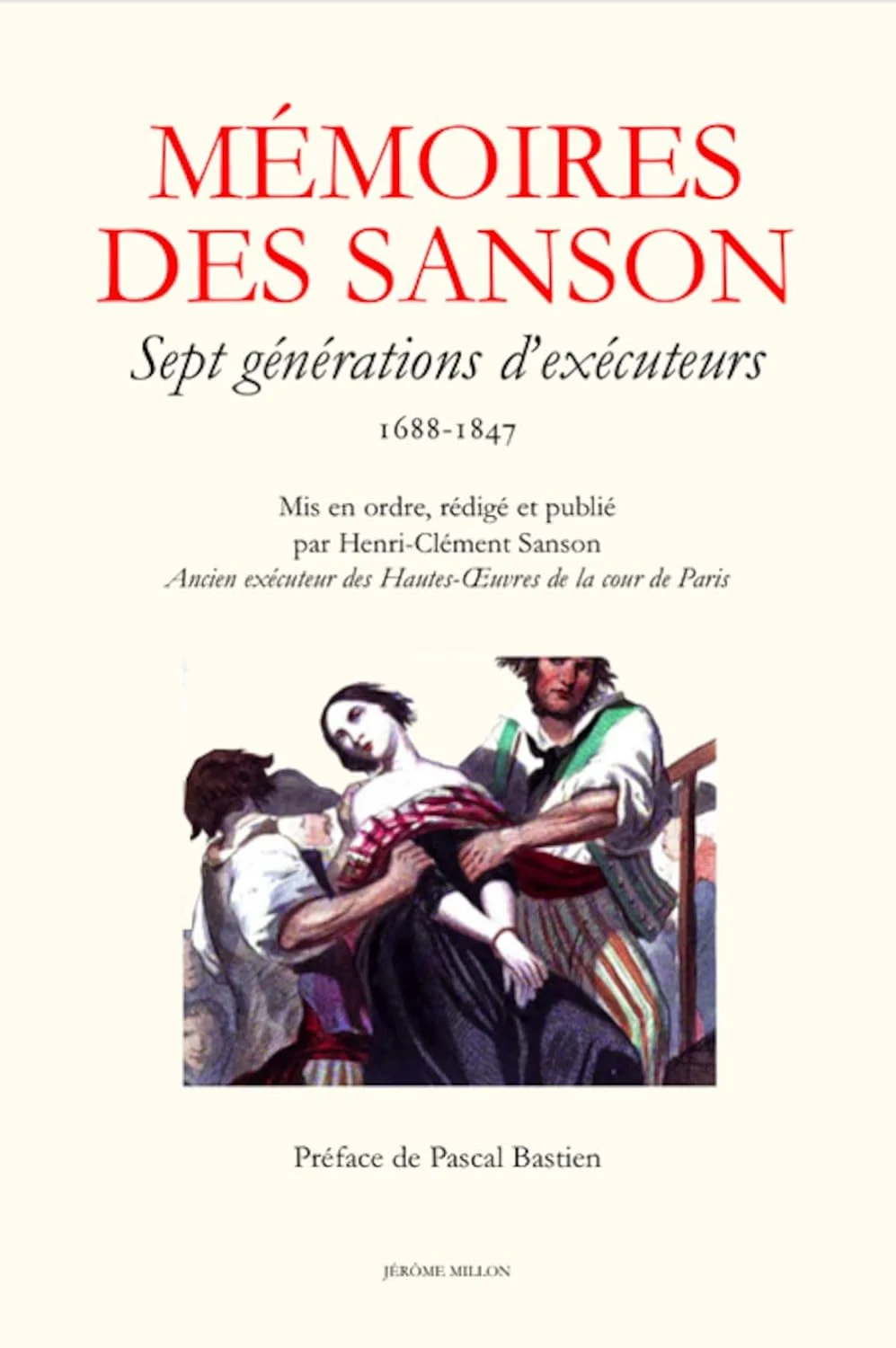
Henri-Clément Sanson (1799-1889) is buried in Montmartre Cemetery, plot number 20, along with his father, Henri Sanson (1767-1840), and his grandfather, Charles-Henri Sanson (1739-1806). The grandfather was the first to use the guillotine, but he had also taken part in the official torture of especially notorious criminals, a practice that had previously taken place in front of the city hall.
Charles-Henri Sanson was the one who executed Louis XVI and many others, among them some of the finest revolutionaries. As for Marie Antoinette, opinions differ. According to the accepted version, Charles-Henri, the father, who led the unfortunate queen to her death, signaled to his son, Henri, to hurry and finish the task so as not to prolong the famous condemned woman’s suffering (it is not for nothing that father and son are buried together).
The Sanson dynasty: one hundred and fifty years of executions:
Charles Sanson, 1635-1707
Charles Sanson II, 1681-1726
Charles-Jean-Baptiste Sanson, 1719-1778
Charles-Henri Sanson, 1739-1806
Henri Sanson, 1767-1840
Henri-Clément Sanson, 1799-1889
Saint Catherine, or the Medieval Dating Site
One more bit of family history: Henri had a brother, Gabriel, a compulsive show-off, who once, while holding up the severed head of an executed man for the crowd to see, stumbled, fell, broke his neck, and died on the spot, his hand still clutching his trophy. The motif of the severed head forms a hidden thread connecting the family of executioners, the square’s former owners, to the figure of Saint Catherine, commemorated through the statues of the “Little Catherines,” her devotees. In 1913, the city of Paris acquired the marble sculpture that decorates Square Montholon, Saint Catherine, sculpted in 1908 by the artist Julien Lorieux. The base of the statue reads: Saint Catherine, a tribute to the Parisian working woman (Sainte Catherine, hommage à l’ouvrière parisienne).

Five young, unmarried Parisian working women, then, are about to head off to the Saint Catherine’s ball on November 25, dressed in their finest and wearing hats. Many of these working women were still single at 25, and so the custom took hold and grew stronger among seamstresses and milliners (the modest classes of society who had not yet married) of leaving their shops and workshops to dance on Saint Catherine’s Day, a chance to finally meet a suitable husband.
The dancing began at the workplace, continued in the street, and ended at the ball. The custom’s origins go back to the Middle Ages and are tied to unmarried women’s devotion to Saint Catherine, patron saint of single women, whose role was to protect them from any harm to their innocence (Catherine, from katharos, meaning pure in Greek, the same root as catharsis, meaning purification). Saint Catherine of Alexandria was, according to tradition, executed by beheading at the age of 18 by Emperor Maxentius on November 25, 307, because she refused his advances.
Legend has it that Catherine, the daughter of the governor of Alexandria, saw Jesus in a vision, and he, impressed by her wisdom and purity, married her in a mystical marriage (that is, a spiritual marriage, in which the bride shares in Jesus’s suffering and dedicates her life and death to him).

The beautiful princess Catherine was also wise and learned, and she defeated the opponents of Christianity with her reasoning and arguments. Emperor Maxentius summoned fifty philosophers and scholars from around the world to confront the clever young woman, but they fell under the spell of her statements and arguments and converted to Christianity. Maxentius had them burned at the stake and proposed that Catherine move into his palace as his second wife. She refused, of course, and the emperor had her beaten with an iron hook and thrown into a dark dungeon without food for twelve days.
The emperor’s wife and the head of the armies, her lover, visited the prisoner and saw angels bandaging her wounds in a dazzling light. The queen, her lover, and his soldiers converted to Christianity. A white dove fed Catherine divine food throughout her time in the dungeon. When the emperor returned from his travels, he found Catherine blooming and radiant, and once again proposed that she become his second wife.
Catherine refused again, of course, explaining that Jesus was her only love. Four serrated, spiked wheels were set to tear her flesh apart, but an angel from heaven shattered them all with such force that four thousand pagan onlookers were killed in the chaos. The queen, her lover the general, and his soldiers, all of whom had confessed their conversion to Christianity, were executed. The now-widowed Maxentius again proposed marriage to Catherine, this time offering her the vacant throne of empress as well.
She refused again and was sentenced to beheading. A heavenly voice answered her prayer: Come, my beloved, my bride, my beautiful one, the gates of heaven are open to you! A stream of milk, instead of blood, flowed from her severed neck. Angels descended from above, carried her body to Mount Sinai, a journey of more than twenty days, and buried it with honor and splendor. And the legend goes on to say that a clear, miraculous oil continually flows from her bones, bringing relief and healing to the bodies of all who are sick.
Saint Catherine’s Monastery, founded in the 6th century in the heart of the Sinai Peninsula, her traditional burial place, bears her name and still stands today. Its monks are the faithful guardians of the holy princess’s tomb.

Every year, on the patron saint’s feast day, starting in the 10th century, young single women would come in procession to her statues to decorate them with hats, ribbons and flowers, in a festive ceremony. Those who married would leave the association of single women, leaving their friends the privilege of putting a hat on Saint Catherine’s statue and asking her for the chance to love and marry.
As we have seen, Saint Catherine was married in a spiritual, that is, an idealized, marriage to the suffering Jesus, and in this sense she serves as a model for all married women. It is, of course, an unattainable model, but in Christian thought, this unreachable purity is meant to serve as a guiding light for wives, an example to live up to.
Young women would arrive at the ball in original hats trimmed with green and yellow ribbons to catch the attention of eligible bachelors. Starting in the 1920s, a festive ceremony was held every year on Saint Catherine’s feast day at the Église Notre-Dame de Bonne Nouvelle in the 2nd arrondissement of Paris, in the Le Sentier neighborhood, where many workshops kept seamstresses and milliners busy at their craft. They too would go out to decorate with flowers and place a hat on Saint Catherine’s statue, found in a niche on the Rue Poissonnière.
Parties and processions were also organized by fashion houses, which gave gifts, cakes and drinks to their unmarried employees. The young designers competed in creativity, putting together colorful and unusual outfits and hats, letting their imagination run wild, while a panel of judges awarded prizes and scores to the most outstanding ones.
The Statues of Square Montholon
The custom of official ceremonies gradually faded over time, but the expression “to put a hat on Saint Catherine” (Coiffer Sainte Catherine), referring to a woman between 25 and 30 who was still unmarried, has remained in the French language. The statues of the five “Little Catherines,” the sculpture dedicated to Parisian working women, were placed in Square Montholon in 1923.
Julien Lorieux, the sculptor, who was born in 1876 in Paris and died in 1915 in Toul (the Alsace-Lorraine region) at only 38 years old, never got to take part in the joyful ceremony. The artist, also known for his engravings on medals and gemstones, took part in many exhibitions and won numerous prizes, and seemed destined for a bright future. But in 1914 he was drafted, and on April 20, 1915, he was struck in the head by shrapnel. Ten days later, he died in a hospital where wounded soldiers from the battlefield were treated.

World War II and the Nazi occupation left an even greater mark on Square Montholon. Two bronze statues installed there at the end of the 19th century were sent to be melted down in 1942: Eagle and Vultures Fighting Over a Dead Bear (Aigle et vautours se disputant un ours mort) by Auguste Nicolas Cain (1821-1894). This was a huge sculpture that once stood above a fountain (which no longer exists, just like the statue itself) by the sculptor Cain, who specialized in monumental animal sculptures.
The second statue, which also no longer exists, was called Monnaie de singe (Monkey’s Money) by François-Laurent Rolard (1842-1912). The statue depicted a street performer holding a hoop, with a monkey wearing a small kettledrum around its neck. In the juggler’s left hand was a shell for collecting money.

In the 13th century, those crossing the Petit Pont (renamed in 2013 the Petit Pont Cardinal Lustiger) were required to pay a toll. The only ones exempt were animal trainers with monkeys, who paid with their monkeys’ tricks instead. This is the origin of the French expression “to pay in monkey’s money” (Payer en monnaie de singe), which originally meant to pay in favors, but today means to cheat or avoid payment. Fortunately, there are many other versions of this same work in the art market, as well as other works by François-Laurent Rolard.

Any attentive visitor to Square Montholon cannot help but notice a plaque, attached to the fence, placed there by the city of Paris, commemorating other victims of human madness: the Jewish children of France murdered in the death camps. The plaque addresses the local resident or passerby and reminds them that more than eleven thousand Jewish children living in France were arrested by the Vichy government’s police, who collaborated with the Nazi occupiers between 1942 and 1944, and were sent to the death camps and murdered. Thirty of the murdered children from the 9th arrondissement had not even reached school age.
The names of these little ones are engraved on the plaque, which asks whoever reads it to hold them in memory. They will have no other resting place.
FAQ
When was Square Montholon built, and who is it named after?
Who designed the square?
How tall are the ancient oriental plane trees at the center of the square?
Related reading
