

I’m stretched out on the worn yellow sofa, long overdue for replacement, staring at the tangle of green branches outside, listening to the song of the cicadas. Cigale: zzzt, zzzt, zzzt, a word that comes from Greek and is an onomatopoeia, that is, an imitation of a sound from nature. The ancient Greeks saw the cicada as one of the identifying signs of the god Apollo, a symbol of music and poetry. Cicada in French is cigale.
Legend has it that angels came down from the sky and arrived in Provence in the heart of summer, in the blazing heat. The angels, surprised to see abandoned fields without a living soul, went to the priest to ask for an explanation. They found him dozing, woke him up, and asked him why everything looked so deserted. The priest explained that because of the terrible heat, the farmers could not work the open fields during the day and preferred to sleep in the shade. The angels went back up to heaven and reported to God. God then sent down a creature with golden, membranous, transparent wings that sang loudly to keep the farmers from dozing off instead of working.
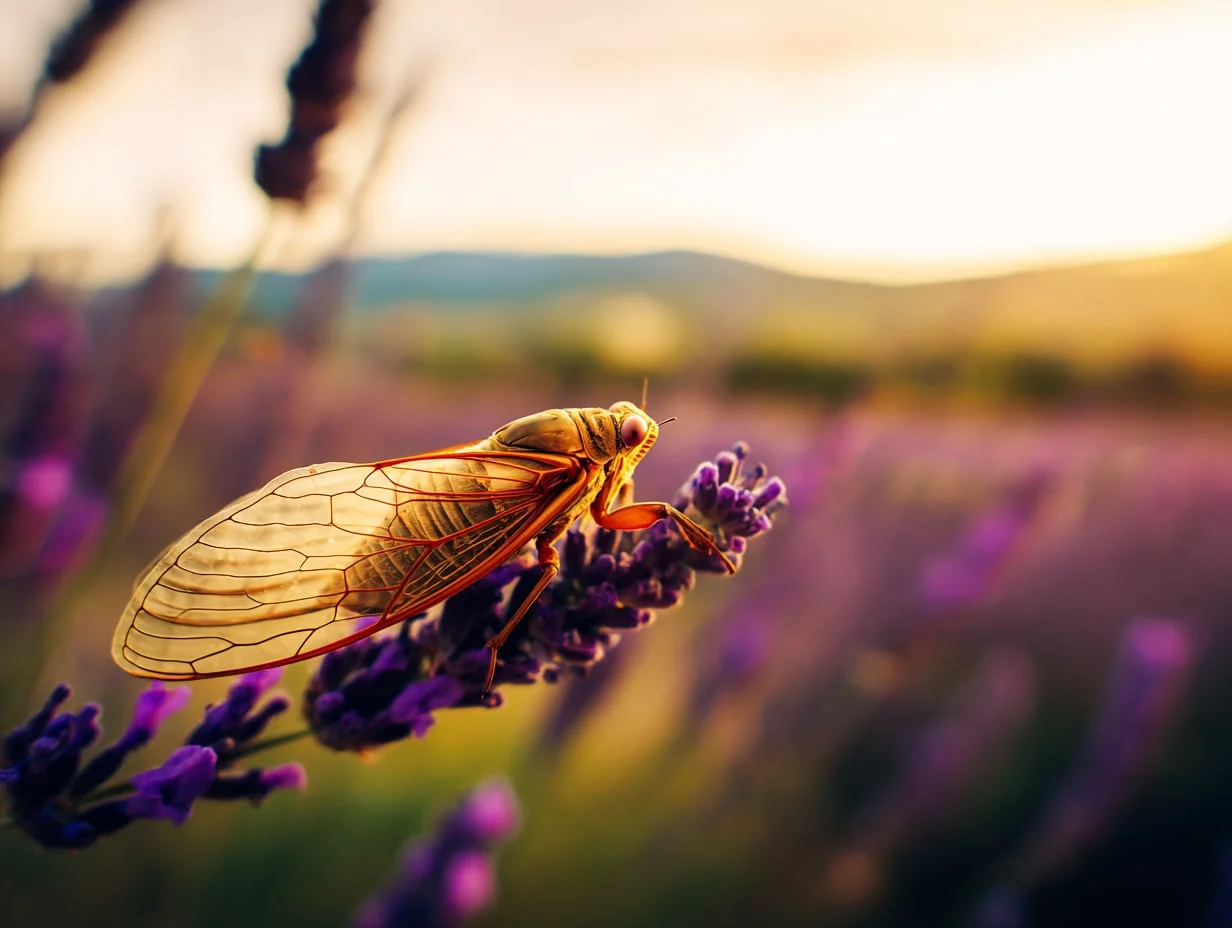
A cicada in a lavender field in Provence. AI-generated image, credit: Zvi Chazanov via Midjourney
Rest, Summer, Love
Rest, summer, love. The cicada’s song is a seduction. The males invite the females to love. The cicada’s song is produced by two drum-like membranes on either side of the hollow front of its abdomen, which, for that reason, acts as a resonating chamber. These sound organs are called cymbales in French, and the song itself is therefore called cymbalisation.
The same word, cymbale, also means cymbals in French. The word cymbale comes from the Greek kumbalon, from kumbē, meaning cup. The cicada’s cymbals are two tiny plates attached by a muscle to its abdomen. The contraction and relaxation of the muscle cause the plate to flatten and then arch at a high frequency, which is what produces the sound. Cicadas only sing during the day; at night, they fall silent.
In the following photo of the abdomen of an Australian cicada, a species called Cyclochila australasiae and known popularly as the Masked Devil cicada, the sound organs are the white plates.
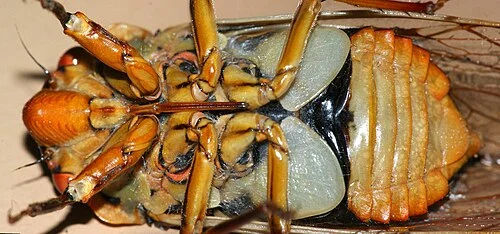
Masked Devil (Cyclochila australasiae), cicada, view of a male’s abdomen. Source: Wikimedia, public domain
And here is what that same Australian cicada looks like from the front.
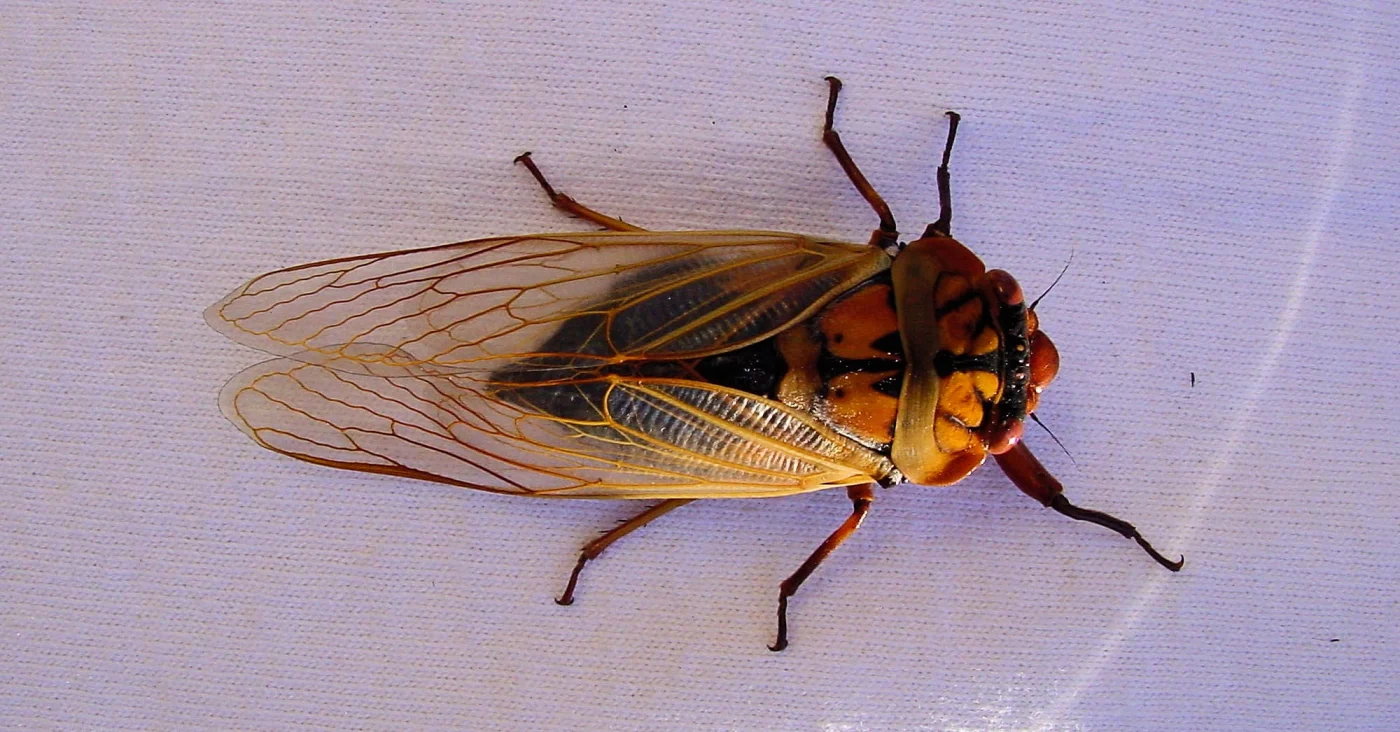
Masked Devil (Cyclochila australasiae), cicada. Source: Wikimedia, public domain
Cicadas, of course, aren’t found only in Provence. We just saw an impressive Australian species. About 4,500 species of cicadas have been counted worldwide, and southern France alone accounts for 16 of them. A cicada lives as a larva underground for four to six years, and then spends another four to six weeks out in the open air, in summer.
Toward the end of her life, in summer, the female will lay up to four hundred eggs, none bigger than a grain of rice. Only about five percent of that clutch will fulfill its purpose and produce larvae by late August or early September, which then burrow into the ground to protect themselves from the cold. The cicada emerges from the ground around June 23, and the process of hatching takes two to three hours. She breaks out of her shell, clings tightly to a tree or a stone with her six legs, and her wings harden. Wherever cicadas are found, you can also spot their molted shells, which look like transparent cicadas.
A cicada emerging from its shell
Cicadas, as I said, are found all over the world, but in Provence, people’s attitude toward them is exceptional, unique. Like the scent of lavender and mimosa, like the shade of pine and olive trees, like the sun’s reflection on the sea, the cicada is one of the symbols of Provence. La Fontaine saw it as lazy; the people of the Mediterranean saw it as divine! How did the cicada become an icon of Provence, decorating homes inside and out, adorning all sorts of products like tableware and jewelry, sold in its markets and shops to locals and tourists alike?
Poetry and Bohemia
Frédéric Mistral versus Jean de La Fontaine
We all know the famous fable by Jean de La Fontaine (1621-1695), from 1668, the first of his 124 fables, known in English as “The Ant and the Grasshopper.” Well, in French, La Fontaine wasn’t actually talking about a grasshopper at all, but about a cicada. The correct title is “The Cicada and the Ant” (La Cigale et la Fourmi). La Fontaine portrays the cicada as careless and idle, following her heart’s whims without a thought for the future. She sang all summer and found herself with nothing to eat come winter, so she went to ask the ant for a favor. And she found…
The Cicada and the Ant
After singing
all summer long,
when the cold wind came,
the cicada found herself with nothing.
Not even a crumb
of a fly or a worm to live on.
So the poor thing went to her neighbor the ant
to cry out her hunger,
she asked, she begged, lend me
a few grains to get by
until the next season.
I'll pay you back, she promised,
before the summer harvest even comes,
on my life, I swear it,
interest and principal.
The ant, not one to lend,
that is the least of her faults.
And what were you doing when it was warm?
she asked the one who had come to borrow.
-Night and day, day and night,
don't be upset, I was singing.
-Singing? Very well then.
Now it's time to dance.
(my translation, O.L.)
Listen to the singer Pierre Lozer perform the fable set to music.
La Fontaine was unfair to the cicada. Entomologists have pointed out his many mistakes. The cicada feeds, at every stage of her life, by sucking sap from roots and trees through a proboscis. She doesn’t need the ant at all, and in any case, she dies by the end of summer. But La Fontaine’s fanciful claims are, of course, forgivable because of the literary genre he excelled at: the fable’s purpose was to illustrate two opposite types of people, the bourgeois and the bohemian. A fable writer has the right to poetic license.
Frédéric Mistral Turned the Cicada into the Muse of Provence’s Poets
Unlike La Fontaine, the Provençal poet Frédéric Mistral (1830-1914) (Frédéric Mistral) actually identified with the cicada: a dreamy singer, an artist who loved the light. The motto he chose for himself, “The sun makes me sing,” was drawn straight from the cicada’s way of life. And the cicada shows up again and again in every portrait of him as his signature mark: on his coat lapel in a drawing Ernest Hébert dedicated to him in 1864, on a bookplate (ex libris) made for him in 1908 by the Catalan painter Joaquim Renart i Garcia, and so on. Mistral partially cleared the cicada’s name of the bad reputation Jean de La Fontaine had given her…
Take a look at the ex libris drawn by Joaquim Renart i Garcia. Below the ribbon bearing the motto, inside the circle, notice Frédéric Mistral’s golden cicada.
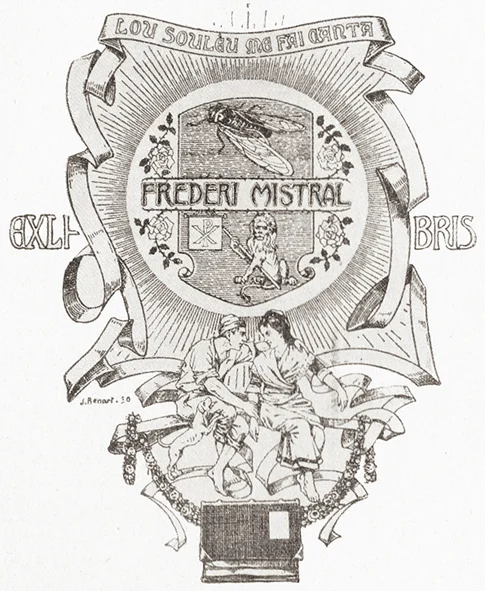
Frédéric Mistral’s ex libris. Source: the book by Jules Charles-Roux marking the anniversary of the publication of the poem “Mirèio”
At the bottom of the ex libris, the couple in love are Vincent and Mirèio, from Mistral’s poem “Mirèio.” It’s also an allegory for the bond of love between Provence and Catalonia.
In 1854, Frédéric Mistral (1830-1914), together with six other colleagues, founded the movement “Félibrige,” from the Greek word philabros, meaning “friend of beauty.” The movement’s goal was to preserve and promote the Provençal language and its culture. Fifty of its leaders, the bearers of its values, wore a gold cicada pin that, after their deaths, was passed down to their chosen successors, much like a seat in an academy. Each gold cicada bore the symbolic name of a region, a city, a river, or a value drawn from the association’s philosophy. A silver cicada was given to other members: artists and other writers.
And here are a few lines from among those dedicated to the beloved cicada, the companion of the 1904 Nobel Prize winner in Literature, Frédéric Mistral:
While the little cicada sings,
modest, content with little,
while she celebrates,
all the other creatures build their nests
and store up food,
and then winter comes, poor cicada,
and the ant tears you to pieces.
(my translation, O.L.)
From “Les Îles d’or” (“The Golden Isles”), a collection of poems published by Frédéric Mistral in 1863
Was this Frédéric Mistral’s ironic answer to Jean de La Fontaine? The ant that, in the fable, condemns the cicada to starvation sees her cruelty doubled and tripled in Mistral’s poem. It’s as though Mistral were writing back to La Fontaine…

Frédéric Mistral, 1907. Source: Wikimedia, public domain
In 1879, the well known naturalist Jean-Henri Fabre (1823-1915) came to the defense of his friend Frédéric Mistral, speaking up for the cicada:
Four years of labor underground, one month of celebration in the sun: that is the cicada’s whole life. Let us no longer blame the grown insect for her wild, joyful triumph.
And a few more lines by Frédéric Mistral, from the movement’s journal:
And the lizards froze open-mouthed in the scorched grass, and the cicadas, frenzied, on the dusty olive trees, on the brambles and the green oaks, under the full force of the sun, sang with fierce desire.From “Provençal Calendar,” 1890
Art and Ceramics
Louis Sicard Turned the Cicada into Provence’s Good Fairy
Then came the ceramic artist Louis Sicard (1871-1946) (Louis Sicard), an educated man and a close friend of Mistral’s, who completed the poet’s work. In 1895, Louis Sicard, a promising young ceramic artist from the town of Aubagne, received a commission from a roof-tile company in Marseille to create an object typical of Provence, a unique gift the company could give its customers. Louis Sicard, who was close to the association for promoting the Provençal language and culture, had no trouble deciding what to make.
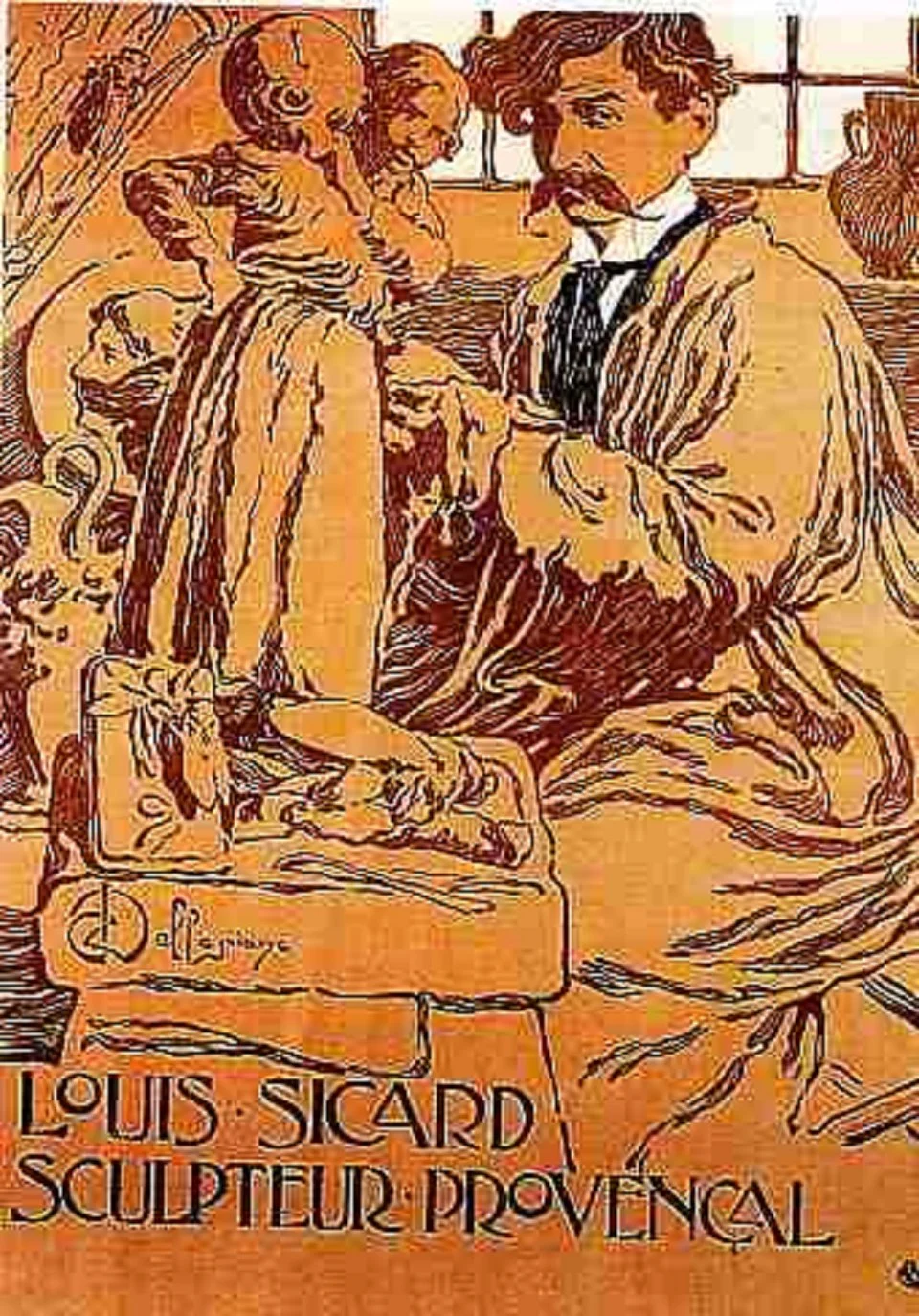
Louis Sicard, Provençal sculptor. Poster by David Dellepiane. Source: Wikimedia, public domain
Louis Sicard (1871-1946), then twenty-five years old, created a paperweight in the shape of a traditional cicada perched on an olive branch, engraved with the motto “The sun makes me sing.” It was the first ceramic cicada. It was a huge success. Louis Sicard earned the honorary title “father of the cicada.” Put the cicada on a stack of papers, and it won’t fly away…
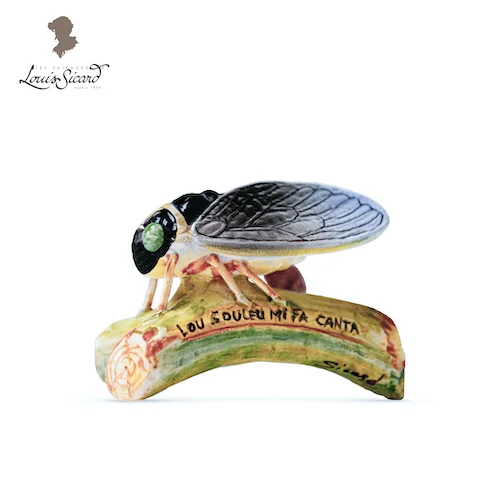
The first cicada. Source: the Louis Sicard ceramics house website
After the tabletop cicada came the wall cicada, a lucky charm that became even more popular still.
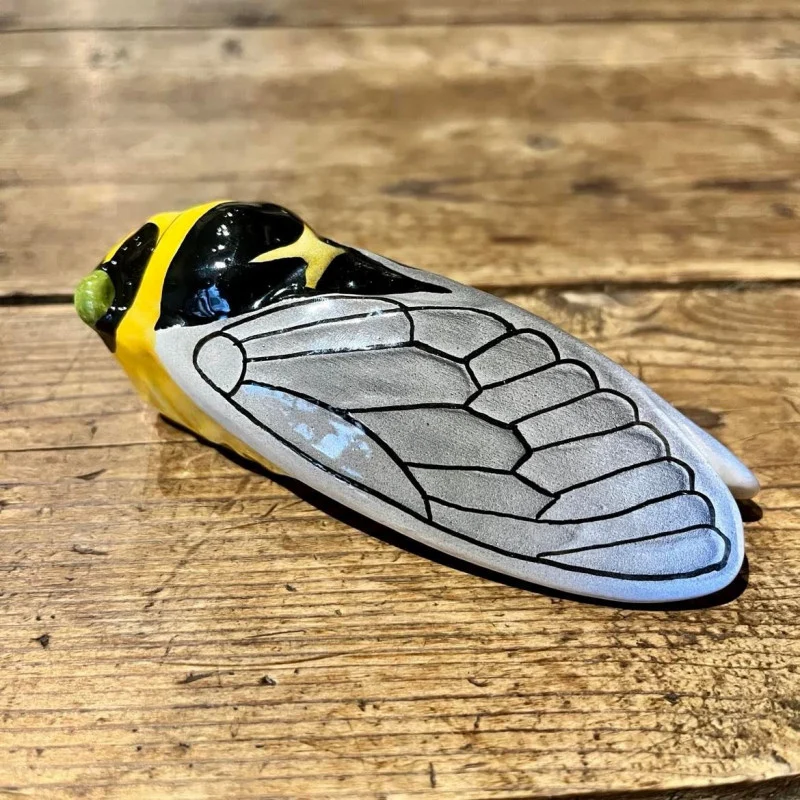
A cicada model used as wall decor. Source: website of Maison Empereur
The cicada on the olive branch became the logo of Louis Sicard and his ceramics house. The plates, cups, jugs, and every other product all carry its mark.
In 1972, Georges, Louis’s son, went to his friends, the couple Ramon and Sylvette Amy, and said to them: “I’ve found successors for the ceramics house. You.” Why them? Out of friendship, because Georges knew the Amy couple would keep embodying the soul of Provence. Ramon and Sylvette said yes to their kindred spirit and bought the workshop. That is how the Amy family took the Louis Sicard ceramics house under its wing and carried the tradition forward.
In this fascinating video, marking 130 years since the first ceramic cicada, you can see Florence Amy, daughter of Georges and Sylvette, telling the story of the cicada, intertwined with the story of the prestigious Louis Sicard ceramics house.
To mark the 130th anniversary of Louis Sicard’s cicada, the Amy family, brothers, sisters, spouses, and cousins, created a white cicada decorated with gold stripes, in a limited edition of one hundred and thirty pieces. This cicada, dressed in modern festive clothes, was made according to the historic model. The traditional methods haven’t changed: like Louis Sicard, his successors still favor handwork. The Louis Sicard ceramics house, blending tradition and modernity, stands as living proof of the friendship between two families, of the craftsmanship typical of Provence, and of its very soul.

The cicada model, 130 years. Source: website of the Louis Sicard ceramics house
Four years underground, four weeks of singing in the sun: the cicada of Provence symbolizes the joy of life, the cheerfulness of love, the ecstasy of artistic creation, music and poetry, the pleasure of rest and idleness, and the very uniqueness of Provence’s atmosphere and landscape. Provence’s poets, like Frédéric Mistral, truly are “friends of beauty.”
The cicada is deeply woven into the culture of Provence and has become one of its most distinctive symbols. Louis Sicard found his successors. More artists from Provence continue in his footsteps, weaving the cicada into their work. Intoxicating!
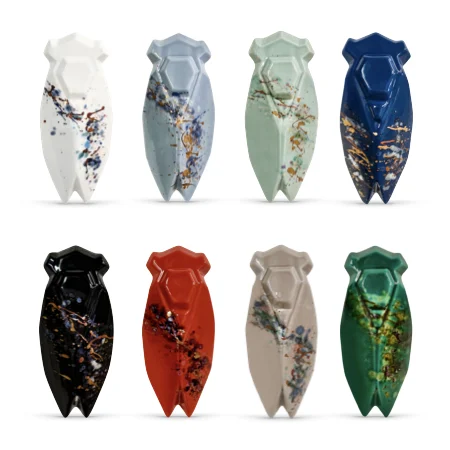
Cicadas, a modern creation. Source: website of the Louis Sicard ceramics house
Link to the Louis Sicard ceramics house, in the center of Aubagne
Related reading