

Giverny: the house and garden where the great Impressionist painter Claude Monet (1840-1926) lived and worked during the second half of his life, from 1883 until his death in 1926. It’s the second most popular tourist destination in Normandy, after Mont-Saint-Michel. Around the house, Monet created a green paradise filled with trees, shrubs, plants and stunning flowers, dotted with ponds, inspired by Japanese gardens.
It’s a legendary site where visitors get a taste of the intimacy of Monet’s life and his family inside the house, and feel, in the garden, as if they’ve stepped straight into one of his paintings, taking in the colors and reflections of the “Flower Garden” and the “Water Garden.”
Claude Monet, who didn’t have a penny to his name at that stage of his life, settled in 1883 with his large, blended family in Giverny. In this village, deep in nature, he painted some of his most beautiful works. He spent his final years here, in relative solitude, completing the great work of his life, while grieving the deaths of his wife Alice and his eldest son Jean, and mourning fellow painters who had passed away. He was the last Impressionist still alive.
The paintings captivate the painter’s admirers, and so does the garden, which served as a model for many of them. Jean-Marie Avisard, the head gardener, who arrived here thirty-five years ago as a novice, now oversees a team of fifteen gardeners. Enthusiastic seasonal workers come from all over the world to help the permanent staff. The garden holds a hundred thousand varieties of flowers and plants, which the gardeners tend in the spirit of Claude Monet.
“The best moment for us is the morning, when there are no visitors yet. The whole garden is ours, the sun is rising and the birds are singing,” says Jean-Marie Avisard. But the gardeners are never really alone. The spirit of the master hovers, lingers, stays. “We never stop asking ourselves,” Avisard continues, “whether the creator of this garden would have loved what we’re doing with it. We never stop thinking about him.”
“We work for Claude Monet,” agrees American gardener James Priest, “he keeps giving us instructions through his writings and through the garden he left behind. We’re grateful to him for the wonderful garden he bequeathed to us, and we try to pass on the delight and love we feel for it to our visitors. Everyone who comes to the garden falls in love with it.” What a privilege, to work in Monet’s garden!
Painting and gardening were Claude Monet’s two great passions. His arrival in Giverny in 1883 marked a turning point in his life and his artistic path. Monet was 43 at the time, and he had no idea he would spend another 43 years in this place. Claude Monet arrived in Giverny at exactly the midpoint of his life.

Why and how Giverny
In 1883, Monet’s lease in Poissy, a town about thirty kilometers west of Paris, came to an end. He hadn’t liked the place anyway and wanted to find another home. During his search, he was drawn to a farmhouse in the village of Giverny, next to which lay a vegetable garden and an orchard of sour apple trees known as “the Normandy orchard” (Le clos normand).
The village and the house, with its garden and orchard, suited him perfectly in every way. The village sits in a damp valley, a microclimate, where the Epte River flows into the Seine. In the early morning, droplets of water evaporate and shimmer with reflections of every color of the rainbow. There was no better place for a painter and gardener like Claude Monet.
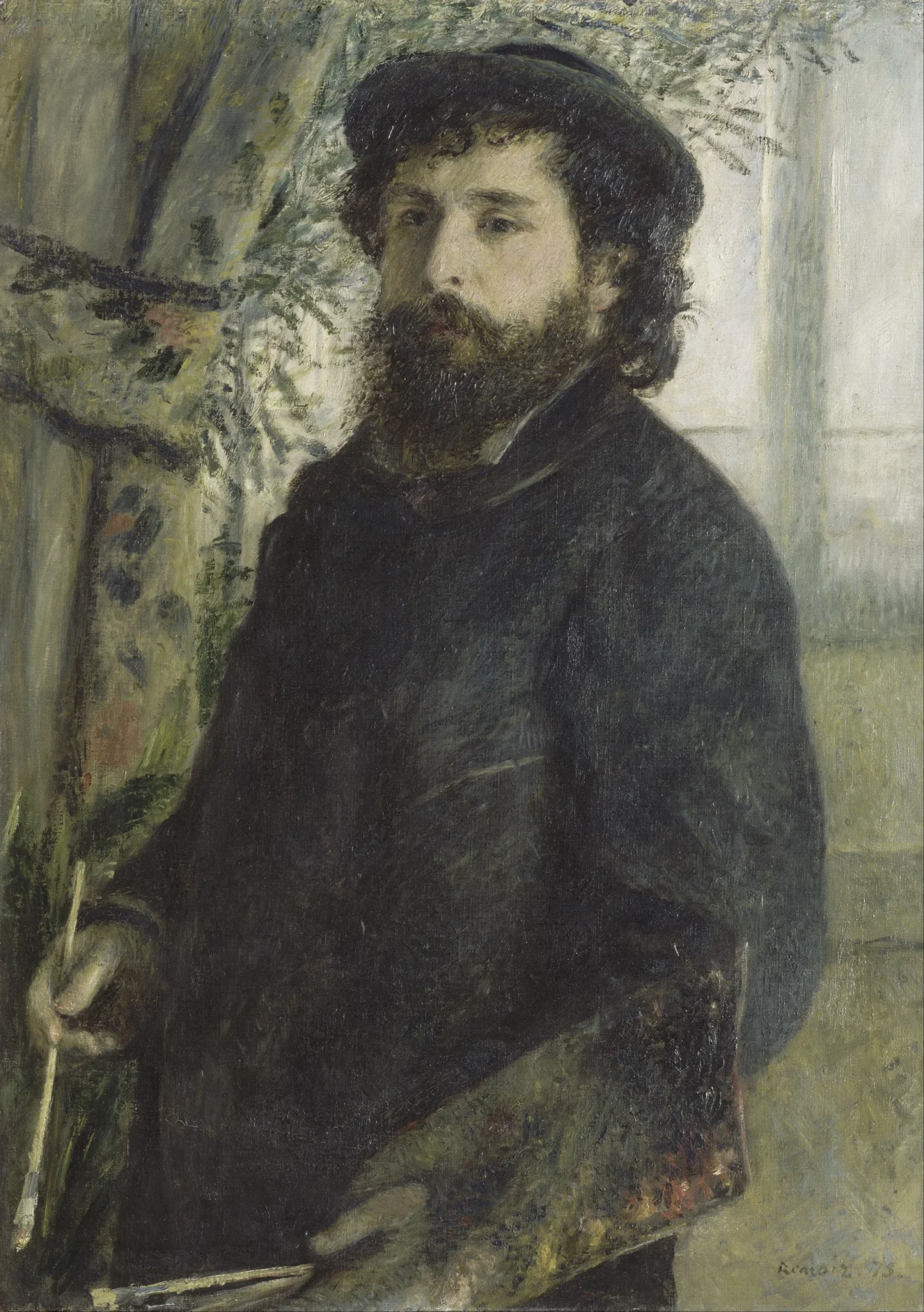
It also suited his unusual family situation. Monet wanted to live outside the capital so he wouldn’t be directly exposed to gossip about his relationship with a married woman. At the same time, the village wasn’t too far, only seventy-five kilometers from Paris, which made it easy for him to stay in touch with the Parisian scene and host close friends. Georges Clemenceau (1841-1929), for example, would come for lunch, dine with the family, and head back to the capital afterward.
On top of that, the house was spacious. A couple with eight children could settle in comfortably. And no small detail: the rent was low. What a find!
Hardships
And yet, difficulties piled up. At that time, Impressionism, a movement Claude Monet had helped found and lead, had not yet achieved the sweeping success that would come later. The arrows of mockery aimed at him would eventually turn into caresses of praise, but in the meantime, Monet’s finances were in terrible shape.
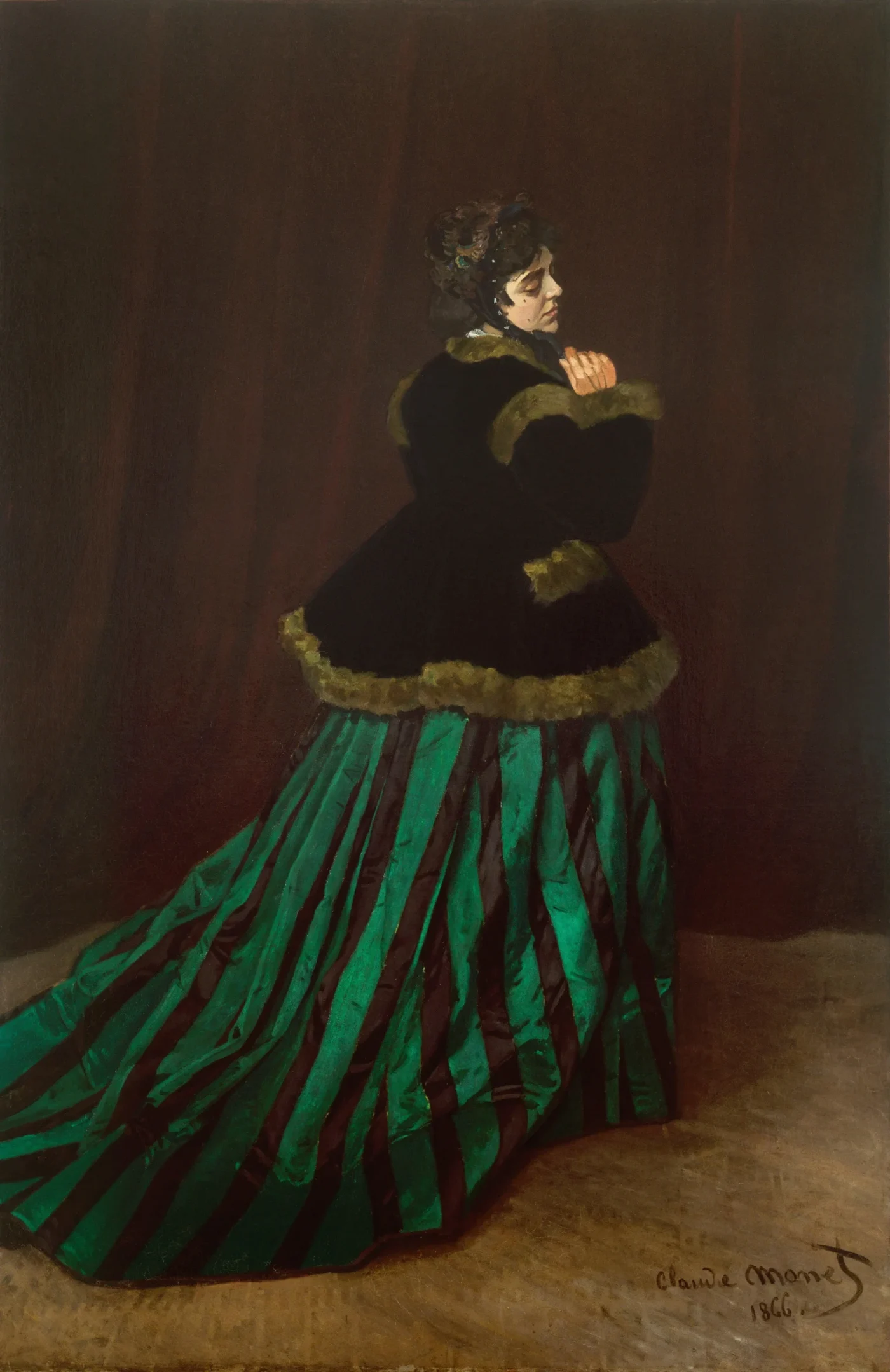
As if that weren’t enough, his family situation, which had drawn criticism in Paris, wasn’t met with much sympathy among the locals either. Claude Monet lost his wife Camille Doncieux (1847-1879) in 1879, when she was only thirty-two. Camille died in agony from cancer, and Monet, overcome with grief at her bedside, picked up a brush and captured her on her deathbed in a heartbreaking painting.
Camille left behind two sons, hers and Claude Monet’s. Claude kept many paintings of his first wife from happier days. Woman in a Green Dress is one of them.
Even while Camille was still alive, Monet had begun a relationship with Alice Hoschedé (1844-1911), who was married to a wealthy textile merchant, art patron and collector, Ernest Hoschedé (1837-1891). In the summer of 1876, Ernest invited Claude to live for a while with his family at the Château de Rottembourg, in the town of Montgeron, about nineteen kilometers southwest of Paris, so he could paint the local landscapes and decorate the salon with his pictures.
Although Alice and Ernest already had five children, four daughters and a son, Alice’s charm worked its spell on Claude, and some say that her sixth child, Jean-Pierre Hoschedé, born around the same time as Camille’s second son, Michel Monet, was actually the painter’s son. The two boys were born about a year apart. Ernest’s passion for art, especially for Impressionism, combined with his poor business sense, drove him into bankruptcy. The Hoschedé family lost the château.
The two families, the Hoschedés and the Monets, settled together in a small house in the village of Vétheuil, near Pontoise. Ernest was absent from home most of the time. Camille’s health declined sharply, and Alice nursed her on her deathbed until the day she died (one can only assume she felt some guilt toward her). Ernest Hoschedé’s death finally allowed Alice and Claude to marry properly.
But not yet, let’s not get ahead of ourselves. Monet arrived in Giverny with his partner Alice and her six children, along with his two sons from the late Camille. Claude Monet was a widower, Alice Hoschedé was separated. Her husband Ernest would die in 1891. Alice nursed him too on his deathbed, and made sure he was buried in Giverny (one can only assume she felt some guilt toward him as well). Four months later, Claude married her.
The extended family, two partners with eight children, settled in Giverny, a small village that had about three hundred residents at the time, with no idea what the future held for them. The villagers weren’t exactly hostile, but they looked at this “tribe” with a mix of concern and curiosity.

Claude Monet fell in love with the Normandy landscape and its light, wandering through nature, hauling his painting equipment around in a wheelbarrow. What’s this strange man doing here? the villagers wondered, and they didn’t spare him from petty harassment. When Claude Monet wanted to paint the haystacks, their owners demanded payment. When he didn’t pay, the haystacks would vanish overnight as if by magic. Claude paid.
When he began painting the series of poplar trees, their owner came to him and said he needed money, so he was going to cut them down and sell the wood. Monet paid. It was worth it. His dealer, Paul Durand-Ruel (1831-1922), bought seven paintings from the series from him and devoted an entire exhibition to them, and them alone.
Harassment, threats, extortion, but Claude Monet never gave up. Nature was always a source of inspiration for him. In his garden, he could create motifs however he pleased and then recreate them in his paintings. Today’s gardeners do the same thing, but in reverse, from painting to garden: they follow Claude Monet’s method, planting flower beds in varied, colorful combinations, or in different shades of a single dominant color, every nuance of blue, for example, with small touches of purple and white. Visitors walking through the garden feel as though they’ve stepped into one of Claude Monet’s paintings.
Monet uprooted the apple trees of the “Normandy orchard” and planted cherry trees, Japanese flowering peach trees, and ornamental trees in their place. Added to the beauty of the blossoms was the color of the thousands of flowers he planted in the garden beds: irises, daffodils, wisteria, tulips, poppies, peonies…
Monet designed his garden according to the light, following the course of the sun. He planted flowers in cool colors, blue, purple, pink, on the east side, and as the sun moved across the sky, the flower colors grew warmer, yellow, orange, all the way to red.
The main path (La Grande Allée), which led from the gate to the house’s front door, was lined with gravel and covered by metal arches draped in climbing roses. Monet planted nasturtiums on either side, blazing in yellow and orange.
The garden became Claude Monet’s second passion after painting. The painter didn’t hesitate to borrow money to buy new flower varieties. The farmers around him worried that the exotic plants would contaminate their fields and poison their livestock, but Monet wasn’t deterred. Who cared. The garden of his dreams was taking shape.
Flourishing
Monet finally began to succeed, and his finances improved. This allowed him to buy, in 1890, the house he had until then only rented. It also allowed him to carry out bigger projects. In 1891, he bought an additional plot of land, adjoining the “Normandy orchard,” to create his “Water Garden.” In 1893, he dug the water-lily pond, which involved diverting a tributary of the Epte River, called Le Ru, the Epte itself being a tributary of the Seine. An artificial creation within nature that became a source for works on canvas.
Over the pond, along the axis of the “Grande Allée,” he built a green, arched bridge, in Japanese style, which created plays of light and shadow. The poplar trees provided the shade, while light passed beneath the bridge. This was his favorite spot for observing the water lilies, a place for meditation with an almost mystical atmosphere. The bridge itself became a subject and appears in Monet’s paintings.
Philippe Piguet, one of Monet’s step-grandchildren (on Alice Hoschedé’s side, his grandmother was named Germaine), points out that with this project, beyond Impressionism, Monet became a pioneer of “Land Art,” a contemporary art movement characterized by large-scale intervention in nature (usually dated to around 1967 in the United States and credited to Robert Smithson (1938-1973) as its founding figure).

Rounding out and deepening the exotic atmosphere are ginkgo trees, bamboo bushes, weeping willows, maple shrubs, Japanese peonies, and lilies. But above all, Monet was mesmerized by the water lilies, which he first discovered at the 1889 Universal Exposition, the one that gave us the Eiffel Tower. A botanist named Joseph Bory Latour-Marliac (1830-1911) crossbred the white European wild water lily with tropical water lilies he bought from collectors, creating ninety colorful varieties, from yellow to red.
Monet discovered them in the pools at the Trocadéro and was captivated. He was, it seems, the first person in France to plant water lilies in his own garden, a brand-new idea. Latour-Marliac, a botanist and nursery owner, had no idea just how different his new customer was from all his other clients… Latour-Marliac invented the colorful water lilies, and Claude Monet made them famous around the entire world.
Every day, a gardener cleaned the water in the ponds so it would look like a polished mirror, and wetted the water-lily leaves after wiping off the dust, so they would reflect the light well. The essence of Impressionism is capturing fleeting light.
That was also Monet’s goal in his nearby series on Rouen Cathedral, painting it again and again under different light, at different hours of the day, in different seasons, in different weather. The same was true of his haystack series, where each painting took on a different color and a different look. This was a revolution. What mattered wasn’t the subject of the painting, nor the motif, but the light itself, the way it moved across it, caressed it, or struck it. Let there be light.
Daily Life
The series enriched Monet and broadened his fame. Many American painters made a pilgrimage to Giverny. On one hand, flattering, but on the other, irritating. The presence of young painters bothered Monet, who couldn’t stand interruptions. Besides, there were four young women in the house, Alice’s daughters, whom Claude had adopted. The young Americans’ courtship of them was not to his liking.
The American painters (among them Mary Cassatt) and French painters too (Cézanne) stayed, during their time in Giverny, at the nearby hotel, Hôtel Baudy. Madame Baudy made a studio available to them, which can still be visited today, as can the dining room where they ate. They gave her paintings of theirs as gifts. The place stopped operating as a hotel but is still active today as a restaurant (Restaurant Baudy). I recommend dining there, and I also recommend visiting the nearby “Museum of Impressionisms” (Le musée des impressionnismes) to complete the picture.
Monet became an authoritative figure, as a painter, as a man, and as head of the family. The life of those living in the house revolved around the work of the patriarch, whose studio was on the ground floor of the main building. This studio became a living room once two more, larger work rooms were installed. In 1886 the second studio, called “the Series,” was set up in the nearby barn. The third, called “the Grand Decorations of the Water Lilies,” was built as a separate structure during World War I.
Monet kept the plaster cladding on the exterior walls of the house in its original pink color, but grew Virginia creeper that climbed up the façade so that it would blend into the garden. He painted the shutters green, and the dining room chrome yellow, including the furniture, bold for his time. 231 Japanese prints by the finest artists decorated the walls: Japonism, as is well known, was at the height of fashion at the end of the 19th century, and Monet embraced it passionately and studied it.
Up to sixteen guests could sit around the table: painters, art lovers, writers. Bonnard, Sisley, Caillebotte, Pissarro, Renoir, Cézanne, Rodin, Sacha Guitry, Octave Mirbeau, Georges Clemenceau, Gustave Geffroy, an art critic and friend of Clemenceau, were among those invited. Human and emotional harmony blended with aesthetic harmony. Monet created for himself the optimal conditions for optimal creation.

After lunch, Monet liked to drink a digestif and coffee with his friends, the painters, art critics, dealers, and collectors, in the studio-salon, which was a kind of intimate museum, a shrine, the only place in the house where his own works, and only his, hung. The collection, in which all periods were represented, let him take stock, examine the different techniques he used, and their development.
A collection to arouse envy and desire. Monet did not heed the pleas of art dealers, especially his personal agent Paul Durand-Ruel, who wanted to buy the works. None of them were meant for sale. How could he part with the record of his artistic path? Testimony, memory, the family tree of his life as an artist but also of his life as a man. Paintings showing Camille, his first wife, that he never sold. Camille with a bouquet of violets, Camille in the garden next to the house where they lived in the town of Argenteuil, northwest of Paris, Camille with their eldest son Jean in that same garden, Camille with Jean and with Claude, Camille on her deathbed. The death of Camille, the wife of his youth whom he had met when she was eighteen, mother of his two sons, affected him profoundly.

In Monet’s house, in the living room, you, the visitors, will only see reproductions of his paintings that hung there during his lifetime. The originals were moved from Giverny to the Musée Marmottan Monet, which includes many of his works. I highly recommend visiting it.
Monet’s closer friends could see, on the walls of his bedroom on the first floor and on through to the bathroom and the hallway leading to the staircase, paintings by Eugène Boudin, Cézanne, Pissarro, Caillebotte, Signac, Renoir, Degas, Manet, Berthe Morisot, painters whose closeness Monet needed, friends and partners in the Impressionist adventure. Not a single painting by Monet himself was found in this part of the house. The bedroom, whose three windows were constantly open toward the garden, was a refuge he retreated to without losing touch with it. The view from it was, and still is, perfect.
A fixed ritual kept order in the days. Meals at set times and a table set magnificently. Monet would get up at five, open the window, and scan the sky. Afterward he would eat a heavy breakfast that included sausages, cheeses, accompanied by a glass of white wine. One child, two, or more would help him load the easel, paints, and brushes onto a wheelbarrow, and so he would go out into nature to paint.
At half past eleven he would return for lunch, and the children would leave their lessons earlier, if necessary, to arrive on time. Although they were subject to a certain regimen, they enjoyed games in the garden and the comfort of the spacious house. Their rooms were on the first floor, each tailored to them. In the blue reading salon at the entrance they would spend quality time with their mother, Alice, and in the garden they would spend time playing and boating with their father, Claude. Bursts of freedom within a strict schedule. Once they bought an automobile, they would take joyful picnics out in nature.

Monet loved to eat and drink well, and the whole family shared the pleasure with him. He oversaw the kitchen’s domain only from a distance; it wasn’t his direct area, but its design was meticulous, like the rest of the house. Monet took care with the harmony of colors and shapes that ruled it. Blue and white ceramic tiles from Rouen and furniture painted in light blue lacquer blended with the copper of the pots. A lovely symphony of calm, soothing shades of blue.
After the meal, Monet would move to the studio-salon, where he would drink, often with friends, plum liqueur and coffee. Giverny became the center of his life. He owed his artistic and emotional balance to the house, the garden, and his wife. The faithful Alice presided over the meticulous household with endless devotion. Alice knew Claude Monet would remain in history.
And more than that, Monet became a myth. Every year, about seven hundred thousand visitors from all over the world visit the house and garden. Giverny is one of the most sought-after tourist destinations in France. Isn’t that proof that Alice was right? The house and garden haven’t lost their charm.
The careful, three-year restoration of the house and garden, which had been neglected after the death of Blanche Hoschedé-Monet, Alice’s daughter and widow of Jean Monet, was carried out true to the original. Claude Monet bequeathed the house with its precious contents and the blooming garden to his son Michel, but Michel had no interest in them and handed over their management to Blanche, the widow of his elder brother Jean. Blanche, who had already been living in the house in Giverny since she lost her husband, faithfully and devotedly tended the embers and nurtured them for twenty years until her death. Blanche, who followed Claude Monet with admiration, a father figure to her, and painted alongside him in the same style. Blanche, Claude Monet’s double, his good fairy, and perhaps even more than that after Alice’s death.

After Blanche’s death, in 1947, wild nature took over the garden, and the house deteriorated and was damaged, flooded with water. In 1966, Michel died in a car accident. In his will, he left the house and garden to the Académie des beaux-arts. The team in charge of the restoration worked wonders thanks to generous American donations and thanks to their expertise and dedication. Archives, photographs, the memories of people who had visited the place: no effort was spared to recreate the site as precisely as possible, as Monet had designed it.
In 1980, the Fondation Claude Monet was established, and the magical site was opened to the general public.

The water lily pond, 1990. Photo and editing: Giles
Final years, the crowning achievement: the Water Lilies
Philippe Piguet, Monet’s great-grandson, has devoted considerable time to researching the family legacy. He has known the house and garden since his childhood. And as he looks at photographs of his great-grandfather after the death of Alice in 1911, he shares with us, strangers who are not strangers, the deep grief of the widower whose world collapsed after his wife’s death.
Claude Monet, now widowed for the second time, as Alice, like Camille, had died in agony from cancer, sank into deep depression and stopped painting for many months. The statesman Georges Clemenceau, worried for the life of his good friend, wrote to him dramatically: “If you don’t pick up your brushes again, I will never come to see you again.” This is the essence of true friendship. A threatening order that did the painter and the history of art a great favor.
Monet picked up the brush again, the magic tool from which he drew the strength to carry on. But a second heavy grief struck him: in 1914 he lost his eldest son, Jean, who was forty-six, to illness. A wife, a son, and his painter friends who had been disappearing one by one. The deaths of Berthe Morisot, Sisley, Pissarro, and Renoir saddened him deeply.
And once again he picked up the brush to carry out his new project, “the Grand Decorations of the Water Lilies,” based on earlier attempts. The appetite of the seventy-five-year-old was reawakened. “Perhaps I owe having become a painter to flowers,” he once said. One could add, “and to the water lilies, the passion of his final years.”
This is the place to clarify that the string of water lilies occupied Monet for about thirty years, from 1890 until his death in 1926. The grand series is made up of three hundred paintings, more than forty of which are large format. The compositions evolved along with the changes that took place in the garden.
From the start of the project, Monet defined two types of compositions. The first type includes the banks of the pond and their dense vegetation, and later the Japanese bridge, as, for example, in the painting “Water Lily Pond”:

The second type focuses, on the contrary, on emptiness, on the surface of the water dotted with flowers and reflections, as, for example, in the painting “Water Lilies”:

Still, only from 1914 on did he devote all his energy to carrying out the project. In the large, well-lit studio he built then (today the museum’s gift shop), he painted “the Grand Decorations of the Water Lilies,” panels two meters high and three to five meters wide. This was the first time he painted in a studio and not in nature. Monet painted the surface of the pond with no horizon, no perspective, for these paintings that have no beginning and no end except for the edge of the frame.
This is a second breakthrough that Monet achieved in the history of art. An image of water and light that overturns a tradition of thousands of years of painting. Art no longer seeks to be faithful to nature. It is nature that bends itself to the painter’s gaze, all the way to the level of the abstract.
Some of the monumental water lily paintings are displayed at the Musée de l’Orangerie. Monet gave nineteen panels as a gift to the nation. “I want to take part in the victory,” he wrote to his friend Georges Clemenceau after the signing of the armistice in 1918. How the painter managed to carry this out, the physical and mental investment it demanded, is almost unimaginable.
Especially since a serious health problem weighed on him. His vision blurred due to a double cataract, and he refused surgery for fear of blindness. The loss of his eyesight contributed to the abstract character of the works that surprised art critics. They didn’t like what they saw, which was very different from all his earlier paintings. See here how the painting of the Japanese bridge became almost abstract:

Claude Monet, The Japanese Bridge, 1918-1924. Painting in the public domain
In the end, Monet gave in to Clemenceau’s pleas and agreed to surgery on his right eye, which he underwent in 1923. Monet was not satisfied with the results of the surgery, but he managed to paint until the day he died thanks to a pair of special optical sunglasses.
Monet became obsessed with one thing. “I planted the water lilies without any intention of painting them,” he said. “I grew them purely for pleasure. A landscape doesn’t fill you in one day. And then, suddenly, the legendary magic of the pond struck me. From that moment on, I painted nothing but the water lilies.”

The water lilies are the crowning achievement of his work, his ultimate legacy. It was hard for him to part with them. He didn’t want to see them leave the place, and he delayed handing them over, to Clemenceau’s dismay.
Claude Monet died in Giverny in 1926, at the age of 86. When the moment came, Blanche summoned Clemenceau. “Are you suffering?” his good friend asked him. “No,” Monet answered, “but this is the end.” Monet asked to be buried like one of the farmers, without flowers and without honors. “I was only a painter who bore witness to the beauty of the world with a brush,” he told Clemenceau. Clemenceau, nonetheless, removed the black cloth covering the coffin in order to cover it with a floral cloth instead.
Half a year later, the permanent exhibition of the panoramic paintings opened to the public at the Orangerie. A water landscape dotted with water lilies, willow branches, reflections of trees and clouds, stretches over a hundred meters before the viewers’ eyes, offering “the illusion of an endless whole, of a wave with no horizon and no shore,” in Monet’s own words.
On the eve of the exhibition’s opening, Clemenceau asked to be alone with the paintings. He stayed a long time and left the museum in tears. Without Clemenceau, Monet would never have agreed to the eye surgery; without Clemenceau, the water lilies would never have found a home at the Orangerie.
Success was not immediate, but it came later. It was again helped by American interest in Monet, which had already appeared starting in 1873 thanks to his agent Paul Durand-Ruel, who opened the broader art market beyond the ocean for him. At an exhibition Durand-Ruel held in New York in 1886, many of Monet’s paintings were sold to “Yankees,” as they were called then. And if the great American collectors were buying Monet, Degas, and other painters, that was a sign there was something to it. The French market opened up too, following the American market, and all of this was thanks to Durand-Ruel.
Painters from the late 1940s, such as Pollock, Rothko, Newman, and Still, owe to the aging master the birth of what is called “All Over” painting, that is, painting with no center, in which no part is more important than any other. Later generations too were influenced, the Minimalist movement, for example, of which “Land Art” is a part, applying its principles and ideas to spaces in the landscape, in nature, in the environment.
The Americans’ interest in Monet swept everyone else along. Art lovers from every corner of the world began to be moved and amazed by the wonders of nature, deepened and expanded by the fingers, holding a brush, of an exceptionally gifted man. How numerous are your works, and all of them made with wisdom.
Claude Monet gave not only France but the history of art itself a gift that reflects the absolute beauty of the world.
Want to visit Giverny?
If this article has made you want to visit, or visit again, this gem that the world has to offer, I invite you to read the article Giverny and Monet’s house: a travel guide. You’ll find there information on how to get to Giverny, how to buy tickets, where to stay, other places in the village worth seeing, and more. In short, everything you need for a successful visit to Giverny.
Note
This article is based largely on three documentary films, episodes from series:
Secrets d’Histoire – Claude Monet: jardins secrets à Giverny, FRANCE TV 3, Août 2011
UNE MAISON, UN ARTISTE – Claude Monet à Giverny, FRANCE TV 5, Juin 2022
Des maisons d’artistes – la maison de Monet à Giverny, Arte.tv, Avril 2023
Related reading