

Musée de l’Orangerie is a Paris museum sitting on the banks of the Seine, a historic site that went through a complete change of career, and the home of some of the finest Impressionist and Post-Impressionist masterpieces. If the image that comes to mind is Musée d’Orsay, you can probably guess the Orangerie’s tragedy. Bad luck has followed it: in the collective imagination, the Orsay will always be seen as the preferred stop for lovers of 19th and 20th century art movements. The Orangerie is sometimes unfairly presented as a mere “add-on” for art lovers who have already done their duty: a visit to the Orsay.
But this modest museum is much more than that. The fascinating history of the building, the neighborhood where it sits, the varied collections displayed within its walls, and above all, the monumental work that gave it most of its fame, all make the Orangerie a fascinating destination for anyone who loves the Impressionist movement and the art of the last two centuries. If you have any interest in the work of Claude Monet, there’s no escaping the tired cliché that follows every well-worn tourist trap: this is a must-see.
Musée de l’Orangerie: Visitor Information
Before I tell you the fascinating story of the Musée de l’Orangerie and its collection, let me give anyone looking for practical information what they need.
The Museum’s Address
The museum stands on a lively, tourist-filled stretch of Paris. The building sits at the western corner of the Jardin des Tuileries, near Place de la Concorde. The exact address, for those who want to use Google Maps: Jardin des Tuileries, 75001, Paris.
Tickets to the Orangerie
I recommend booking tickets in advance to skip the line at the ticket counter. If you want to visit several museums, here are a few combined tickets as well:
- Admission ticket to the Orangerie
- Combined ticket for the nearby Jeu de Paume museum and the Orangerie
- Combined ticket for the Musée d’Orsay and the Orangerie
- Combined ticket for the Musée Picasso and the Orangerie
- Combined ticket for the Musée Marmottan Monet and the Orangerie
- Combined ticket for the Centre Pompidou and the Orangerie
Opening Hours
The Orangerie is open every day except Tuesday, from 9:00 a.m. to 6:00 p.m. Even though it’s not as large as other museums, I’d set aside a few hours for your visit, to really take in the collection or just to sit quietly with Monet’s water lilies. The last entry, if you insist on arriving right before closing, is at 5:15 p.m. From time to time the museum hosts small concerts in its various exhibition rooms.
Now that we’ve covered the practical details, let’s dive into the history and discover how the Musée de l’Orangerie came to be, and how its artworks ended up there.
The Greenhouse Effect
Visitors to the Orsay take a great interest in the site’s history. The story of the train station that failed in its original purpose and became a major art museum (with the highest number of visitors after the Louvre Museum) has become a kind of legend in French folklore, and a fixture in every tour guide’s notebook.
As it turns out, fate decreed that French art museums would never be built in buildings meant for cultural purposes from the start. The Louvre began as a fortified royal palace; the Orsay building was once a train station; and the Orangerie, as you’ll soon discover, was built to meet a high-level imperial demand: a shelter for the nation’s orange trees. A greenhouse, if you insist on sticking to the dictionary definition.
Napoleon the Small
Napoleon III was a descendant of the Bonaparte family. When you carry the name “Napoleon Bonaparte,” your fate is sealed: no matter how impressive a legacy you leave, in culture, urban planning or the economy, you will always be “Napoleon the Small.” Victor Hugo coined that sarcastic nickname in an influential political pamphlet he published, titled “Napoléon le Petit.” And yet, Napoleon III left his mark on the annals of the French nation.

The first (and only) president of the Second Republic and the emperor of the Second Empire; the last emperor to close out a monarchic dynasty; a responsible politician who successfully oversaw the modernization of the French economy; a leader who reshaped the face of the capital and helped cement its cultural standing; and finally: the man who founded the Musée de l’Orangerie. Even if that was never his intention.
In fact, if you asked Napoleon III, all he wanted was to open a hall large enough to shelter the citrus trees of the Jardin des Tuileries from the winter cold. Until the building went up, the trees were kept in the Grande Galerie of the Louvre Museum, a situation that was bound to change once a dedicated space was set aside. But if you’re picturing an ordinary greenhouse, some plain, unremarkable structure of glass panels or plastic sheeting, you clearly haven’t been introduced to the spirit of the French nation yet. For them, practicality is just an excuse for elegant grandeur, nothing less.
Fruit and Citrus: The Museum’s Architecture
Architecture
The architect Firmin Bourgeois was entrusted with completing the building. He took part in designing several buildings around Paris and was known for his attention to fine finishing, regardless of the nature of the project.
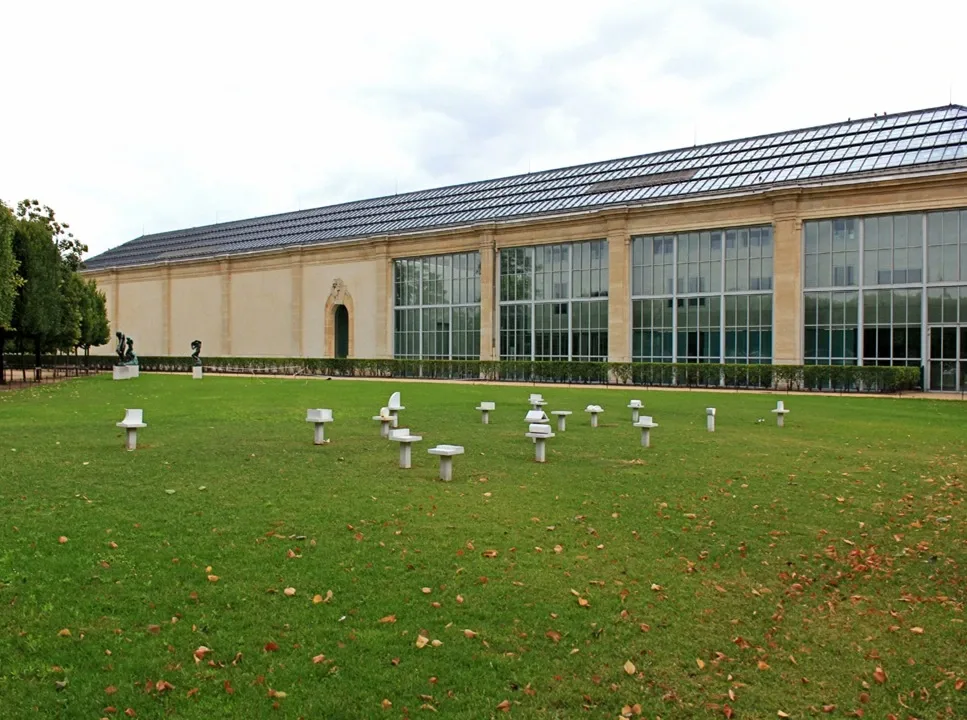
At first, the design reflected the site’s original purpose. On the south side, glass was used to let sunlight in for the plants. The opposite side of the hall, by contrast, was almost completely closed off, with barely any windows, to protect the delicate seedlings from the cold northern winds.
The Entrance Gates
An elegant, functional storehouse for trees? Clearly that wasn’t going to be enough. And what is a grand building without an Italian touch? Enter the great Louis Visconti. A French architect and designer (born in Italy), son of a Roman art historian, and the architect behind the visual overhaul of the Louvre.
Working for “his majesty” was nothing new to him; alongside designing Parisian residential buildings, Visconti took part in designing public buildings, squares (including Place Saint-Sulpice), and important national sites. His best known work? Napoleon’s tomb (the great one, not le Petit). His gracious contribution to the citrus-scented facade of the Orangerie shows in the decoration of the building’s main entrances, on its eastern and western sides.
The Roof Facade
Charles Gallois-Poignant rounds out the list of artists who took part in designing this classical building, one inspired by the striking principles of Greek architecture. His job was to design the triangular roof facade that crowns the decorative columns. The roof’s decorations feature cornucopias (in Latin: Cornu Copiae), a familiar Greek artistic motif that was widely used in ancient Rome.
The horns symbolize wealth and agricultural abundance. They originate in ancient mythology, where they were often paired with gods of fertility and prosperity. This same motif of abundance appears on ancient coins, including those of the ancient Kingdom of Judah, as a symbol tied to prosperity. A cluster of plants completes the artistic look, a silent reminder of the museum’s original purpose.
And if it wasn’t already obvious, the name Musée de l’Orangerie is itself a historical relic, a hint at its earlier role as a storehouse for citrus fruit, oranges in particular…
An Artistic Turn
Until 1922 the building belonged to the state, which put it to a variety of creative uses: storing seedlings, housing equipment, lodging soldiers, hosting concerts, serving as an occasional shelter for traveling galleries, and finally, to its great shame: a venue for city-sponsored dog shows.

Like many far more significant changes, World War I was the catalyst that reversed this multi-purpose drift. Attempts to strengthen national identity and recognize the value of art as a cornerstone of French folklore led the authorities to the following decision: the property was handed over to management of the sub-department of fine arts, alongside the national Galerie du Jeu de Paume. It’s worth noting that the resemblance between the Orangerie and the Jeu de Paume is no accident; both were built in the same decade, on the same architectural principles and in line with the values of the neoclassical movement.
Once the transfer of ownership was complete, the Orangerie’s purpose shifted once again. This time, it was decided that the building would serve as a space for artistic dialogue, a kind of stronghold for painters and artists who could display their work, debate weighty aesthetic questions, and operate under the patronage of the state, which saw itself then (and in many ways still does today) as the patron of French art.
Claude Monet
I follow nature but cannot grasp it; perhaps I owe the fact that I’m a painter to flowers. ~Claude Monet
During the period when the museum changed hands, Oscar-Claude Monet (1840-1926) was working on what many consider the magnum opus of his career: the “Water Lilies” series. In a burst of patriotic spirit, the painter decided to donate the monumental canvases to the state, an unprecedented gesture at the time.
Since the water lily paintings are considered the cornerstone of the Orangerie and the main draw for visitors, a few words of explanation are in order. If you already know the story of this historic series, feel free to skip to the next paragraph.
Portrait of the Artist as a Visionary
Claude Monet is widely considered the painter most closely associated with the Impressionist movement. As one of its founders and leading figures, this towering figure embodied many of the movement’s core principles in his work: soft, bright colors, a central focus on how light breaks apart, and the use of artistic and visual techniques that heighten the visual experience.
As the unofficial author of the movement’s manifesto, Monet believed that “landscape is nothing but an impression, and an instantaneous one.” The modern artist, in the Impressionists’ view, had no obligation to trace historical figures or momentous events in his work, but rather the wondrous poetry embodied in still nature, and the connection it reflects between the eternal and the fleeting.
“There is an abundance of poetic and marvelous subjects in the life of Paris,” wrote Charles Pierre Baudelaire, the celebrated poet and art critic, after visiting the Salon of 1846. “The marvelous envelops and saturates us like the air, but we do not see it.” As the movement’s standard-bearer, Monet found his inspiration close to home: a sea view from his window, a woman holding an umbrella, everything served as a source of inspiration for Monet. Even his own garden.
Water Lilies
On Luck and Fate
Giverny is a commune in Upper Normandy, France. The commune is known for Claude Monet’s house, and especially for the spectacular gardens scattered across its grounds. Monet believed that a man of refined spirit had a duty to surround himself with uplifting sources of inspiration. He devoted many years of his life to cultivating the gardens around his house, planting thousands of ornamental flowers. The small ponds, the Japanese bridge, the weeping willow and the water lilies are all central subjects in some of his most celebrated work.

History might have looked different had Monet stayed in a bourgeois Paris home, in the city where he and his colleagues laid the foundation of the art movement; it might have looked different had his neighbors’ petition succeeded, the one filed out of fear of the exotic plants the eccentric painter brought with him; but luck and fate joined forces to create an aesthetic history. “I’m not good at anything except painting and gardening,” Monet once said, in a burst of modesty. Luckily, his “limited skills” were enough to secure his place in the hall of fame of recent influential artists.
Capturing the Moment
Starting in 1889, Monet showed a growing tendency to present series of paintings that examine a single subject from different perspectives. Behind the idea stood a clear theory and methodology. Members of the movement championed the particularity of art and emphasized the dynamic nature of their subjects, in keeping with shifts in weather, light and the artist’s own state of mind. The series “Haystacks” (in French: Les Meules) and “Water Lilies” (in French: Les Nymphéas, the scientific name for the water lily plant) are striking examples of his work during this period.
Monet devoted the last thirty years of his life to completing the “Water Lilies” series. It would not be an exaggeration to say that the work is a mirror reflecting the most important aspects of the Impressionist spirit. The motifs of water, the breaking rays of light, the many perspectives on a single object, the fragile dynamism of the ongoing subject, the short brushstrokes, all of these elements seem to come together into a harmonious reflection of nature’s beauty. Water lilies were for Monet what sunflowers were for van Gogh: a representative symbol of the “core beliefs” he held dear.
From Theory to Practice
Monet’s prolific work yielded 250 oil paintings. From time to time he shut himself away, almost obsessively, in his studio, polishing his work to perfection, expressing a fresh point of view, and capturing with his brush yet another facet of a fleeting moment. In his later years, the painter suffered from cataracts. The clouding of his eye’s lens dimmed his ability to see reality clearly and led to blurred spots in his vision.
Such a condition might have ended the career of a naturalist painter; for an Impressionist, Monet proved, the curse could become a blessing, at least in the field of art. The purple and pink splotches of color in his later works are a hint of his illness. The painter never denied his vision problem and never tried to mask it by distracting from the reality he perceived. Quite the opposite: he warmly embraced the change and emphasized the subjective, personal layer, an unbreakable rule for the Impressionist painter.
Coarse brushstrokes, intense, stirring colors, a mysterious, almost abstract celebration of “impressionistic” individuality. A depiction of reality may succeed or fail; when a painter presents his state of mind, even his relative failures shed light on his aesthetic and spiritual character.
“A Monument to Peace”
In November 1918, a day after the armistice was signed, Monet promised to donate several of his works to the French government. Despite a formal victory and the annexation of German territory, the spirit of the French nation was broken and grieving. 1,300,000 people lost their lives in the “Great War,” placing France third in the death toll among all nations that took part in the campaign. France (like the British Empire) licked its wounds and sank into gloom and stagnation, which cost it standing on the international stage.

“A Monument to Peace” is what the painter called the eight “Water Lilies” paintings he donated to his beloved country, head bowed low. The absence of a horizon or shoreline symbolizes the sense of hopelessness and despair; the coarse brushstrokes and the unstable, dynamic texture hint at a sorrowful recognition of a world full of upheaval; what once was would never be again.
But on the other hand, hope also finds expression in this stirring work. The intense blue colors give the missing horizon the ability to reflect, in a deliberate artistic inversion, within the stormy waters themselves; the wide canvases were designed to provide a horizontal, almost circular viewpoint, as if hinting that the world would right itself after “this horrible war,” as Monet called it. “The war to end all wars,” as hope still beat in hearts torn by grief.
The Water Lilies Find a Home
In 1922, the year Monet completed the works he dedicated to the state, the Orangerie, in yet another of its many incarnations, belonged to the sub-department of fine arts. Between hosting occasional exhibitions and serving as a cultural meeting place, it was decided to turn the historic building into an annex of the “Musée de Paris of Modern Art.” As for Monet’s works, which didn’t quite fit the Orangerie’s intended purpose, the French government, recognizing their value, considered housing them at the renowned Musée Rodin. Georges Clemenceau, president of the Council of Fine Arts (and, in his other role, prime minister of France), had other plans.
A formidable intellectual, sharp-tongued and quick-witted, with a deep affinity for art and a fierce national spirit, it was hard to talk “the Tiger” (as his countrymen called him) out of his plans. The Orangerie underwent yet another transformation, this time for the sake of Monet’s work, the object of Clemenceau’s admiration and the work of his friend. The painter’s work received the most impressive honor that could be given to a man of culture: a magnificent hall dedicated to displaying his art. Or, to be precise, one single work in eight different panels.
It’s All About Perspective
Camille Lefèvre was the architect entrusted with preparing the space for its current role. A professor at the National School of Decorative Arts, he was known for his active political involvement and his affinity for social issues. In the course of his work he collaborated with artists and intellectuals, which made it easy for him to build trust and win Monet’s affection. Together, the two devoted their strength and energy to turning the Orangerie into the ideal building for displaying the works.
As someone who had spent more time than almost anyone studying the importance of light and its effect on how a viewer interprets a work of art, Monet believed that the “Water Lilies” could not truly be understood without the right perspective for viewing them. He spent many hours, together with Lefèvre, on the architectural task. In time the two could congratulate themselves on the result. Two oval rooms, a nod to infinity and cyclicality; eight panels spanning 91 meters; Monet, the perfectionist, was finally satisfied with the outcome.
A Window to Art
Compromise is unavoidable when adapting an existing building. Monet, however, showed no flexibility at all on the question of the skylight at the center of the room. The paintings were meant to suggest both continuity and permanence, as well as the fleeting changes that occur within a stable framework. And what better way to capture the countless movements of the artist’s mind, and of a reality full of upheaval, than by letting the natural cycle of sunlight play out in the room? The light breaking in the bright room is the very embodiment of the impressionist vision. The room sits on an east-west axis, exactly along the sun’s path, from the Arc de Triomphe to the Louvre Museum. Claude Monet knew exactly how to make the most of that.
How We Said Goodbye
Work on the “Water Lilies” was finished as early as 1922, but the museum wasn’t opened to the public until 1927. Various reasons caused the delay: architectural needs, administrative necessities, a desire to bring the building to perfection, countless factors that gave Claude Monet an excuse, since he found it hard to part with one of the high points of his life. Eventually, the museum opened its doors. In a ceremony both festive and somber, the red ribbon was cut. The “Monument to Peace” became a monument to the artist himself. The man who defined an era and laid the groundwork for so many aesthetic movements never got to attend the event, held after his death.
At first the site carried the name of the hero who had reshaped its purpose: the “Musée Claude Monet.” Later, after it was annexed to the Musée du Luxembourg (which originally served as a museum of contemporary art and today is mostly used for temporary exhibitions), its name was changed to the “Musée National de l’Orangerie des Tuileries.”
The reason for the name change was twofold: on one hand, despite the importance of the mythological painting, reducing Monet to just “Water Lilies” would have done a disservice to his larger legacy. On the other hand, the museum had expanded its collection, and the old name no longer matched its new role as a home for further Impressionist and Post-Impressionist works. The historical context, meanwhile, the ironic reminder of its original purpose, mattered now more than ever.
Rotating Exhibitions at the Musée de l’Orangerie
In 1930 the Orangerie joined the Louvre Museum. Occasional exhibitions, featuring works from the Louvre and other national museums, were displayed in the western part of the building. Each year, the temporary collection on display at the Orangerie was swapped out. Between 1930 and 1933, an Impressionist exhibition was hosted at the museum, drawing in fans and admirers of the movement.
Another temporary exhibition that drew considerable attention was titled “Painters of Reality” (in French: Peintres de la réalité). It was held in 1934 and was dedicated to the meticulous realism of 17th-century art. Another exhibition, featuring masterworks by the Flemish painter Peter Paul Rubens, drew in a million visitors. 1942, to the nation’s great shame, saw an exhibition gallery dedicated to Arno Breker, the architect and sculptor who received the official backing of the Third Reich, whose art was seen as the antithesis of modern aesthetics, which the fascist leadership considered “degenerate.”
The cultural “comeback” arrived in 1946. After World War II, the French government devoted its efforts to restoring great historical pieces, works salvaged from the jaws of the bloody war. In a joint effort by the Allied powers, important pieces were restored and temporarily displayed at the Orangerie.
Jean Walter and Paul Guillaume
The temporary exhibitions drew great acclaim. Alongside the Galerie du Jeu de Paume, in partnership with the Louvre’s painting department, the Orangerie hosted a wide variety of galleries, representing the full spectrum of modern movements and giving a stage to the different ways art captures the human spirit. The success of these exhibitions led other institutions to adopt the same model. More national institutions began holding short-term cultural events. Trends in the art world that had once been pushed to the margins found a voice and made their way into the mainstream and the establishment.
Even so, the place was still considered somewhat inferior compared to older, more established cultural strongholds. No matter how important, fleeting exhibitions couldn’t give the museum the institutional stamp of approval, the kind of recognition the Orangerie so badly needed on its way into the collective consciousness. The turning point came from an unexpected direction: Domenica Walter, widow of the art collectors Paul Guillaume and Jean Walter, was responsible for the renaissance of this storied building.
Paul Guillaume
Guillaume was one of the first prophets to be granted a vision of modernity. ~André Breton, surrealist writer and poet
In the bustling Parisian culture scene of the 20th century, Paul Guillaume was a major player. Unlike other art collectors, who typically came from aristocratic or bourgeois elites, Paul made his way to the top on his own. First in a small garage in Montmartre, and later in a modest Parisian gallery, Paul’s path into wealthy Parisian society was paved with hard work.
But the difference didn’t end there. Other dealers, even the discerning ones who knew how to appreciate groundbreaking innovation, were afraid to challenge prevailing conventions or question accepted notions of art. It was far easier, they thought, to sell their work without trying to topple age-old institutional idols rooted in long-standing aesthetic traditions. Paul Guillaume, by contrast, was driven by an almost messianic sense of aesthetic mission.
The New Pilot
Faithful to his early days, he constantly pushed to advance the social dimensions of Parisian culture. In response to the authorities’ inaction and their disregard for the cultural and social traits of the modern era, Paul declared his ambition to establish a museum of modern art. As cracks began to appear in the Eurocentric worldview, the colorful dealer championed exhibitions of African art, considered groundbreaking at the time. His financial support for struggling painters made him, in the eyes of many of his acquaintances, the patron of the art of his time. They tried to repay him in kind, immortalizing him in their paintings.
At just 23 years old, already a young but financially established art dealer, Paul Guillaume’s portrait was painted by Amedeo Modigliani, the towering painter at the forefront of 20th-century modernism. The inscription “Novo Pilota,” “the new pilot,” speaks volumes about how much the artists admired their patron.

The patron who, while still a young man, was already considered a champion of innovative art. Adding Guillaume’s name to the painting, in such a prominent spot (in the upper left corner), is seen as an important element in creating its intimate feel. This is how the artist cemented the connection between the painting and Paul, the man who supported him in a time of crisis (as a side note: when the work was created, the swastika that appears in the painting was considered simply a symbol of good luck. The tragic connotations are the product of a darker era that came later).
Amedeo Modigliani was one of two famous painters who enjoyed the dealer’s patronage, as he became an enthusiastic promoter and collector of their work. The other was Chaïm Soutine, the renowned Expressionist born in Belarus. What did the two have in common? Their shared Jewish heritage (you know how it goes: a Jewish story never gets its stamp of approval without that provincial context). If you’d like to read more about them, I highly recommend Orna Lieberman’s article Amedeo Modigliani and Chaïm Soutine: The Last Bohemians of Montparnasse.
A Dream and a Tragic Death
Henri Matisse, Constantin Brâncuși, Pablo Picasso and Giorgio de Chirico were among the other painters and sculptors of the era whose work stirred the aesthetic passions of this French art lover, who bought and traded their work. Impressionism, Post-Impressionism, Expressionism, Modernism, Cubism, Fauvism, Surrealism and Metaphysical art: Guillaume stood at the forefront of his era’s culture and was never afraid to actively champion controversial trends.
His collection grew alongside his great dream: a museum of modern art that would showcase the best of the paintings and sculptures he had acquired over the years. That dream might have become reality, had fate not raised its cruel hand and cut him down before his time. In 1934, the passionate collector died of peritonitis, at just 42 years old.
Domenica, Keeper of Secrets
The gossip surrounding this story could fuel an entire detective novel. His wife Domenica’s questionable past, her many affairs, and the mysterious story of two lost wills all led to suspicions that this tragic death was in fact a planned murder.
During the first 24 hours after Guillaume began suffering from the violent abdominal pain that comes with peritonitis, Domenica didn’t bother to call for help. Her home remedies, she later claimed, would be enough to cure him. Even once she decided to get him medical care, she didn’t call an ambulance, preferring to drive him herself, on what became his final journey.
A complaint filed against the widow Walter never led to an indictment. The old-timers of Paris and other “well-informed sources” say that a plea deal quietly struck between Walter and the state authorities, one that involved handing over the magnificent art collection she inherited in exchange for dropping the charges against her. But let’s stick to the known facts amid all this fog: Domenica’s marriage to Jean Walter.
Jean Walter
Jean Walter was a French architect who designed public housing, including hospitals and apartment buildings. This short biography wouldn’t have been enough to earn him a glamorous life, if not for a dramatic twist. In 1925, after serving in World War I as an aide to Georges Clemenceau (whom you already read about), Walter took part in a mining venture near the Moroccan city of Oujda. Finding rich deposits of lead and zinc multiplied Jean’s fortune many times over. And, as you might expect, this is where our acquaintance Domenica entered the story.
The affair between the two unfolded in rather bizarre fashion. Part of it took place right under Paul Guillaume’s nose, as he preferred to ignore the “hints,” including the fact that all three lived together. After Guillaume’s tragic death, the two married in a ceremony that drew considerable attention, formalizing their questionable relationship.
Between Innovation and Tradition
During her marriage to Walter, the art collection underwent major changes in character. Sentimentality toward her previous husband’s possessions was never a strong trait of Domenica’s, and she bought and sold pieces as she pleased. African sculptures and paintings, whose promotion had been Paul’s life mission, were abandoned in favor of a more conservative collection. Alongside the African collection, modern sculptures with bold motifs and avant-garde paintings that didn’t suit the couple’s taste were also set aside. Eclecticism gave way to uniformity. The restless spirit was bound in the chains of conformity.
In place of the pieces that were sold, the couple acquired other works of art, this time with a clear purpose: creating coherence and harmony across the collection, and turning its once-chaotic variety into a defined collection fit for display in a dedicated museum.
And since we can’t ignore yet another entry on this philanthropist’s list of questionable spouses, Jean Walter’s end was tragic too: a car accident in 1957, while he was driving his wife and her lover (don’t ask) to a modest country bistro, brought his life to an end. It won’t surprise you to learn that her self-confidence served her again this time, as she chose not to call emergency medical services and instead drove herself to get help for the injured man.
The Collection Passes to the State
And so, from a world of mysterious suspicions and wagging tongues, we arrive at the Musée de l’Orangerie. When France offered to take the collection under its wing, the widow accepted. It took a full five years to prepare the museum for this notable addition (1960-1965).

The space that once hosted rotating exhibitions was removed; two new levels were added to the building; a staircase with a decorative railing led to the new gallery rooms; and in 1966, in a ceremony attended by the renaissance man André Malraux (adventurer, writer, amateur sociologist, and minister of culture under de Gaulle), the magnificent gallery was unveiled to the public. Despite all this, Domenica officially retained ownership of the works until her death in 1977.
About a year after her death, another round of renovations took place. The museum underwent various changes, with the goal of permanently housing the works of Paul and Jean, after whom the collection is named. The pieces were now displayed to visitors based on curatorial logic, aiming to improve the viewing experience. As part of this overhaul, the Orangerie’s administration separated from the Louvre Museum and the Galerie du Jeu de Paume. The national gallery’s collection, incidentally, was handed over to the future Musée d’Orsay.
Details of the collection
“One of the finest collections of European paintings,” is how the museum’s website describes this group of works. That might be a small exaggeration, but there’s no denying the importance of what’s on display here, or what it means. The 148 works, gathered between the 1930s and the 1960s, show a real cultural balance and reflect many of the modern movements that defined the 20th century and directly shaped the art of our own time.
The collection includes 25 works by Renoir, 15 by Cézanne, and 12 by Picasso. Other big names, like Gauguin, Monet, Sisley, Matisse, and Modigliani, round out the list, adding a layer of artistic depth to works that are challenging, fascinating, and often melancholy, created during a turbulent and complicated era.
The final steps
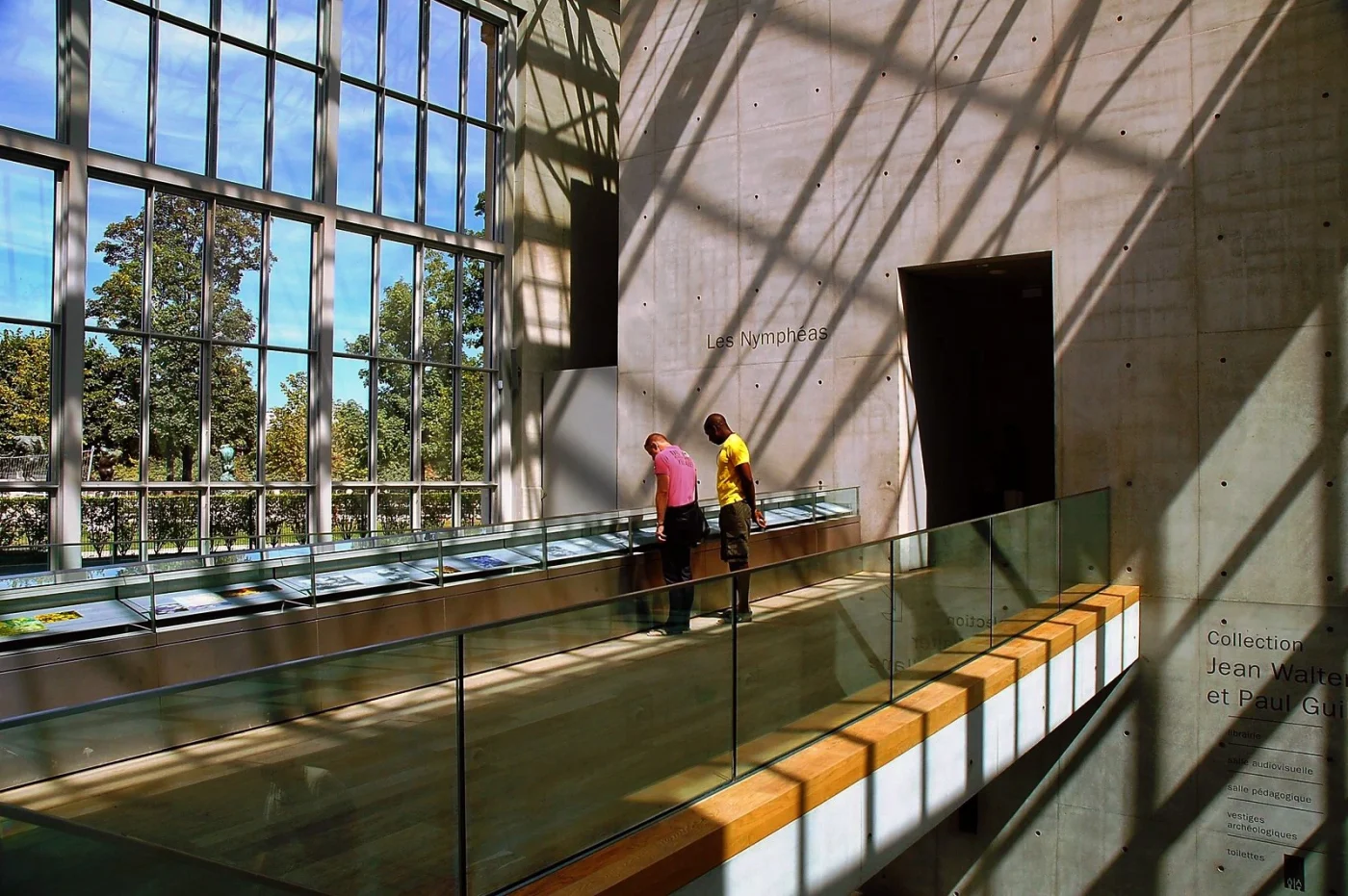
Looking ahead is essential if you want to preserve the past. The changes of the modern era demand that the museum keep adapting to the spirit of the times. The last major renovation took place between 2000 and 2006. The architecture firm blp, led by Olivier Brochet, oversaw the construction. The two uppermost levels, which had housed part of the collection, were removed. The basement rooms held the collection of Jean Walter and Paul Guillaume. With the upper levels gone, natural light could once again fall on the Water Lilies.
The work didn’t stop there. Temporary exhibition spaces were built so visitors could once again enjoy rotating shows. An auditorium, a space for learning and discussion, and a handsome library were the final touches, proof that the museum keeps listening closely to what the public wants. One unexpected discovery, the remains of a wall built under Louis XIII (as part of the defenses of the Tuileries Palace), briefly halted the renovation and worried the people working on it. Luckily, a few minor architectural adjustments solved the problem before it became a real crisis.
Since bureaucracy is always part of any good Parisian story of intrigue, I’ll mention that in 2010 the two leading museums of Impressionist art were joined under a single administrative body, named the “Public Establishment of the Musée d’Orsay and the Musée de l’Orangerie” (in French: Établissement public des musées d’Orsay et de l’Orangerie).
Related reading
