

I arrived in the village of Beuvron-en-Auge (Beuvron-en-Auge) in October 2025, when autumn had painted Normandy in shades of gold and crimson, following a warm recommendation from my friend Yossi Drori (you can read about it in his article on the Cider Route).
Yossi’s description had fired up my imagination, but nothing prepared me for what I actually saw. Walking into the village, I felt like I had stepped into a 17th-century postcard brought back to life. The soft autumn light caressed the dark timber beams of the houses, the geraniums still clinging to their window boxes, and the pastoral silence broken only by birdsong. How, I asked myself, could a place this perfect still exist in our world? The answer, as is so often the case in France, lies in a story.
A Norman rollercoaster: the remarkable history of Beuvron-en-Auge
To understand the magic of Beuvron-en-Auge, you have to go back thousands of years. This is a story about builders, nobles, revolutionaries, and above all, about the vision of one man who saved an entire village from the teeth of time and forgetting.
From beaver to baron: the ancient roots
The story begins with the name, as it so often does. “Beuvron” comes from the Gallic word “biber,” meaning beaver (yes, the cute animal with the big teeth). The name points to a deep connection with the land and the streams running through the area, the Doigt and the Vieux Doigt, which were once home to those industrious creatures. It’s a first clue to the character of this place: a village born from the Norman landscape itself.
But it was an important noble family, the House of d’Harcourt, that left its true mark on the village. This family, whose roots trace back to the companions of William the Conqueror (Guillaume le Conquérant, c. 1027-1087), held the lands of Beuvron for four hundred years, from 1382 until the French Revolution in 1793. Their coat of arms, two gold stripes on a red field, remains the village’s official emblem to this day, a living witness to its feudal past.

The “de Beuvron” branch of the d’Harcourt family was one of the most important in France. Figures such as François III d’Harcourt (1627-1705), Marquis de Beuvron, were senior courtiers and military men. His son, Henri d’Harcourt (1654-1718), was a brilliant diplomat who served Louis XIV.
In recognition of his devoted service, especially during the political maneuvering that led up to the War of the Spanish Succession, the Sun King granted him the title “Duc d’Harcourt,” making the family one of the kingdom’s most senior houses. This link between a tiny village in Normandy and the corridors of power at Versailles is exactly the kind of story I love uncovering.
Life, prosperity and a “good death” in the 17th and 18th centuries
Under the rule of the House of d’Harcourt, the village reached the height of its prosperity. The local economy flourished thanks to the leather tanning and weaving industries. This wealth made possible the construction of the magnificent 17th and 18th-century timber-framed houses that give the village its distinctive character to this day. This wasn’t purely an aesthetic choice, but a direct product of the local economy and materials: oak from the forests and clay from the fertile soil.
The social and religious life was no less rich. One of the most fascinating stories I uncovered concerns the “Brotherhood for a Good Death” (confrérie pour ‘bien mourir’), founded in the village church in 1686 by the local priest. The brotherhood, which received the approval of Pope Innocent XII (Innocentius XII, 1615-1700), was meant to prepare its members for a proper Christian death.
The existence of such a society speaks to a tightly knit community, one that shared not only commercial life but also deep existential and spiritual anxieties. Only the French could set up an organized bureaucratic society just to make sure you die properly. They probably had a board, minutes, and surely tea and light refreshments at the meetings (because even dying should be done on a full stomach).
A revolutionary son, a slow decline
The revolutionary winds sweeping across France at the end of the 18th century did not spare Beuvron-en-Auge. One of the village’s most famous sons was Thomas Jouenne-Longchamp (1761-1818), a young politician elected to represent the area in the National Assembly. At the height of the trial of King Louis XVI (1754-1793), Jouenne-Longchamp voted in favor of the king’s execution, an act that branded him a “regicide.” After Napoleon’s fall and the restoration of the monarchy, he was exiled from France and died in exile in Brussels.
After the Revolution, the village entered a long, slow decline. The weaving and tanning industries vanished, and progress passed it by. The railway line, opened in 1879, was closed to passenger traffic as early as 1938, and the village became a “forgotten backwater,” as the locals themselves described it. Its historic houses were neglected, the ancient timber beams were covered in layers of concrete and modern plaster, and the magic faded almost entirely.
A Renaissance man: how mayor Michel Vermughen saved a village
In 1971, with Beuvron-en-Auge on the brink of architectural extinction, a man named Michel Vermughen (born 1923) was elected mayor. Vermughen was no ordinary politician; he was a man of vision who understood the treasure buried beneath layers of crumbling concrete. He saw the beauty that had been, and he dreamed of the beauty that could be.
In 1972 he founded the “Association for the Protection and Improvement of Beuvron-en-Auge,” a brilliant move that allowed him to raise funds and grants for preservation. His first mission was to restore the heart of the village: the covered wooden market (Les Halles), which had been torn down in 1958. And then came a moment of pure genius.

Vermughen heard that several ancient farmhouses in the area were about to be demolished to make way for the construction of the A13 highway. He convinced the authorities to let him dismantle these farmhouses and preserve the original building materials: centuries-old timber beams, antique tiles and carved stones.
With these materials, and with the help of the villagers, he rebuilt the market in 1975, not as a copy, but as a new-old creation, authentic down to its foundations. At the same time, he encouraged residents to strip the modern plaster off their houses and expose the original timber beams. The village began breathing again. Thanks to his work, Beuvron-en-Auge was awarded the prestigious label “One of the Most Beautiful Villages in France” (Les Plus Beaux Villages de France), and the main square is named after him today, Place Michel Vermughen.
A modern artist’s muse: David Hockney in Normandy
The story doesn’t end there. Vermughen’s preservation work created a virtuous circle of authenticity. The beauty that had been preserved drew in tourists, and tourism provided the means to keep preserving it further. But the greatest proof of his success came in 2019, when one of the world’s most important artists, the British painter David Hockney (born 1937), fell in love with the landscape and the quiet of the area and bought a 17th-century house on the edge of the village.
During the COVID lockdowns, Hockney found a creative refuge in his Norman home. He began documenting the arrival of spring in a stunning series of paintings he created on his iPad, “The Arrival of Spring, Normandy, 2020.”

His paintings, filled with vivid colors and a love of life, spread the beauty of this region around the world and brought the village international recognition. Hockney’s presence is the final seal of approval on the success of this preservation vision: the authenticity so carefully preserved became a source of inspiration for great art, securing Beuvron-en-Auge’s place not only on the map, but also in the pages of art history.
A perfect afternoon in Beuvron-en-Auge: my route
Beuvron-en-Auge is a village that needs to be experienced on foot, slowly. Half a day will be enough for you to soak up the atmosphere, discover its charming corners and feel the historical pulse beating through its lanes. Here is my recommended walking route.
Place Michel Vermughen and the covered market (Place Michel Vermughen & Les Halles)
Every visit has to start here, at the beating heart of the village. This isn’t just a beautiful square ringed by cafés and small shops, it’s a living monument to the vision of the mayor who saved this place. Stand in the middle and look around at the restored timber facades, each one a work of art in its own right.
Step under the enormous roof of the covered market. Take a close look at the massive, ancient timber beams used to build it. Picture the bustle of the market in the Middle Ages, then think about the astonishing story of its reconstruction in the 1970s from recycled materials. This is the spot where the village’s past and present meet in the most tangible way.
- Open days and hours: The structure is always open.
The old manor houses (Les Manoirs): a glimpse into the noble past

Beuvron-en-Auge and its immediate surroundings are dotted with ancient country manor houses (Manoirs), remnants of the age of nobility. Most are privately owned and cannot be visited, but you can and should admire them from the outside.
The most striking of all is the Vieux Manoir (Old Manor) from the 15th century, standing right at the entrance to the main street. You can’t miss its carved timber beams and its impressive appearance. A short distance outside the village are two more manor houses listed as historic monuments:
The Manoir de la Hogue from the 17th century and the Manoir du Lieu Hocquart from the 17th and 18th centuries. Even if you only see them from the road, they round out the picture of country noble life in Normandy.
- Open days and hours: All the manor houses are privately owned and not open to the public.
The Center for Crafts (Espace des Métiers d’Art)

Inside the village’s former schoolhouse is now a lively center for local artisans. This is the place to see how old traditions of handcrafted work continue to live on. Here you’ll find workshops for pottery, artistic woodworking, leatherwork, porcelain painting and even a knife maker.
I highly recommend stepping in, chatting with the artisans and watching them at work. It’s a wonderful opportunity to pick up a unique, authentic souvenir, one that tells a story and comes straight from the hands that made it.
- Open days and hours: Hours vary between workshops, but most are open Tuesday through Saturday, generally between 10:00 and 18:00. It’s best to check the local tourism website.
Église Saint-Martin
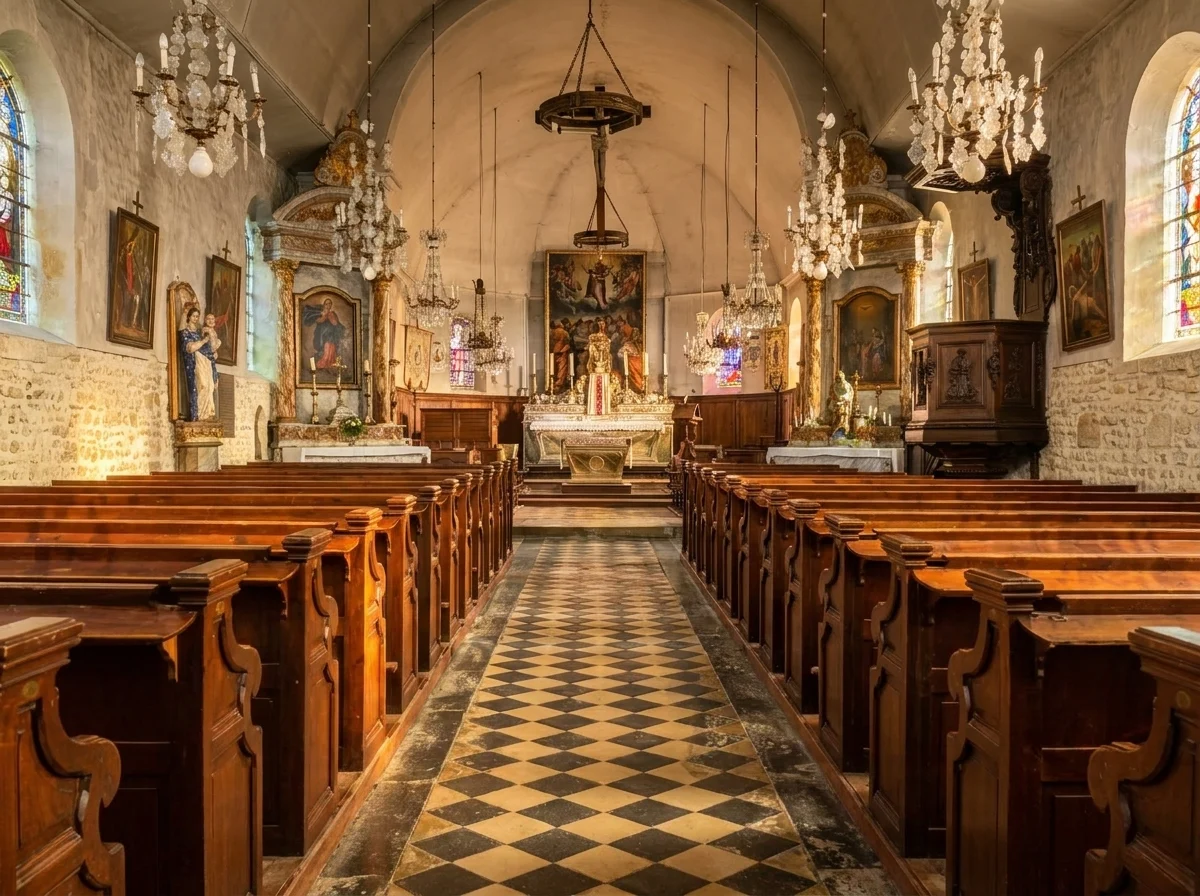
A short way north of the main square stands Église Saint-Martin, a modest 17th-century building. It may not be as grand as Normandy’s great cathedrals, but it has a quiet charm of its own. Step inside for a few minutes of calm and take in the 18th-century main altar and the simple spiritual atmosphere. This church is a reminder of the community life that revolved around it for centuries.
- Open days and hours: Usually open during the day.
Wandering through time

Finish your visit the best way possible: get lost. Wander through the side lanes, look for the ancient 18th-century Auberge de la Boule d’Or, and don’t be afraid to step onto Rue de l’Enfer (Hell Street). Every corner of this village tells a story, and every facade is a lesson in history and aesthetics.
Practical information for travelers
Here are a few small tips to help you make the most of your visit:
Getting there and parking
The easiest way to reach Beuvron-en-Auge is by car. The village is about a 30-minute drive from Caen and Lisieux, and about two and a half hours from Paris. Across from the tourist office you will find a large, free public parking lot, which also has a charging station for electric cars.
When is the best time to visit?
Every season has its own charm, but in my opinion, fall is the perfect time. The dazzling colors of the changing leaves and the crisp air create a magical setting. On top of that, the last weekend of October brings the “Cider Festival” (Fête du Cidre), a lively event with a farmers’ market, tastings, and music.
Other events worth noting are the Geranium Fair (Foire aux Géraniums) in May, and the Beuvr’Antiques antiques market, held on the second Sunday of every month.
Tourist office
Don’t hesitate to stop by the local tourist office (Bureau d’information de Beuvron-en-Auge). The staff is friendly and happy to give you a map, information about upcoming events, and even book you a spot on the guided tour.
- Address: 2 Esplanade Woolsery, 14430 Beuvron-en-Auge.
- Opening hours: generally Tuesday through Saturday, 10:00-13:00 and 14:00-18:00 (summer hours may be longer).
Sleep like nobility: where to stay in the area
This time, during my visit in October 2025, I chose to settle into a lovely apartment in Deauville, which served as a comfortable base for exploring the whole Pays d’Auge region. That said, if you want to experience the area more intimately, here are a few lodging options closer to Beuvron-en-Auge.
Le Grand Hôtel de Cabourg, MGallery (5 stars)

For anyone looking for classic seaside luxury, there is no spot more iconic than this hotel in Cabourg, about a 20-minute drive from Beuvron. It’s a grand hotel from the Belle Époque era, where the writer Marcel Proust (1871-1922) was once a regular guest. The rooms are elegant, the sea views are breathtaking, and the service is top-notch. A true once-in-a-lifetime experience.
Château de la Bribourdière (4 stars)
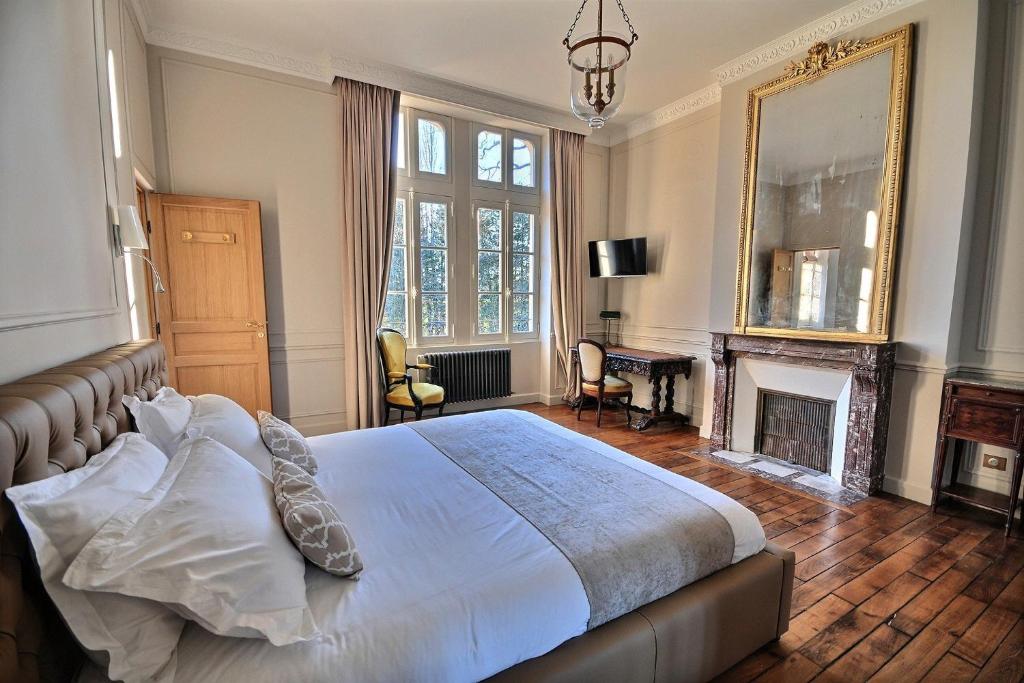
If you’ve ever dreamed of sleeping in a French château, here’s your chance. Just a very short drive from Beuvron, in the heart of the countryside, sits this charming château. It offers spacious, tastefully decorated rooms, well-kept gardens, and a peaceful, romantic atmosphere. The place gets fantastic ratings for its hospitality, beauty, and quiet.
Le Pave d’Hotes (3 stars)

For anyone who wants to stay right in the heart of Beuvron-en-Auge itself, this is one of the best options around. This charming guesthouse occupies a beautifully renovated historic building and offers comfortable rooms, a wonderful breakfast, and warm hospitality. The location is perfect: just a short walk from all the restaurants and shops in the village.
Le Pressoir (3 stars)

Another gem of rural hospitality right in the village. “Le Pressoir” (the cider press house) is a beautiful guesthouse with a well-tended garden, run by a lovely couple (the owner also runs an art workshop at the arts center). Guests praise the warm welcome, the carefully prepared breakfast, and the pleasant rooms.
Hotellerie Normande (budget hotel)

For travelers on a tighter budget, this hotel in the nearby town of Dozulé, about a 10-minute drive from Beuvron, is an excellent option. It’s a simple, clean, and functional hotel that offers great value for the price and makes a convenient base for exploring the area, including the D-Day beaches and Cabourg.
Related reading