

There are places in France that feel like they were lifted straight out of a postcard: places where the air is clearer, the green is deeper, and the silence runs further down. In October 2025, during one of my trips through Normandy, I found myself spending a magical half day in exactly such a place: the village of Cambremer. I arrived there in the late morning, just as the last wisps of fog were lifting off the hills of the Pays d’Auge, revealing a valley thick with apple orchards.
This short visit was actually the first half of a day spent touring Normandy’s enchanting villages, and in the second half of that same day I visited Beuvron-en-Auge, the more famous of the two. But Cambremer, with its modest and authentic character, won my heart in its own right. It’s not just a beautiful village, but the beating heart of Norman culture: the unofficial capital of the Cider Route (Route du Cidre), and a place with a rich and surprising history hiding behind its ancient stone and timber houses.
In this article, I want to take you on a journey through time and place. We’ll dive together into Cambremer’s fascinating past, uncover stories that few people know, and then set out on a half-day walking route that will let you soak up everything this charming village has to offer, from its stunning gardens to its family-run Calvados distilleries. Let’s get started.
The long and surprising history of Cambremer
To understand Cambremer’s charm, you have to understand its story. This isn’t just a collection of pretty houses, but a place shaped over centuries by religious power, wars, and small and large human stories. The history of this village runs far deeper than its modest size would suggest.
From the Celtic tribes to the power of the bishops
The story of Cambremer begins before the name “France” even existed. There’s evidence suggesting the area was settled as far back as the Celtic era, and remains have been found indicating a Roman presence there too, likely a small military outpost. But Cambremer’s true identity began to take shape in the early Middle Ages, closely tied to the power of the Church.
Starting in the 6th century, the village fell under a unique ecclesiastical arrangement. It was “exempt” from the authority of the nearby Bishop of Lisieux, and answered directly to the Bishop of Bayeux instead. This was no small matter. The Bishop of Bayeux made Cambremer the capital of his barony, granting it supreme judicial powers, including the right to try capital cases.
In practice, this meant Cambremer wasn’t just another feudal village, but an administrative and religious center of real power. The bishop ruled with a firm hand over a long list of estates and territories across the region, such as the Château de Crèvecoeur-en-Auge and Manerbe, all administered from Cambremer. This direct rule by the Church shaped the village’s character for centuries, giving it a regional importance far beyond its physical size.

Life, death, and demons during the Hundred Years’ War
The Hundred Years’ War (1337-1453) was a terrible period for Normandy. The region became an ongoing battlefield between France and England, and daily life for residents was filled with fear, violence, and uncertainty. Peasants abandoned their land to seek refuge in fortified towns, and bands of soldiers from both sides looted the villages.
Cambremer did not escape this reality. To this day you can find fortification remains from that era in the area around the village, known as the “English Castle” (Château des Anglais), a silent witness to those hard times. But within the great chaos of war, local stories also took root: legends passed from mouth to mouth that offer a rare glimpse into the mental world of people of that time.
One of the juiciest and strangest of these stories is that of the priest Jean Patye (dates unknown), dating from 1537. According to legend, Patye was obligated, under an ancient agreement, to travel to Rome to sing the epistle at the Christmas midnight mass. The journey was long and exhausting, so the desperate priest decided to take drastic action: he made a pact with the devil. The devil agreed to fly him to Rome and back in a single night, and in exchange, Patye promised him his soul.

The devil kept his word, and the priest found himself in the Vatican. While he was there, he not only sang the epistle, but also slipped into the archive and destroyed the original document that obligated the priests of Bayeux to make the yearly journey. When he returned to Cambremer that same night, he freed his colleagues from the burdensome duty. This legend, fanciful as it may be, shows how in a time of intense faith and deep fear, the line between reality and the supernatural was completely blurred.
The Renaissance, the Revolution, and a name in Proust’s novel
After the wars ended, Cambremer began to recover and change its face. Starting in the 16th century, impressive manor houses and half-timbered buildings typical of the region were built in the village, some of which still stand today. During the Wars of Religion, the area again saw turmoil, and during the French Revolution, the forests of Cambremer served as a hideout for bands of “Chouans,” royalist rebels who opposed the revolutionary government.
But one of the most delightful anecdotes in the village’s history has nothing to do with battles or kings. It belongs to literature. The great writer Marcel Proust (1871-1922), who spent a great deal of time in Normandy, chose to use the name “Cambremer” for one of the aristocratic families in his immortal novel “In Search of Lost Time.”
In the book, the characters hold an amusing exchange about how strange and unfortunate the name is. One character remarks on how the name ends, and another chimes in on how it begins. The joke plays on an awkward combination of words (in French, Cambronne is the name of a general famous for a particularly crude exclamation, and “merde” means excrement). The fact that the name of this small, quiet village found its way into a literary masterpiece is a wonderful historical wink that every Francophile should know.
From saints who banished snakes to magnificent architecture
Beyond the great events, Cambremer’s history is also woven through with local legends and small details that make it special. One of the oldest legends tells of a visit by Saint Vigor, the Bishop of Bayeux, to the Cambremer area between the years 522 and 525. According to tradition, the saint performed many miracles and drove snakes out of the area, a symbolic act representing the triumph of Christianity over paganism.

Later periods left a more tangible mark on the village. Cambremer’s architecture, especially from the late 17th century and the second half of the 18th century, is a testament to prosperity and good taste. Many houses were built from reddish brick and timber beams, decorated with ornaments unique to the region, such as Saint Andrew’s crosses (croix de Saint-André) and fern-leaf motifs. This building style, combined with the village becoming a cantonal capital under Napoleon, contributed to its growth and to the construction of many public buildings and brick houses, giving the village the distinctive character it still carries today.
What to do in Cambremer? A one-day itinerary
Now that we’ve dived deep into the history, it’s time to discover Cambremer as it is today. I spent about half a day in Cambremer (including a wonderful lunch), and I think the most important stops are the Jardins du Pays d’Auge, some of the loveliest gardens I’ve ever seen, the village church (which hides a sad story), and then a hop over to an excellent restaurant near the church. It’s a great restaurant, one that alone would be worth the trip to the village.
Les Jardins du Pays d’Auge
Our first stop is a true gem, a place that reads like a hymn to the Norman landscape and culture. The “Jardins du Pays d’Auge” are not just gardens; they are a living work of art, and they rightfully earned the prestigious “Jardin Remarquable” label (Remarkable Garden). The story of this enchanting place begins in 1994, when Armelle and Jacques Noppe bought about 30,000 square meters of land (later expanded to more than 40,000 square meters) around an old, restored farmhouse. Together with landscape architect Chantal Lejard-Gasson, they turned an empty pasture into a botanical and architectural masterpiece.

Today, you can wander among magical themed gardens, each offering a completely different atmosphere. You’ll find the “Sun Garden,” marked by warm, golden colors, the “Moon Garden,” which plays with fascinating perspective tricks, and the “Water Garden,” which gives an almost tropical feel. But the garden that will really spark your imagination is the “Devil’s Garden” (Jardin du Diable), don’t worry, there’s no real witchcraft there, but every plant in it is poisonous to some degree, so you might want to keep your hands in your pockets!
What makes this place so special is the harmonious blend of greenery and traditional Norman architecture. The owners collected old timber-framed structures from all around the region, took them apart, and rebuilt them inside the gardens. Don’t miss the green maze with its philosophical motifs, or the eco-museum (housed in an old stable) that displays the tools of craftsmen from days gone by. Give yourself at least two hours to soak in the beauty and calm of this place.
Opening hours:
- May 1 to September 30: open every day (including Sundays and holidays), from 12:30 to 18:30.
- October 1 to 20: open Monday through Saturday only, from 13:00 to 17:00. (Hours may change, it’s best to check the official website before you go.)
Tickets and more information: admission for an adult is about 9.50 euros. For more information, visit the gardens’ official website.
Église Saint-Denis de Cambremer and its moving Pietà
After the calm of the gardens, I highly recommend stopping by the village center to soak up a bit of spiritual history (and some genuinely moving art). The Église Saint-Denis has been the beating heart of Cambremer since the late 12th century (it was officially consecrated in 1188 by the Bishop of Bayeux, Henri II).

Although most of the church was destroyed and rebuilt in the 17th century, the imposing square bell tower, built of limestone in the Romanesque style, survived the test of time (and was even declared a historic monument in 1921).
But the real magic of this church is hidden inside. Alongside beautiful 20th-century stained glass windows telling the story of Saint Denis, you’ll find an extraordinary work of art: a large, moving Pietà painting created right after World War I by the artist and renowned glass artist Jean Hébert-Stevens (1888-1943), with his wife, Pauline Peugniez, modeling for Mary Magdalene.
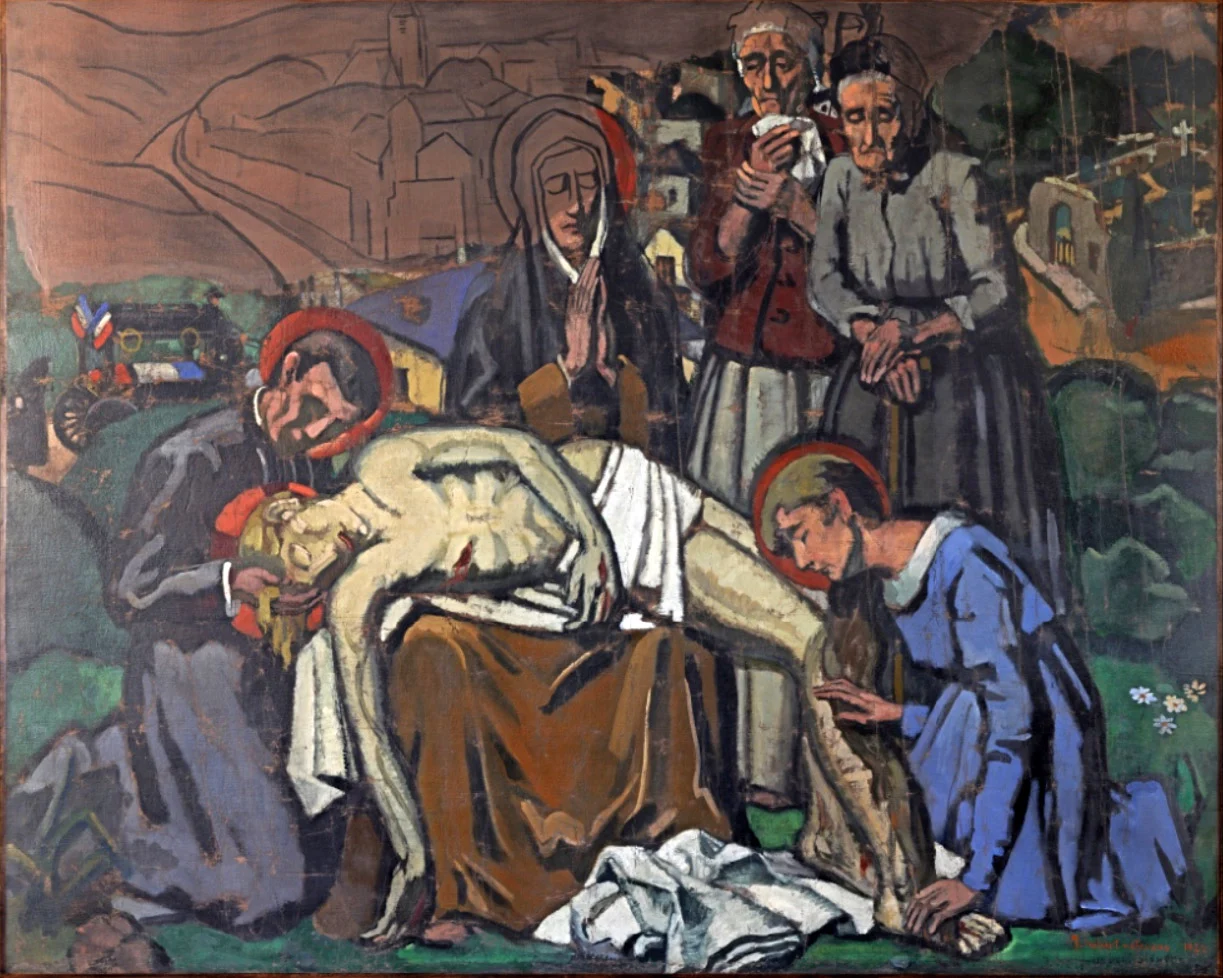
The painting, which mourns the horrors of World War I, was damaged in a fire at one point but underwent a remarkably careful restoration, and was recently donated to the church by the artist’s grandson. This moving gift was dedicated to the memory of Arthur Bonny (1981-2015), his beloved son whose life was cut short too soon. The unexpected combination of the ancient medieval stone walls and this modern, deeply personal work gives the place a truly unique atmosphere. It’s well worth a visit, even if you’re not among the faithful.
L’Authentic: a restaurant worth coming to the village for on its own
As its name suggests, L’Authentic offers a warm, authentic experience. It’s a family-run bistro run by the De Silva couple, who greet every guest with a wide smile. The interior is full of vintage pieces and nostalgia, creating a cozy, inviting atmosphere. The cooking here is home-style French cuisine with Mediterranean influences, and the dishes were both generous and delicious.

As a starter we got country bread baked at the local bakery, which was the perfect partner for a wonderful anchovy dish we had. For the main course we had veal scallop, served with cream, mushrooms and a Pommeau sauce (a local apple-based spirit). And finally, I couldn’t resist tasting the homemade chocolate mousse, which was also excellent.
The prices were very reasonable, the flavors were great, and the service was excellent, so if you’re looking for one more reason to make the trip to Cambremer, here it is.
Opening hours: open only on Friday and Saturday evenings, from 18:00 to 21:00.
Reservations: for more details and reservations, visit the restaurant’s official website.
Calvados Pierre Huet
Unfortunately I didn’t have time to visit this one when I was in Cambremer, since I already had to get to my next stop, but you can’t really talk about Cambremer without mentioning the Pierre Huet distillery, a well-established and highly regarded institution operating since 1865. It’s the story of five generations of one family, who have devoted their lives to the art of turning apples into a drink fit for the gods.
The guided tour of the place (about 45 minutes) is a fascinating sensory experience. You’ll see the old apple press and the traditional wood-fired stills, but the truly magical moment comes when you step into the cellars. There, among hundred-year-old oak barrels, you’ll be wrapped in deep, sweet scents of apple, wood and the passage of time.
The tour ends, of course, with tastings. You can sample the distillery’s four AOC-protected products: cider, Pommeau de Normandie, and of course, Calvados aged to different degrees. It’s a great opportunity to understand the subtle differences between the drinks and pick up a bottle or two as a souvenir.
Since I unfortunately didn’t get the chance to visit, I don’t have photos of the place, but I found a short video for you to get a feel for it.
Opening hours:
- April to September: Monday to Saturday, 09:00-12:30 and 14:00-18:00. Sundays and holidays, 10:00-13:00 and 15:00-18:00.
- October to March: Monday to Saturday, 09:00-12:30 and 14:00-18:00. Closed Sundays and holidays. (It’s best to check the official website before you go.)
Tickets: the tour and tasting cost 3.50 euros per person. You can reserve a spot through the distillery’s official website.
Before you go on… Enjoying the read? So you don’t miss a single fascinating article or a great tip on France’s hidden gems (and yes, the best articles go out every weekend!), feel free to sign up for our newsletter. Click right here to sign up for free (don’t worry, we hate spam just as much as you do).
Practical information for visiting Cambremer
Parking
Cambremer is a traveler-friendly village with convenient parking options. For private cars, there are several free parking lots, mainly around the church square and at the entrance to the village.
For travelers with a camping-car (motorhome), there’s a free, well-organized parking area at Place de l’Europe, right next to the gendarmerie station. There’s also a service point for emptying and cleaning, with water and electricity available for a small fee using tokens, which you can buy at shops in the village.
When should you visit?
You can enjoy Cambremer in any season, but there are two dates that make a visit especially memorable. If you want to experience the authentic village atmosphere at its best, plan to arrive on a Sunday morning in July or August. During these hours, between 10:00 and 13:00, the church square hosts the “Marché à l’Ancienne” (the old-fashioned market), a charming farmers’ market with local produce, a lively atmosphere and the scents of Normandy.
For those of you who love good food, the best time to come is the first weekend of May. That weekend, the village hosts the “AOC-AOP Festival,” a prestigious food festival that draws producers from all over France and Europe, showcasing their finest products bearing protected quality labels. It’s a true celebration of gastronomy.
Where to stay in Cambremer and around
On my last visit to the area, I chose to stay in a lovely apartment in Deauville, which made a great home base for exploring the Normandy coast and the Pays d’Auge. That said, if you want to experience the countryside in the deepest way, I highly recommend staying at one of the charming guesthouses (Chambres d’Hôtes) scattered around Cambremer. Here are a few favorites, broken down by price range.
4 and 5-star stays
Maisons d’hôtes: Domaine Le Coq Enchanté
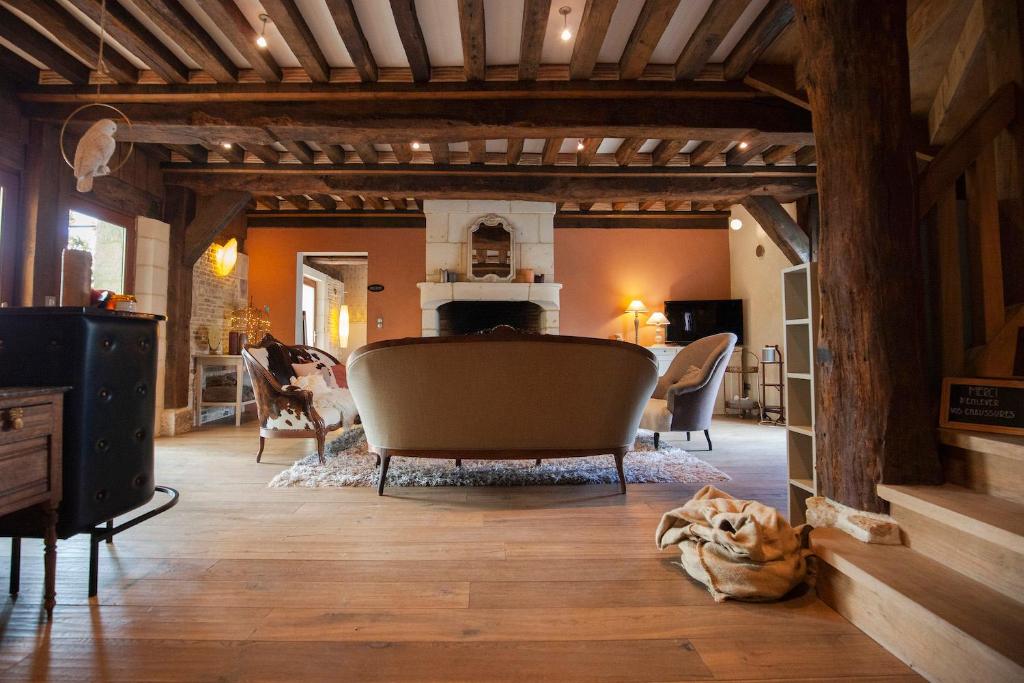
This isn’t just a guesthouse, it’s an entire estate of charm and indulgence. The property is made up of several beautifully restored Norman stone houses, a romantic gypsy caravan, and even a transparent “bubble” for sleeping under the stars. With some units rated 4 and 5 stars, the place offers complete tranquility, manicured gardens, and spa facilities like a sauna and jacuzzi. It’s ideal if you’re looking for a luxurious, secluded getaway in the heart of nature.
Check availability and prices here
Les Marronniers

Ever dreamed of sleeping in a 17th-century Norman manor? This is the place for you. Les Marronniers is a stunning historic manor house offering spacious, carefully decorated rooms, some with private spa bathtubs. The hosts, Christine and Vincent, are known for their warm welcome and indulgent breakfasts, with homemade bread, jams, and pastries. The view from the estate, overlooking the Dives river valley, is simply breathtaking.
Check availability and prices here
3-star stays
Le Pavé d’Hôtes (in Beuvron-en-Auge)

This guesthouse sits in the beautiful neighboring village of Beuvron-en-Auge, considered one of the prettiest villages in France. Le Pavé d’Hôtes is an authentic timber-framed Norman house offering comfortable rooms, a sunny garden, and private parking. The location is perfect, just a short walk from the village’s picturesque main square, and makes an ideal starting point for exploring the Cider Route.
Check availability and prices here
Le Pressoir (in Beuvron-en-Auge)

Also located in Beuvron-en-Auge, Le Pressoir is a charming guesthouse set in a beautiful old building. The host, Sylvie, earns high praise for her warm and attentive welcome. The rooms are comfortable, breakfast served in the summer in the lovely garden is a treat, and the overall atmosphere is calm and relaxed. A great place to feel the true pulse of rural Normandy.
Check availability and prices here
Budget option
La Maison de Manon Calvados Chambres D’hôtes (in Bonnebosq)
In the nearby village of Bonnebosq, you’ll find a real gem for travelers on a smaller budget who aren’t willing to compromise on quality. La Maison de Manon is a recently renovated guesthouse that gets nearly perfect ratings from guests for its cleanliness, comfort, and service. The place offers beautiful rooms, a lovely garden, an excellent breakfast, and all at a very fair price. Fantastic value for the money.
Check availability and prices here
Related reading