

My first visit to Rouen is a bit of a blur in my memory. I was a kid, and the only thing that stuck with me was Notre-Dame Cathedral. I didn’t understand anything about Gothic architecture or history back then, but I stood there with my mouth open, facing this enormous structure that looked like it had been woven out of delicate stone lace. That image stayed with me for decades, like a promise that one day I would have to come back.
And then, in October 2025, that promise came true. During a trip to Normandy with my parents, I gave the city a full two days (which in practice turned into three, once you count arrival and departure). I finally got to discover the city behind my childhood memory, explore its little streets, learn its stories and breathe in its distinctive atmosphere. Based on that experience, I built this itinerary for you: two days that include everything that, in my opinion, makes Rouen one of the most fascinating and beautiful cities in France.
The History of Rouen: The Key to Understanding the City
Before we get started, let me say that you really can’t understand Rouen just by wandering its pretty streets. To feel its true pulse, you need to know the stories hidden between the cobblestones and inside the walls of its crooked-roofed houses.

This is a city whose history reads like an epic drama: from Viking longships sailing the Seine, to the mighty dukes of Normandy, to the tragic and inspiring story of one young woman who changed the fate of France within these walls.
The history here isn’t just dates and battles, it’s the soul of the place. I wrote about the city’s fascinating history in detail in this article, and I highly recommend reading it before your visit. It will turn every street corner and every building you see into a much richer, more meaningful experience. So before we get down to business and start exploring, take a few minutes and read the following article: The History of Rouen.
A detailed two-day route through Rouen
I split the route into two days, and to keep the scrolling on the site manageable, you’ll see two buttons up top (Day 1 and Day 2). Once you finish reading about the first day, just click Day 2 and that day’s route will appear.
Day 1: The heart of Gothic history, well-kept secrets and excellent food
We’ll dedicate the first day to the eastern part of the historic center. It’s a particularly dense and compact area, where every attraction is just a few minutes’ walk from the next, no wasted time and no crisscrossing the city back and forth.
Morning (9:30 a.m.): Notre-Dame Cathedral, following in the footsteps of Richard the Lionheart and Claude Monet
I started my first day exactly where my childhood memory began: in front of Notre-Dame Cathedral (Cathédrale Notre-Dame de Rouen). Even as an adult, its power struck me. This isn’t just a church, it’s a monumental work of art, a lace of stone reaching toward the sky that makes you feel small and awestruck. Its facade, which has weathered centuries of history, tells a story of faith, power and artistry.

But the real magic reveals itself once you step inside and realize you’re walking on ground where some of the most important figures in Norman history are buried. Here, for example, you’ll find the tomb of Rollo (c. 860-c. 930), the legendary Viking chief who became the first Duke of Normandy, the man who started it all.
The juiciest anecdote, proof that sometimes the heart goes one place and the body another, concerns the legendary King of England, Richard I “the Lionheart” (1157-1199). Even though he was King of England, he apparently preferred the wine and cheeses of Normandy, and in his will he asked that after his death, his heart be buried in Rouen Cathedral as “a keepsake of love for Normandy.” So while the rest of his body was scattered elsewhere, his physical heart rests here, a symbol of the deep connection (or maybe just the culinary affection) between the great warrior and the capital of his duchy.
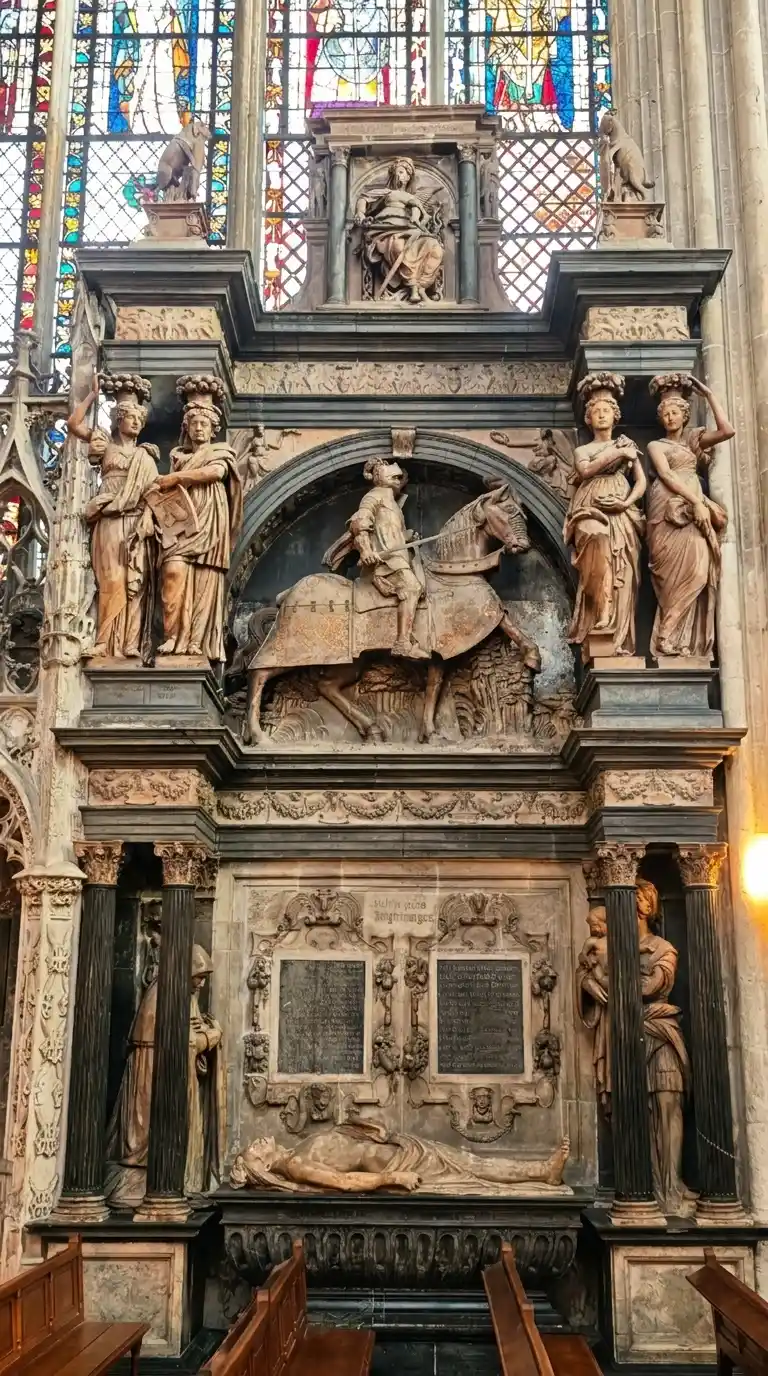
And speaking of tombs, try to get into the Chapelle de la Vierge (Lady Chapel). I say try because it’s usually closed to the general public, but sometimes it opens for prayer services. If you manage to get in, you’ll find the tomb of Louis de Brézé (1460-1531), husband of Diane de Poitiers. It’s one of the most beautiful and impressive tombs built during the Renaissance, and I highly recommend seeing it (the chapel holds quite a few other treasures too, but start with this one).
And of course, you can’t talk about the cathedral without mentioning Claude Monet (1840-1926). The great Impressionist painter was so mesmerized by the way light played on the stone facade that he rented a room in the building across the street and painted it in a series of nearly 30 paintings, at every hour of the day and in every season.

- Opening hours: Monday 2:00 p.m. to 7:00 p.m., Tuesday through Saturday 9:00 a.m. to 7:00 p.m., Sunday and holidays 9:00 a.m. to 6:00 p.m.
- Tickets: Admission to the cathedral itself is free. Top tip: ask at the tourist office about the “special tours” (visites insolites) that let you descend into the hidden crypts.
- Official website: Official website of Rouen Cathedral
Late morning (11:00 a.m.): Historial Jeanne d’Arc, a sound-and-light experience in the Archbishop’s Palace
Just half a minute’s walk behind the cathedral, on Rue Saint-Romain 7, you’ll find the Historial Jeanne d’Arc. The museum is housed inside the gorgeous Archbishop’s Palace, the very place where the unforgettable retrial took place that overturned her conviction after her death.

I was deeply impressed by the digital multimedia sound-and-light show (parcours spectacle) projected onto the palace’s ancient stone walls. The show leads visitors from room to room, telling the story of her life, her trial and her transformation into a legend in a moving and absorbing way.
That said, I couldn’t help an ironic thought: the people of Rouen first burned her at the stake, and later figured out they could make a nice bit of money off her… (but hey, at least the museum is excellent!). Want to know the full story of this national heroine? Feel free to read the article Joan of Arc: witch or saint?
- Opening hours: Tuesday through Sunday 10:00 a.m. to 7:00 p.m. Closed on Mondays.
- Tickets: Booking ahead is recommended to secure a spot on the sound-and-light tour.
- Official website: Official website of Historial Jeanne d’Arc
Sweet break (12:30 p.m.): Dame Cakes, wonderful cakes in a magical setting
After the emotionally charged historical journey with Joan of Arc, this is exactly the time for a sweet break. On the very same street, at number 70, you’ll find the charming tea salon Dame Cakes. The place is housed in the old workshop of Ferdinand Marrou, the city’s famous blacksmith who installed the spires of the cathedral.

I had wonderful cakes and exceptional homemade pastries there, in an atmosphere that is simply delightful and takes you right back to the Belle Époque. If the weather cooperates, ask to sit in the small, blooming inner garden, with a dreamy view of the cathedral’s spires.
- Opening hours: Monday through Friday 9:30 a.m. to 7:00 p.m., Saturday 9:00 a.m. to 7:00 p.m. Closed on Sundays.
- Official website: Official website of Dame Cakes
Afternoon (1:30 p.m.): Église Saint-Maclou, lace in stone and the Flamboyant style
Let’s continue east, just about a 3-minute walk, to Place Barthélémy, where you’ll find Église Saint-Maclou. If the cathedral is the king of Gothic architecture, Saint-Maclou is the undisputed princess of “Flamboyant Gothic” style. Its facade is decorated with curving arches that look exactly like flames frozen in stone.
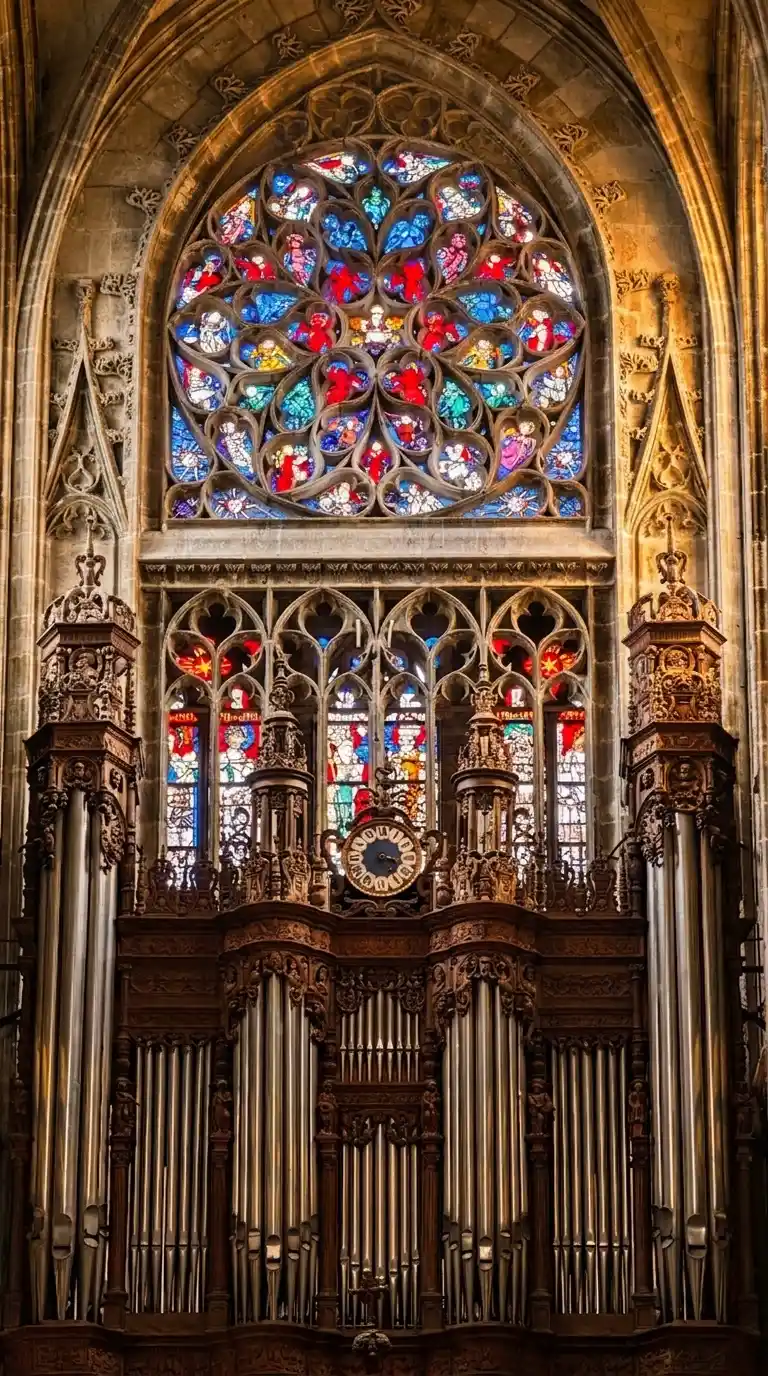
The inside of the church offers an intimate and impressive atmosphere. Don’t miss the picturesque stone stairs leading up to the church’s magnificent organ, supported by stunning Renaissance columns created by the sculptor Jean Goujon.
- Opening hours: Saturday and Sunday 10:00 a.m. to 12:00 p.m. and 2:00 p.m. to 5:00 p.m., Monday 10:00 a.m. to 12:00 p.m. and 2:00 p.m. to 6:00 p.m. (closed the rest of the week).
- Official website: Official information about Église Saint-Maclou
Lunch (2:30 p.m.): Restaurant Rotomagus, a meat lover’s feast facing the church
Just a few steps from Église Saint-Maclou, right on Place Barthélémy at number 7, you’ll find Restaurant Rotomagus waiting for you. If you’re a meat lover, this is a must-stop for you. It’s one of the best steak restaurants I’ve eaten at in France!

They specialize in quality cuts of meat grilled over an open charcoal fire, and the atmosphere is wonderful. Sitting on the terrace facing the church’s Gothic facade and the ancient half-timbered houses is a culinary and visual experience you won’t want to end.
- Opening hours: Monday through Saturday 12:00 p.m. to 2:00 p.m. and 7:00 p.m. to 10:00 p.m. Closed on Sundays.
- Official website: Official website of Restaurant Rotomagus
Late afternoon (4:00 p.m.): Aître Saint-Maclou, macabre beauty and the secret of the mummified cat
We’ll head to nearby Rue Martainville 186 and step into the Aître Saint-Maclou. It’s one of the most unusual and unsettling sites in Europe: a mass graveyard from the 14th century, built to bury victims of the Black Death plague.

The inner courtyard is surrounded by stunning wooden galleries carved with macabre motifs: skulls, crossed bones, burial tools and scenes of the “Dance of the Death” (Danse Macabre), meant to remind the living of the fleeting nature of their existence (Memento Mori). And as you walk between the columns, look carefully for the small display case in one of the walls, where the unexpected mummy of a mummified cat is displayed, found between the walls during restoration work! Today, ironically and charmingly, this quiet courtyard has become an art center, with workshops and a pleasant café.
- Opening hours: Open daily, 9:00 a.m. to 7:00 p.m. Free admission.
- Official website: Official website of Aître Saint-Maclou
Late afternoon (4:45 p.m.): Les Violons du Robec, the magic of violin making
Before we move on to our next stop, I recommend making a small detour onto the picturesque Rue Eau-de-Robec, where a small stream flows through the middle of the street. There, at Place du Lieutenant Aubert number 18, you’ll find a unique studio called Les Violons du Robec.

This is a fascinating workshop for repairing and building string instruments, run by the talented luthière Manon Bard. It’s a wonderful experience to watch this delicate craft up close, to smell the wood and varnish, and to feel this ancient musical tradition come to life right before your eyes (and if you’re lucky, you might even catch them on an open day for the general public).
- Opening hours: Tuesday through Friday 10:00 a.m. to 12:00 p.m. and 2:00 p.m. to 7:00 p.m., Saturday 10:00 a.m. to 12:00 p.m. and 2:00 p.m. to 6:00 p.m. Closed on Sundays and Mondays.
- Official website: Official website of Les Violons du Robec
Early evening (5:30 p.m.): MUNAÉ, the Museum of Education, toy rifles in the classroom
We’ll end the first day by continuing our short walk along Rue Eau-de-Robec until we reach number 185: the Musée National de l’Éducation (MUNAÉ), housed in an impressive old half-timbered house (“Maison des Quatre Fils Aymon”).

The museum presents five hundred years of the history of education in France, with an amazing reconstruction of a classroom from the Third Republic era. What impressed (and amused) me most there were the toy rifles hung openly in every French classroom in the 19th century! It turns out that young children went through military drills as part of their school schedule… and here we are complaining that modern school systems are too militaristic!
- Opening hours: Monday, Wednesday, Thursday and Friday 1:30 p.m. to 6:15 p.m., Saturday and Sunday 10:00 a.m. to 12:30 p.m. and 1:30 p.m. to 6:15 p.m. Closed on Tuesdays.
- Tickets: Admission to the museum is free!
- Official website: Official website of MUNAÉ
Day 2: Antique Clocks, Joan of Arc’s Stake, Art and Medicine
On the second day, we’ll focus on the central and western axis of the old city, connecting the bustling commercial heart, the site of Joan of Arc’s tragedy, the rich world of art, and Flaubert’s birthplace.
Morning (10:00 a.m.): Gros-Horloge, the clock that sets the city’s pace
We’ll start the morning on Rue du Gros-Horloge, Rouen’s lively shopping street. At its center stands the famous astronomical clock tower (Gros-Horloge), built in the Renaissance and decorated with stunning gold carvings.
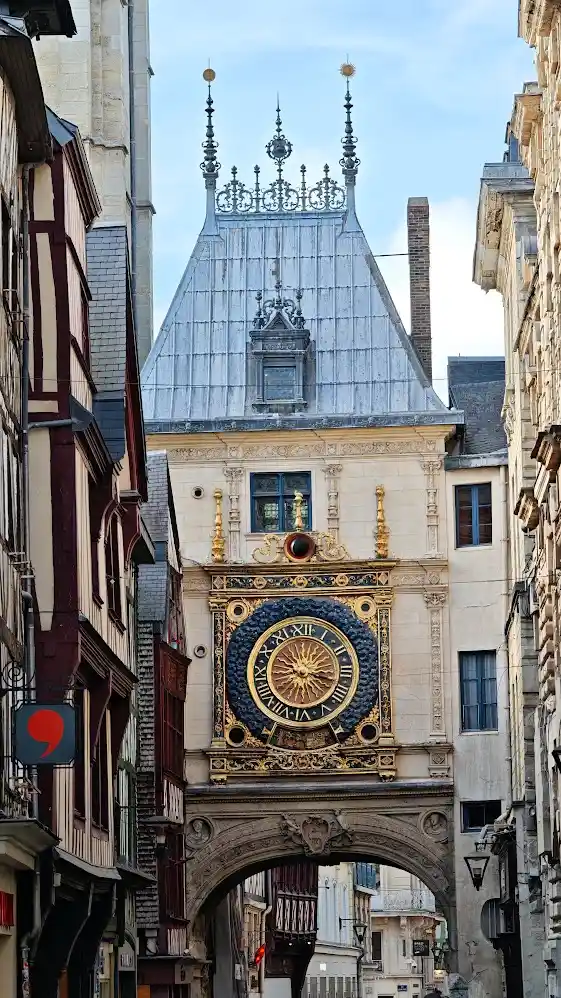
This bell tower was a symbol of the city’s secular power, standing in contrast to the cathedral. I highly recommend going inside, climbing the narrow stairs, and seeing the ancient mechanism, still active after dating back to the 14th century. Take a close look at the clock face: it has only one hand, and a daily wheel displaying rotating Roman mythological figures. At the top of the climb, a panoramic terrace awaits with an amazing view over the rooftops of Rouen.
- Opening hours: April to September: Tuesday to Sunday, 10:00 a.m.–1:00 p.m. and 2:00–7:00 p.m. October to March: Tuesday to Sunday, 2:00–6:00 p.m. Closed on Mondays.
- Price: 7.70 euros for adults.
- Official website: the official website of the Gros-Horloge
Late morning (11:30 a.m.): Place du Vieux-Marché and the Church of Joan of Arc
We’ll continue down the street westward until we reach Place du Vieux-Marché. Here, on May 30, 1431, Joan of Arc was burned at the stake at just 19 years old. A tall metal cross in the middle of the square marks the exact spot of her execution.

At the center of the square stands the modern Church of Joan of Arc (Église Sainte-Jeanne-d’Arc), built in the 1970s. Its curved roof is shaped like flames of fire and an upturned ship, and inside it incorporates stunning 16th-century stained glass windows rescued from the Church of Saint-Vincent, which was destroyed in World War II.
Important information about the Church of Joan of Arc:
- Opening hours: Monday to Thursday and Saturday, 10:00 a.m.–12:00 p.m. and 2:00–6:00 p.m.; Friday and Sunday, 2:00–6:00 p.m. Free admission.
- Official website: official information from the Rouen tourism office
Afternoon (2:00 p.m.): Musée des Beaux-Arts, Géricault, Monet and a surprise from Paris
We’ll head a bit north toward Square Verdrel to the Musée des Beaux-Arts of Rouen. This is one of the richest and most important museums in France, holding a rare Impressionist collection, including Claude Monet’s original cathedral paintings, which perfectly complement yesterday’s visit to the cathedral.

While touring the museum, don’t miss the moving sculpture of the painter Théodore Géricault (1791-1824). But it’s really not the only sculpture worth stopping for. Beyond the Géricault piece, there’s another especially impressive sculpture I simply have to mention (and you can see it in the photo right below). It’s “Bacchante couchée” (Reclining Bacchante), created by James Pradier (1790-1852), who was also responsible, among other things, for the sculptures surrounding Napoleon’s tomb at Les Invalides in Paris. The level of finish, the precision of the small details, and the feeling that it’s almost coming to life simply captivated me.

On top of all that, I came across a wonderful painting in the museum called “Un repas de noces à Yport” (A Wedding Feast at Yport), painted by Albert-Auguste Fourié (1854-1937). I had seen copies of this painting in Oudi’s apartments in Paris, and I was surprised to discover the actual original right here in Rouen.

As you can see, the painting depicts a lively scene representing community and rural bourgeois life in the Normandy region at the end of the 19th century. The festive meal takes place under the shade of apple or pear trees (typical of Norman farmyards), and at the center of the table sits the young bride, with guests around her raising their glasses in her honor in a relaxed, joyful and polite atmosphere. I really loved the precise realistic style of the painting, which also carries soft, bright touches of light influenced by the Impressionist movement.
Of course, I’ve only scratched the surface of everything you can find in the museum, and there’s a lot more to see there. My friend Alon Klibanov doesn’t say lightly that this museum alone is worth the train ride from Paris to Rouen and back (and the most amazing part? All this beauty is shown to you for free).
- Opening hours: Wednesday to Monday, 10:00 a.m.–6:00 p.m. Closed on Tuesdays.
- Tickets: admission to the museum’s permanent collections is free!
- Official website: the official website of the Musée des Beaux-Arts
Late afternoon (4:15 p.m.): Musée Flaubert et d’Histoire de la Médecine, a dentist’s chair and a guillotine
We’ll finish the route by walking west to Rue Lecat 51, home to the Musée Flaubert et d’Histoire de la Médecine (Museum of Flaubert and the History of Medicine).

The museum is housed in the old Hôtel-Dieu hospital, the place where the great writer Gustave Flaubert (1821-1880) was born, and where his father served as chief surgeon.
The museum offers a fascinating and unusual combination of Flaubert’s literary mementos and a rather unsettling historical medical exhibit. I was especially struck by the antique dentist’s chair, which looks like parts of it were pulled straight out of the 18th century (especially its worn-out upholstery!), and by the exact model of a guillotine on display there, an old and rather fatal cure for a headache, if you ask me.

- Opening hours: Tuesday to Sunday, 2:00–5:30 p.m. Closed on Mondays.
- Official website: the official website of the Musée Flaubert
Recommended guided tours in Rouen
I always love wandering around and discovering places on my own, but sometimes a good guide can reveal secrets and stories you’d never find by yourself. If you want to dig even deeper, here are a few tours that look excellent to me and offer different experiences:
Where to stay in Rouen: the perfect base for exploring Normandy
My strong recommendation is to stay in Rouen itself, for at least two nights. The reason is simple: Rouen isn’t just an amazing city in its own right, it’s also a perfect home base for discovering the treasures of Normandy. On my last visit, I stayed at Hôtel Paulette, a charming boutique hotel in a great location, though it has one big drawback: the rooms there are very small for my taste. Luckily, you can find more hotels in my article on hotels in Rouen.
When you sleep in the city, you get to experience its charm in the evening hours, after most of the day-trip tourists have already left. On top of that, Rouen makes it very easy to take day trips to iconic sites like the D-Day beaches, the Cider Route, the cliffs of Étretat, or the picturesque villages of the Pays d’Auge region.
Related reading