

Parc Borély, the most visited park in Marseille, 17 hectares of surprises, enchants first-time visitors with its ponds, its varied statues, and its different gardens. And for locals, each one has childhood memories of it, like Marcel Pagnol (1895-1974). Parc Borély is one of the seven wonders of Marseille, and at its heart stands a château.
At the heart of Parc Borély stands the Château Borély. The château is the crown, the pearl, the cherry on top. Built to glorify the family name of a bourgeois family, the Borély family, who made their fortune in trade, to mark their rise up the social ladder, to house them in comfortable and magnificent surroundings, and to let them host balls and feasts, it became a museum in the service of the public: education, learning, and enjoyment for all. And the rural estate around the château, once used by this privileged and distinguished family to breathe fresh air, became a public park for everyone’s enjoyment.
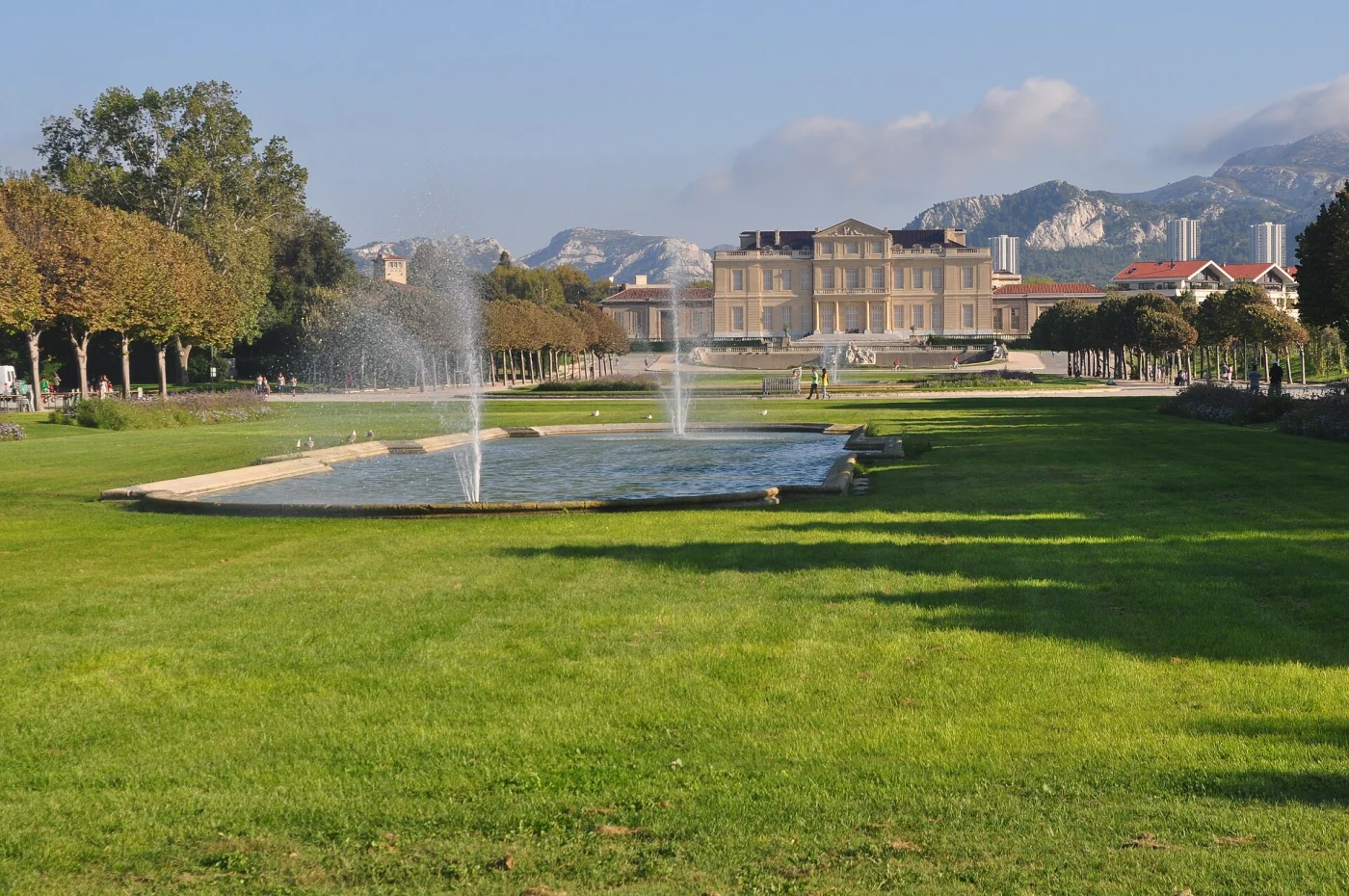
How did this whole story begin, thanks to which the residents and visitors of Marseille now enjoy a green, sprawling gem dotted with works of art: Parc Borély (Le Parc Borély), and at its heart a château, the Château Borély (Le Château Borély), now home to an impressive museum, the Musée Borély (Le Musée Borély), or more precisely and fully, the Museum of Decorative Arts, Earthenware, and Fashion (Le Musée des Arts décoratifs, de la Faïence et de la Mode)?
The Château Borély is the story of an ambitious family of merchants who fulfilled a collective dream and left their mark on Marseille. The Borély family owned many urban real estate holdings and a spacious, comfortable country house, bought by Joseph Borély, but his son Louis, who pushed for the construction of the château, aimed for something beyond the typical country house (bastide) common among people of his class in the city. Building this château in Marseille in the second half of the 18th century, by the father and his sons, the Borély brothers, was a long process in which several generations gradually contributed to the family’s economic and social standing.
Their home was considered extraordinary for its time, so much so that the term “château” replaced the term “bastide” (country estate) to describe it. The house and the treasures it held completed, just fifteen years before the Revolution, the collective rise of a bourgeois family that had lasted nearly two hundred years. It was a fascinating process that began with the purchase of a suburban farm by a merchant at the end of the 17th century, and ended with the opening of a public museum dedicated to decorative arts in 2013: a captivating journey of ambitions and worldviews that continues to this day.
Joseph Borély Buys a Country House with Gardens, Vineyards, Pastures, and Land
Joseph Borély (Joseph Borély), a successful businessman and one of the deputy mayors, like several other members of his family who attained this prestigious position thanks to their excellence in Mediterranean trade, sought to put down the deepest possible roots in the region by purchasing a rural property. And so, in 1684, he bought from a member of the Parlement of Aix-en-Provence, Elzéar Dantoine, a farm surrounded by farmland, pastures, vineyards, trees, and gardens: a dozen hectares, with the right to use the already available irrigation canal for thirty-six hours a week. The farm benefited from its proximity to the Huveaune River, from which the canal was diverted, and from the fertile silt deposits of its estuary.
A country house, in fact, more than a farm, which included a large house for the owner’s use and a small house, the “farmer’s house,” where the sharecropper used to live. Renovations and improvements were carried out by Elzéar Dantoine and then by Joseph Borély immediately after he bought the estate from the former. The large house, two hundred square meters, had a ground floor with a kitchen and a chapel, and one floor with two rooms. The small house had a ground floor with a kitchen and one floor with a single room. Next to it stood a stable, a dovecote, and a rabbit hutch.
Joseph Borély asked the bishopric for permission to pray in the private chapel and to have Mass said there, which shows his intention to make the estate a permanent residence, or at least to spare himself the trouble of riding into the city center by carriage every Sunday to attend church. The religious hierarchy, not eager to disperse its authority, granted his request anyway. About fifteen years after buying the estate, Joseph won this coveted privilege.
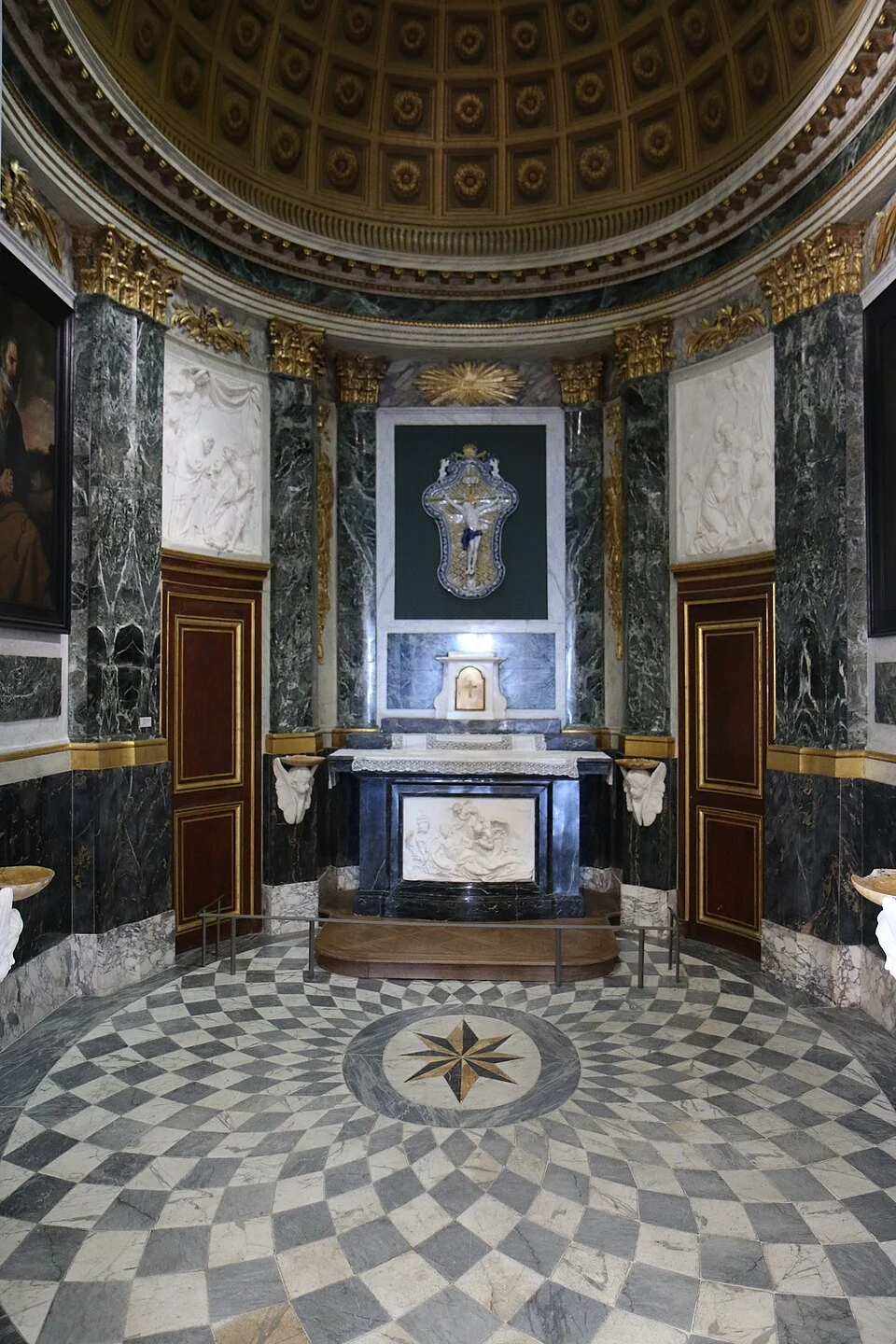
The photo below shows the chapel at the Château Borély, though not Joseph’s chapel, which no longer exists because his house was demolished (more on that shortly), but rather the chapel built by his successors:
Louis Borély Buys More Farms and Land, Expanding His Father’s Inheritance
Louis Borély (Louis Borély), Joseph’s son, was born on December 18, 1692, in Marseille into this successful family. He quickly joined the family business, and for that purpose lived in Alexandria from 1717 to 1723 together with his brothers. That same year, 1723, his father Joseph died. Louis returned to Marseille and married a young woman named Anne Abeille, from a similarly prominent background, whose family’s status was even higher since she had received a title of nobility two generations earlier.
Louis Borély, nearing thirty, became very wealthy after inheriting from his father and his uncle. Although he was the third brother, he received the lion’s share of the inheritance after one of his brothers died young. His uncle, who was childless, also passed on to him his position as advisor to the king in the office of the auditor of Provence.
Louis and Anne Borély had eleven children, but only seven survived. Anne Abeille herself died in 1741, at only forty years old. The eldest orphan was only fourteen. Louis Borély, now a widower nearing fifty, nurtured during this period the ambition to build a château on the estate he had inherited from his father in the Bonneveine neighborhood, not far from the seashore. Not just another bastide, however beautiful and comfortable, of the kind that dotted the area by the hundreds, but something of a higher order: a château!
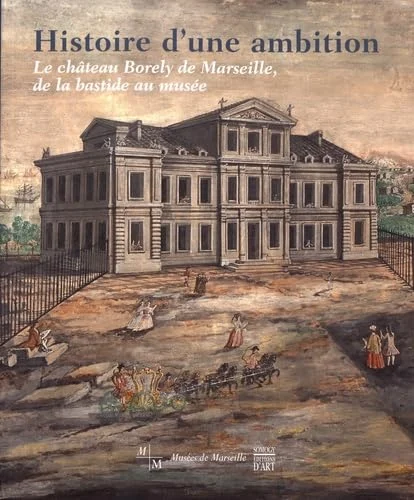
A comfortable, spacious country house, in fact, already stood on the site and remained standing until the château’s construction was completed… The ambition paid off… The Château Borély is a story of ambition, as the title of the album dedicated to it, from which I drew most of the information in this article, suggests. Let’s go slowly, step by step, tracing the history of this family project that became public heritage.
Four years after his wife’s death, in 1745, Louis Borély returned to Egypt, this time not to Alexandria but to Cairo, and together with the youngest of the brothers, Denis, revived the family’s trading business. Ships loaded with seeds (grain, rice), silk, and oil (for soap production in local factories) arrived on their behalf at the port of Marseille. Before setting out, Louis Borély took care to leave a will in favor of his eldest son. In those days, the risk of a journey to the East was far from negligible.
Nine years later, in 1756, Louis Borély returned to Marseille and began buying farms to enlarge the rural estate he had inherited from his father Joseph in the Bonneveine neighborhood. Eight years before Louis was born, his father, Joseph Borély, had bought the first farm, as we saw, more a country house than a farm, which became the seed from which Parc Borély and the château overlooking it would grow, to the glory of the city of Marseille. Louis Borély bought four more farms around it to expand the land his father Joseph had bought. In 1727 he bought a farm called “La Michelle,” in 1738 “La Tirane,” in 1760 “La Dumone,” and in 1764 “La Valbelle.” Farms and their lands around the original farm: fortune certainly favored the Borély dynasty! And so did diligence and ambition, of course.
In 1770, Louis-Joseph-Denis (Louis-Joseph-Denis), Louis’s son, acquired two more plots of land south of the estate, an opportunity that fell into his hands. More than fifty-four hectares, in the family’s possession, in a prime location by the sea: no small matter! That same year “La Louise” was purchased, in 1812 “La Charrier,” and in 1815 “L’Anjouvine” (by the son-in-law of Honoré, Louis-Joseph-Denis’s brother), three farms that connected, from east to west, with the plots by the sea.
Louis Borély Builds a Château on the Site of the Estate
In 1765, three years before his death at seventy-six, Louis Borély began building the château. Louis Borély is the man who acquired most of the works of art that would adorn it, and the five hundred volumes that would form its library.
His request to fix the spelling of the name “Borély,” which until then had been written differently each time, Borel, Borele, Borrelly, Bourrely, was granted. His ambition to receive a title of nobility, de Borély, was fulfilled.
Louis turned to the architect Charles-Louis Clérisseau, whose reputation as an expert in the Italian style preceded him and had reached as far as the court of Catherine II, Empress of Russia. His drawings contributed to the fashion for ancient architecture that gave rise to the Neoclassical movement. Charles-Louis Clérisseau returned from an eighteen-year stay in Italy and met with Louis Borély.
In 1766, the first contracts for the supply of building materials for the château were signed. In 1767, work began. Louis Borély died on April 2, 1768, leaving generous donations to hospitals and other charitable institutions. The château project took shape under the direction of the next generation.
Louis Borély’s sons, the brothers Louis-Joseph-Denis (Louis Joseph Denis) and Honoré (Honoré), entered the scene to fulfill their father’s dream. The country house that Joseph Borély had bought remained standing and served the family until the work was finished. The exact date of its demolition is unknown, probably sometime between 1770 and 1780.
Louis Borély’s Sons, Louis-Joseph-Denis and His Brother Honoré, Complete the Château
Remember that the father, Louis, had turned to the famous and sought-after architect Charles-Louis Clérisseau? The façade of the château was preserved according to Clérisseau’s design, but the son, Louis-Joseph-Denis, felt that some of the overly ornate elements Clérisseau had conceived should be removed, and for that he turned to the architect Esprit Brun (Esprit Brun) to erase the unnecessary decorations. And indeed, the Neoclassical building that visitors see today is the most refined, the most perfect version of it.
Louis-Joseph-Denis then turned to a painter from the town of Aubagne (Aubagne), Louis Chaix (Louis Chaix), and first sent him, at his own expense, to train in Italy. Louis Chaix made copies of Raphael, Titian, Rubens, and Guido Reni (Guido Reni), and brought back a copy of “The Rape of the Sabine Women” (Ratto delle Sabine) by Pietro da Cortona (Pietro da Cortona).
Louis Chaix worked wonders on the interior design, which throughout the château, in every room, is based mainly on three forms: paintings, plaster ornamentation, and gilded woodwork. Their main theme is a hymn of praise to Apollo, god of the sun and the arts, told through episodes that illustrate his deeds. For the ceiling painting of the entrance hall, the model used was “Aurora” (Aurora) by Guido Reni, 1614. Louis Chaix’s painting, “The Chariot of Apollo” (le Char d’Apollon), is without a doubt the most important and impressive work in the château, seeming to herald to visitors the château’s enlightened purpose as a patron of the arts:
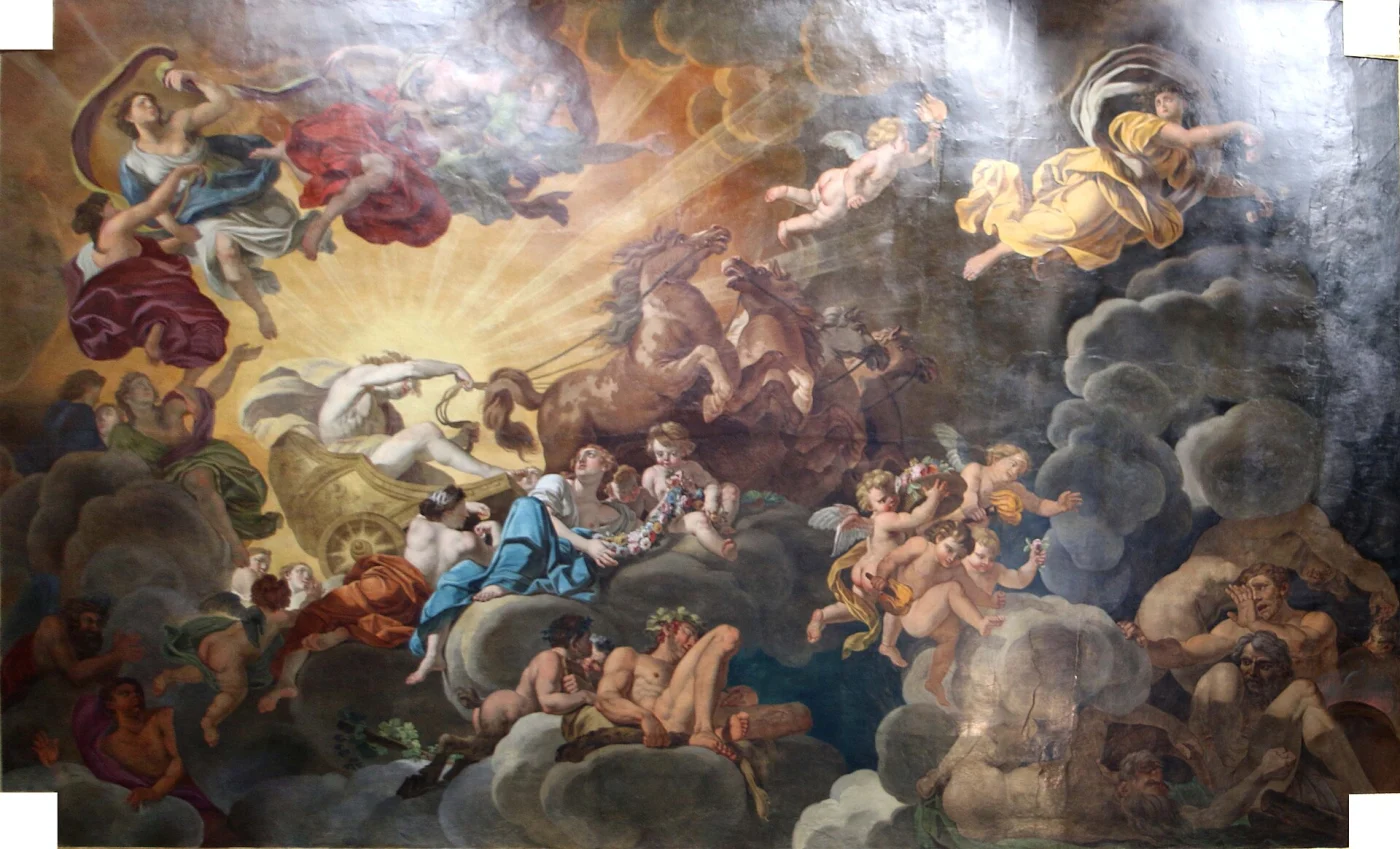
Louis Chaix took Guido Reni’s model and infused it with his own content, giving it movement and life. The “Seasons” and the “Hours” do not accompany the chariot but swirl through the sky. The Titans, enemies of the gods, sink into darkness in the direction opposite to the “Rising of the Day.” The latter, in a billowing robe of light, accompanied by a putto (chubby child) carrying a torch, shows the way to Apollo’s chariot horses while scattering roses like drops of dew.
Apollo, who puts an end to darkness, is the center of the painting and carries the message of the Château Borély. Apollo, bringer of the triumph of light and art, is the patron of the château. And so are its owners, who bring progress, wisdom, and prosperity to the city of Marseille, delighting their guests with magnificent celebrations. At Apollo’s feet, Demeter, goddess of agriculture and the harvest’s abundance, is accompanied by Anthea, goddess of flowers and gardens. Bacchus and Pan, always ready to enjoy nature, lie sprawled drunkenly among the clouds. The fierce North Wind and the gentle East Wind take part in this divine scene. Fire and water complete the picture.
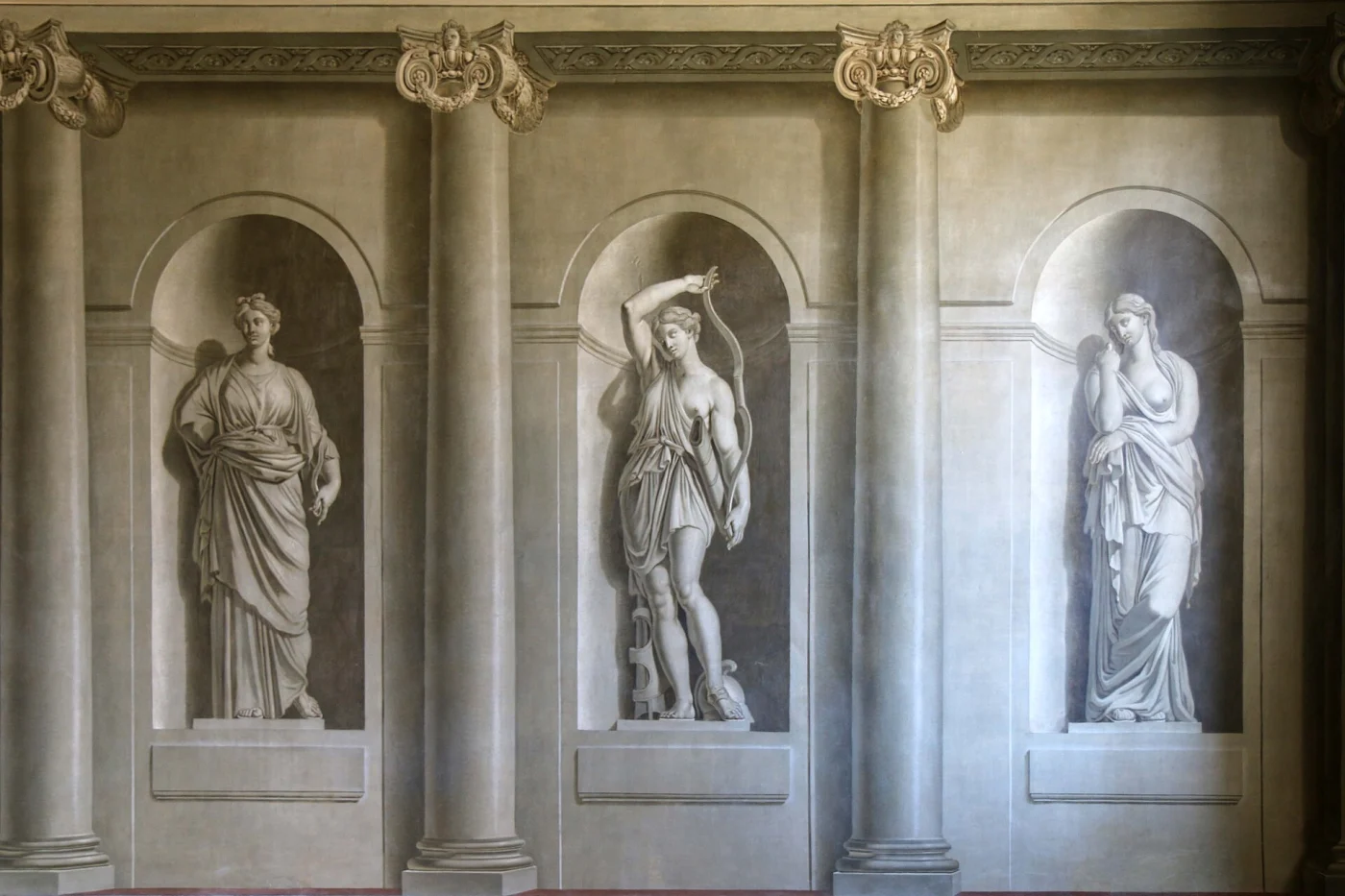
The upper half of the staircase wall creates an illusion of niches in the Italian Renaissance style, each holding a goddess: Flora, Aphrodite, Diana, and their companions, who accompany the sunrise and glorify the painting of Apollo driving his chariot. Visitors climbing the stairs discover them one by one.
In the photo, we see Hygieia, goddess of health and cleanliness (the source of the word “hygiene”), daughter of Asclepius, god of medicine, holding a snake in her left hand; Diana the huntress, equipped with a bow and quiver and wearing a short tunic; and Mnemosyne, goddess of memory and mother of the nine Muses, depicted as a pensive woman resting her head on her right forearm.
The plaster decorations, shaped as flowers, wreaths, crowns, dances, and songs in honor of Bacchus, god of wine, around a satyr playing a flute, hint at the pleasures awaiting the château’s guests as they climb the staircase: a feast of the gods, a dance ball, joy of body and soul.
From the entrance hall, visitors move on to the “Golden Salon,” where a copy of “The Rape of the Sabine Women,” 1629, hangs:
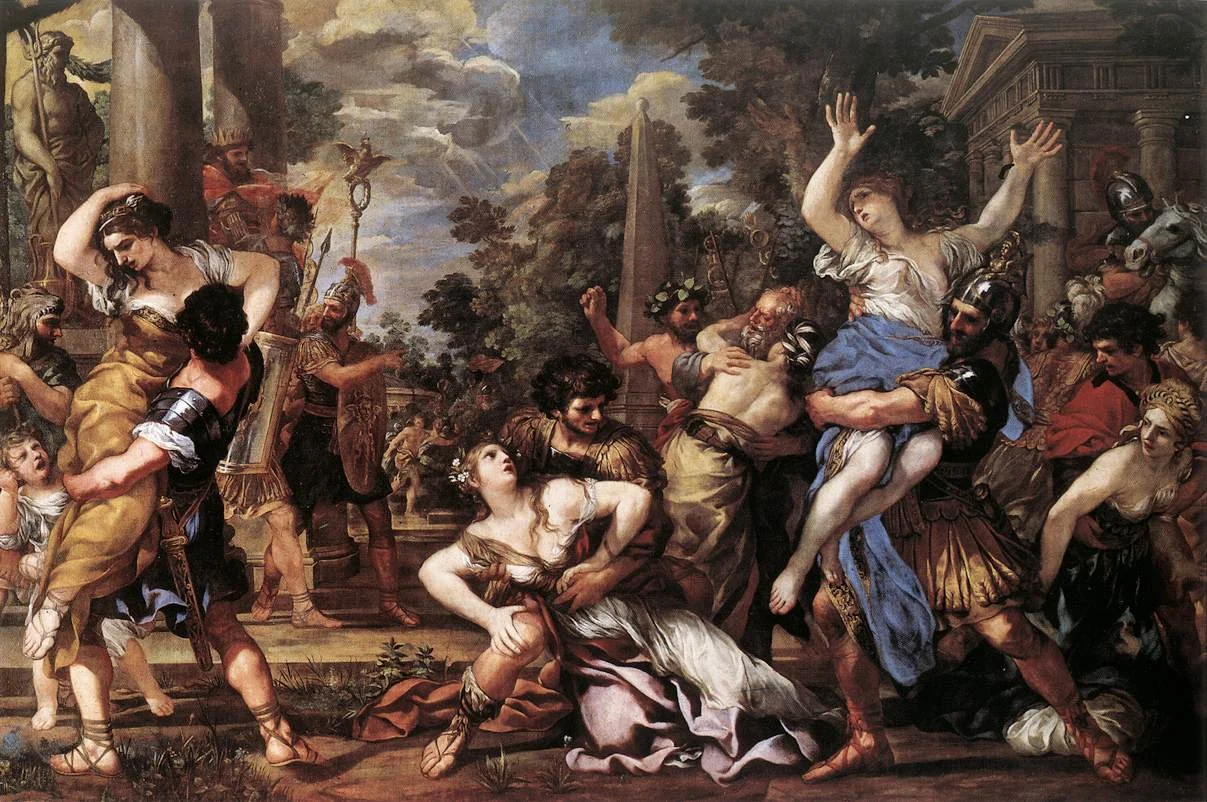
This salon is the most magnificent of the row of salons on this floor. The gilding on most of the paintings, the plaster decorations, and the woodwork give it a warm, pleasant glow, and at sunset, as light filters through the windows facing the sea, its colors pour in and deepen even further.
The château’s paintings and decorations depict a variety of mythological scenes from antiquity, as was customary at the time, but the theme of the god Apollo, who appears throughout its various spaces, is especially emphasized, a personal choice. The place is, to a large extent, dedicated to him, the god of light, the arts, poetry, and rhetoric. The Borély family identified with him. Visitors who see Apollo leading the sun’s chariot in the ceiling painting of the entrance hall see him again in the ceiling painting of the library, leading the nine Muses (a photo of this painting is not available online, and I did not photograph it myself during my visit because it was very dark, so I will have to describe it instead):
Apollo, god of the arts and music, leans on a harp, depicted on Mount Parnassus, his home, in the company of the nine Muses. The painting is dynamic, its figures placed on different levels, one above the other, leading upward toward the triumphant Apollo, raising a laurel wreath, the prize awarded in artistic competitions. Apollo, with a halo over his head, stands atop the clouds.
The Muses can be identified by their individual attributes and are accompanied by cherubs celebrating the triumph of art with trumpets and palm branches. One of them carries a statue of Homer, the father of poets.
It took four years to finish building the château, and another seven years to complete the interior design. Louis-Joseph-Denis continued to beautify the château and reward the artists he admired until his death.
Many famous figures came to admire Louis Chaix’s works: kings, dukes, diplomats, artists, and writers, among them King Charles VI of Spain, Princess Maria Carolina of Naples and Sicily, and the poet Alfred de Vigny (1797-1863). They all signed the château’s golden guestbook, which is still kept there. Bourgeois, merchants, and even ordinary people benefited from the owners’ generosity and were invited to see the château.
Here is a video to give you a feel for it: an outside view, an inside view, focusing on the ceiling painting “The Chariot of Apollo”:
The story began in 1684 when Joseph Borély bought the first house in the Bonneveine neighborhood. A hundred years later, in 1784, his grandson Louis-Joseph-Denis died, having done the most, after his father Louis, to complete the château. A hundred years that gave birth to the project and shaped it. By a remarkable coincidence, the grandson died exactly a hundred years after his grandfather bought the original farm, the seed of the château and the park. Louis-Joseph-Denis died at fifty-three, and he too, like his father, left donations to the sick and the poor. The estate passed to his brother Honoré, who had been his partner throughout. Louis-Joseph-Denis never married and had no children. More than a merchant, he was an art lover, and his life’s mission was to build and beautify the family château and its gardens.
A gossip columnist from the city wrote in her diary that Louis-Joseph-Denis Borély carried on a love affair with one of the Marseille Opera’s singers, Henriette Pezé (Henriett Pezé). Louis was head over heels in love with her, and Henriette returned his love while also enjoying his wealth and generosity. The beautiful young woman died of tuberculosis in 1780, at twenty-two.
Louis-Joseph-Denis had her body removed from the cemetery and brought to the château, where he had it embalmed and hidden behind a glass partition at the back of the library. Whenever he moved the partition aside, he could see his beloved standing in her niche, dressed in her opera costume.
Louis-Joseph-Denis, who was seventeen years older than his beloved, died four years after her. After his death, his brother Honoré removed the mummy and returned it to the cemetery. Some say he buried her somewhere on the estate grounds…
Is the gossip columnist’s story true? I don’t know. Just as I don’t know whether what is told about Otto von Bismarck’s cousin, Guido Henckel von Donnersmarck, who supposedly embalmed the body of his beloved wife, La Païva, and hid her in a glass coffin in the attic of his château, is true or not. Two very similar stories. You can read about the second one here.
Honoré had been married for ten years to Marie-Catherine de Surian (Marie-Catherine de Surian), the widow of his cousin, and managed the neighboring estate that belonged to her, “La Sallade.” Honoré added his wife’s estate to all the property he inherited upon his brother’s death, and so the couple made it even grander and more splendid!
Honoré strengthened the estate and added volumes to the library. During the Revolution, he found refuge in Switzerland and later in Montpellier, and when he returned, safe and sound, he found the château unharmed. Honoré died in 1804, leaving the property to his only daughter, Louise-Jeanne-Marie (Louise-Jeanne-Marie). Four years before her father’s death, she had married a military man and statesman, Count Pierre Léandre de Marc-Tripoli de Panisse-Passis (Pierre Léandre de Marc-Tripoli de Panisse-Passis).
The count continued to maintain the estate and enrich its art collections. The couple’s son, Marquis Gaston de Panisse (Gaston de Panisse), decided to give up the château and its treasures. It was not an easy decision, since the marquis was attached to the château, but he had to choose. The marquis had inherited from his childless uncle another significant property, the Château de Lamanon (Le Château de Lamanon), near Aix-en-Provence, and chose to invest his resources in this property and in the village he built around it.
And so Gaston de Panisse, the fifth generation of the Borély family, parted ways with the château. Let’s recap: Joseph Borély, a merchant living in Marseille, bought a farm surrounded by gardens and farmland in the Bonneveine suburb, by the city’s seashore. Joseph’s son Louis bought more and more farms to expand the land he had inherited, each time acquiring another farm with its gardens and land. Then Louis began building a château near the original farmhouse, which was later demolished. Louis’s son, Louis-Joseph-Denis Borély, together with his brother Honoré, finished building and completing it. These two sons continued to cultivate the château, following the dream of their father and grandfather. Honoré’s daughter, Louise-Jeanne-Marie, inherited the château and, together with her husband, continued to maintain it. But Gaston de Panisse, Louise’s son, who inherited the château from her, was forced by circumstance to sell it.
Joseph Borély 1642-1723
Louis de Borély 1692-1768
Louis-Joseph-Denis de Borély 1731-1784, Honoré de Borély 1732-1804
Louise-Jeanne-Marie de Borély 1774-1831
Gaston de Mark-Tripoli de Panisse-Passis 1807-1891
The château and park pass to the city of Marseille through railway builder Paulin Talabot
The sale of the château took place during major urban changes that transformed the face of Marseille within twenty years: new streets, an expanded port, public buildings, and the arrival of the railway.
This last change was directly tied to the sale of the Borély estate. The engineer, entrepreneur, industrialist and businessman Paulin Talabot, who built the first railway lines in southeastern France, did not miss the chance to buy it. On March 25, 1857, Gaston de Fagnas signed a contract selling the Borély estate to a company that had been formed two weeks earlier by Paulin Talabot specifically for this purpose. Paulin Talabot paid Gaston de Fagnas one million francs for the property. In 1831, the year Gaston de Fagnas inherited the estate, it had been valued at 371,817 francs.
Marseille’s botanical garden had stood for fifty years in the 4th arrondissement, on the grounds of the Couvent des Chartreux, and was known, accordingly, as the Jardin botanique des Chartreux. Paulin Talabot coveted the site in order to run a stretch of the Marseille-Toulon railway line through it. And so, in 1856, the garden vanished, along with its trees, shrubs and plants, its potted plants, its great greenhouse, its fountains, its orange orchard, its canal, its library, its director’s house. Paulin Talabot received from the city the pearl he had destroyed for the sake of the railway, and in exchange handed over land from Borély Park so the city could relocate the botanical garden there.
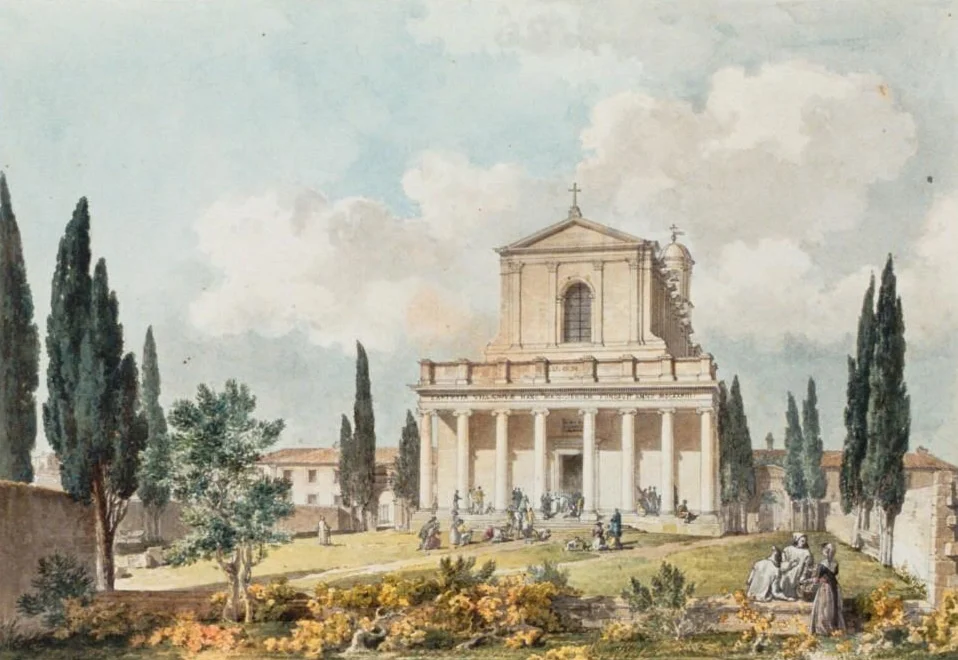
Paulin Talabot needed the city of Marseille not only to run a railway line through the site of the botanical garden, but also to build and use the loading and unloading docks of the Joliette neighborhood (Les Docks de la Joliette). Talabot understood how important it was to unload goods arriving by sea directly onto trains headed to Lyon or Paris, and indeed he won the project. It should be noted that the plan to build a new port south of Marseille was abandoned in favor of the Joliette neighborhood, so Talabot no longer had any interest in the land from the Borély estate for building warehouses.
The docks remained in their original use until 1988, and today the site houses companies and businesses, with fashionable boutiques, restaurants and attractive bars on the ground floor. The city, for its part, wanted a public park, wanted to turn the château into a museum, and wanted to build a hippodrome, goals that were all fully achieved. The park and the château museum draw large crowds, both locals and tourists.
In 1862, the city of Marseille turned to Adolphe Alphand, Baron Haussmann’s right-hand man for everything related to Paris’s parks, and asked him to design Borély Park. Alphand’s plan was accepted and carried out.
How much of it still exists today, and what has changed? You’ll find out about the park, its gardens, its statues and its other wonders in the follow-up article. I recommend exploring it without skipping its hidden corners. And of course, don’t miss the Château Borély itself: in addition to its architecture and artworks, be sure to see its permanent collection. Rotating exhibitions keep things interesting on a regular basis.
The museum today: a harmonious blend of past, present and future
Since it was acquired by the city of Marseille, the château housed the archaeology museum until 2013, when it became a museum of decorative arts, ceramics and fashion. The challenge, after four years of renovation, was to breathe new life into the château while preserving the memory of its 18th-century past, and at the same time guiding visitors toward contemporary art. So, for example, a lamp by a modern designer greets visitors who, in the same breath, will take in the furniture of the Borély family, the château’s original builders. And even more remarkably, most of the Borély family’s original design has, by great luck and to everyone’s astonishment, been preserved.
The challenge was met. The building’s restrained elegance stands in contrast to the richness of its interior, where antique decoration is combined with contemporary museography. On display is a wide range of works: ceramics, furniture, glassware, tapestries, art objects, design and fashion, from the 18th century to today. The fashion gallery shows pieces by well-known designers and young talent, updated regularly to keep pace with the museum’s current programming. In other words: visitors enter the château as if they were guests of the Borély family, but they never lose touch with the present day.
We’ve already seen the row of lavish salons meant for receiving guests. You enter them through the southern facade, which overlooks the courtyard. From the entrance hall, a staircase leads up to the “Golden Salon” and the other public spaces. The private spaces were arranged on the upper floors, reserved for the owner, his family and his friends. On the first floor, visitors will find six small apartments, each made up of two rooms: a bedroom and an adjoining study. These were the apartments of family members. Only Louis-Joseph-Denis enjoyed four private rooms, including a library, in his own apartment.
Especially striking is the royal bedroom, whose original wall covering was recently restored, albeit in a simpler form (one wood motif was kept instead of two). These are fabric panels in an Indian style (also found in Chinese and Persian fashions of the 18th century), depicting a recurring motif of a tree with curling branches bearing flowers, a “tree of life,” originating from a striped rock formation.
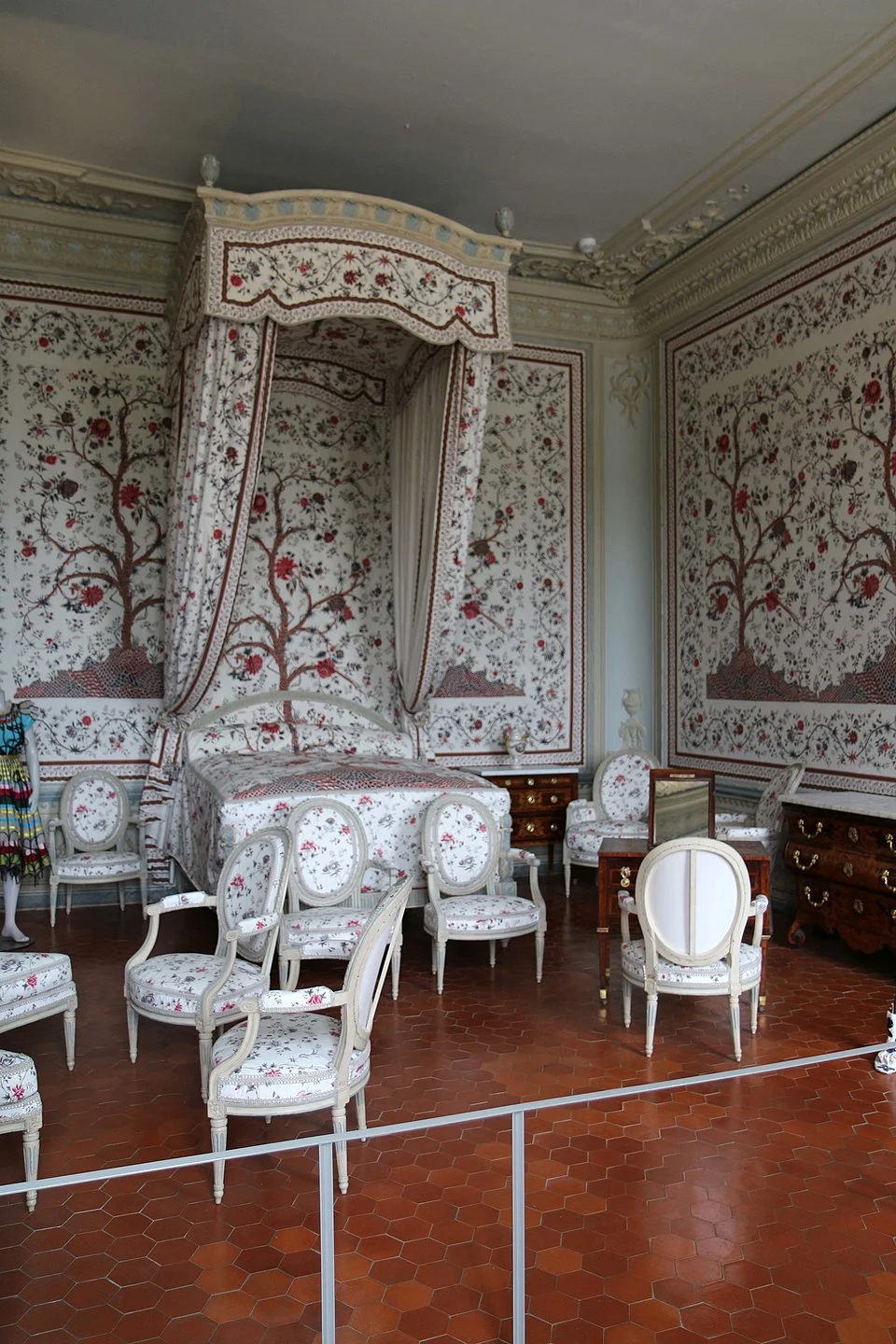
Also integrated into the Indian-style decor these days are three vases shaped like enigmatic heads, a tribute to Flora, the Roman goddess of flowers, gardens, spring and youth, created by the artist Françoise Vergier (born 1952), who moved to live in a village in Provence. The decorated vases are meant to hold dried flowers and spices. Death and life, masculinity and femininity, beauty and utility, sculpture and painting, body and landscape all come together in the work of this ceramic artist, who is also a sculptor and painter.
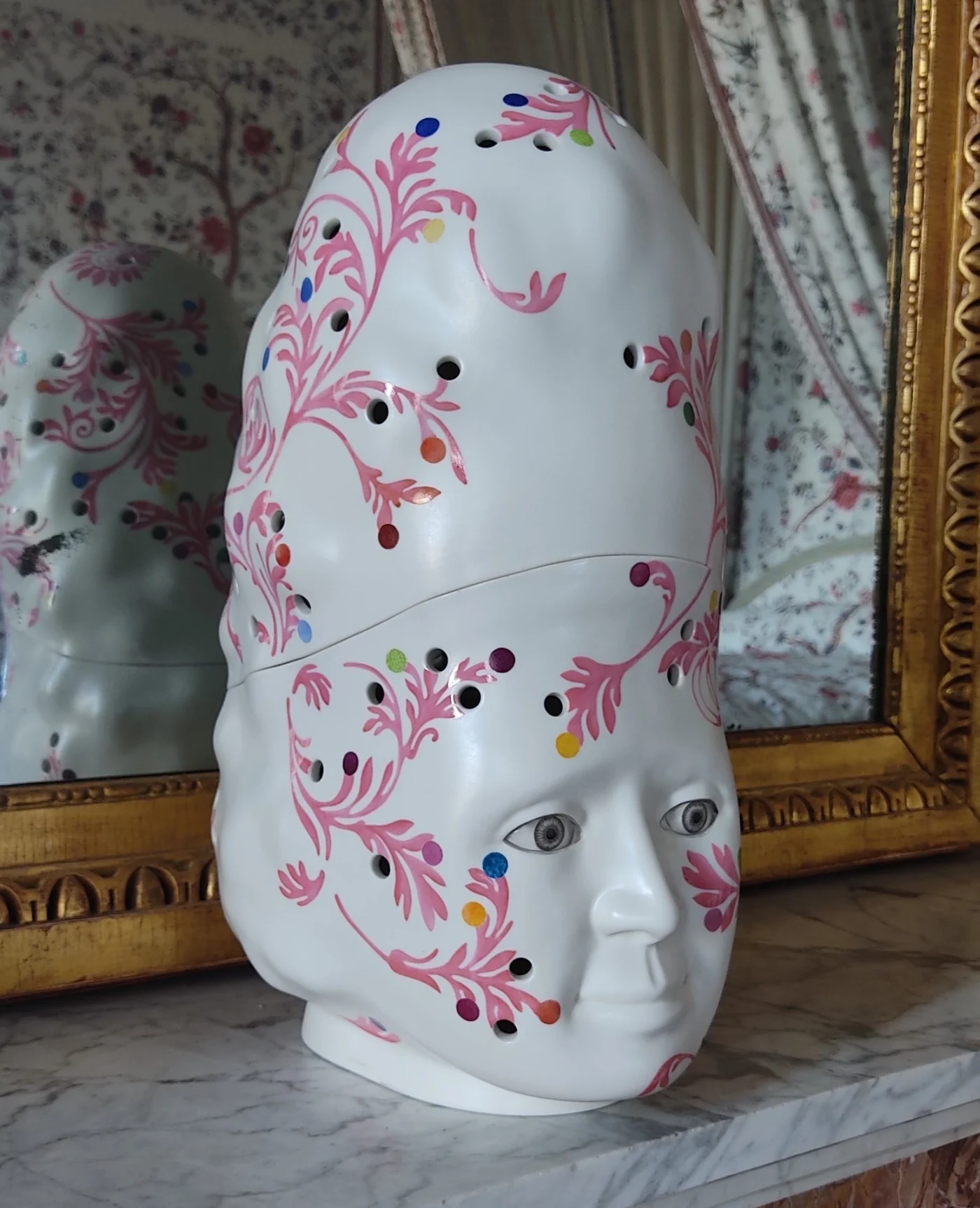
Françoise Vergier, vase. Source: the Facebook page of the Musée Borély
The second floor was set aside for guests: six bedrooms arranged around a large central rotunda. Alongside these apartments, there is a whole network of hidden corridors, rooms and staircases used by the servants, so they would never cross paths with the owners, their families and their friends.
And to close, here is a video by Marseille’s popular historian, Judith Aziza:
Link to the museum’s official website
Link to the park’s official website
Related reading