

Planier Island (l’Île de Planier) sits about 15 kilometers from the old port, making it the farthest of the Marseille islands from the city. It’s a fairly small, rocky island, just 3 hectares, battered by wind and waves, and surrounded by reefs that lie just below the surface. These treacherous reefs have wrecked many ships over the centuries. The remains of several wrecks, two in particular, along with the wreckage of a German fighter plane, draw marine archaeologists and divers alike. They come to unravel the mysteries of these wrecks and to admire the diverse creatures that have made homes in their compartments and swim through their hulls. Beyond the fish’s fondness for ruins, fishing is forbidden in the area, so marine life here thrives twice over. The waters around the island have become a sought-after and unique diving site.
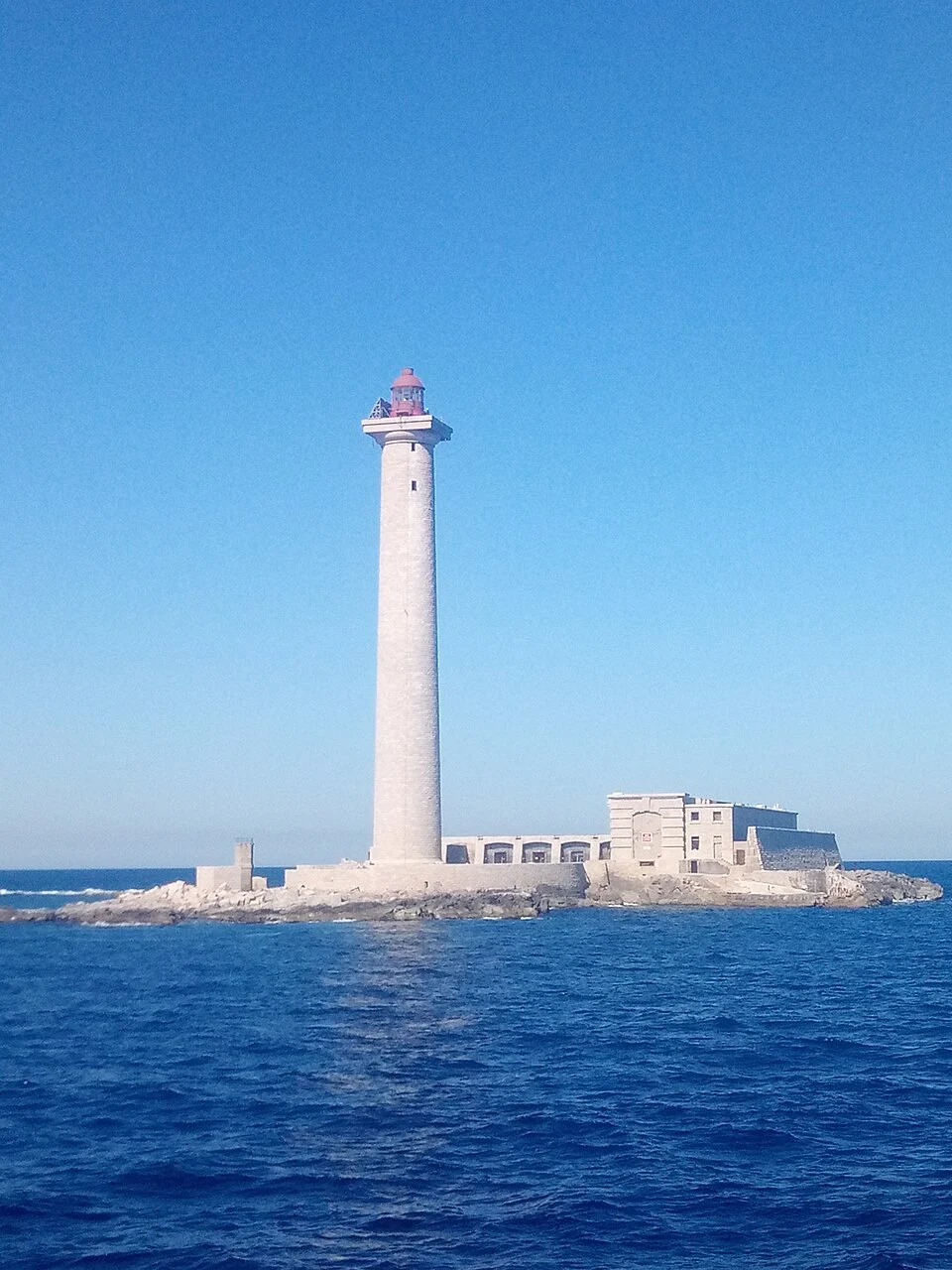
And if the seabed around the island is scattered with wrecks that delight divers, its lighthouse, whose familiar silhouette stands out against the horizon, has become a symbol of travel and freedom: the freedom to enter Marseille, and the freedom to sail far away from it. More than anything, the island is identified with its famous lighthouse, dear to the hearts of Marseille’s residents. A lighthouse that for 700 years has shown sailors their way. The Planier lighthouse has a long and fascinating history, full of twists, going back to the Middle Ages. Its various transformations, as we’ll see, mirror the development of science itself. The current structure, its fifth version, earns it the title of the tallest lighthouse in the Mediterranean, standing 71 meters above the sea.
The lighthouse rises vertically on the island, standing out against its flat topography, which is actually where the island got its name. “Planier” comes from the Greek word planasia, meaning “flat” or “level.” In other words, Planier means “the flat island” or “the plain island.” This is the same root behind the name of the Italian island of Pianosa (isola di Pianosa), which was also originally an ancient Greek colony, just like Marseille. Pianosa sits off the coast of Tuscany and shares the same topographic traits as Planier, including a lighthouse of its own.
The Planier lighthouse, the buildings around it, and the island as a whole were designated a historic site in 2002. It’s the only lighthouse in the Mediterranean to receive this protection. It belongs to the state and sits within the Calanques National Park (le Parc national des Calanques). In 1986 the lighthouse became fully automated. Since 1991 it has run on solar power: no fewer than 74 photovoltaic panels, controlled by smart chargers, feed two 24-volt batteries rated at 2,600 amps. Every 5 seconds the lighthouse sends out a white flash, visible from up to about 42 kilometers away, guiding merchant and pleasure boats and shouting at them, in every language: stay away from me! It’s the first lighthouse ships see as they approach Marseille.
The Planier lighthouse guides ships arriving from the south or west toward a safe passage into the city’s various harbors. Its role as watchman and guardian has earned it a special place in the hearts of sailors and Marseille’s residents. Visible day and night, the lighthouse is an inseparable part of the Marseille skyline, recognized much like the city’s iconic basilica, with its distinctive, elegant silhouette: something like a Greek Doric column topped with a square lantern room resting on its rounded head. In bright sunlight you might have to squint to spot it from the southwest of the city, but once night falls, its steady white glow is easy to pick out.
The Planier lighthouse is sometimes called the “Statue of Liberty” of Marseille. Migrants who arrived in Marseille by sea felt the lighthouse as exactly that, a “statue of liberty,” as they passed between Fort Saint-Nicolas on one side and Fort Saint-Jean on the other. The freedom to enter the city for the first time or to return to it, the freedom to gaze at the lighthouse and dream of journeys beyond it, the freedom of sailors and travelers to set off for distant shores, and the freedom of divers to discover the stunning silent world beneath its waters.
A history of the lighthouse
In 1319, Robert d’Anjou (1277-1343), king of Naples and count of Provence and Salerno, signed a royal decree ordering the construction of a 12-meter lighthouse off the coast of Marseille. Under this decree, every shipowner who anchored near Planier Island was required to leave behind one hundred cut stones brought from the mainland. The island’s position, as an outpost in front of many small islands near the ancient Phocaean coast, let it spot ships heading toward shore from a distance. Even then it was meant to serve as a defense, responsible for Marseille’s security, equipped with bronze cannons and a watchful garrison under the command of a captain.
Construction began in 1320, and the lighthouse, the fourth built in the region, became active six years later. At the time it was called a “tour à feu” (fire tower). Fires were lit atop the towers to show sailors their way. On the platform at the top of the tower built on Planier, pine branches, resinous wood, peat, and sometimes fish oil or olive oil were burned out in the open.
This first “fire tower” built on Planier Island served two purposes. The first was to warn ships of the dangerous reefs and strong waves nearby. The second was to scan the horizon to prevent the approach of pirates or ships of the Saracens, the Muslim invaders. If enemies were spotted, a large distress fire would be lit, which other towers would see and light in turn. This chain of fires would alert the people of Marseille to prepare to defend the city.
The tower kept functioning this way for four hundred years, until 1774. That year it was raised by 23 meters. The wood fire was replaced by a lantern with a reflector lamp made up of 14 oil lamps, from the historic workshop of Pierre Tourtille-Sangrain (Pierre Tourtille-Sangrain). In 1829 a new lighthouse was built, 36 meters tall, fitted with a “Fresnel lens” (la lentille de Fresnel), invented in 1822 by the brilliant engineer Augustin Fresnel (1788-1827) (Augustin Fresnel). This produced a light with long white flashes every 30 seconds. In 1881 a new cylindrical stone tower was built, 59 meters tall, this time with an electric light giving off 3 white flashes separated by a red flash. In August 1944 it was destroyed by the Germans. Its Fresnel lens survived because a German engineering officer, aware of its enormous value, had it stored in a barn in the town of Cucuron, in the Luberon.
Watch the video below to see the Fresnel lens mechanism, with its four panels, begin to rotate. The video was filmed during a technicians’ inspection on December 6, 2017:
In 1945, a temporary light was installed on a pole. In 1947, work began on the current lighthouse and the buildings surrounding it, funded by the Marshall Plan. The whole complex was designed in an innovative architectural style, the work of architects and designers André Arbus and André Crillon, who ran a joint firm, Arbus & Crillon.
The complex has two parts: the lighthouse on the eastern side of the island, and the buildings beside it. These are notable for their carefully matched height and are arranged in two wings: to the north, the keepers’ and their families’ quarters, in a spacious two-story building; and to the west, the technical facilities, including workshops, the machine room, and storage, all built around a large courtyard. Both the lighthouse and its surrounding buildings are faced in cut stone, at a time when the fashion of the day called for concrete.
The lighthouse itself is a slightly truncated conical tower topped with a square platform carrying the lantern. It’s reached by a beautiful spiral staircase in Art Deco style. The choice of materials, the architecture, both eclectic and forward-looking, and the presentation of the lighthouse and its buildings like a carefully designed plaza in the middle of the sea, all combine to create a stunning, monumental complex. This commitment by the architects, which runs against the dominant modernism of the era, reflects a wish to stay true to the spirit of Marseille’s great projects, realized or not, from the squares of Pierre Puget (1620-1694) (Pierre Puget) to Sainte-Marie-Majeure Cathedral and the Frioul Islands.
The tower was inaugurated in August 1959. Its careful architecture inspires awe and admiration in the face of this magnificent giant standing in the middle of the sea.
The lighthouse and the island today
The keepers left the island in 1992, once automation made their presence unnecessary. A diving center that opened right after they left closed in 2004. The buildings have been deteriorating ever since. What a shame! This is a potential that could and should be put to good use, and several projects have been proposed over the years, such as artist residences, an educational center, a divers’ hostel, and a scientific research station, but none has gotten past the idea stage. Let’s hope that funding will soon be found to reinforce the buildings and bring some of these plans to life. The island is abandoned, and visitors are forbidden from landing on it due to the risk of collapse of the long-neglected structures.
As noted, access to the island itself is forbidden, but you can get close by boat, admire its beauty, and dive in the waters around it. Several boat tours depart from Marseille to explore the islands, the harbor, and the Calanques. You can also rent a private boat to sail out toward the lighthouse. Fishing, on the other hand, remains off limits.
In the fascinating video below, we tour the island together with the person responsible for it. We’ll see the two wings: the former keepers’ and their families’ residence, and the technical buildings on the other side that once served as storage for food and drink and as workshops. A bread oven and chicken and rabbit coops gave the families a degree of self-sufficiency. At first four keepers and their families lived there, and later just two families. A private tutor for the children was also based on the island.
We’ll see the impressive lighthouse rising upward. Everything is automated, everything is electronic. We’ll climb together with the caretaker up the magnificent 362-step staircase, decorated with a perforated Art Deco railing, and reach the lighthouse terrace, from which a stunning view opens up. The island remains abandoned, as noted, but not far from it, the dance of divers brings its surroundings to life.
Shipwrecks as dive sites
The circumstances of the sinkings
Ships that ignored the lighthouse’s bright warning flashes paid a heavy price. About twenty wrecks lie beneath the water, from the earliest Greek vessels to the Moroccan cargo ship Chaouen. There’s even the wreckage of a German Luftwaffe Messerschmitt Bf 109 fighter plane.
On March 7, 1944, Captain Hans Fahrenberger took off from a German-controlled air base in Avignon on a mission he had little choice but to fly. Hans was a flight instructor, a lover of aircraft, and an enthusiastic glider pilot. That was his real passion. He loved life, had no sympathy for Nazism, and wasn’t a fighter by nature. The young Hans had simply been swept up in the whirlwind of human madness.
As noted, Hans was a flight instructor based in Avignon. That day, there was nothing to be done: he received an order. American B-17 bombers were flying along the coastline toward Marseille, escorted by P-38 Lightning fighters. A Luftwaffe fighter squadron took off from Avignon to intercept the convoy.
The young captain, Hans Fahrenberger, flew a Messerschmitt Bf 109 G-6, ready for combat. After the German pilots spotted the American formation, they attacked, using the element of surprise gained by approaching out of the light. During the dogfight that followed, Fahrenberger’s Messerschmitt took a hit in the engine. It was knocked out of action, spewing thick smoke that filled the cockpit. Hans was above the clouds, cut off and alone. The plane dove toward the sea, trailing a plume of smoke. The Americans had no doubt the German’s fate was sealed.
Hans dove without knowing where he was. And then, suddenly, an island appeared ahead of him. Hans recognized Planier, south of Marseille. He released himself from his harness, and the plane hit the water nearly flat, nose slightly up, but the sea was rough and water flooded the cockpit immediately. Hans managed to escape just before it sank, thanks to his parachute, which pushed him upward like a life preserver. With the last of his strength he swam to the deserted island. Exhausted and completely alone, he stripped off his wet clothes to dry them. The lighthouse had been destroyed by the Germans themselves, and Hans read signs warning “minefield.”
Then, suddenly, a plane. Hans waved his arms wildly toward it. He didn’t know it was a comrade searching for him. The comrade returned to base and reported, without realizing it was Hans, that a naked man was frantically waving his arms on the ruined, abandoned island the Germans had forbidden anyone from approaching. A patrol boat reached the island in the afternoon and rescued him.
Hans survived the war and died in 2009, at age 90, in Munich, not before witnessing the reconciliation between Germany and France. What remains of his time in Provence is the wreckage of his Messerschmitt, resting underwater, discovered by divers in 1970. Thousands of divers have since explored it.
Just a few meters from the wrecked plane lies another attraction, the next stop on the tour: the wreck of the Moroccan cargo ship Chaouen, which sank 26 years after the Messerschmitt went down. You can also include a third wreck nearby on the same tour, the Dalton, which sank 42 years before the Chaouen.
The Chaouen belonged to Morocco’s national shipping line and ran the Marseille-Casablanca route, carrying citrus fruit. On February 21, 1970, it was carrying 640 tons of oranges from Casablanca to Marseille. The captain had already radioed the port to announce his ship’s arrival when, at around 7:40 p.m., it ran aground on one of the island’s two most notorious reefs, known as “Pierre à la Bague” (the Ring Stone), a wide rock that, seen from above, looks like a ring, carved by powerful waves into channels, caves, crevices, and passages.
The weather was mild and the sea was calm. The ship was apparently running on autopilot, unsupervised, which is the only way to explain how it ended up on the famous Pierre à la Bague reef, right next to the lighthouse. Some, however, offer an economic explanation: since the price of oranges had dropped during the voyage, the captain may have preferred to sink his ship and file an insurance claim for both vessel and cargo. Eyewitnesses described a “sea of oranges,” with hundreds of citrus fruits floating in the city’s small harbors. What was the real reason the ship ran aground? We’ll probably never know. The captain and the ship took that secret to the grave.
After several rescue attempts, the captain was forced to order the ship abandoned, as it grew more and more broken apart and flooded. It sank the following afternoon. Its bow remained above water for about 15 years, but repeated storms gradually pulled it under.
The cargo ship Dalton ran aground in 1928. On February 12, it sailed from Lavrio, Greece, bound for Marseille, carrying a cargo of lead ingots. On February 19, at around 2:10 a.m., it struck rocks near the lighthouse and sank. Broken in two, the ship went down like a stone at the foot of the island’s dock, about twenty meters from shore, just 45 minutes after the collision. The entire Greek crew was rescued safe and sound by the lighthouse keepers.
Heavy fog hung over the area the day the ship sank. The court nevertheless found the captain responsible for the sinking. He had failed to change course as he approached the lighthouse. The second officer was also found at fault for not warning the captain of the danger.
Diving the three wrecks
There’s plenty of curiosity about what’s hidden inside these sunken vessels, and in this case, inside the plane too (there’s another small plane wreck nearby, but this article focuses on the three best-known dive sites, which you can actually visit all in a single trip). Entering the dark interior compartments carries risks that don’t exist in open-water diving, and that only heightens the thrill for daring adventurers chasing an intense experience. Loss of visibility, loss of orientation, sharp edges and debris: the risks are countless.
Discovering a sunken ship sometimes feels, for divers, like stepping into a scary movie. Fans of horror films and ghost stories will find plenty to love here. Still, the three sites near Planier Island draw thousands of divers each year and are considered safe. These impressive structures attract an unusually dense concentration of marine life and let you dive deep into history, literally and figuratively.
The Chaouen lies on its left side, facing Planier Island, remarkably well preserved. The dive runs along the deck, at a depth of 4 to 5 meters. You can see its two magnificent anchors, the open stern, the propeller, and the rudder.
The Messerschmitt, by contrast, lies upside down on a sandy bottom. The engine is visible but in poor condition. The plane is badly damaged, but the 30 mm cannon mounted on the propeller hub is still visible. Both wings, in fairly good shape, are still attached to the fuselage. The tail has broken off. The cockpit isn’t accessible.
As for the Dalton, its shallow depth, between 15 and 35 meters, makes it accessible to divers of every level. In fact, it’s one of the most visited wrecks in the harbor, despite the damage it has sustained. It’s easy to descend to the rear cargo hold, without missing the propeller and rudder (at a depth of over 30 meters).
In the video below, follow a dive through all three sites, which can be visited in a single outing: a triple tour that creates a unique experience, combining emotion, exploration, and the chance to watch stunning marine life up close:
The lighthouse in the writers’ words
The Planier lighthouse, the first point of contact arriving in Marseille and the last on the way out, holds a special place not only in the hearts of sailors and the city’s residents, but also in the hearts of writers. Alexandre Dumas (1802-1870) mentions it in his travel accounts, but above all in his novel “The Count of Monte Cristo,” where Edmond Dantès sees it “shining like a star.” Blaise Cendrars (1887-1961), in his autobiographical novel “The Astonished Man,” senses it as a kind of cosmic connection: “and before me, the double sphere of sky and sea, and at its center, the Planier lighthouse.” Joseph Conrad (1857-1924) describes a similar feeling: “I watched the sails of ships and the smoke of steamers rising in the distance, beyond the tall, slender Planier lighthouse, which, like a thin white vertical streak, doubled the horizon line in the wind.”
Émile Zola (1840-1902), in his book “Naïs Micoulin,” describes it from a different angle:
Marseille, at the far end of the bay, was hidden in mist. To the left, only the turning Planier lighthouse returned every minute, piercing the darkness with a yellow beam that suddenly went out. Nothing was sweeter or gentler than this light, endlessly lost on the horizon, and endlessly found again.
Alphonse Daudet (1840-1897), in his novel “Sapho,” stays in the same register of feeling:
When only the splash of an oar in the water, or the distant bark of a ship’s dog, breaks the silence, out on the open sea, across the whole breadth of the open sea, the Planier lighthouse throws out, as it turns, a long red or white flame that tears through the darkness, revealing in a flash the silhouettes of islands, forts, and rocks. Its watchful beam, guiding a thousand lives on the horizon, is always the journey itself, inviting it in, beckoning to it, calling out in the voice of the wind, in the waves of the open sea, and in the hoarse murmur of some steamship still wheezing and panting somewhere in the harbor.
And the most inviting quote of all comes from Albert Londres (1884-1932), in his report “Marseille, Gateway to the South”:
It’s a lighthouse two miles out from shore. Every evening you can see it sweeping its light across the open sea, and along the coast too. This lighthouse is famous the world over, and it’s called Planier. Every time you look at it, remember that at that very moment, it’s being talked about above every sea and under every constellation. And when no one’s talking about it, they’re thinking about it. If Planier welcomes you home, it also watches over your departure. Take the trip to Marseille, young people of France, go see the lighthouse that will show you a great road you never thought existed, and maybe then you’ll understand.
And to finish, a link to a photo tour of the island
To stay in a state of wonder at the beauty of this site, I invite you to watch a visit by the team responsible for the island, who come to maintain it and check on its condition. If you don’t understand French, don’t worry: the point here is simply to see the stunning images of the arrival on the island, the island itself, and the lighthouse.
For boat tours, organized or private, to the Calanques, see this official website
For certified diving centers, see this official website
Related reading