

I’m planning a long trip through Normandy in September-October 2025, and this time I’ve decided to make Deauville my base for exploring all the wonders of this region (if you want to know where I’ll be staying, click this link). To come prepared, and to make the most of my stay there, I decided to dig deep into the history of Deauville and its neighbor and eternal rival, Trouville. What I found was such a fascinating story, full of passion, art and twists, that I felt I had to share it with you.
You surely know my ironclad rule: to really enjoy a place in France, you should get to know its history. So to feel the unique pulse of each of these magical towns, you can’t just stroll along the promenade. You have to know their story. And oh, what a story it is! A story about two sisters, one bohemian, the other glittering. A story of rivalry, art, love and passion. This article is the perfect preparation for your visit, and for mine too.
Before you dive in: this article runs about 2,500 words. If you’d rather skip ahead, scroll down to the end, where you’ll find links to practical guides on what to see in both towns and where to stay.
Trouville, the “Queen of Beaches” and the Muse of Artists
Our story begins, like every good story, with the elder sister, the one who was there first. Before Deauville was even a dream in a duke’s mind, Trouville was already there, alive and breathing. She was the beating heart of the region, the place everyone looked to.
The Discovery: From Fishing Village to Paris’s Bohemian Coast
In the Middle Ages, Trouville (Trouville) was nothing more than a small, peaceful fishing village, nestled safely at the mouth of the Touques River. For centuries, life moved at a slow pace, following the tides, and no one imagined the revolution that was about to take place.
Everything changed in 1825. A young painter from Paris named Charles Mozin (1806-1862), was searching for new landscapes and arrived by chance in Trouville. He immediately fell in love with the wild, unpolished charm of the village, its endless sandy beaches and colorful fishing boats.
Mozin returned to Paris with paintings full of light and life, which introduced Trouville to the world. In his paintings, he documented the simple life there, fishermen returning from the sea, and the dramatic landscape. The paintings were shown in the prestigious salons of Paris and sparked enormous curiosity. Suddenly, everyone was talking about “Trouville.”
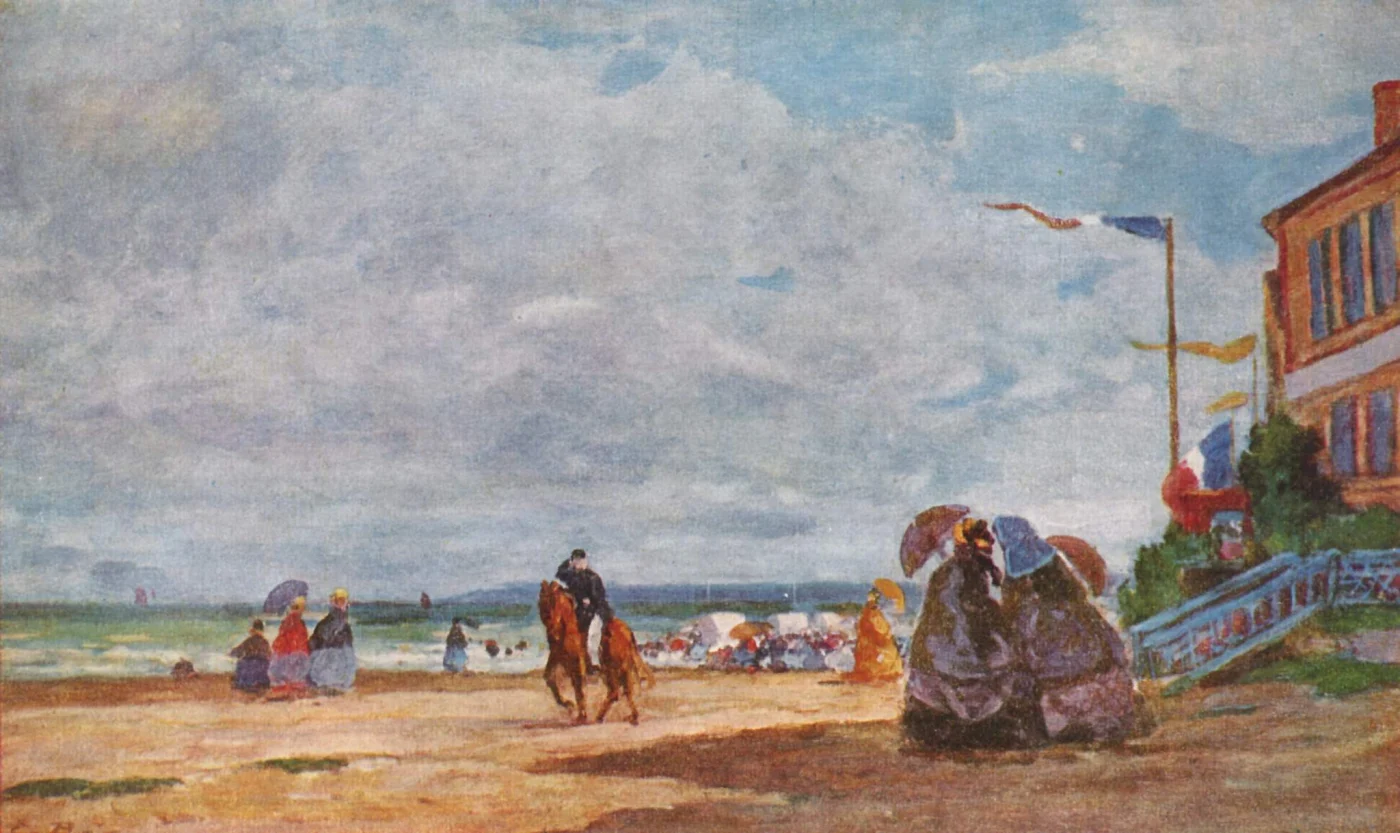
Following Mozin, artists and writers began to flow into Trouville, drawn to its authenticity and turning their backs on the artificial luxury of other resort towns like Dieppe. Among them was the celebrated writer Alexandre Dumas (1802-1870), who wrote with humor that “Trouville, in terms of latitude, was then almost as unknown as Robinson Crusoe’s island.” In a very short time, Trouville became a major tourist destination.
The ones responsible for this transformation were, of course, the artists. Painters like Eugène Boudin (1824-1898) and Claude Monet (1840-1926) set up their easels there, captivated by the ever-changing light of Normandy. They painted not only the landscape, but also the new society that began flocking to the coast: elegant women in crinoline dresses and parasols, who became a symbol of the Belle Époque. In this fascinating way, art fed tourism, and tourism, in turn, supplied new subjects for art.
Forbidden Love on the Beach: Gustave Flaubert and the Passion That Shaped His Life
But the most fascinating story to come out of Trouville, the one that made it part of world literary history, is a love story. An impossible love that forever changed the life of one of the greatest writers France has ever known.
The Fateful Meeting with Élisa Schlésinger
In August 1836, a shy fourteen-year-old boy named Gustave Flaubert (1821-1880) was walking on the beach at Trouville with his family. Suddenly he saw a beautiful young woman, Élisa Schlésinger (1810-1888), a married woman of twenty-six and mother of an infant daughter. In that instant, his world turned upside down.
Years later, he would describe that moment in his writing: “I was frozen with astonishment… I felt my heart for the first time, I felt something mystical, strange, like a new sense… I was in love.” Legend has it that the wind blew off her scarf, and he ran to pick it up and handed it back to her, trembling all over. That was the moment his life’s single great passion was born.

The story was especially “juicy” for its time. Élisa was known as “Madame Schlésinger,” but in fact she was still officially married to her first husband, an army officer who had disappeared in Algeria. She was living with the music publisher Maurice Schlésinger, and it was only years later, after her first husband’s death, that the two were able to marry. For the young Flaubert, she was the embodiment of beauty, mystery and forbidden love.
The Birth of Madame Arnoux: How Trouville Entered World Literature
This love, which was never consummated, haunted Flaubert his entire life. It became an obsession, a source of inspiration and an open wound. Trouville and the figure of Élisa Schlésinger became an inseparable part of his emotional and creative world.
Decades later, when he wrote his masterpiece, “Sentimental Education” (L’Éducation Sentimentale), he poured all his memories and feelings into the unforgettable figure of Madame Arnoux, the unattainable love of the book’s hero, Frédéric Moreau. That chance encounter on the beach at Trouville thus became one of the founding stories of modern literature.
In a letter he wrote to Élisa in 1872, many years after their meeting, he revealed the depth of his feelings:
Against this radiant backdrop, where dear ghosts reach out their arms to me, the most striking figure is yours! Yes, yours. Oh, poor Trouville!….
The Splendor of the Belle Époque: the Hôtel des Roches Noires and Its Famous Guests
Trouville’s crowning glory came with the Belle Époque, the beautiful era of the late 19th century. A perfect symbol of this period is the Hôtel des Roches Noires (Hôtel des Roches Noires), a palatial hotel that opened in 1866 and immediately became the center of social life in the “Queen of Beaches.”
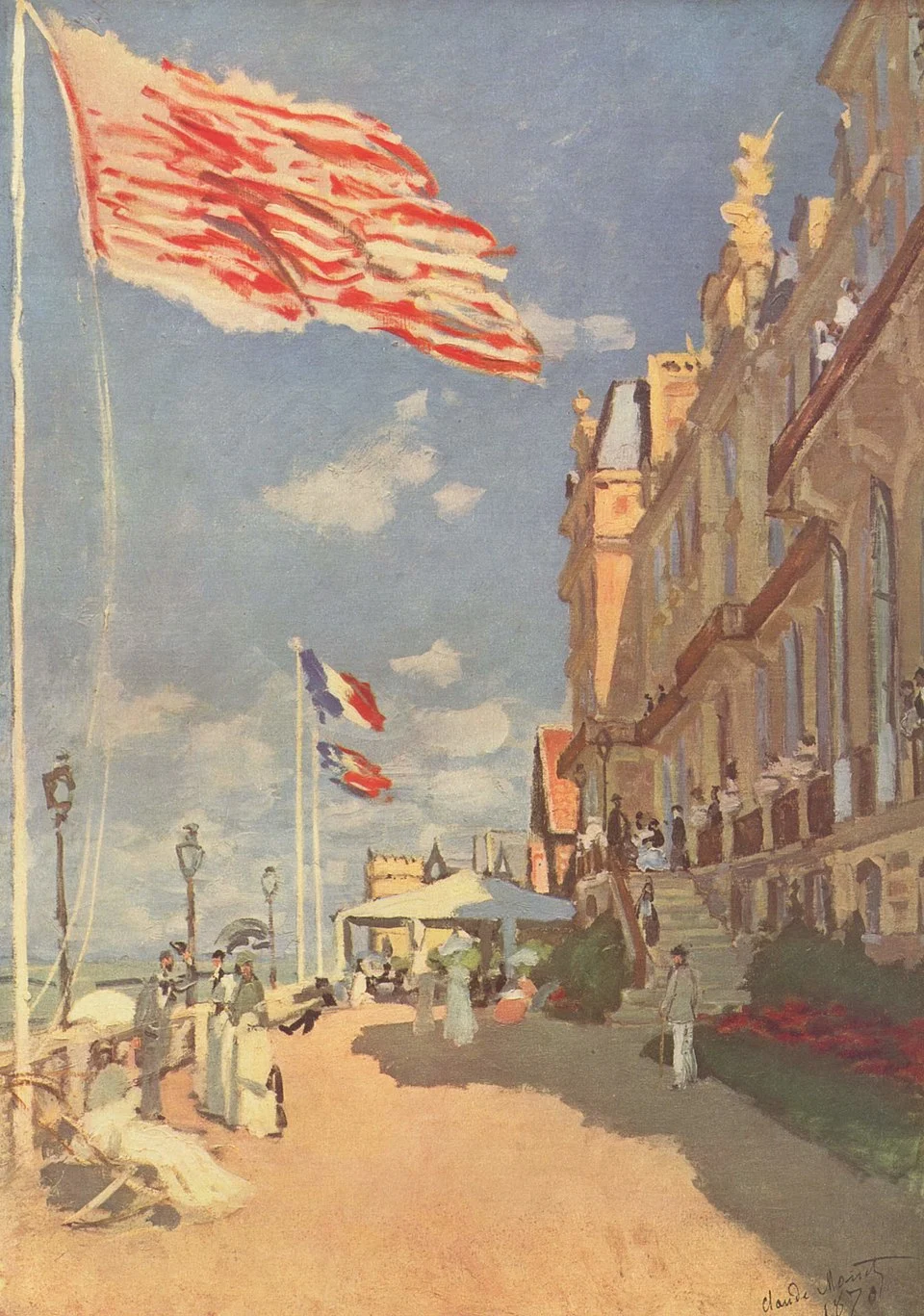
The hotel, with its impressive facade of red brick and beige stone, drew in all the elite of Europe. Claude Monet immortalized it in a famous painting from 1870, showing elegant guests sitting on the terrace and gazing out at the sea.
But above all, the hotel became a literary shrine. Marcel Proust (Marcel Proust 1871-1922) was a regular guest, who came here with his grandmother to breathe the sea air. The hotel and its atmosphere directly inspired the fictional resort town of “Balbec” (Balbec) in his monumental novel “In Search of Lost Time.”
Decades later, another writer, Marguerite Duras (Marguerite Duras 1914-1996), bought an apartment in the hotel, which had by then been converted into apartments, right next to the rooms where Proust had stayed. She spent her summers there until the end of her life, and wrote of the “violent magic” of Trouville. That same building thus became a symbolic meeting point between two giants of 20th-century French literature.
Deauville, a Duke’s Dream Born from the Sand
While Trouville developed organically, driven by artists and bohemians, the story of her younger sister, Deauville, is the complete opposite. Deauville did not grow, it was created. It was not discovered, it was invented. It was born from the vision of one man, a powerful, ambitious and unrestrained man, who decided to create a “kingdom of elegance” out of nothing.
“Let’s Build a Kingdom of Elegance Here”: the Vision of the Duc de Morny
To understand Deauville, you first have to know the man behind it: Charles, Duc de Morny (1811-1865). Morny’s story is a novel in itself, full of secrets, intrigue and glamour.
The Emperor’s Half-Brother and a Man of the Grand World
Morny embodied the Second Empire of Napoleon III. He was a larger-than-life figure: a shrewd politician (president of the Legislative Assembly), a bold businessman and speculator, a Parisian dandy, an avid fan of horse racing and theater, and a key figure in the 1851 coup that brought Napoleon III to power.
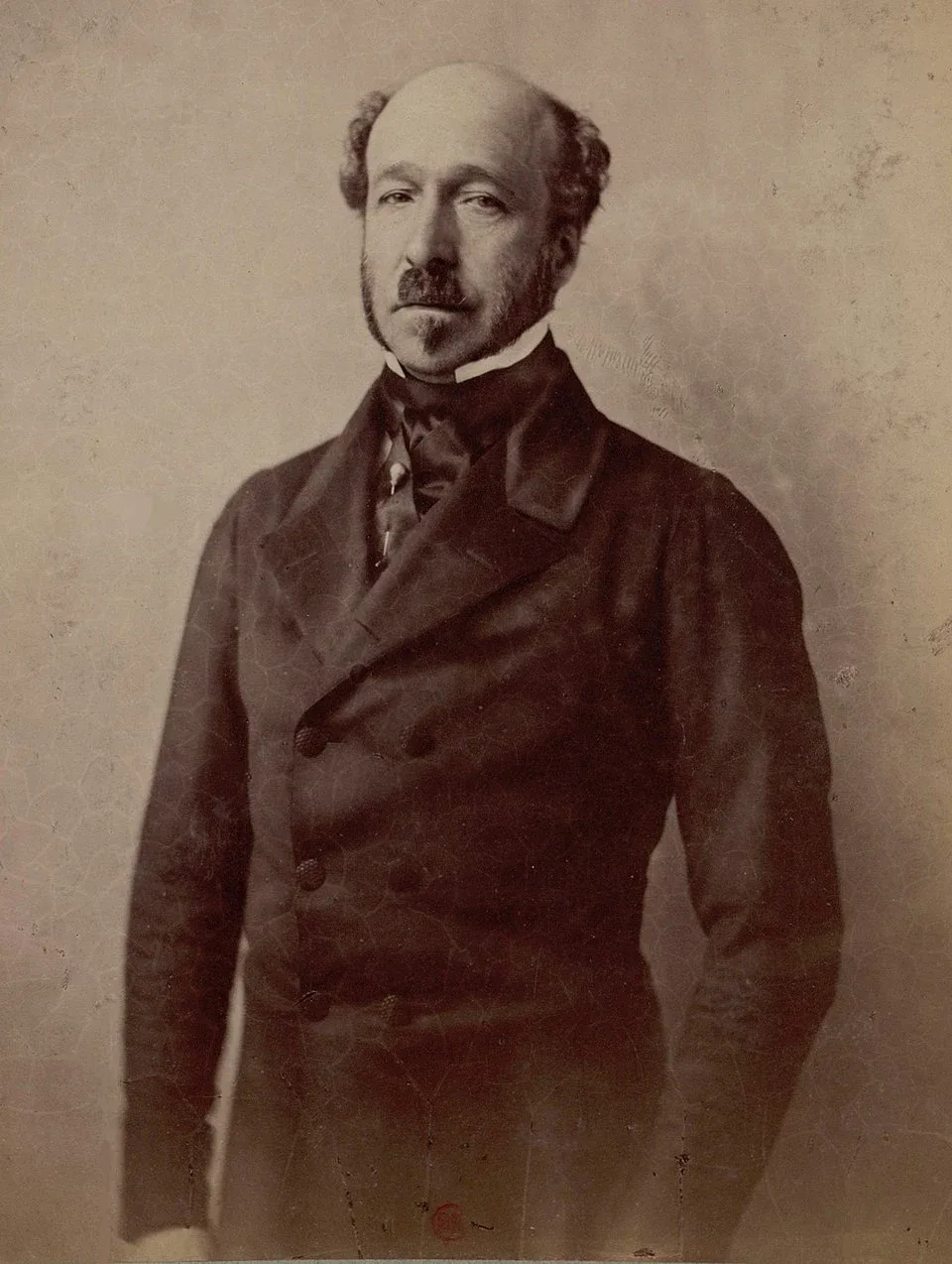
But his most “juicy” secret was his origin. He was the illegitimate son of Hortense de Beauharnais (1783-1837), queen of Holland, which made him the half-brother of Emperor Napoleon III. His father was her lover, the Comte de Flahaut (Auguste Charles Joseph de Flahaut de la Billarderie, 1785-1870).
His birth was carefully concealed, and he was registered under fictitious parents. This background shaped him into a man accustomed to working behind the scenes, using his connections, and thinking big.
Turning a Swamp into Paradise for the Aristocracy
The story begins in the summer of 1858. The Duc de Morny was invited to Trouville by his personal physician, Dr. Joseph Olliffe (1808-1869), who was also the director of the local casino. Morny stood on the Trouville shore, looked east across the Touques River, and saw… nothing. Just swamps and desolate sand dunes.
But where others saw wasteland, Morny saw opportunity. And then he declared what would become his famous line: “What openness, and what beauty! Let’s build a kingdom of elegance here.” He teamed up with Dr. Olliffe, the banker Armand Donon (1818-1902), and the architect Desle-François Breney (1804-1891). Together they bought 2,400 dunams of swampland for 800,000 gold francs.
What happened next was nothing short of an engineering and economic marvel. In just four years, between 1860 and 1864, an entire town rose up out of the sand. Workers drained the swamps, laid out wide, straight streets inspired by the plan that Baron Haussmann (1809-1891) had drawn up for Paris, and built infrastructure at a dizzying pace. This was not just a resort town; it was a declaration of the power and wealth of the Second Empire.
A Racetrack Before a Church: the Birth of the Capital of Horses
Nothing symbolizes the character of Deauville more than the fact that its racetrack was built before its church. The Hippodrome de la Touques (Hippodrome de la Touques) opened in August 1864, and immediately became the beating heart of the new town.
Morny, who was himself a rider and owner of racehorses, understood that horse racing was the perfect magnet to draw in the wealthy international elite he wanted to attract. It was an aristocratic pastime, a chance to be seen, to place bets and to mingle with high society.
At the same time, the other pillars of the “kingdom of elegance” were being put in place: the railway line from Paris was extended to reach the town in 1863, cutting travel time from the capital to just five hours. A grand casino opened in 1864, and a long wooden boardwalk called “La Terrasse” (La Terrasse) stretched along the coast. Deauville was ready to conquer the world.
The Battle of the Sisters: The Fight for Normandy’s Crown
With Deauville established, the stage was set for the real drama: the rivalry between the two sisters for the title of “Pearl of the Normandy Coast.” It was a bitter rivalry, fought not just on the beaches and in the salons, but also in the casinos, on the racetracks and in the fashion magazines.
A Duel of Casinos and Glamour
Deauville’s start was anything but smooth. The sudden death of the Duc de Morny in 1865, followed by the fall of the Second Empire in the Franco-Prussian War in 1870, dealt a heavy blow to the young town. Its aristocratic patrons vanished, and it became what one writer called an “elegant corpse,” a beautiful but empty ghost town.
For decades, Trouville, the “Queen of the Beaches,” reigned unchallenged. But then, at the start of the 20th century, the tide turned. Deauville’s new mayor, Désiré Le Hoc, decided to revive his town. He made a brilliant move: he “poached” the successful manager of Trouville’s casino, a charismatic businessman named Eugène Cornuché (1867-1926), who also owned the famous Maxim’s restaurant in Paris.

Cornuché was a visionary, just like Morny. He understood that Deauville had to offer something Trouville could not: modern, uncompromising luxury. He tore down the old casino and built a new one in its place, grand and dazzling, which opened in 1912. Right after that, he built two legendary luxury hotels: the Normandy (1912) and the Royal (1913).
It was a declaration of war. The wealthy crowd, always chasing the next big thing, flocked to Deauville. Its new casino and lavish hotels completely overshadowed Trouville’s. The balance of power shifted, and this time for good.
The Crazy Years: Deauville Becomes Paris’s 21st Arrondissement
The 1920s, the “Crazy Years” (Années Folles), were Deauville’s golden age. It became the ultimate symbol of the liberation, pleasure and modernity that followed the First World War. The writer Jean Cocteau (1889-1963) coined the nickname that has stuck to this day: “Paris’s 21st arrondissement.”
Coco Chanel Liberates Women (and Invents Resort Fashion)
One of the central figures who shaped the spirit of the era in Deauville was none other than Gabrielle “Coco” Chanel (1883-1971). In 1913, she opened her first boutique outside Paris in Deauville. The money for the venture came from her lover and the love of her life, the charismatic English polo player Arthur “Boy” Capel (1881-1919).

In that small boutique, Chanel started a revolution. She watched wealthy women strolling the beach in suffocating corsets and uncomfortable clothes, and decided to set them free. Inspired by sailors’ striped shirts, the blazers worn by “Boy” Capel, and the need for practical clothing suited to modern life, she began designing elegant sportswear out of jersey fabric, a material until then used only for men’s underwear.
It was a runaway success. Women fell in love with the new freedom she offered them. Years later, Chanel said: “My fortune is built on that old jersey sweater I wore because I was cold in Deauville.” Her love story with Capel ended in tragedy when he was killed in a car accident in 1919. Legend has it that her grief is what led her to turn the little black dress into a legitimate fashion staple, saying that the whole world would be mourning right alongside her.
In Dr. Orna Lieberman’s article, Misia Sert: Cultural Icon, Queen of Paris, you can read more about the world of high society between Paris and Deauville. Misia was a close friend of Chanel’s and a source of inspiration for Proust, which is covered in parts two and three of that article.
Parties, Gambling and Stars
Deauville in the 1920s was one long party. The new casino was packed with stars like the dancer Mistinguett (1873-1956) and the actor Sacha Guitry (1885-1957). In 1924, the famous wooden boardwalk “Les Planches” was inaugurated, becoming the main runway for fashion and high society.
The rivalry between the sisters did not destroy either of them. Instead, it created two separate, complementary identities. Deauville became the capital of sequins, fashion and international glamour. Trouville, on the other hand, dug in with its more authentic, artistic and family-oriented identity. It kept drawing writers like Marguerite Duras (1914-1996), who sought out its “violent charm” over the glamour of its neighbor. And so a perfect duality was born: the glamorous sister and the soulful sister.
From the Ruins of War to Hollywood Glamour
The story of Deauville and Trouville did not end in the 1920s. Like the rest of Europe, the two towns went through the upheavals of the 20th century, but they knew how to reinvent themselves and stay relevant in the modern world.
Scars of the Occupation and the Belgian Liberation
World War II put an end to the celebrations. The Germans occupied both towns, camouflaged the hotels and casino and filled the beaches with fortifications and barbed wire in anticipation of a possible Allied invasion. Those dark years left their mark on both towns.

Liberation came in August 1944. After fierce fighting in the area, it was the Belgian soldiers of the “Piron Brigade” (Brigade Piron) who crossed the Touques river and liberated the towns. In their memory, the bridge connecting Deauville and Trouville is still called the “Bridge of the Belgians” (Pont des Belges) to this day.
A Rebirth: The American Film Festival
After the war, Deauville once again proved it could reinvent itself. Under the leadership of the energetic mayor Michel d’Ornano (1924-1991) and the hotel and casino magnate Lucien Barrière (1923-1991), the town searched for a new way to stand out.
The breakthrough came in 1975 with the founding of the American Film Festival. It was a brilliant strategic move, linking Deauville directly to the glamour of Hollywood and securing it a place of honor on the international map. Ever since, every September, the world’s biggest film stars walk Les Planches, and the tradition of naming beach cabins after them has become one of the town’s best-known trademarks.
My Personal Recommendation
You’ve read all the history, and now it’s time to go explore? That is exactly why Yael Suliman, whose grandmother lived in Deauville for much of her life, wrote the article ‘Deauville and Trouville, a Lovely Pair‘.
So Where Should You Stay?
If you ask me, despite Trouville’s charm, I find Deauville to be the more convenient base, with a wider range of services and a livelier atmosphere in the evenings. I personally chose to stay in a wonderful apartment belonging to Yael Suliman and her brother, which is perfectly located and offers everything you need for a great trip (not to mention that Yael and I have been friends for years, and she’s written several wonderful articles for my site).
You can find the details of the apartment at this link.
And if you’d like to check out other places to stay in Deauville, I’ve put together, as always, a page with all my top hotel recommendations.
Related reading