

I have visited Mont-Saint-Michel twice in my life. On my first visit, I was like most tourists: stunned by the sheer size of the place, jostled along with the crowds on the main street, snapping pretty pictures and trying to soak up some of the magic. It was impressive, no doubt, but I felt like I was missing something. On my second visit, years later, I came prepared. I had dug deep into its history: the legends, the wars, the monks and the prisoners. And this time… this time it was a completely different experience. Every stone told a story, every step whispered a secret. Suddenly, the place stopped being just a tourist site and became a living, breathing thing, with a soul 1,300 years old.
One of my strongest conclusions is that to truly enjoy everything Mont-Saint-Michel has to offer, to feel its real power, you simply have to know its history. That’s why I wrote this article. It’s not just a travel guide; it’s an invitation to a journey through time, a key that will let you open the hidden doors of this wonder and turn your visit from a pretty experience into an unforgettable one.
From Dream to Reality: How Was the Wonder Born?
The story of Mont-Saint-Michel doesn’t begin with architects or kings, but with a dream. And before the dream, there was a lone granite rock, exposed to the winds and to the most powerful tides in Europe. In ancient times, even before Christianity, the place was called “Mont Tombe” (“Mount of the Tomb”). Some believe it was a pagan cult site, perhaps Druidic, a place of mystery and natural power. But all that was about to change in the early 8th century, thanks to one man and a particularly stubborn vision.
The Legendary Beginning: The Angel, the Bishop and the Pierced Skull
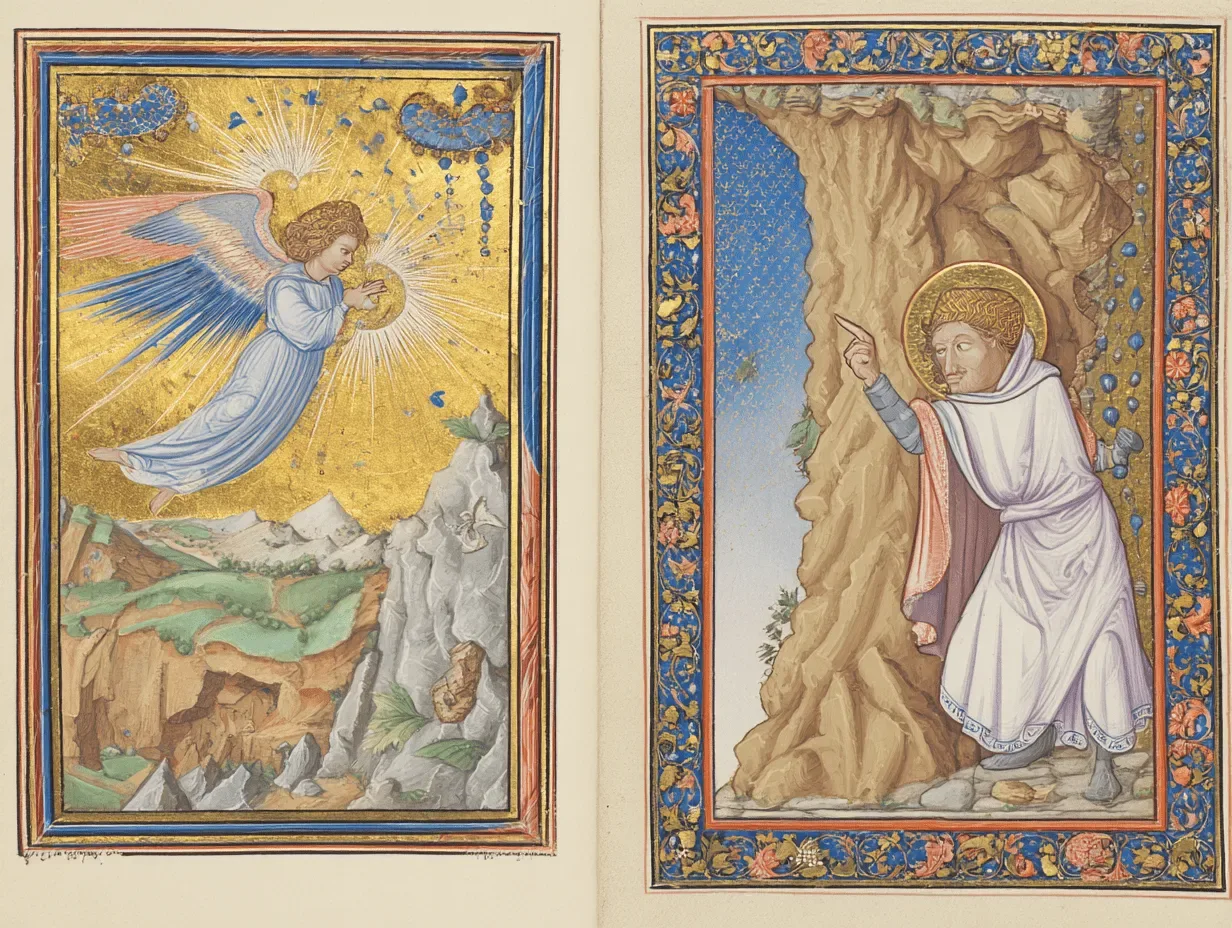
Meet Aubert d’Avranches (c. 660-725), the bishop of the nearby town of Avranches, in the year 708. According to legend, which is the founding story of the place, one night none other than the Archangel Michael, commander of the heavenly armies, appeared in Aubert’s dream and asked him to build a sanctuary on that lone rock. Aubert, a cautious man, woke up and figured it was probably just a strange dream, or worse, a trick of the devil. He ignored it.
On the second night, the Archangel Michael came back, this time a bit more forceful. “Aubert, why don’t you obey me?” But the bishop still hesitated. On the third night, the Archangel Michael had lost his patience. He appeared again, and in his anger, to prove to the skeptical Aubert that he was entirely real, he pressed his finger firmly into the sleeping bishop’s skull. When Aubert woke up in the morning, he felt a sharp pain in his head, and when he touched the spot, he discovered, to his shock… a hole.
This story, which sounds like a folk tale, is more than just a story. It is a brilliant branding strategy. Because what could be more convincing than physical proof of divine intervention? And the most astonishing part is that the skull, with its strange round hole on one side, still exists today! It is kept as a sacred relic at the Basilica of Saint-Gervais in Avranches. Carbon-14 testing dated it precisely to the time of Bishop Aubert, between the years 662 and 770 CE. Modern science explains that the hole was most likely caused by a benign cyst, but in the Middle Ages, the story of the angel’s finger was all anyone needed. Aubert took the hint, and began building the first sanctuary on the “Mount of the Tomb,” which changed its name to “Mont-Saint-Michel.”
From Pagan Mount to Benedictine Monastery: The Normans Change the Game
Aubert’s first sanctuary was fairly modest. The big leap forward came almost 250 years later, and it was a brilliant political move as much as a religious one. In 966, Richard I (933-996), Duke of Normandy, decided it was time to clean house. He removed the community of canons who had been serving at the site (whom he claimed lived far too loose a life) and brought in Benedictine monks, known for their iron discipline, their scholarship and their devotion.
This wasn’t purely a matter of faith. By establishing a large and impressive Benedictine monastery at such a strategic point, on the sensitive border between Normandy and Brittany, the Norman dukes solidified their rule and displayed their power and strength. They took the powerful myth of the Archangel Michael and harnessed it for their political ends. The monastery quickly became one of the most important pilgrimage centers in the Christian world, but also an intellectual and cultural hub. The monks established a “scriptorium” (a writing room) and turned the monastery into a “City of Books” (Cité des Livres), where they copied and illuminated magnificent manuscripts, which further boosted the place’s prestige. This created a virtuous circle: the legend attracted pilgrims and royal donations, the money funded the monastery’s expansion and its intellectual output, and the prestige drew in even more pilgrims and important visitors. Mont-Saint-Michel’s success didn’t come from faith alone, but from a brilliant combination of a gripping story, shrewd politics and a rich culture.
“The Marvel” (La Merveille): A Masterpiece of Architecture and Faith
As the monastery’s prestige grew, so did the need to expand it. But here the builders of the Middle Ages ran into an almost impossible engineering challenge: how do you build an 80-meter-long church and enormous residential buildings on the sharp peak of a granite rock? There was nowhere to build outward, since there was only sea and sheer drop. Their answer is what makes Mont-Saint-Michel an architectural masterpiece to this day.
Building on Thin Air: The Medieval Engineering Challenge
The unknown architects’ solution was bold and brilliant: instead of leveling off the peak, they decided to build upward, in layers. They used the rock’s steep slopes as a foundation, and built a series of crypts (underground chambers) and supporting chapels that created an artificial, level and massive platform. On top of that platform, they built the main abbey church. The result is a structure that looks as if it is “floating” in midair, a dizzying, vertical piece of architecture in which every floor supports the one above it.
To grasp the scale of the undertaking, you have to picture the logistical effort involved. They quarried heavy granite blocks, some of which were brought from the nearby Chausey Islands, and had to raise them 80 meters into the air. They did this using wooden cranes and enormous pulleys known as “squirrel cages,” powered by the muscles of workers walking inside a giant wheel. It was hard, dangerous work, a testament to the faith and the remarkable engineering skill of the time.

From Romanesque to Gothic: The Story of “The Marvel”
The story of the most famous part of the abbey, known as “The Marvel” (La Merveille), begins, like a lot of good stories, with a disaster. In 1204, Breton forces allied with Philip II Augustus (1165-1223), King of France, attacked the abbey of Mont-Saint-Michel (which was loyal to the Duchy of Normandy), and during the fighting set fire to large parts of it. King Philip, who felt guilty (and also needed the Church’s support), decided to atone for it and granted the abbey a huge sum of money for its reconstruction.
That money made possible one of the most ambitious projects in Gothic architecture. Between 1211 and 1228, the monks built an astonishing structure on the steepest, north-facing side of the rock, with two façades and three floors, which came to be called “The Marvel.” This structure is not the whole abbey, but a specific Gothic addition designed to hold everything needed for the monks’ daily life.
The architecture of “The Marvel” is, in effect, a diagram of medieval society and theology. On the lowest floor was the “Aumônerie,” where the monks received poor pilgrims and gave them alms. This was the floor of “those who work.” On the middle floor were the “Guest Hall” and the “Knights’ Hall,” where nobles and kings were received. This was the floor of “those who fight.” And on the uppermost, brightest floor, closest to heaven, were the monks’ dining hall (the refectory) and the famous cloister, a colonnaded courtyard, a masterpiece of serenity suspended between sky and sea. This was the floor of “those who pray.” Climbing up through “The Marvel” was both a physical and a spiritual journey, from the earthly world toward heavenly contemplation.
An Impregnable Fortress: Wars, Knights and Royal Dramas
With the outbreak of the Hundred Years’ War between England and France (1337-1453), the role of Mont-Saint-Michel changed dramatically. Its strategic location turned it from a pilgrimage center into a critical military stronghold. It became a symbol of French resistance, the only stronghold in all of Normandy that never fell into English hands.
A Symbol of Resistance: The Hundred Years’ War and the English Siege
The monks and knights joined forces to turn the place into a formidable fortress. They built massive walls, watchtowers and fortified gates surrounding the small village at the foot of the abbey. But their secret and most effective weapon was nature itself: the tides. English armies that tried to besiege the Mont found themselves trapped in quicksand-like mud or swept away by the powerful tides, which turned the fortress into an isolated, impenetrable island.
Louis d’Estouteville and the 119 Knights: A Story of Heroism That Entered the Pantheon
Here comes one of the juiciest and most heroic stories in the place’s history. In 1434, after years of siege, the English decided to make one last, desperate attempt to capture the Mont. They attacked with a large force, but facing them stood a handful of brave defenders. Leading them was the noble captain Louis d’Estouteville (c. 1400-1464), who had only 119 knights at his disposal, local noblemen who had taken refuge there.
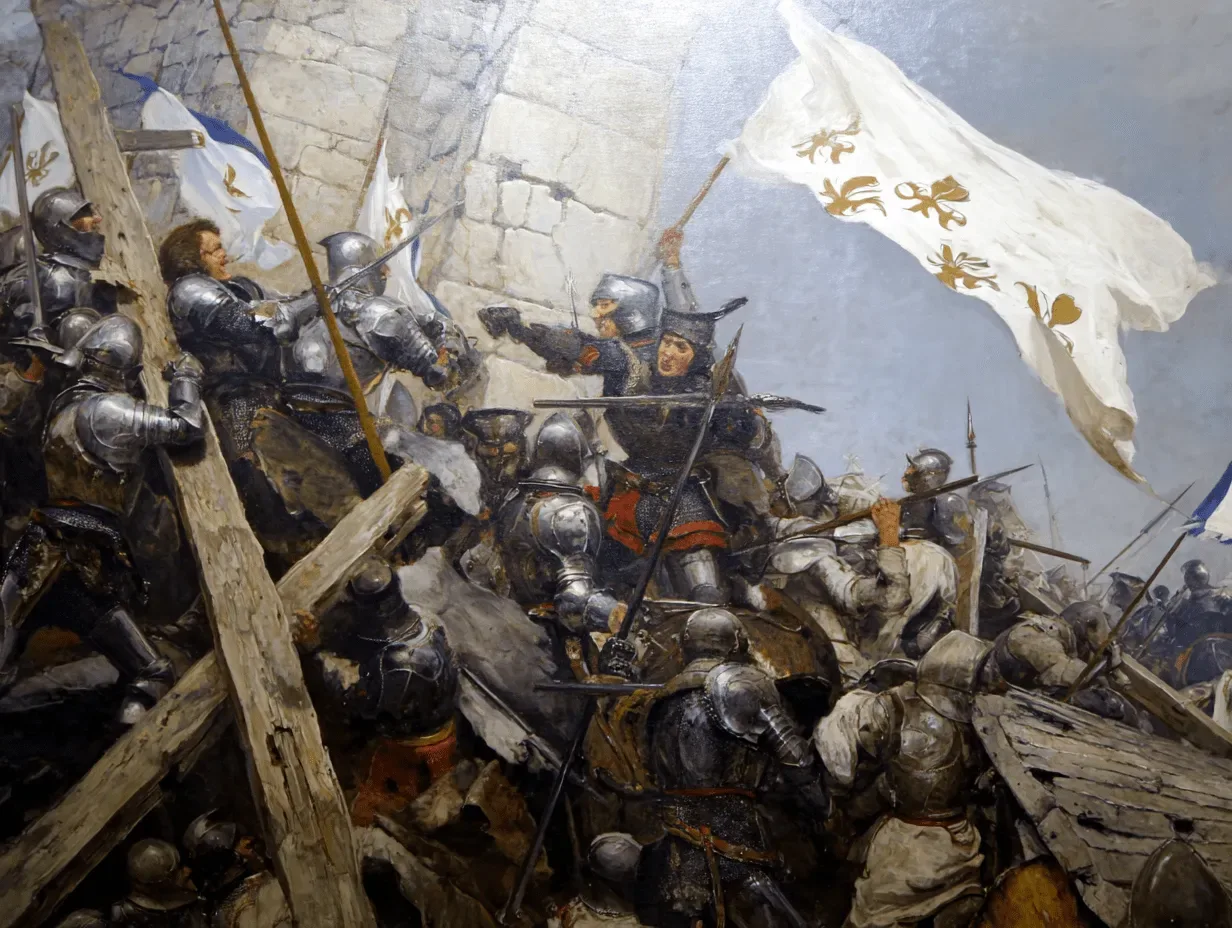
In a fierce battle at the fortress gates, the 119 knights and their men managed, against all odds, to repel the large English army. The English retreated in disgrace, leaving behind on the battlefield two large cannons (bombards). Those cannons, spoils of war, still stand proudly today at the entrance to Mont-Saint-Michel, and have earned the affectionate nickname “les Michelettes.” This remarkable victory cemented the myth of Mont-Saint-Michel as a place enjoying the divine protection of the warrior angel, Michael.
The Dark Side of the Monarchy: Louis XI and the Iron Cages
After the war ended, the Mont’s military role faded, but a new, dark chapter was about to begin. King Louis XI (1423-1483), known as a cunning, cruel and paranoid man, was the first to understand the potential of this isolated, fortified place, and he systematically turned it into a state prison for his political enemies.
This is where the dark legend of “les fillettes,” “the little girls,” an ironic nickname for hanging iron cages in which, according to the story, prisoners were held in horrific conditions, unable to stand up straight or lie down. This story became a symbol of Louis XI’s cruelty, especially thanks to Romantic writers like Victor Hugo (1802-1885), who helped spread it.
But here, as your friendly know-it-all, I feel I should separate legend from reality. Louis XI really was a harsh king who used chains and brutal prison conditions. Still, modern historical research shows that the story of the cages was shaped and exaggerated by his political enemies to blacken his name. It seems only a handful of prisoners were ever held in such cages, and the famous cage shown to tourists for many years was actually a later reconstruction. It’s a great example of how history is sometimes written by the winners, or at least by whoever shouts the loudest.
“The Bastille of the Seas”: When the Abbey Became a Fearsome Prison
The use of Mont-Saint-Michel as a prison reached its height after the French Revolution. In 1790, the revolutionaries expelled the last monks, nationalized the abbey, and officially turned it into a prison for political and criminal inmates. The isolated, secure site, once a symbol of the power of the monarchy and the Church, now became a symbol of the new state’s oppression, earning the grim nickname “the Bastille of the seas” (La Bastille des mers).
Revolution, Political Prisoners and Daring Escape Stories
For about 70 years, hundreds of prisoners passed through the abbey’s walls, which had been converted into small workshops and prison cells. Among the most famous inmates were republican revolutionaries like Armand Barbès (1809-1870) and Louis Auguste Blanqui (1805-1881), who had opposed the monarchist regime that rose after Napoleon. Conditions were harsh, and isolation was total.

But even under these conditions, the human spirit sought freedom. There are remarkable stories of escape attempts. In 1842, Barbès and Blanqui tried to escape using a rope made of bedsheets, but the attempt failed when Barbès fell, was injured, and was discovered. A more successful story is that of a prisoner named Édouard Colomba, who in 1834 managed to escape through a narrow chimney and a forgotten tunnel he found, becoming one of the very few who ever managed to escape from “the Bastille of the seas.”
Victor Hugo and the Rescue of the Abbey: “A Toad in a Jewel Box”
This grim chapter in the history of Mont-Saint-Michel could have ended with the total destruction of the place. The buildings were neglected, the walls were crumbling, and the site had lost all its splendor. The man who saved it was none other than the literary giant of France, Victor Hugo (1802-1885).
Hugo visited the site in 1836, and was shaken to his core. He was struck by the architectural beauty of the abbey, but disgusted by how it was being used. In a famous letter, he coined the sharp, unforgettable description of the prison: “a toad in a jewel box” (un crapaud dans un reliquaire). He didn’t stop there. In impassioned articles and appeals, he declared: “Mont-Saint-Michel is for France what the Great Pyramid is for Egypt. It must be protected from all corruption.”
Hugo’s words, along with the voices of other intellectuals and artists of the Romantic era, stirred up a public outcry. Suddenly, the French began to see Mont-Saint-Michel not just as an old, useful building, but as a cultural treasure, a symbol of the nation’s soul, “heritage” that belonged to everyone. This process, which Hugo helped lead, was in effect the birth of the modern idea of historical preservation. Public pressure did the rest: in 1863, Emperor Napoleon III (1808-1873) ordered the prison closed, and in 1874 the site was officially declared a national historic monument, paving the way for its magnificent restoration.
A Modern Turnaround: From Mass Tourism to Renewed Wonder
With the prison closed, Mont-Saint-Michel was reborn, this time as a tourist destination. Crowds of visitors began flocking to the site, and there was a need to provide them with services. And so, alongside the restoration of the ancient stones, a new legend was born, modern and a lot more delicious.
Mère Poulard and the World-Famous Omelet
In 1888, a young, energetic woman named Annette Poulard (1851-1931) opened a small inn with her husband at Mont-Saint-Michel. She ran into a problem: pilgrims and tourists arrived at all hours of the day, at the mercy of the tides, and they were always hungry. She needed a dish that could be made quickly, that was filling and tasty. Her brilliant solution was simple: an omelet.

But this was no ordinary omelet. “Mère Poulard,” as she came to be known, developed a secret recipe for an airy omelet, puffed up like a soufflé, which she whisked at a particular rhythm in copper bowls and cooked over an open wood fire. The omelet, together with her warm and generous hospitality, became a sensation. Kings, presidents, artists and celebrities from all over the world came to taste “Mère Poulard’s omelet.” To this day, her restaurant is an institution, and the omelet (whose price, I should mention, is legendarily high) is a culinary symbol of the place, an inseparable part of the modern visitor experience.
Restoring the Island: A 21st-Century Project
The latest chapter, as of now, in the story of Mont-Saint-Michel is a return to its origins. In 1879, a causeway-dam was built connecting the Mont to the mainland and allowing easy access for tourists. But this dam had a destructive and unforeseen consequence: it blocked the natural flow of the tides. Over more than a century, tons of sand and silt built up around the Mont, threatening to permanently connect it to the mainland and destroy its unique character as an island.
At the start of the 21st century, France launched a massive engineering project, one of the largest in Europe, to “restore Mont-Saint-Michel’s maritime character.” They tore down the old dam, and in its place built an elegant, lightweight footbridge (pont-passerelle) on thin pilings, allowing water to flow freely beneath it. The goal was to let the sea wash away the accumulated silt, and at high tide, to turn Mont-Saint-Michel back into a true island, surrounded by water on all sides. It is the latest chapter in the eternal dialogue between humanity, faith and the powerful forces of the sea.
The best-kept secret of Mont-Saint-Michel: discovering it without the crowds
After all those stories and history, let me share with you my most important tip, the secret that will turn your visit into an entirely different experience. The real magic of Mont-Saint-Michel doesn’t reveal itself at midday, when thousands of tourists pack the main street. It reveals itself in the quiet hours, when the sun sets and the crowds leave.
Picture yourself walking through the narrow, empty lanes, lit by yellow street lamps, hearing nothing but your own footsteps on the ancient stones, the rustle of the wind and the cries of the seagulls. Picture the abbey lit up, standing like a crown of light against a night sky full of stars. In those moments, once the crowds are gone, you can almost hear the whispers of 1,300 years of history. It’s an almost mystical experience, a real connection to the soul of the place.
There’s only one way to earn that experience: you have to stay overnight on site, or at least arrive very early in the morning before everyone else. Staying at one of the few hotels on the rock itself, or in one of the picturesque villages nearby, will let you discover Mont-Saint-Michel the way few people ever get to see it: quiet, mysterious and magical beyond words.
If you’d like to take my advice, you’ll be happy to know I’ve put together a full article about places to stay near or on Mont-Saint-Michel, and all that’s left for you to do is pick the one that suits you best.
Related reading