
A king of France had to know not just how to live, but how to die. Since he spent his whole life in grand palaces, it only made sense that when his time came to move on to a better world (as if he hadn’t had it good enough here), he would not be buried in a simple grave, but inside a cathedral under a magnificent monument. Since the Middle Ages, the kings of France chose the Basilica of Saint-Denis as their final resting place, and most guidebooks will tell you that you can find the tombs of every king there since Dagobert I (r. 629-639).
But that’s not quite true, because France’s last two kings were not buried there. The first was King Charles X (r. 1824-1830), who was forced to flee France after the 1830 revolution and died in exile in Slovenia. He was buried in Gorizia in 1836. The second was King Louis-Philippe (r. 1830-1848), who also had to flee after a revolution and died in England in 1850. But unlike Charles X, his body was returned to French soil. Instead of being buried at Saint-Denis, though, he was laid to rest, at his own request, in Dreux.
The History of Dreux
The town of Dreux, part of a county of the same name, belonged to the French crown’s domain, and during the Middle Ages it became a battleground between France and the Duchy of Normandy and the English crown. The hill on which the complex now stands served as a key military fortress as early as the 12th and 13th centuries, defending the borders of the Capetian royal domain to the last, and it saw no shortage of sieges, including ones led by King Henri IV (r. 1589-1610) during the Wars of Religion.
In 1775, King Louis XVI, who had his eye on the Château de Rambouillet, decided to give the town of Dreux to its owner, the Duc de Penthièvre, in exchange for the château.
The duke took the opportunity to move the remains of his father, the Duc de Toulouse (an illegitimate son of Louis XIV), along with the rest of his family, from the church at Rambouillet to the one in Dreux, where he himself was buried in 1793. But not long after, the revolutionary government decided to desecrate the family’s graves and toss the bones into a mass grave.
After the Bourbon Restoration, the Duchesse d’Orléans, daughter of the Duc de Penthièvre and mother of Louis-Philippe (future king of France), decided to build a royal chapel on the very spot where her family’s mass grave lay. The chapel was built in the neoclassical style, fashionable in the early 19th century, and featured Doric columns and a beautiful dome.
Beyond building the chapel, the duchess, Marie-Adélaïde de Bourbon (1753-1821), led a fascinating life. After divorcing her husband, Philippe Égalité (who voted for the execution of Louis XVI and later met his own end on the guillotine), she went into exile in Spain. There she fell in love with Jean-Guillaume Rosay (1754-1820), a former government official and revolutionary. Their love was so strong that when he died, she insisted he be buried in the royal chapel, and to this day his simple tomb stands right next to those of the kings and princes (it turns out love really can beat politics, at least sometimes).
In 1830, after coming to power, Louis-Philippe decided to turn the family burial chapel into a royal one that could rival Saint-Denis, where, as mentioned, nearly every king of France was buried. Since the neo-Gothic style had become very popular in France by then, the king surrounded the original chapel with Gothic-style structures, completed in 1845. The result was a stunning building, though some would call it a bit kitschy because of the mix of styles.
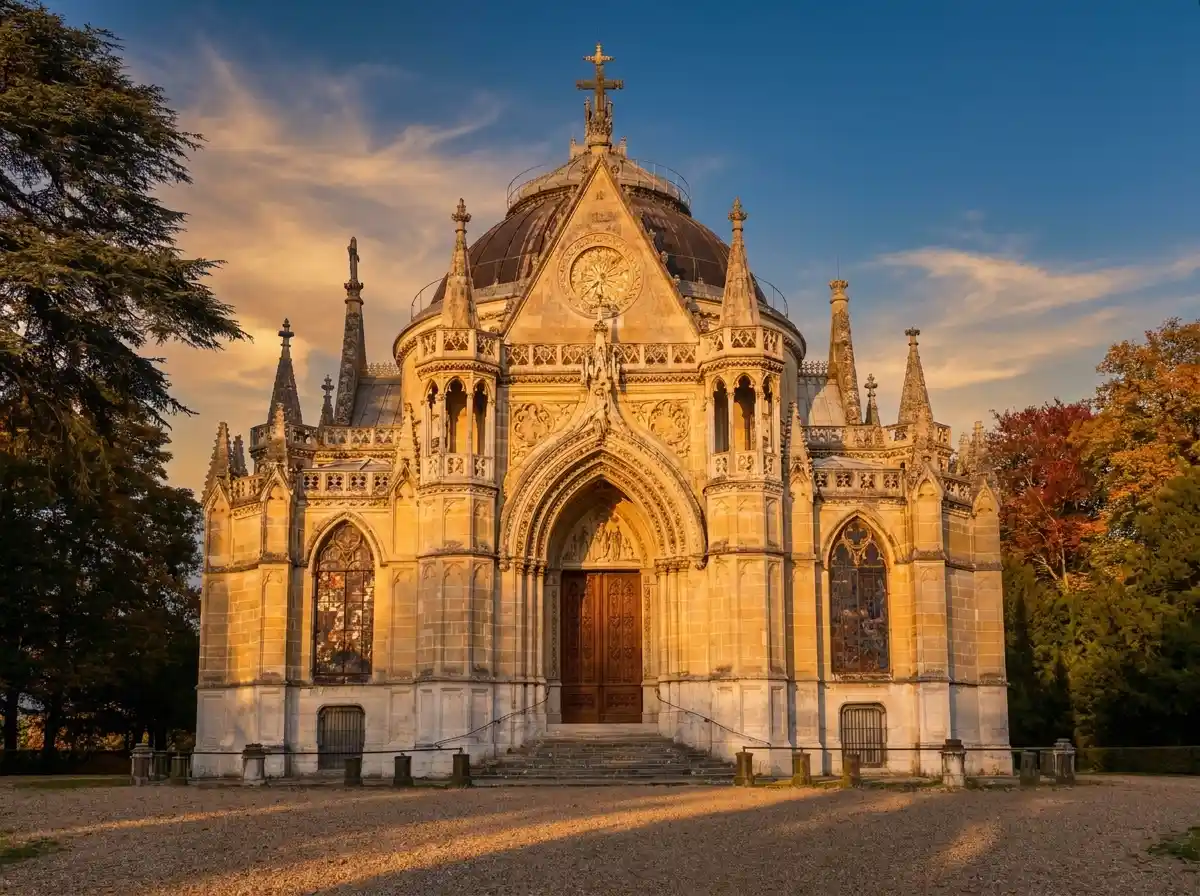
Visiting the Dreux Chapel
Louis-Philippe had to flee France in 1848 and died in England. His wife died in 1866, and it was only ten years later that their remains were returned to France and buried in Dreux alongside the rest of the Orléans family. Today you can find several dozen graves of Orléans family members in the complex, and some of their descendants still claim the throne of France (the current claimant is the Comte de Paris, who calls himself Henri VII).
Since there’s an admission fee, you actually enter the church from below, through the crypt, where most of the tombs are, and then make your way up to the level of the original entrance. When I walked into the complex, I had no idea what to expect. At first, all you see are a few unremarkable headstones, some of them empty (presumably for future use, I imagine). But then you turn right, and this is what greets you.
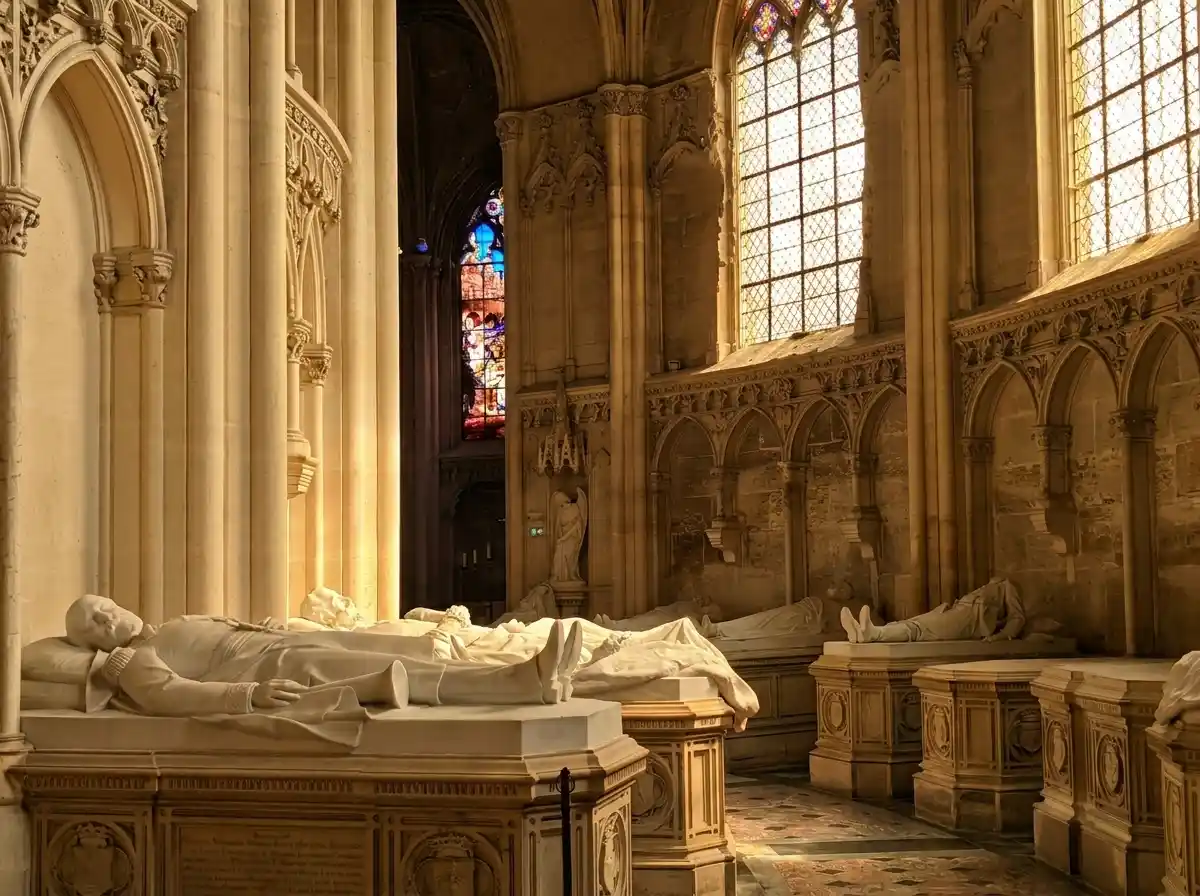
There’s something striking about the quiet, morbid beauty of this place. This is the point where you start wandering from tomb to tomb, learning about the people buried there. Despite being wealthy nobles, their lives didn’t always go smoothly. Take, for example, the tomb of Ferdinand-Philippe, Duc d’Orléans (1810-1842), and his wife, Hélène of Mecklenburg-Schwerin (1814-1858).
Reach Out and Touch Him
Ferdinand-Philippe was Louis-Philippe’s eldest son and was seen as the great hope of the House of Orléans, thanks to his success in the French army and his role as a major patron of the writers of his time (he was a friend of Alexandre Dumas, Victor Hugo, Alfred de Musset and others). But in 1842, the crown prince was killed in a carriage accident near Porte Maillot, west of Paris. His wife, Hélène of Mecklenburg-Schwerin, who brought the tradition of the Christmas tree to Paris, was a Protestant.
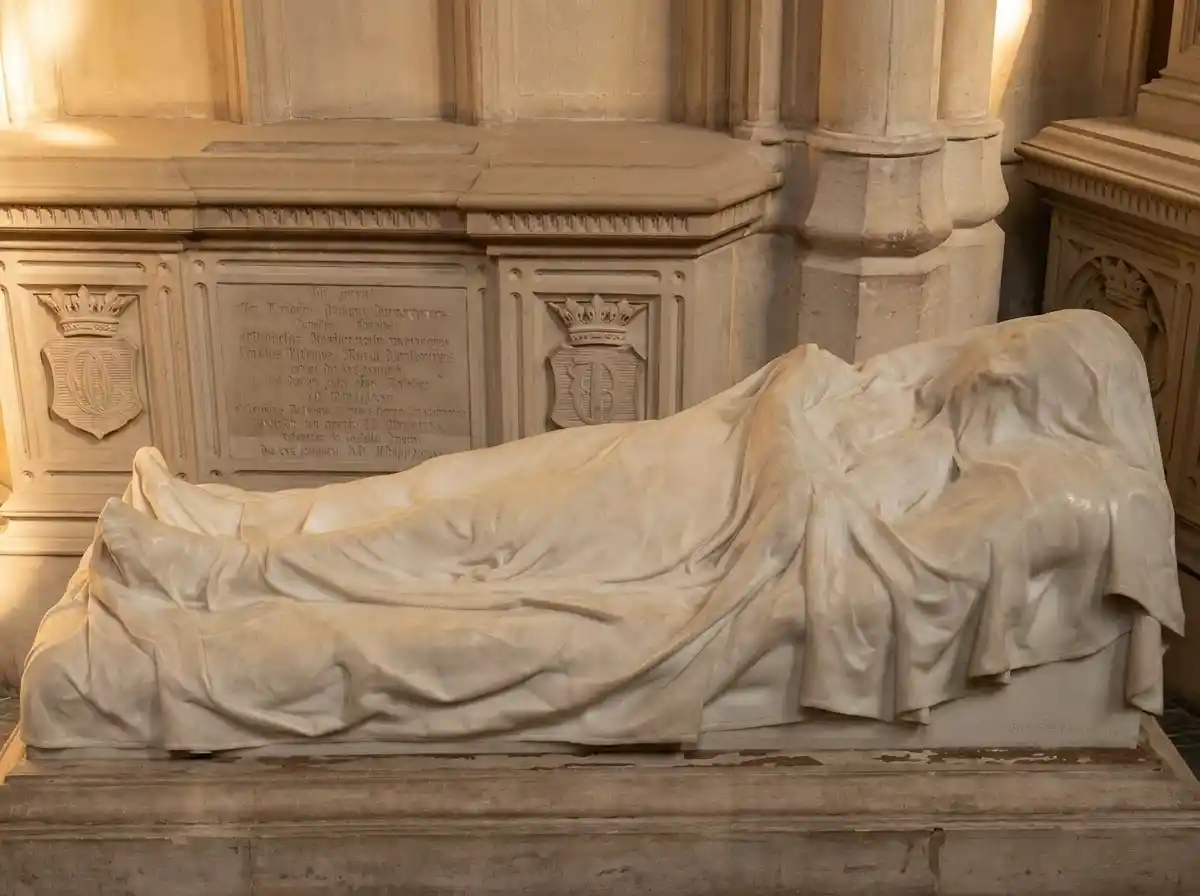
Because of this, when she died of tuberculosis in 1858, she could not be buried alongside her husband and had to be laid to rest in a separate chapel. But the sculptor Henri Chapu (1833-1891), who was responsible for her tomb, didn’t want to fully separate a couple who had loved each other so deeply in life. So when he carved her monument, he had her hand reach toward her husband’s tomb, a gesture meant to let her reunite with him even in death.

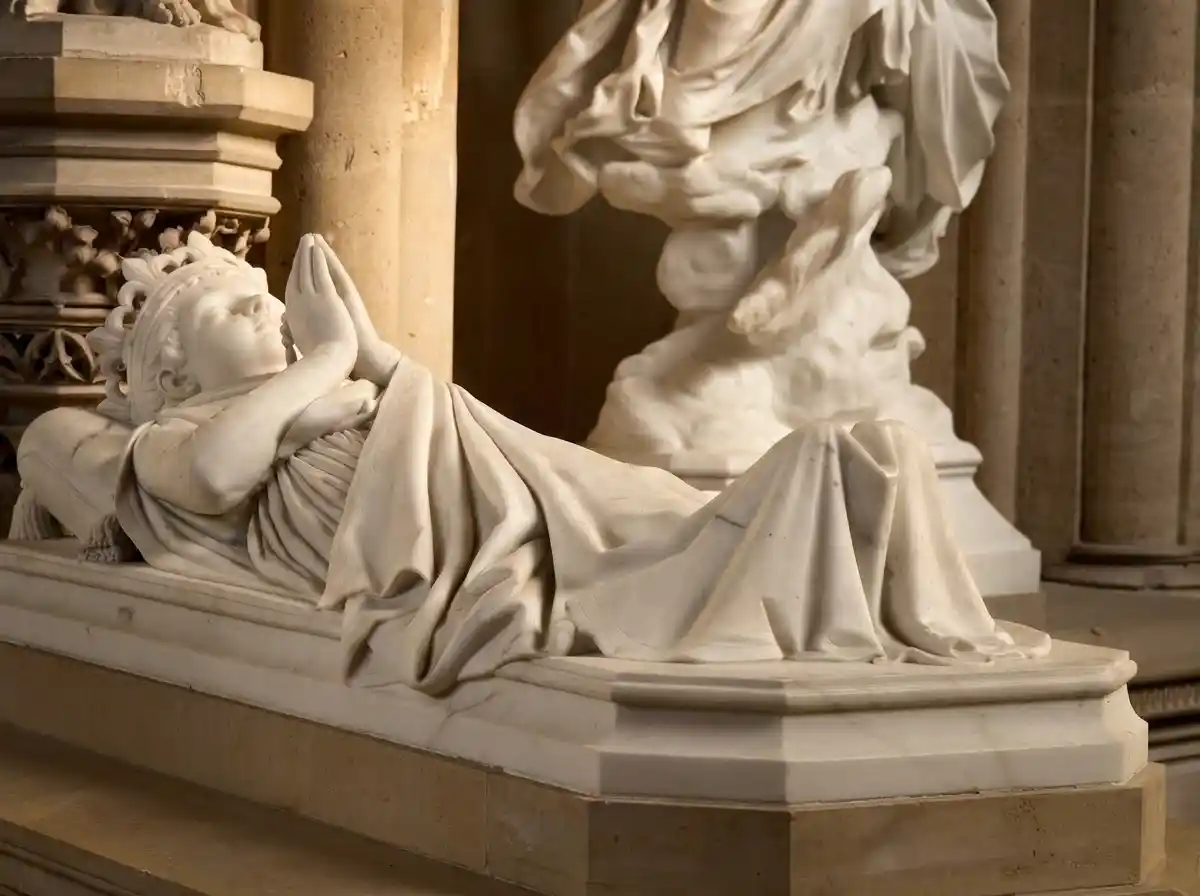
As you wander among the tombs, you’ll notice that even princes lost their young children more than once. Take little Prince Louis d’Orléans, for example, who died in 1874 at just seven years old. The sculptor Aimé Millet (1819-1891), who created several of the statues at the Paris Opera, decided to “wrap” the child in a kind of semi-transparent marble cloth, so visitors can still make out the little prince’s features, forever seven years old.
Heroism in the Flames, and Other Family Tragedies
One of the most chilling stories I discovered in the complex belongs to the Duchess Sophie-Charlotte of Bavaria (1847-1897). In May 1897, a massive fire broke out at a charity bazaar in Paris (the Bazar de la Charité). Despite the flames, the duchess refused to flee and insisted on staying behind to help the young women escape, declaring that “the duchess must leave last.” Her courage cost her life. The statue originally designed for her showed her writhing in the flames, but her family was so shaken by the realism that they replaced it with the peaceful statue that stands there today.
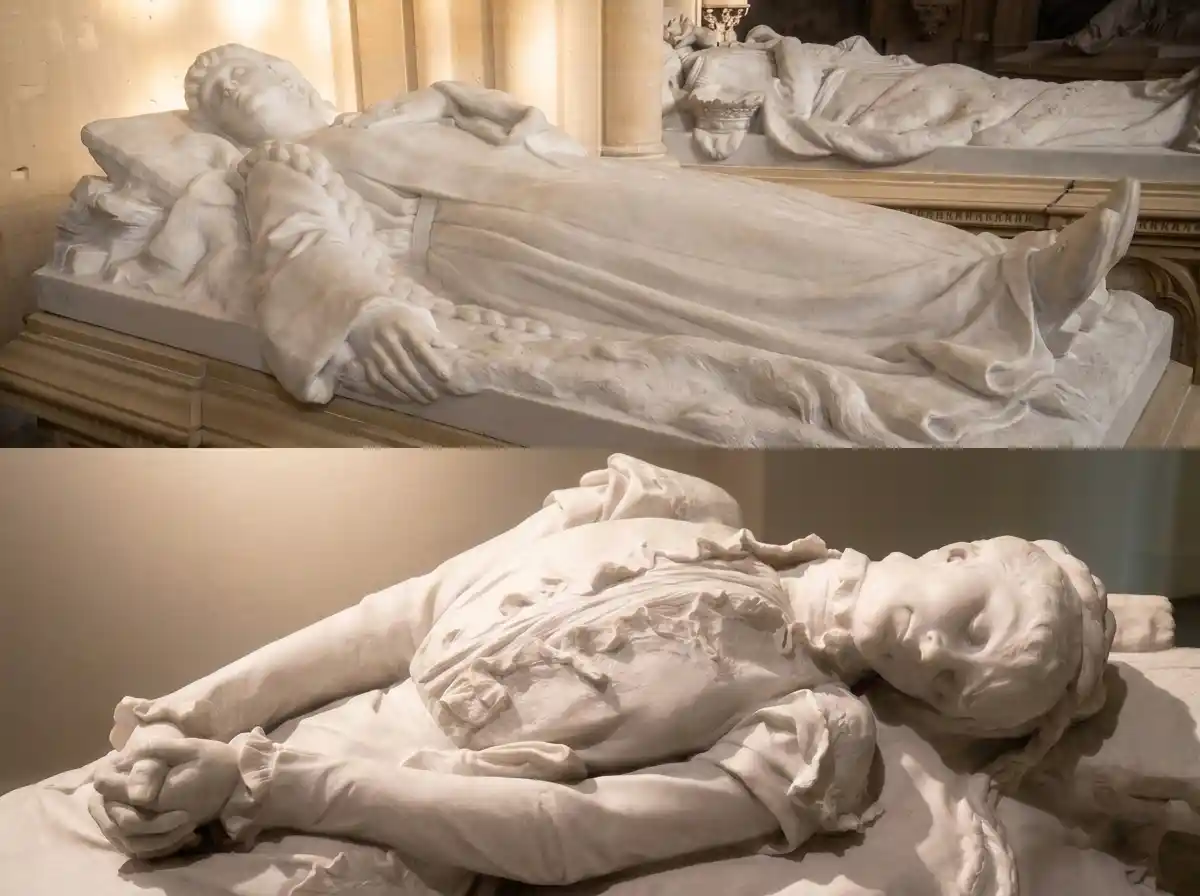
You’ll also come across Marie d’Orléans (1813-1839), a gifted Romantic sculptor who designed the angel on her own tomb, and Bathilde d’Orléans (1750-1822), mother of the Duc d’Enghien, who was executed on Napoleon’s orders (her tomb is adorned with a weeping angel). The Brazilian branch of the family is represented too, with Prince Antônio Gastão de Orléans e Bragança (1881-1918), who served as an officer in World War I only to die in a plane crash shortly after.
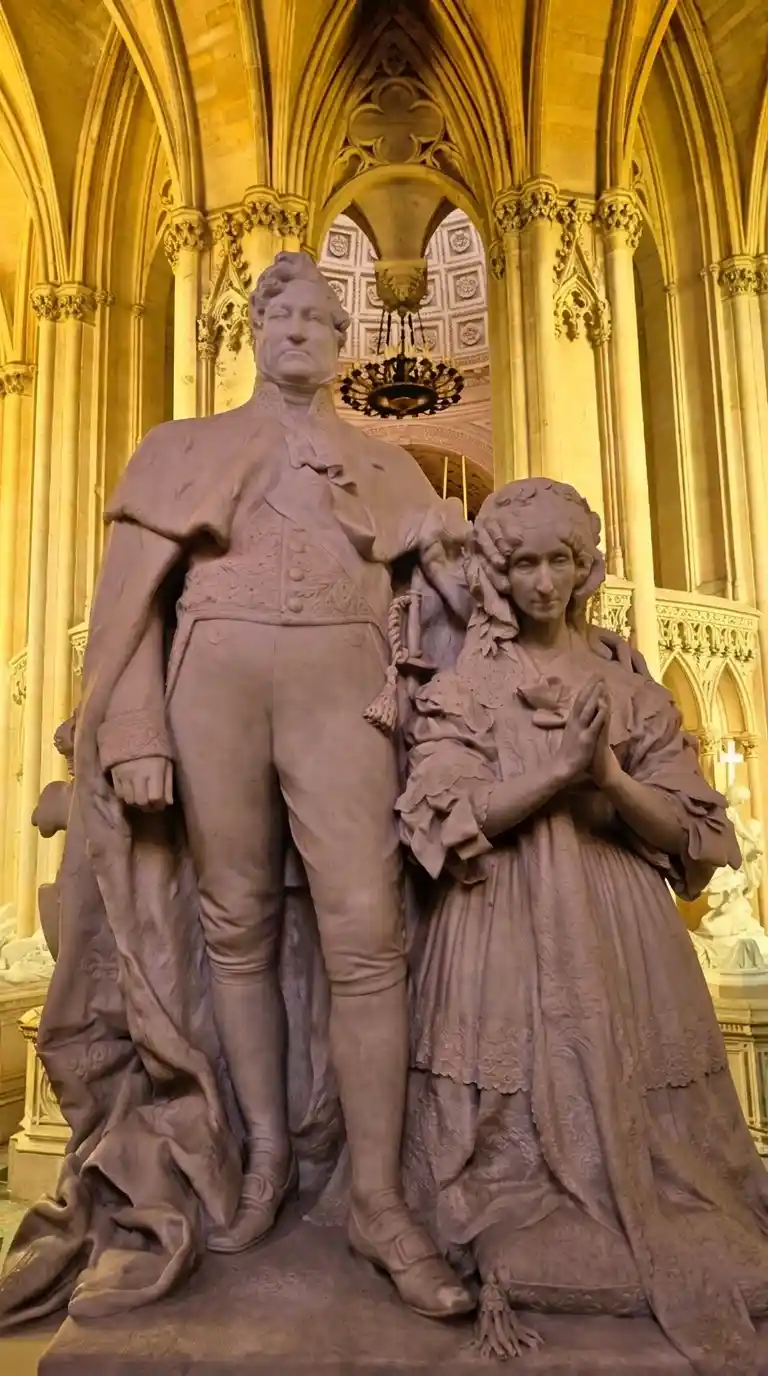
And finally, you reach the tomb of Louis-Philippe and his wife. This tomb is different from the others: here, the deceased king is sculpted standing, while his wife kneels in prayer beside him. The marble statue, unveiled in 1886, was considered so beautiful that it seemed a waste to leave it sitting on a grave, so it went on a kind of “tour,” reaching its peak when it was displayed at the 1889 Paris World’s Fair (the very fair for which the Eiffel Tower was built).
Architecture, Stained Glass and a Rare Organ
The chapel is not just a grand cemetery, it’s a work of art in its own right. The architect Pierre-Bernard Lefranc (1795-1856) drew inspiration from the legendary architect Eugène Viollet-le-Duc (1814-1879) to design the neo-Gothic space. But the real gem is the collection of stained-glass windows from the Sèvres porcelain works, which cast a deep blue glow known as “Sèvres blue.” Painters like Jean-Auguste-Dominique Ingres (1780-1867) and Eugène Delacroix (1798-1863) lent their talent to designing the windows, with the saints depicted in the glass bearing the faces of members of the royal family.
At the western end of the church, a massive pipe organ from 1845 awaits you, built by the famous organ maker Aristide Cavaillé-Coll (1811-1899), whose sound still echoes between the stone walls during concerts to this day.
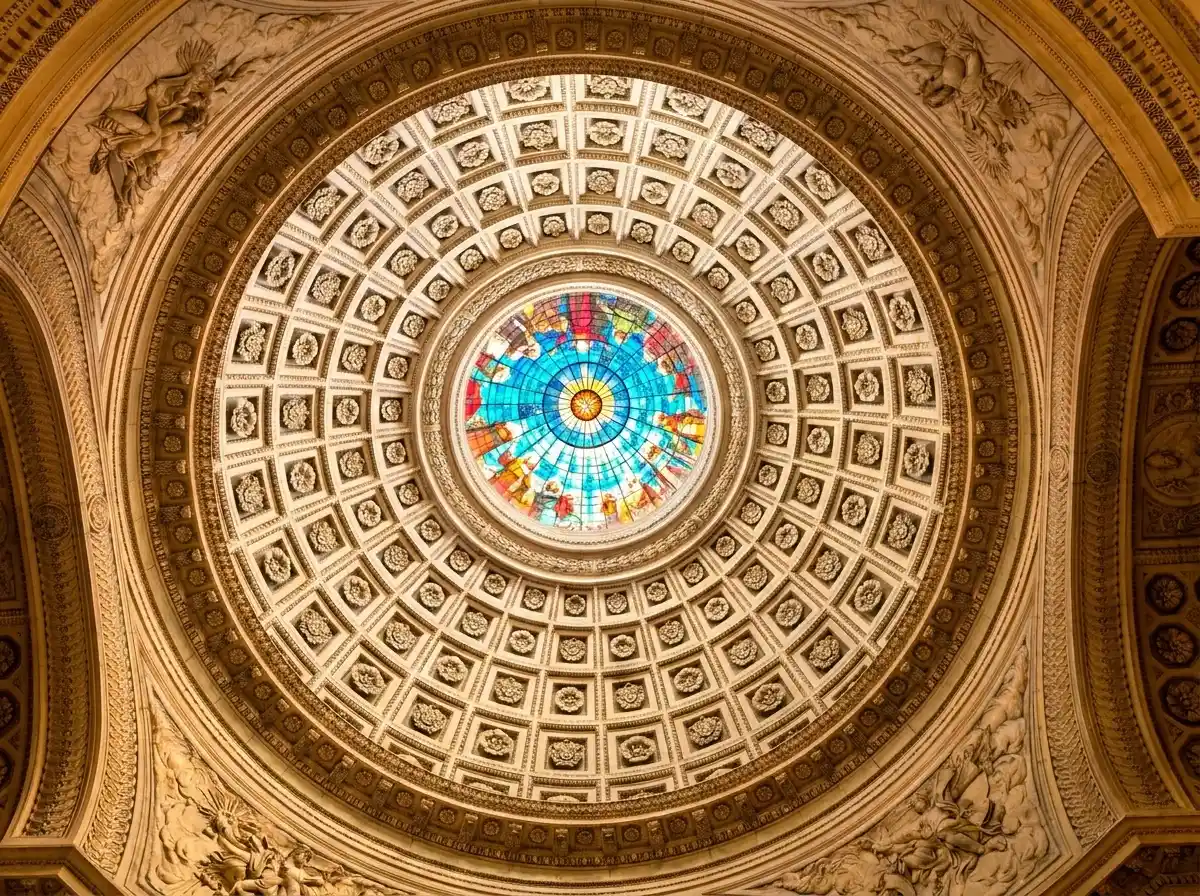
After you’ve finished looking at the tombs, head up to the church itself. This is actually the oldest part of the building, though ironically it’s built in a style newer than the rest (because of its neoclassical design, which is completely different from the neo-Gothic parts). Once you’ve admired the stained glass and the organ, look up, and you’ll see one of the most beautiful domes you’ve ever seen.
Practical Information for Visitors
If you’d like to see this marvel up close, keep in mind that the complex is closed during the winter months (January through March and December) and on Tuesdays. From April through September, it’s open continuously (between 9:30 a.m. and 5:30 p.m., usually with a midday break). In October, it’s mostly open on weekends. Admission costs about 9.20 euros per adult and includes an audio guide (children under 7 enter for free). Remember that flash photography is not allowed, to protect the artwork, and you’re not permitted to touch the marble statues.
Where to Stay in Dreux
On my last trip I stayed in Yael and her brother’s lovely apartment in Deauville, but staying in the Dreux area makes it easy to explore both eastern Normandy and the western part of Île-de-France. Here are a few recommended hotels in Dreux and the surrounding area, at a range of prices:
Domaine de Primard
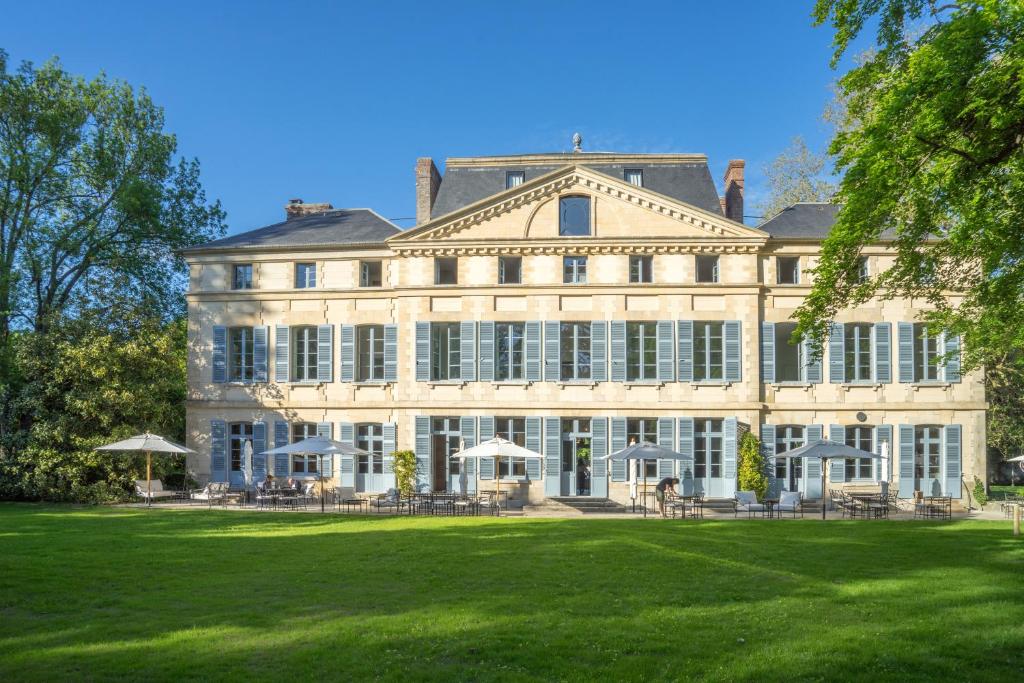
A luxurious estate a short distance from Dreux, offering a spa, gourmet restaurants and gorgeous gardens. Perfect if you’re looking for indulgence without compromise. More information and booking.
Hotel Le Beffroi

A comfortable, classic 3-star hotel located right in the heart of Dreux’s historic pedestrian street. Excellent value and a great location near the attractions. More information and booking.
The Originals City, Hôtel des Lys
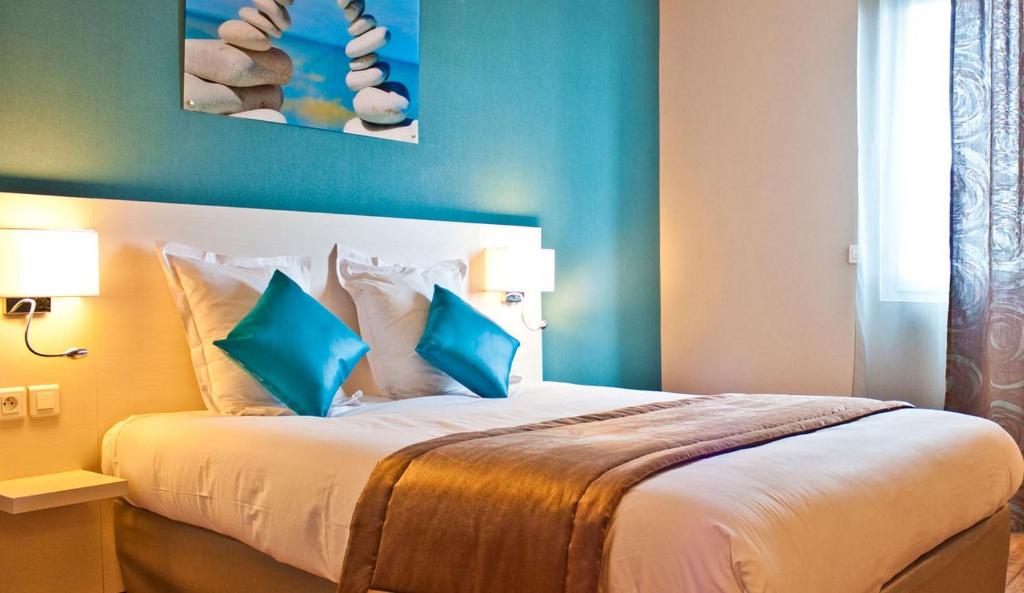
A great and very comfortable option in the center of Dreux, offering modern rooms and secure private parking. More information and booking.
B&B HOTEL Dreux Nord

A budget-friendly, functional hotel that’s great for travelers with a car looking for a clean, comfortable place to stay at an especially affordable price. More information and booking.
Wrapping up
The chapel in Dreux, where the members of the House of Orléans are buried, is in my opinion one of the most special places in France, and it was the highlight of the trip I took in early May 2016, and to which I returned in September 2025. But I’m well aware that it’s not for everyone, and quite a few people find that sort of morbid atmosphere off-putting. For everyone else, I highly recommend visiting this place and combining it with a visit to the town itself, where quite a few Renaissance and Baroque houses still stand. Since the town is also a short distance from the Château d’Anet, I’d also recommend fitting that into the same day trip.
Related reading