

Some cities are just a stop along the way, and some cities are a destination in themselves. Their story is so powerful, so full of passion, drama and twists, that it crosses oceans and continents, whispers your name and invites you to dive into its soul. In my opinion, Caen, the historic capital of Normandy, is one of those cities. Its story, which officially begins in 1025, isn’t just a timeline of events. It’s an astonishing human epic.
This is a city of enormous contrasts: a city born of sin and penance, that flourished under the rule of a ruthless duke and a proud queen, that became a center of free thought and defiance, and finally, a city that was burned almost to the ground and rose from the ashes like a mythological phoenix. Caen is the place where violent love gave birth to sublime architecture, the city from which Charlotte Corday set out on her mission to destroy the “poison machine” of revolutionary terror, and finally a city where the most complete destruction gave way to one of the most inspiring rebirths you’ll find anywhere.
So let me take you on a journey, not just through the sidewalks and buildings of today’s Caen, but into the stories pulsing beneath them. This is the story of a city that shaped Normandy, influenced England, and even today, a thousand years after its founding, still echoes with the stories of the heroes and villains, the saints and sinners, who made it what it is.
Guillaume and Mathilde: The Violent, Fiery Love Story That Built a Capital
Every great story needs a dramatic starting point, and the story of Caen begins with one of the most turbulent, violent and strange love stories in the history of the Middle Ages. This is the story of the man we know as “William the Conqueror,” though here I’ll call him by his French name, Guillaume (Guillaume le Conquérant, 1027-1087), and Mathilde (Mathilde de Flandre, 1031-1083), the couple who founded Caen not through cold strategic planning, but out of passion, sin and a desperate need for redemption.
“I would rather be a veiled nun than be given to a bastard!”
To understand the drama, you need to know the characters involved. On one side was Guillaume, the young Duke of Normandy. He was the illegitimate son of Duke Robert the Magnificent (Robert Ier de Normandie, c. 1010-1035), and so he carried throughout his life the insulting nickname “Guillaume the Bastard” (Guillaume le Bâtard). Guillaume was a tough warrior, a forceful man who grew up in a world of betrayals and schemes and had to fight for every inch of authority.
On the other side was Mathilde of Flanders. She was his complete opposite: a woman of noble birth, the daughter of the Count of Flanders and granddaughter of a king of France, with royal blood flowing in her veins straight from Charlemagne. She was proud, educated and beautiful. When Guillaume, “the Bastard,” asked for her hand, her response was sharp and humiliating. According to the chronicles, she declared: “I would rather be a veiled nun than be given to a bastard!”

Guillaume’s response was not sending flowers or writing love poems. Instead, he acted on the “Viking” instincts of his ancestors. He rode all the way to Bruges, where Mathilde lived, ambushed her outside her father’s palace, and when she came out, he grabbed her by the hair, dragged her across the ground, beat her and threw her into the mud before galloping off in a fury.
And here comes the astonishing twist in the plot. When the wounded and shaken Mathilde was brought back to her furious father, she did not cry or demand revenge. Instead, she looked at her father and declared that she would marry no man but Guillaume. His courage, audacity and determination had impressed her so much that she saw him as the only man worthy of her.
I don’t know what you make of this “courtship,” but to me it looks like the Norman version of a crash course in the art of seduction.
Either way, this was a violent beginning for what would become one of the strongest and most loyal relationships of the era.
Sin, Penance and Stone: The Birth of Two Great Abbeys
But even after Mathilde agreed, a major problem remained. Pope Leo IX (1002-1054) forbade the marriage. The official reason was consanguinity: Guillaume and Mathilde were distant cousins. For years, they lived under a cloud of sin, their marriage unrecognized by the Church.
Finally, a solution was found. To obtain the pope’s forgiveness and legitimize their union, the ducal couple agreed to perform a grand act of penance. They vowed to build, in Caen, the city that was beginning to develop as their capital, two enormous Benedictine abbeys, one for each of them.
And so, out of a story of forbidden love and violence, two of the most magnificent structures in Normandy were born. Guillaume founded the “Abbaye-aux-Hommes” (Men’s Abbey), dedicated to Saint Étienne, and Mathilde founded the “Abbaye-aux-Dames” (Women’s Abbey), dedicated to the Holy Trinity. At the same time, they built the mighty Château de Caen, one of the largest fortresses in Europe.
The construction of these three monumental structures turned Caen, almost overnight, from a small town into the political, religious and military capital of the duchy. Guillaume and Mathilde made Caen their seat, and when they died, each was buried in the abbey they had founded, sealing their legacy in stone and ensuring that their story would remain forever woven into the story of the city they created. But even death did not truly mark the end of the story for Guillaume.
An Unfitting End for a Great Conqueror: The Funeral That Ended in an Explosion
While Mathilde’s funeral passed without any particular incident, Guillaume’s own funeral, in September 1087, was a grotesque event that became legend. Guillaume, who in his later years had become a very heavy man, died in Rouen after being injured in battle. His body was brought for burial at the Saint-Étienne church in Caen, but that’s where the trouble began.
The coffin that had been prepared for him was too narrow and too short for his bloated body. Instead of preparing a new coffin, the gravediggers tried to force the body into the box. The pressure was too great, and during the funeral ceremony, to the horrified screams of those present, the Conqueror’s belly burst open. A terrible stench filled the church, and the dignified ceremony ended in haste and embarrassment, a humiliating and unforgettable end for one of the most powerful rulers of his time.
And if you thought that from that moment on Guillaume rested peacefully, I recommend you keep reading into the next chapter.
A City of Defiance: From Wars of Religion to Revolutionary Fire
The stubborn, rebellious character of its founders seems to have seeped into the very stones of the city. Throughout history, Caen has never been a submissive city. It became a vibrant intellectual center, earning the nickname “the Athens of Normandy” (l’Athènes normande), but also a focal point of intense ideological conflict, which reached its peak in two dramatic events that revealed the city’s defiant soul.
The Conqueror’s Grave: A Tale of Desecration and the One Bone That Survived
In the 16th century, the winds of the Protestant Reformation blew powerfully across France, and Caen, with its prestigious university, became one of the most important Protestant strongholds. Tension between Catholics and Protestants (Huguenots) grew steadily, until it erupted into severe violence during the Wars of Religion.
In 1562, Protestant forces took control of the city. In a wave of religious, iconoclastic zeal, they went on a campaign of destruction against the symbols of the Catholic Church. One of their main targets was the Men’s Abbey (Abbaye-aux-Hommes), the place where the magnificent tomb of the city’s founder, William the Conqueror, lay.

The furious crowd broke into the church, smashed the magnificent tombstone, opened the grave and desecrated the remains of the legendary king-duke. His bones were scattered through the streets of the city in rage. It was a massive symbolic act, not just an attack on Catholicism, but an erasure of the symbol of the old order, of the feudal system that Guillaume represented.
But amid the chaos, a small miracle occurred. According to tradition, a brave monk or official managed, at the last moment, to snatch one bone from among the scattered remains: Guillaume’s left thighbone. He hid it until the storm passed. Remarkably, this is the only bone that survived from the great Conqueror, and it was returned to the restored tomb years later. Mathilde’s tomb, incidentally, escaped a similar fate and remained almost entirely intact.
Charlotte Corday: The Murderous Angel Who Came from Caen
Two hundred years later, the spirit of defiance in Caen took on a new form, this time in the shape of a young, determined and lethal woman. Her name was Marie-Anne Charlotte de Corday d’Armont (1768-1793), and she would enter history as “the Murderous Angel.”
Charlotte, the daughter of an impoverished noble family and a descendant of the great playwright Pierre Corneille (1606-1684), was educated at the Women’s Abbey (Abbaye-aux-Dames) in Caen. When the French Revolution broke out, she embraced its principles with enthusiasm. But when the revolution degenerated into the Reign of Terror under the radical Jacobins in Paris, Caen became a refuge for their moderate rivals, the Girondins.

Young Charlotte, who lived in Caen, met the exiled Girondin leaders, listened to their passionate speeches, and became convinced that the Revolution had been hijacked by bloodthirsty tyrants. In her eyes, the main culprit was Jean-Paul Marat (1743-1793), a kind of one-man poison machine, a radical journalist and politician who relentlessly called for mass executions in the pages of his newspaper “The Friend of the People.”
With cold determination, she decided to take matters into her own hands. On July 9, 1793, she boarded a stagecoach from Caen to Paris. At a shop in the Palais-Royal she bought a sharp knife, and under the false pretext that she carried information about conspirators in Caen, she managed to secure an interview with Marat, who suffered from a severe skin condition and conducted his business from a therapeutic bath.
While Marat was writing down the names of the “traitors” she was dictating to him, Charlotte drew the knife and plunged it deep into his chest. He managed to cry out, “Help me, my dear friend!” and died. She was arrested immediately, and at her swift trial she declared the famous line: “I killed one man to save a hundred thousand.”
She was executed by guillotine four days later. And here’s one last juicy detail: when the executioner held up her severed head to the crowd, his assistant, a carpenter named Legros, slapped it across the face. Witnesses reported that the crowd was stunned to see Charlotte’s cheeks flush with what looked like anger, as if she were still alive. The Jacobins, in a desperate attempt to turn the political assassination into a crime of passion, even ordered a postmortem examination to check whether she was a virgin. She was.
The Phoenix of Normandy: Caen’s Suffering and Rebirth
The last and most painful chapter in Caen’s history is also the most inspiring. It’s the story of a city that became a victim of the very strategic importance that had once brought it glory, a city nearly wiped off the map, only to be reborn more beautiful and stronger than ever.
Summer 1944: The Battle for Caen and the Destruction of the Old City
On June 6, 1944, the day of the Normandy landings, Caen was a key strategic target for the Allies. Its position as a vital crossroads, along with the open plain to its south, ideal for building airfields, made capturing it essential. The original plan was to take the city on the very first evening of the invasion.
But reality turned out very differently. The German army, especially its elite panzer divisions, defended the city with fierce determination. What was supposed to be a quick operation turned into a brutal war of attrition that dragged on for almost two months, from June to August 1944.
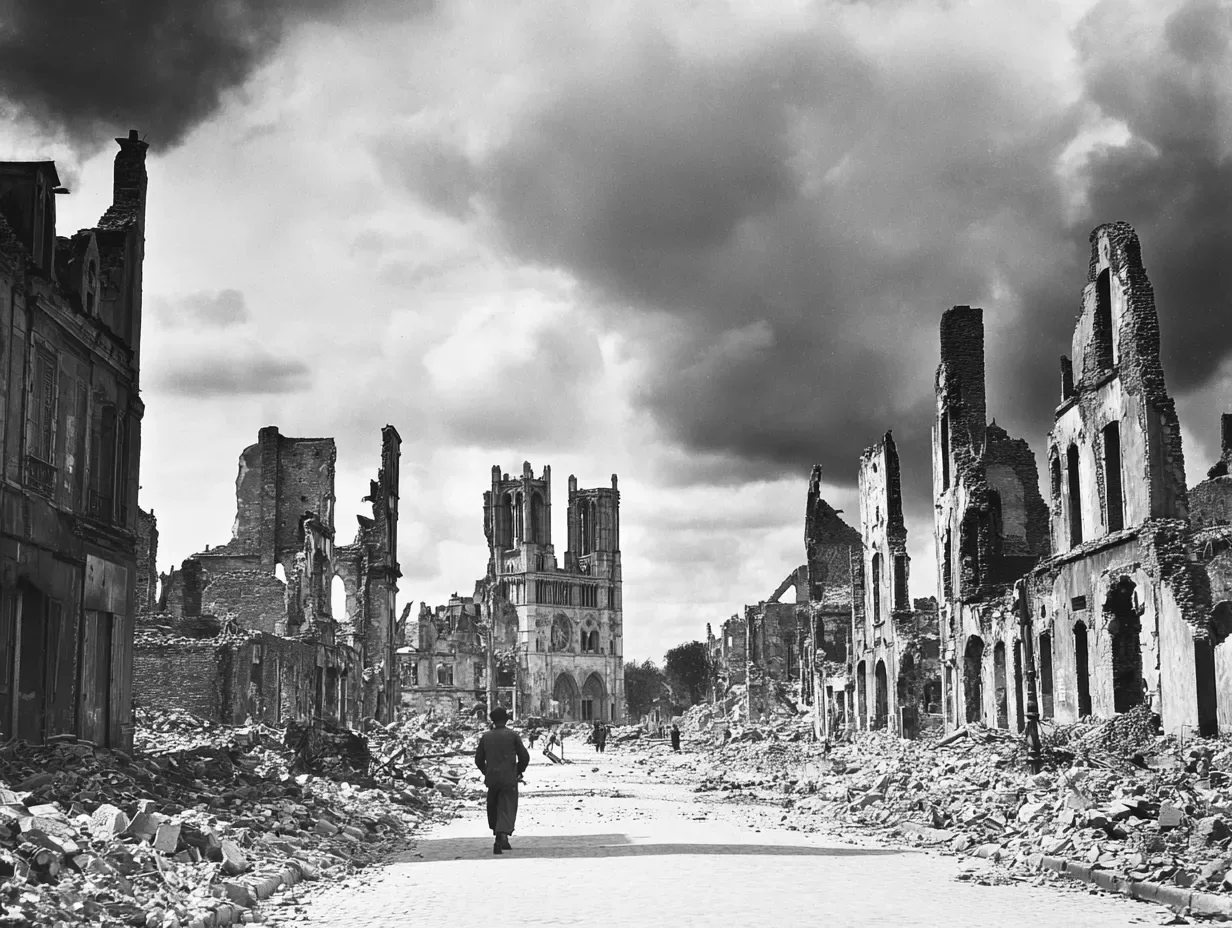
For Caen and its residents, this was an apocalypse. The city endured heavy aerial bombardment and relentless artillery fire. Operations like Charnwood and Goodwood reduced entire sections of the city to rubble. When the dust settled, the picture was almost unbearable: about 70 percent of the city was destroyed, the historic center was wiped out, and thousands of civilians were killed. Of 60,000 residents, only about 17,000 remained.
In a chilling twist of history, the buildings that suffered the least damage were the very ones that had defined Caen’s glory in the Middle Ages: the massive stone castle and the two abbeys founded by Guillaume and Mathilde. Their thick walls, built to withstand sieges of arrows and swords, now sheltered thousands of civilians from 20th-century bombs.
Building on the Ruins: A Vision for a Modern City That Honors Its Past
The task facing Caen after liberation was almost unimaginable: rebuild a city on top of its own ruins. But instead of giving in to despair or settling for generic construction, the city’s leaders and the chief architect of the reconstruction, Marc Brillaud de Laujardière (1889-1973), chose a different path, one of respect for the past and vision for the future.
They rejected the idea of pastiche, a fake imitation of the old city, but they also resisted extreme modernism that would have cut the city off from its roots. The vision was to create a new city, bright and spacious, that would serve as a dignified stage for the historic treasures that had survived.
The huge amount of rubble (more than two million cubic meters) was used to raise the low-lying areas of the city, which had always suffered from flooding: a modern solution to an old problem. The new streets were designed to create stunning perspectives toward the castle and the churches. And most importantly, many of the new buildings were built from local limestone, the famous Pierre de Caen (Caen stone), the very same stone used to build the abbeys and the castle 900 years earlier, creating a material and spiritual continuity between old and new.
The crowning achievement of the reconstruction was the rebuilding of the Université de Caen, this time as a grand modern campus at the foot of the castle. Its inauguration in 1957 symbolized, more than anything, Caen’s return to life, not just as a city of stone, but as a city of spirit, knowledge, and hope. The phoenix of Normandy had spread its wings and taken flight once more.
Uncovering Caen’s Secrets at Your Own Pace
Caen’s story is one you need to take in slowly. You really can’t grasp the depth of its drama in a quick visit. To feel the echo of Guillaume the Conqueror’s footsteps in the halls of the Abbaye-aux-Hommes, to picture Charlotte Corday’s determined stride through the streets of the old city, or to stand in awe before the city’s miraculous revival, you need to give it time.
Wander the narrow medieval streets of the Vaugueux neighborhood, sit at one of its cafés, and let the history sink in. Get lost along the picturesque Rue Froide, with its artist studios and bookshops.
To make Caen your base for discovering its amazing story and the nearby D-Day beaches, I recommend finding yourself a charming hotel or a cozy apartment. Staying for a few days will let you experience the city not as a tourist site, but as a living, breathing place where every stone tells a story.
And if you’d like to turn all this history into a hands-on walk through the streets, I’ve put together a detailed walking route through Caen just for you, guiding you step by step to every site I’ve mentioned here.
You can browse a wide range of accommodation options in Caen right here.
Related reading