

The Loire Valley (Val de Loire) is without a doubt one of my favorite places in France (after Paris, of course). And honestly, that’s no surprise, because this is where my great love of French history and culture began, back when I was nine years old and asked what Francis I (r. 1515-1547) had died of (if you want to find out the answer to the question that started it all, read my article A Contagious Love).
Since then I’ve gone back to the Loire Valley more times than I can count, visiting both the most famous châteaux and some lesser-known ones. After getting quite a few requests from people planning a trip to the Loire Valley, I decided to gather all the châteaux I recommend into one article, and even put together a multi-day itinerary to help you explore them at a relaxed pace. I’ve also added a few other attractions that aren’t exactly palaces, but if you’re already in the Loire Valley, they’re well worth a visit.
A short history of the Loire Valley, and why it has so many châteaux
The Loire Valley lies southwest of Paris and stretches along the Loire River, the longest river in France. The first towns in the valley (Orléans, Tours and Angers) were built back in Roman times, while the châteaux started going up during the Middle Ages.
At first these châteaux served a purely defensive purpose. Nobles such as the counts of Blois or the Plantagenet family, who lived in the area, used them to control their lands and collect taxes from the peasants. One example of this kind of château that has survived completely intact to this day is the Château d’Angers, which I’ll cover in the next chapters.
From the 15th century through the end of the 16th century, the Loire Valley became one of the most important political centers in France. It started when King Charles VII lost Paris early in his reign, and most of the land left to him was in the Loire Valley. As a result, even after he managed to drive the English out of most of France, the king continued to live in the Loire Valley for much of his reign. The king and his mistress Agnès Sorel especially loved the Château de Loches, the first château built purely for pleasure rather than military purposes.
Louis XI continued his father’s tradition and made the city of Tours the center of his rule. As a result, a good number of nobles began building their own châteaux close to the city, to stay near the king. His son Charles VIII invaded Italy in 1494 and brought the Italian Renaissance back with him. As a result, under his successors Louis XII (r. 1498-1515) and Francis I (r. 1515-1547), the fortified châteaux began turning into lavish palaces. The Italian influence of artists such as Leonardo da Vinci (1452-1519) led to the creation of some of the grandest palaces in the Loire Valley, including Chambord, Azay-le-Rideau and Chenonceau.
At the end of the 16th century, when King Henri IV returned to Paris after the French civil wars ended, the Loire Valley began losing its political importance. And yet, it was precisely in the 17th century that some of its most beautiful châteaux were built, including the Château de Cheverny and the wing built by Gaston d’Orléans at the Château de Blois.
But all of this was the Loire Valley’s swan song. Louis XIV did not have a particular fondness for the Loire Valley and preferred to build Versailles and Marly in Île-de-France. As a result, the French nobility largely stopped building and living in the Loire Valley. This turned the valley into a sleepy place, which was jolted awake only twice. The first time was during the French Revolution, which caused considerable damage to many of the palaces. The second time, the Loire Valley briefly returned to the spotlight when Napoleon deposed the Spanish king Charles IV and his son and imprisoned them in Talleyrand’s Château de Valençay.
But after Napoleon’s rule, the valley went back to sleep. As a result, most of the Loire Valley never became heavily industrialized, and its châteaux, together with the surrounding countryside, were preserved in all their charm. The railway lines laid down during the 19th century brought tourists to these châteaux for the first time, and turned the valley into one of the top tourist destinations in France.
Now that we’ve covered the history, there’s nothing left to do but start planning your trip.
Map of the Loire Valley: the châteaux, the palaces, the attractions and a few recommended restaurants
Before we start, I thought it would be a great idea to share a Google map I made, which includes a huge number of the châteaux you can find in this valley. Using the map, you can easily see where each château is located, and plan your trip accordingly.
Legend:
Châteaux are marked with a star
Restaurants are marked with a knife and fork
Over the coming months I’ll try to keep updating this map and add more restaurants and attractions, so it’s always worth coming back to the article to check what’s changed.
As you can see, the Loire Valley is paved with châteaux (there are around 300 of them today, and not all of them appear on the map). There’s obviously no way you can visit them all, so if this is your first time in the valley, you’ll want to focus on the most famous ones. If you’ve already visited the Loire Valley before, I’ve allowed myself to add a list of a few lesser known châteaux that I particularly love.
So, let’s get started:
Must-see châteaux you can’t skip
These are the most important and most visited châteaux in the Loire Valley. If this is your first time there, I recommend visiting at least three or four of them (depending on how much time you have).
Chambord
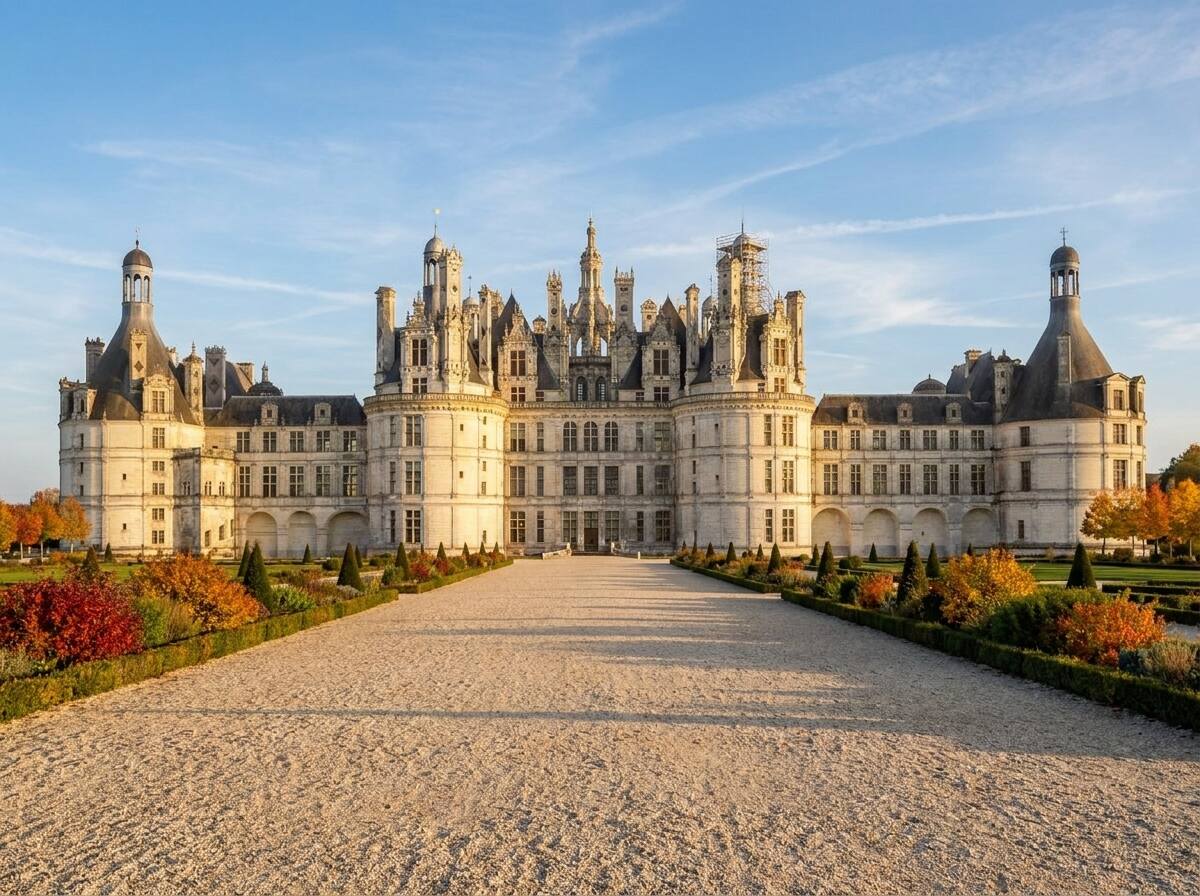
This is the largest château in the Loire Valley, and quite possibly the most famous one too (though here it has some stiff competition from the Château de Chenonceau). The château was built under Francis I, and some claim that Leonardo da Vinci (1452-1519) himself was behind its design (others attribute it to Domenico da Cortona).
As you could probably tell from the video, this is a seriously impressive château. Once inside, you’ll find dozens upon dozens of rooms and especially grand, wide staircases. And of course, if you climb all the way up, you’ll be rewarded with a stunning view of the Loire Valley.
Important: since this is one of the most popular châteaux in the Loire Valley, I highly recommend buying your tickets in advance so you don’t have to stand in the long ticket lines (especially in summer).
Buy an admission ticket for Chambord
More information about the Château de Chambord
Château de Chenonceau

This is, without a doubt, my favorite château in the Loire Valley, and if you only had time to visit one château, this is the one I’d recommend without hesitation. This charming château was built during the 16th century, and later had a wing added that doubled as a bridge over the Cher River.
The château was once home to two of the most famous mistresses in French history: Diane de Poitiers (1500-1566), mistress of King Henri II (r. 1547-1559), and Gabrielle d’Estrées, mistress of Henri IV (r. 1589-1610). Two queens of France also lived in this charming château: Catherine de’ Medici (1519-1589) and Louise de Lorraine, who painted one of the rooms black upon learning of the murder of her husband Henri III (r. 1574-1589). She never left that room until the day she died.
As you’ve probably gathered, I highly recommend visiting this château, both for its history and for its treasures. You’ll find fascinating stories here (so a guided tour is well worth it), as well as a small wax museum, and even a vineyard that sells its own wine. In short: this is a must-see château.
As I mentioned about the Château de Chambord, since this is a very popular château, I highly recommend buying tickets in advance to save yourself the wait in line.
Buy tickets for the Château de Chenonceau
Azay-le-Rideau

If you loved the idea of a château standing as a bridge over a river, you’re sure to love the idea of a château standing beside a lovely lake. This charming château was built by Francis I, and unlike the enormous Chambord, this one is a small château on a human scale.
After watching the video, you’ll understand why it’s no surprise that this is one of the most popular châteaux in the Loire Valley, with around 300,000 visitors a year. So, as with the other popular châteaux in this chapter, I highly recommend buying your tickets in advance.
Buy tickets for the Château d’Azay-le-Rideau
Château de Blois

The Château de Blois is my second favorite château in the Loire Valley (right after Chenonceau). The main reason is the historical richness you’ll find there.
Many of the Loire Valley’s châteaux were built slowly over hundreds of years, so you can find wings from different periods. But no other château shows this as clearly as the Château de Blois. You’ll find the Louis XII wing, the Francis I wing, and the Gaston d’Orléans wing, each built in a completely different style.
Add to that a juicy piece of history that ends in murder (of the Duke of Guise, which I wrote about before in my article on the Hôtel de Soubise in Paris), and you get one of the most fascinating châteaux in the Loire Valley. And if you happen to visit during the summer, don’t miss the sound and light show held there every evening.
Buy tickets for the Château de Blois
Château d’Amboise

Another château I love is the Château d’Amboise. I love it for exactly the same reason I love the Château de Blois: history, history and more history. Several kings lived here during the 15th and 16th centuries, and the château saw uprisings and even the rather absurd death of one king. I mean, of course, Charles VIII (r. 1483-1498), who was running to a tennis match in the courtyard and on the way hit his head on a low doorframe and died.
So yes, Amboise is without a doubt one of the châteaux well worth visiting during your Loire Valley trip. You’ll find not just lavish rooms there, but also the chapel where Leonardo da Vinci (1452-1519) is buried. And if you make it there, you get two palaces for the price of one, since the house of the brilliant artist, also open to the public, is not far away at all.
Buy tickets for the Château d’Amboise
Clos Lucé

This is the residence King Francis I gave to Leonardo da Vinci (1452-1519), where he lived out the last years of his life. It’s very close to the Château d’Amboise, and there’s even an underground passage leading from the château to da Vinci’s house. The passage was built so the king could visit the great artist whenever he wished.
Here you’ll find sketches by Leonardo da Vinci, models of his inventions (including his famous tank), and of course one of the rooms where he lived and worked. There’s no doubt this is a must for da Vinci lovers, but also for parents traveling through the Loire Valley with their kids.
Buy tickets for Clos Lucé
Château de Villandry

If up to now the focus has been on the châteaux themselves and what happens within their walls, at Villandry what’s really interesting is outside the château. I mean, of course, the stunning French-style gardens planted around it.
What’s interesting is that the gardens, which are the main attraction here, were actually planted in the early 20th century and have no connection to the château’s own history. Even so, these are stunning gardens, as you can see in the video above, and they’re definitely worth a visit (especially if you’ve already seen one château that day and are looking for something different, so you’re not seeing more of the same thing).
Buy tickets for the Château de Villandry and its gardens
Château d’Angers (Angers)

If every château I’ve recommended so far has been a Renaissance château, then for this one I can use Monty Python’s immortal line: And now for something completely different. This is a medieval château that has survived almost completely intact, and it gives you a chance to see what a fortified castle from that era actually looked like.
But beyond the impressive towers and fortifications, the Château d’Angers holds another major attraction: a massive tapestry on display there that tells the story of the Apocalypse.
So if you want to experience something dark and medieval, I highly recommend not skipping this château (especially if you’re already in the area).
Buying tickets for the Château d’Angers
Châteaux for advanced travelers
If you’ve already visited the Loire Valley before and seen all the “must-see châteaux” (or most of them), let me recommend a few lesser-known châteaux that I personally love.
Château de Cheverny (Cheverny)

Honestly, this château almost made it onto my “must-see” list, but at the last minute I decided to leave it off because that list was already getting too long. Still, I personally recommend it highly, for beginners and advanced travelers alike.
The first reason is simply the beauty of the château. Unlike a lot of the châteaux along the Loire that mix medieval, Renaissance and Baroque elements, Cheverny was built entirely in the 17th century, and it’s one of the finest examples of French Baroque architecture.
And if you or your kids love the comic book series “Tintin,” you’ll be happy to hear that this château served as the model for the home of Captain Haddock, one of its main characters. The château also offers visitors a kind of show where they feed the hunting dogs. Some of you will love it, others might find it a bit of a vulgar display, but it’s definitely an interesting experience.
Information about Château de Cheverny and its activities
Château d’Ussé (Château d’Ussé)

This is a small, relatively little-known château built in the 15th century, with gardens added in the 17th century by the famous landscape architect André Le Nôtre (1613-1700).
Beyond being a beautiful, charming château, it’s especially well suited for families doing the Loire Valley with kids, thanks to its connection to the story of Sleeping Beauty. You can read more about it in the article Ussé: the château of Sleeping Beauty.
Information about Château d’Ussé and its activities
Château de Valençay (Valençay)

Château de Valençay became famous after it was purchased by Talleyrand, who was Napoleon’s foreign minister at the time. It later served as a (rather delightful) prison for Spain’s deposed king and his son.
This is a charming château with a beautiful garden, plenty of treasures and interesting history, exactly what you’d expect from a French château. But in my opinion, its real significance comes from the fact that it’s where the famous French chef Antonin Carême (1784-1833) lived and worked. He’s responsible for quite a few of French cuisine’s most famous dishes.
So if you love the culinary history of France and you’re looking for a lovely château that’s a bit less touristy, this is definitely the château for you.
Buying tickets and information about Château de Valençay
Château de Brissac (Brissac)

All the châteaux I’ve written about so far became museums long ago, owned by the state or by a town. But there are a few châteaux whose owners still actually live in them, and to me, those châteaux have a special charm.
Brissac is one of those châteaux, and it’s one of the ones that impressed me most in the Loire Valley. Not just because it’s one of the tallest châteaux in France (7 stories), but because of the story of the family it belonged to.
You can read more about the château in the article Château de Brissac: meeting the Duke while strolling through the palace garden.
Information about Château de Brissac
Fontevraud Abbey (Fontevraud)

True, this isn’t a château, but a stunning abbey with an incredibly rich history, which is exactly why it’s well worth a visit. Several of England’s most famous kings are buried here, including Richard the Lionheart. Later, the place went from an abbey to a prison, where, among others, the playwright Jean Cocteau (1889-1963) was held.
I highly recommend visiting this abbey if you find yourself in the western part of the Loire Valley, and if you’d like more details about my own experience there, feel free to read the article Fontevraud: the abbey of England’s kings that became a French prison.
Information about Fontevraud Abbey
The Loire Valley with kids
True, the main appeal of the Loire Valley is its châteaux. But if you’re planning to explore the Loire Valley with kids, you’ll need to mix in a few other attractions, or you’ll end up with a revolt on your hands (your own little version of the French Revolution).
Luckily, there are a few attractions kids will love, and if you work them into your trip the right way, there’s a good chance they’ll let you enjoy the châteaux and the other things that interest kids a bit less.
Futuroscope (Futuroscope)
I decided to start right away with the attraction furthest from châteaux or history. This is a theme park built around multimedia, with 3D films and even 4D films (God knows what that means). About 2 million people visit every year, and it has attractions you won’t find at any other theme park, as you’ll see in this video.
After watching the video, you’ll understand that while all the tourists are rushing off to Disneyland Paris, Futuroscope is the French people’s best-kept secret. I promise your kids will have a blast there, and you’re in for a pretty special experience too.
Since this is a wildly popular park, I highly recommend buying tickets in advance.
Tickets for Futuroscope
Puy du Fou (Puy De Fou)
Now let’s move on to a theme park that connects a lot better with the Loire Valley and its châteaux. Worth noting: this park isn’t actually in the Loire Valley itself but south of the city of Nantes. Since Nantes is close to the western edge of the Loire Valley, the distance isn’t great, and the park’s character makes it a wonderful addition to your château experience.
So what’s this park all about? In two words: French history. You’ll find a series of areas here, each dedicated to a different historical period (Viking invasions, the Middle Ages, the era of the Three Musketeers, the French Revolution and more). Each area is packed with attractions you can experience while learning about the history of France along the way. In short, it’s an especially fun experience for parents and kids alike. Don’t believe me? Watch the short video below and I’m sure you’ll be convinced 🙂
On top of all that, in the evening there are incredibly impressive shows at the park, featuring dozens of actors in period costumes. So I recommend setting aside at least two days for the park and making sure to buy your tickets as early as possible, since tickets for the shows are limited and sell out fast.
Tickets for Puy du Fou
Where to stay at Puy du Fou or nearby
You can find hotels at the park itself or nearby at this link.
ZooParc de Beauval
This is one of the largest zoos in France, and also one of the most beloved. You’ll find more than ten thousand animals here, living in a relatively open environment. On top of that, you can enjoy a long list of shows, like a birds of prey show, that will definitely impress your kids.
You can get a taste of what this zoo has to offer in the video below:
This zoo is located southeast of the Chenonceau and Chambord châteaux, so it’s worth considering a visit while you’re on your way there. On top of that, as you can see in the video, you can actually stay in several indulgent hotels right on the zoo grounds (not a bad option for a multi-stop trip).
Buying tickets for ZooParc de Beauval
As with any popular site, it’s worth buying tickets in advance here too, so you don’t waste time in line at the box office. You can find tickets at the following link:
Where to stay at ZooParc de Beauval
As I mentioned, the place offers visitors several pretty decent places to stay, which let you enjoy a relaxed visit to the zoo. If you’d like to stay there or nearby, feel free to click this link.
A Loire Valley itinerary
Now that I’ve told you about the Loire Valley’s main châteaux and attractions, it’s time to give you an itinerary that connects all these points. For this itinerary, I’m working from a few assumptions:
- You don’t need organized tours in the Loire Valley. If you want a guided tour of a day or more, feel free to check out the article A day outside Paris for a few recommendations.
- You’re going to rent a car (otherwise getting from château to château in the Loire Valley will be a nightmare, since public transportation isn’t very developed there). If you’re looking for good sites for renting a car, I recommend reading the article Renting a car in France.
- My third assumption is that you’re setting out from Paris and returning to it.
As you’ll see, this itinerary runs a bit more than a week. I’m fully aware that not everyone has time to spend a week in the Loire Valley, and I also know not everyone is starting and ending their trip in Paris. So I highly recommend treating this itinerary as a kind of modular route: take what works for you, and know that there’s no obligation to do all of it.
So, with that introduction out of the way, let’s get started!
Day 1: Leaving Paris and arriving in the Loire Valley
I like to pick up the car in the southern or southwestern suburbs of Paris to avoid driving through the city (not a particularly fun experience). Once you have the car, let me suggest not driving straight to the Loire Valley, but dedicating the first day to the road itself and stopping at a few charming spots along the way. Here are a few ideas:
- the Abbaye du Vaux de Cernay, an old abbey turned boutique hotel. It’s great fun to explore the grounds, and you can get an excellent lunch there.
- The town of Chartres, home to one of the most magnificent cathedrals in France.
- The town of Dreux, home to the grand royal chapel where the House of Orléans is buried. This is one of the most unique places I’ve visited, and it left a strong impression on me.
- Château d’Anet, if you believe a day without a château is a day wasted, I invite you to visit the château of Diane de Poitiers (1500-1566). We’ll hear plenty about Henri II’s mistress when we visit Château de Chenonceau, but this château has plenty of charm of its own, and it makes a great “warm-up château” before the big ones of the Loire Valley.
By the end of that day, you should arrive at the hotel or apartment from which you’ll take day trips around the eastern part of the Loire Valley. To really get to know this area without spending too much time in the car, I highly recommend staying in Blois (in the link I gave you, you’ll find plenty of recommended hotels and apartments for every budget).
Day 2: The châteaux of Blois and Valençay
If you took my advice and decided to stay around Blois, I’d start the day at the Château de Blois and visit its various wings. After that, I’d consider having lunch in town itself and then driving south toward Valençay.
This château is completely different from Château de Blois, both in its architecture and its history, so visiting it won’t feel like “more of the same.” The focus here is the culinary story of Carême and the art that fills the château, mostly from the 18th and 19th centuries. For history lovers, I’d recommend taking the opportunity to visit the small chapel where Talleyrand is buried.
At the end of the day, drive back to Blois and return to the château to enjoy the spectacular sound and light show, which will help put a lot of history in order for you and make sense of what you saw earlier in the day. Since the show takes place after dark and the sun sets late in summer, feel free to have dinner in Blois or along the way there before the show (depending on how hungry you are).
Day 3: Chambord and Cheverny
Start the day by driving east to the impressive Château de Chambord. Take your time and walk around the grounds to photograph this magnificent palace. If you decide you want to go inside, set aside about two hours for the château itself. Afterward, have lunch in the area and drive on to Château de Cheverny.
Try to arrive at the château grounds close to feeding time for the dogs, then tour the château itself. While Blois (except for the wing of Gaston d’Orléans) was built mostly in the 16th century, Cheverny is a product of the 17th century. As a result, you’ll get to enjoy two quite different châteaux and won’t feel like you’re repeating the same experience. Another option, if you’d rather not go to Cheverny, is to drive to Château de Valençay, which will also give you a different experience from the one at Blois.
Head back to Blois at the end of the day and pack your bags. Tomorrow we head to our next stop.
Day 4: Amboise, Clos Lucé and the city of Tours
Set out in the morning from Blois toward the town of Amboise. There you’ll find two châteaux that are almost within walking distance of each other. I’d start with a visit to Château d’Amboise, then explore the town and have lunch. After lunch, I recommend visiting the home of Leonardo da Vinci at Clos Lucé.
Once you’ve finished at Clos Lucé, drive on to the city of Tours. I highly recommend staying in Tours or the area around it so you can explore the châteaux of the central and western Loire Valley. If you take my advice, feel free to check out the article on staying in Tours.
Finished settling into your hotel or apartment? Feel free to head into Tours and have dinner there.
Day 5: Futuroscope
After so many châteaux, it’s time for something completely different, so I recommend visiting Futuroscope. This amusement park is about an hour’s drive from Tours, so you won’t waste much time on the road and can spend the whole day enjoying the park. There’s no doubt that a day focused on technology and science will not only be fun, but will also build your appetite to get back to the châteaux.
After you’re done at the park, head back to Tours for dinner, or eat at one of the restaurants in the villages along the way. Tomorrow we continue with the palaces.
Day 6: Azay-le-Rideau and Fontevraud Abbey
Pack your bags and set off toward Château d’Azay-le-Rideau, located about a half-hour drive from Tours. Visit the château, and don’t forget to walk around the grounds surrounding the lake. Pure magic.
Once you’ve finished visiting the château, feel free to drive west toward Fontevraud Abbey, which will give you a completely different experience from the château. Here, as the name suggests, you’ll visit a Gothic structure with a history going back nearly 1,000 years, accompanied by an excellent multimedia exhibit.
After you’re done exploring there, drive on to the town of Angers, where I recommend spending the next few nights. If you take my advice, you’ll find excellent hotels and apartments in my article on staying in Angers.
Day 7: Puy du Fou
Staying true to our strategy of variety, today we’ll head to the Puy du Fou amusement park, about an hour from Angers. It’s a very large park, so you’ll spend the whole day there (the most dedicated visitors stay overnight for a night or two to fit everything in).
If you decide not to stay overnight at the park, feel free to head back to Angers for dinner.
Day 8: the châteaux of Angers and Brissac
Since you’re staying in or around Angers, I recommend starting the day with a visit to Château d’Angers itself, and of course don’t miss the display of the Apocalypse Tapestry.
After lunch in Angers (there are quite a few excellent restaurants there), head on to Château de Brissac. This château is completely different from Château d’Angers, since it’s a grand residential palace rather than a fortress. As such, it pairs very well with a visit to Angers on the same day.
Once you’re done, head back to Angers for dinner and the night.
Day 9: wrapping up the Loire Valley trip and returning to Paris
After seeing so many châteaux, I think it’s a good time to wrap up the trip before you reach total château overload. Here are a few options:
- Return the car in Angers and take the train to Paris.
- Drive back to Paris (if you’d like to break up the relatively long drive, I’d recommend staying in Orléans), which also lets you catch one more château along the way that you haven’t seen yet.
- Drive to Nantes, return the car there, and fly home from there. If you need a hotel there, check out my article on hotels in Nantes.
Enjoy, and have a great trip!
Looking for more information about the Loire Valley?
If all this wasn’t enough, feel free to read all the articles I’ve ever published about the Loire Valley (some mentioned here, some not). I’m pretty confident that after reading through all of them, you’ll be more than ready to hit the road :-).
You can find all the articles on the Loire Valley page.
Related reading