

The first time I set foot in Château de Chambord, I was 10 years old. Mostly, I remember a long, exhausting walk through enormous corridors, a desperate search for something to “happen,” and the disappointing realization that I was standing in front of a massive, impressive-from-the-outside, but… pretty empty-on-the-inside castle. At the time, it felt like a colossal waste of historical real estate. (Kids, go figure.)
But life (and France) loves to give us second chances. A few years ago, I got to go back. This time, armed with a bit more understanding, and after doing my historical “homework,” everything looked completely different. Suddenly, the empty walls filled with stories. The staircases whispered secrets from the Renaissance, and the old fireplaces told tales of kings who came to hunt and celebrate. Once you understand that Château de Chambord isn’t just “a house,” but an architectural, political, and even mystical statement of intent, you really start to love it. (And between us, once you know where to look for the drama, every château turns into a fascinating historical soap opera, and Chambord is without a doubt the VIP season.)

Practical Information: How, When, and Why to Visit Chambord?
Before we dive into the history and the juicy stories I promised you, let’s get the slightly boring but super important practical information about visiting the château out of the way, and then we can move on to the truly interesting part of the article: the history of Chambord.
Opening Hours
The château is open to visitors every day of the year (except January 1, December 25, and the last Monday of November).
- April through October: 9:00 a.m. to 6:00 p.m.
- November through March: 9:00 a.m. to 5:00 p.m.
- Important: the French gardens close about half an hour before the château itself. The ticket office closes half an hour before closing time.
Tickets for Château de Chambord
Regular admission costs around 30 euros. Admission is free for visitors under 26 who are residents of the European Union. I highly recommend booking tickets in advance to skip the lines, especially during the busy summer months. Personally, I recommend buying your Chambord ticket through Tiqets. If you’d like to compare prices, feel free to check out my toolkit, where you’ll find a few more reliable, user-friendly sites that might offer a slightly cheaper admission ticket.
How Do You Get to the Château from Paris?
Château de Chambord sits at the heart of the Sologne region, surrounded by a walled park that’s as large as the entire city of Paris! Most people who work it into their trip rent a car and tour the Loire Valley over several days. But, and this is an important but, you really don’t have to rent a car just to get here (and honestly, as you’ll see in a moment, sometimes it’s really not advisable).
A Guided Tour from Paris
If you’re based in Paris and want to take a day trip to visit Chambord, and maybe a few other châteaux in the Loire Valley, let me highly recommend that you skip renting a car or even taking public transportation (although both are possible, as you’ll see shortly), and simply take a guided tour. The reason is that financially, it won’t cost you significantly more than the price of a car plus gas or public transit tickets plus château admission, and on top of that, it gives you peace of mind and lets you see several châteaux in a single day. That’s what I did a few years ago, and some of the photos you’ll see in this article come from shots I took during a tour I booked through GetYourGuide.
So if you’ve decided to take my advice and do something similar, here’s a list of day tours from Paris that include Château de Chambord.
Public Transportation
If you’re based in Paris and want to reach Chambord by public transportation, you can take an SNCF train from Gare d’Austerlitz to the city of Blois. The ride takes about an hour and a half. From the Blois train station, during tourist season (April through November), a dedicated shuttle (Navette Blois > Chambord) will take you straight to the château’s gates.
If you’re looking for a recommended site to book train tickets in advance (which is pretty much a must, since tickets can sell out or get very expensive closer to your travel date), feel free to check out this link. If you’d like to compare prices across a few train ticket companies, you’ll find all the most reliable and recommended ones in my toolkit.
Car Rental
If you’ve decided to rent a car in Paris and drive to Chambord anyway, the fastest and most convenient route is to take the A10 toll highway south from central Paris to exit 16 (Mer), then follow the signs along the D205 and D112. Château de Chambord has organized paid parking areas (lots P0, P1, P2). I recommend arriving in the morning to secure a spot close to the entrance, since the walk from the main parking lot to the château takes about 10 minutes.
The History of Château de Chambord: Far More Than Just Stones (and Parties)
I promised you juicy stories, and Chambord is simply a gold mine of gossip, vision, and royal ego. Its history breaks down into key periods, each with its own tragic (or wildly extravagant) hero.
Francis I: The King Who Wanted to Rule the World
Our story begins in 1515. A young, tall, and charismatic king, Francis I (r. 1515-1547), takes the throne after two kings before him died without heirs. After winning the famous Battle of Marignano in Italy, he decides to prove to everyone that he’s not just another king, but a king-builder.

In 1519, he lays the cornerstone for the craziest project of all: building the largest Renaissance château in France. But where does he choose to build it? In one of the least welcoming spots in the entire Loire Valley: deep in a swampy, mosquito-infested, isolated patch of marshland.
Why? The simple answer is that Francis wanted an area rich in wild game for hunting. The deeper answer is that this difficult terrain was a way of showing off the supreme power of the crown (in the spirit of “I will conquer even nature itself, and drain the swamps to build my palace”).
But hold on, the story gets even more mystical and fascinating. Researchers who have tried to crack “the codes of Chambord” have found that this was no mere pompous hunting lodge. During that period, the king commissioned texts from the theologian Jean Thenaud (1480-1546) that included explanations of… Kabbalah and the Hebrew mystical tradition! Yes, you read that right. Renaissance thinkers saw reality as a living thing, full of hidden forces. For Francis I, Kabbalah was a kind of hidden knowledge that could grant extraordinary powers.
Chambord was designed as mystical speech in stone, an attempt by the king to gain complete and total power over human, natural, and supernatural matters alike, and to become a kind of Dominator Mundi (ruler of the world). The château is packed with geometric structures meant to reflect divine harmony, and with salamanders (Francis’s emblem, believed to be able to live within fire).
The painful irony of this story? Even though Francis I poured a fortune (and entire profits from the royal treasury) into this project for decades, he barely lived in it! Over his 32 years on the throne, he spent only about 72 days total at Chambord. The château remained unfinished at the time of his death.
The Sun King and Molière: A Premiere in Freezing Cold
Let’s jump ahead to the 17th century. Louis XIV, the “Sun King,” finally decides to complete the château’s construction and furnish it a bit (after all, you can’t invite friends over to a house with no couches, and Chambord was famous for its chilly emptiness). He also builds the stables and lays out the gardens.
But the most interesting and famous contribution of his era is actually cultural. Here, inside the cold château surrounded by forest, the playwright Molière’s masterpiece “Le Bourgeois gentilhomme” premiered in October 1670, featuring dance and music by Jean-Baptiste Lully. Picture the French nobility shivering in the October cold deep in the Sologne, trying to laugh at Molière’s jokes while the wind whistled through the château’s 282 chimneys. (The king, by the way, loved the play, which saved Molière’s career from his enemies at court.)
In 2015, the play was staged again at Château de Chambord, and here’s a short video clip from it:
If you love the play as much as I do and want to watch the full version of it (filmed at a different château), here’s the version I’d recommend:
Maurice de Saxe: The Man Who Brought “Vegas” to Chambord
In the 18th century, Chambord welcomed its most colorful, outlandish, and flamboyant tenant yet: Marshal Maurice de Saxe. He was a brilliant military man, a war hero, and quite the ladies’ man (to put it mildly). King Louis XV granted him the château as a reward for his brilliant military victories on behalf of France.

Saxe turned Chambord from a seasonal hunting retreat into a party center on a historic scale. He brought his own private cavalry regiment, built lavish stables for them, and set up a theater inside the château that operated almost around the clock.
He threw parties, hosted performances, commanded troops, and lived the life of a rock star from the era of the “War of Lace” (Guerre en dentelles). Rather ironically, the man who survived countless bloody battles on Europe’s most dangerous front lines met his end right here at Chambord, in his own bed, in 1750. (Local legends, which always love a bit of blood, tell of a secret duel over a love affair, but most historians agree it was simply a combination of illness and, let’s say, an overly demanding and indulgent lifestyle that caught up with him.)
World War II: “Saving a Little of the World’s Beauty”
And here, a dramatic circle closes in the 20th century. In 1940, as the Nazis stood at the gates of Paris and war loomed, the directors of France’s national museums (led by Jacques Jaujard) carried out the greatest logistical operation in the history of art: the evacuation of the Louvre Museum. Thousands of priceless works of art were packed up in the dead of night and sent into hiding across the country so they wouldn’t fall into German hands or be destroyed in bombings.
Chambord, thanks to its isolated location far from major roads and strategic targets, was chosen as the central sorting station (Triage) for these works. As it was poetically described in one exhibition recently shown at the château, the goal of this operation was “to save a little of the world’s beauty” (Sauver un peu de la beauté du Monde). It’s hard not to feel moved thinking of works like the Mona Lisa lying in wooden crates in the château’s dark, cold rooms, surrounded by villagers and French staff who guarded them at great personal risk, while the world outside went up in flames. Chambord went from a monument to royal ego to a vault safeguarding the soul of human culture.

What Shouldn’t You Miss at the Château de Chambord?
Now that you understand what historic stones you’re walking on and how much drama has soaked into these walls, what should you actually see once you’re inside? The château has more than 80 rooms open to the public (out of over 400 rooms in total!), and it’s very easy to get lost. Here are a few must-see spots you don’t want to miss:
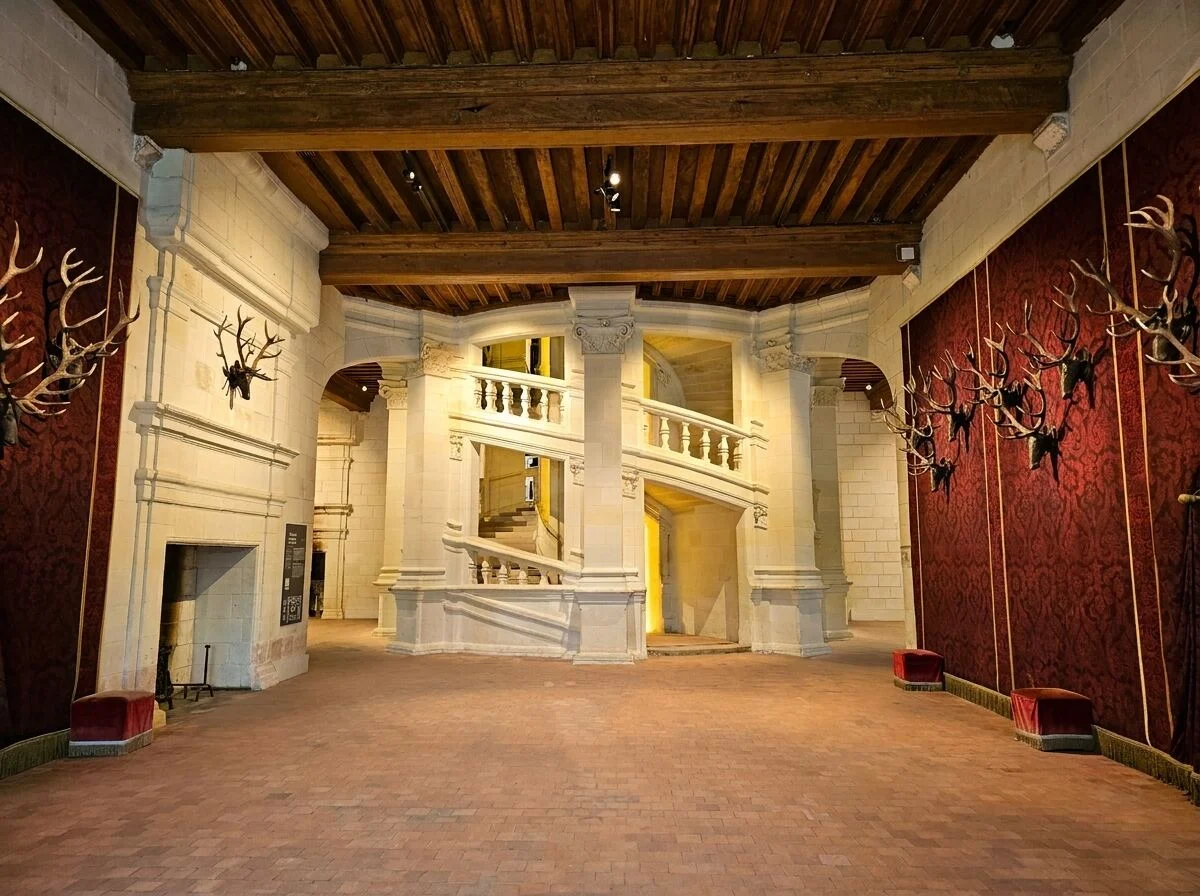
- The Grand Staircase (the double-helix staircase): the architectural showstopper of Chambord. It consists of two spiral staircases intertwined around a single hollow central axis, a design credited to none other than the genius of Leonardo da Vinci (1452-1519), who was living nearby at Amboise at the time. The trick is simple but brilliant: two people can go up and down at the same time without ever meeting. (A perfect design for kings trying to dodge the Spanish ambassador in the morning, or their lawful wife at night.)
- The terraces and the “forest of chimneys”: when you climb the double staircase up to the roof of the château, you’re met with a completely surreal sight. The roof isn’t flat at all; it looks like a small city suspended in the sky, crowded with hundreds of chimneys decorated with salamander emblems and the letter F for Francis I. From up here, you also get a breathtaking view of the gardens and the forest surrounding the estate.
- The Francis I wing and the King’s wing (Salle du roi): here you’ll see the restored royal rooms showcasing the splendor and extravagance of the 16th and 17th centuries. Pay special attention to the vaulted, stone-carved ceilings: it’s an extraordinary work of art that demands you look up and admire the small details.
- The French gardens (Les jardins à la française): the park and gardens recently underwent an extensive restoration, and they create a perfect contrast between the precise, clean, symmetrical order of French gardening and the wildness of the forest surrounding them.
- The vegetable gardens (Jardins-potagers): this is a relatively new project launched in 2019. These gardens span about 5,000 square meters and are meant to grow organic fruits and vegetables using traditional methods, right where the old stables used to stand.
Where to Stay in and Around Chambord: Feel Like Royalty at Night
If you’ve decided not to settle for just a day trip from Paris, and instead want to soak up the magic of the Loire Valley slowly and quietly (and there’s simply nothing more romantic than seeing Chambord lit up at night after the crowds of tourists leave and complete silence sets in), I have two wonderful recommendations for where to stay in the area.
Le Relais de Chambord: Sleep Within Touching Distance of the Château
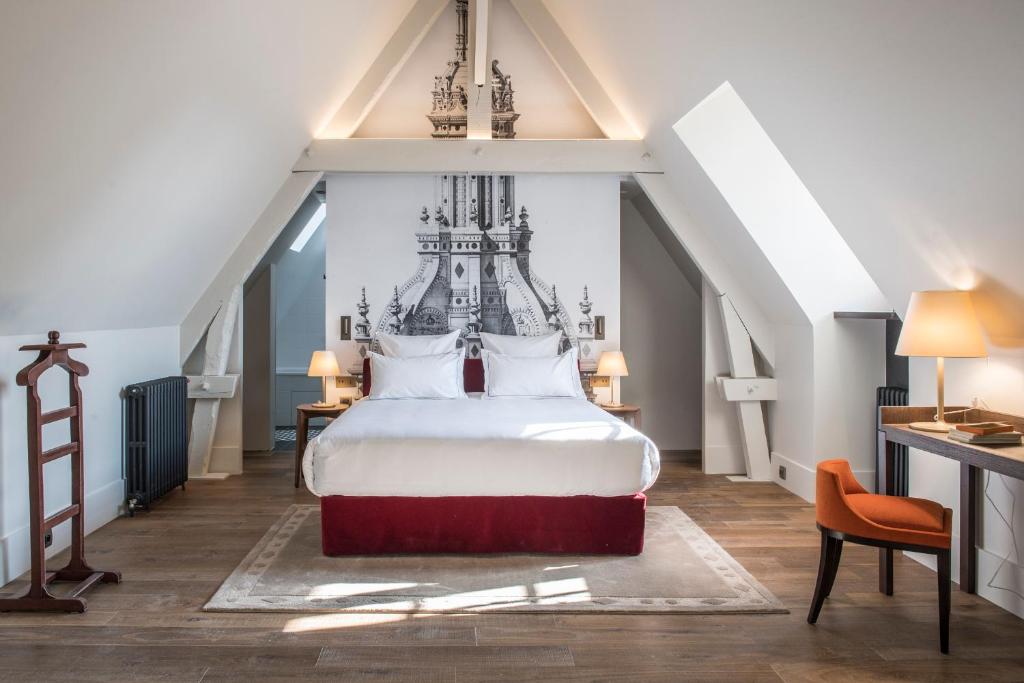
This hotel is simply a dream come true for anyone who wants to wake up facing the Château de Chambord. It’s a 4-star hotel that was completely renovated in 2018 by the famous architect Jean-Michel Wilmotte (born 1948). It sits just about fifty meters from the château! The hotel offers 55 rooms, some with a direct, breathtaking view of the château and the French gardens, and others overlooking the peaceful Cosson river. The hotel also has an excellent restaurant (Le Grand Saint-Michel) offering dinners with a view of the illuminated château.
Click here for more information and to book a room at Relais de Chambord.
Château des Grotteaux: Classic Elegance Near Chambord

If you’d rather get a bit of distance from the tourist bustle at the heart of the estate, while still staying close enough (in the nearby area of Huisseau-sur-Cosson), Château des Grotteaux offers a more authentic and intimate French “château” experience. It’s a perfect spot for couples looking for a combination of exclusive natural surroundings, personal attention, modern comfort wrapped in history, and rich breakfasts served as if you were, at the very least, Maurice de Saxe (1696-1750) at the height of his glory.
Click here for more information and to book a room at Château des Grotteaux.
***
What’s Next?
If you’re looking for more articles about the Loire Valley, feel free to check out the Loire Valley travel guide page on my site.
So you never miss an article, since every weekend I send out the best ones, I invite you to sign up for our newsletter!
Click here to sign up for our newsletter.
Thanks for walking with me through the corridors of history, and I’ll see you in the next article!
Related reading