

The Loire Valley is the place where I fell in love with France, and it happened thanks to a visit to one of the châteaux there when I was nine years old, and the question “what did Francis I die of” (you can read all about it in the article A Contagious Love). From that moment on, I understood one important thing: if you really want to enjoy a visit to a place, you simply have to know its history before you ever set foot in it.
And that is exactly the goal of this article: to help you understand why there are châteaux in the Loire Valley at all, and what fascinating stories played out here centuries ago. Before we dive into the story itself, it’s worth clarifying something: this is an article about the history of the whole valley, not a travel guide. If you came here to plan a visit, you’ll find all the practical information (how to get there, where to stay in the Loire Valley, details on every major château and more) on the full Loire Valley page. Here, we’re going back in time, long before anyone had to worry about parking.
Before the Beautiful Châteaux: A Valley Built on War
The Loire, the longest river in France, was not always a romantic backdrop for photographs. For centuries it was a front line. Whoever controlled the river controlled the route between northern and southern France, and that’s why its banks were lined not with palaces but with fortresses, thick and ugly, with a single purpose: to kill anyone who tried to cross without permission.
The figure who represents that era more than anyone else is Foulques Nerra, Count of Anjou (c. 972-1040). He built more fortresses than any other man in the region during his time, including the keep of Langeais, one of the oldest fortified towers still standing in France, built around the year 994.

But what draws us to Foulques Nerra isn’t his engineering. It’s the legend attached to him: it’s said that he had his first wife, Élisabeth, executed by burning in the town square on suspicion of adultery, and dressed her (as the story goes) in her wedding gown. It’s hard to know how much of this is fact and how much is a moral lesson added later, but what we do know for certain is that the man made the pilgrimage to Jerusalem four separate times to atone. A man who feels that need for atonement usually knows exactly what for.
1429: The Girl Who Recognized a King in Hiding
And speaking of atonement and faith: the Loire Valley is also the stage of one of the defining moments in all of French history. In 1429, a seventeen-year-old peasant girl, Joan of Arc (c. 1412-1431), arrived at the Château de Chinon to meet the Dauphin Charles, later King Charles VII (r. 1422-1461), and convince him that God had sent her to save France.
Tradition has it that the Dauphin, who feared impostors and assassins no less than he feared the English, hid among his courtiers and dressed another courtier in royal clothes, and that Joan, without hesitating for a moment, walked straight up to him and recognized him. We can’t know for certain exactly how it happened: the precise details of the scene come to us through chronicles written in admiration, not dry documentation. But the fact that the meeting itself took place in Chinon, and that Charles then gave Joan soldiers and set out with her toward Orléans, is no longer legend. That is the point where the Loire Valley, quite literally, changed the course of the war.
The Valley of Kings Is Born: Charles VIII, Francis I and an Italian Dream Château
After a hundred years of war, the valley became something entirely different. Charles VIII (r. 1483-1498) came back from his campaigns of conquest in Italy captivated, not by the battlefields, but by the architecture. He brought Italian artists and architects with him and began transforming the Château d’Amboise into a Renaissance palace. There’s a bitter twist to this: Charles died in 1498 at age 27, after hitting his head on a low doorframe in that very same château, on his way to a game of tennis. A king who brought the Renaissance to France was killed by a door. It’s hard to invent an ending like that.

And if that wasn’t enough for you, in 1560 a Protestant conspiracy (the “Amboise conspiracy”) was uncovered, plotting to kidnap the young King Francis II and topple the ruling Guise family. The conspiracy failed, and those involved were hanged from the balconies of the château itself, in front of a crowd invited to watch. That’s not just a dry fact from a history book, it’s the moment you realize that beneath all that beauty, this valley was still a political battlefield.
Francis I (r. 1515-1547) took the Italian idea much further. In 1519, the very same year Leonardo da Vinci (1452-1519) died, Francis began building the Château de Chambord, the largest and most eccentric of the Loire châteaux, with its famous double-spiral staircase, which many attribute to Leonardo’s own inspiration.

Leonardo spent his final years at Clos Lucé, right next to Amboise, at Francis’s personal invitation. Some claim the king himself held his hand at the moment of his death, and the famous 19th-century painting by Ingres cemented that image in our collective memory. However, many historians doubt that Francis was even at Clos Lucé that day. But even if those historians are right, the story is too beautiful not to tell. What do you think?
Two Women, One Château: The Battle for Chenonceau
If there’s one château in the valley that proves French history was sometimes run not by men but by women, it’s the Château de Chenonceau.
Henri II (r. 1547-1559) gave it as a gift to his mistress, Diane de Poitiers (1500-1566), a woman twenty years his senior, who held him (so the story goes) through sheer force of will as much as through charm. Diane built the famous bridge over the Cher River.

But in 1559, something happened that changed the story in an instant: Henri was gravely wounded in a jousting tournament when a splintered piece of a lance belonging to a Scottish knight named Gabriel de Montgomery pierced through his visor and straight into his eye. He died ten agonizing days later. The moment Queen Catherine de’ Medici (1519-1589) became a widow, she wasted no time.
As the story goes, she never forgave Diane for her years of humiliation, and within just a few days forced her to trade Chenonceau for a smaller, far less prestigious château, Chaumont. We can’t know for certain whether this was pure revenge or a calculated political move: Catherine knew how to be both at once. It was she who added the magnificent gallery above the bridge, and turned Chenonceau into the stage for the French court’s most extravagant parties.
Murder in the Palace: The Drama That Unfolded at Blois
The Château de Blois is perhaps the most dramatic stage in the entire valley, and not by chance: at certain periods it served almost as a parallel capital to Paris. In December 1588, it was the scene of one of the most famous political assassinations in French history: King Henri III (r. 1574-1589), who felt threatened by the growing power of Duke Henri I de Guise (1550-1588), leader of the Catholic League and seen by many as the true king of France, invited him to a private meeting in his chamber at the château. Guise entered, and the king’s guards (a group known as “the Forty-Five”) stabbed him to death the moment he walked in. His brother, the Cardinal de Guise, was murdered the following day.
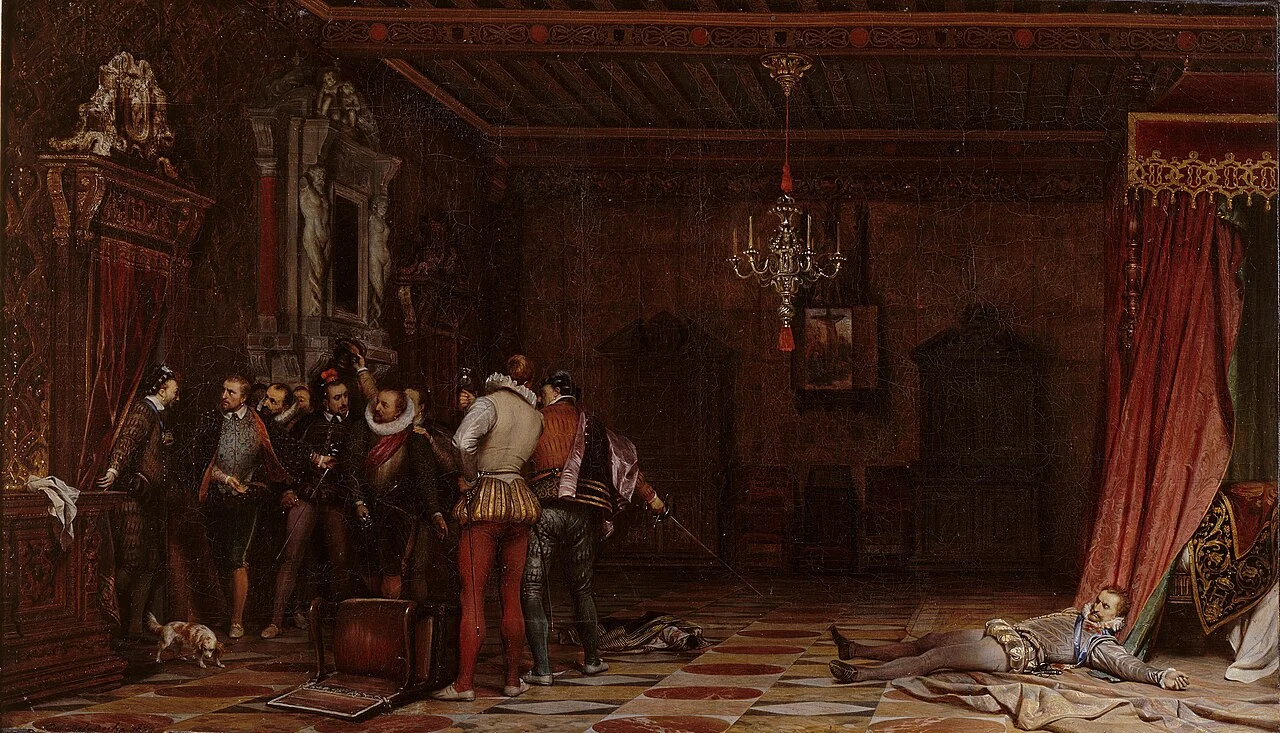
Henri III himself was murdered less than a year later by a fanatical monk. You could say Blois is the château where we learned that even gilded walls don’t stop blood.
Legends That Stayed Between the Walls: Ussé and the Green Lady of Brissac
Not every story in the valley is documented in official chronicles. Some survived as oral legend, and that’s exactly what makes them no less fascinating. The Château d’Ussé, with its white turrets stacked like something out of a children’s book, is identified in local tradition as the inspiration for Sleeping Beauty by Charles Perrault (1628-1703), who published the tale in 1697.
There’s no solid historical proof that Perrault actually visited and wrote the story under its direct inspiration. It’s a tradition that was born and took hold over time, not a documented fact. But take one look at this château, and you’ll understand why the story stuck to it so strongly.

The Château de Brissac, the tallest of all French châteaux (seven floors!), carries a darker story: the legend of “the Green Lady,” the ghost of Charlotte de Brézé, the illegitimate daughter of Charles VII, who, according to the story, was murdered by her husband Jacques de Brézé after he caught her committing adultery. Her ghost, so they say, still wanders the corridors at night.

The 17th and 18th Centuries: From Center of Power to Bourgeois Estates
As the years went by, the kings of France started feeling that the Loire Valley was a bit… out of fashion. Think of it like celebrities deciding Paris is no longer trendy and moving to sunbathe on the Riviera instead. Louis XIV, who wanted to build himself a dazzling, perfectly regimented new toy called Versailles, shifted the political center of gravity far from the river. Once the royal court packed up its suitcases and candlesticks and moved to the Palace of Versailles, the valley gradually lost its status as the political nerve center of France. But ironically, that very abandonment is exactly what saved its charm from further political exploitation, at a time when Paris had become the stage for aggressive political and diplomatic battles.
Instead of kings and dukes with armed entourages, the valley began filling up with local nobles and newly wealthy bourgeois looking to build themselves elegant “vacation homes.” The châteaux built or renovated in that period were no longer meant to defend against enemies. Moats? Imposing watchtowers? Not a chance, those would just ruin the view from the terrace.
The châteaux of this era were built with one goal: to display wealth, culture and good taste. Unlike older châteaux, many of them have remained intact and are held by the same families to this day, combining meticulous French gardens with architecture meant to show that their owners “knew how to live well.”
During the Enlightenment (the 18th century), the valley became a fascinating intellectual hub. This was the era when châteaux turned into literary salons. Figures like Madame Dupin, who owned the Château de Chenonceau at the time, hosted the great philosophers of the Enlightenment. Picture Jean-Jacques Rousseau wandering the corridors, debating liberty and equality, while the local nobility tried to figure out how the river affected their crops. The river itself continued to function as France’s “highway”: ships loaded with wine, salt, sugar from Nantes and vinegar from Orléans flowed back and forth, setting the economic rhythm of the entire region.
Revolution: Which Châteaux Survived the Architectural Guillotine?
The French Revolution of 1789 was not gentle with the Valley of Kings. The Revolution wasn’t just a matter of guillotines in Paris: it was an earthquake that reached every village in Touraine and Anjou. Many châteaux were seized as “national property” (biens nationaux), sold off to shrewd entrepreneurs, and sometimes even partially demolished so their stone and valuable materials could be sold. For the radical revolutionaries, the châteaux were symbols of tyranny that had to be erased, or at worst, free quarries open to the public.
Here is the era’s balance sheet of terror and survival:
- The châteaux that didn’t survive the architectural guillotine: The Château de Chanteloup, for instance, which was nothing less than “the Versailles of the Loire” and spread across enormous gardens, was almost entirely demolished and dismantled so its building materials could be sold (today only the Pagoda of Chanteloup remains, standing alone as a silent witness to a splendor that was lost). The same cruel, capitalistic fate befell the Château de Richelieu, the vast, extravagant complex of the famous cardinal, which was taken apart and sold stone by stone. It was a surreal sight of organized, calculated destruction.
- The châteaux that found themselves “Republican usefulness”: So who did escape demolition? Those the Republic found a practical, unglamorous use for. The clearest example is the royal Abbey of Fontevraud, which was turned into a maximum-security prison (the place continued to function as a prison until the mid-20th century!). Other châteaux became military barracks or field hospitals. In short, if you weren’t royalty, your odds of survival came down to agreeing to an extreme “career change” involving iron bars, uniforms or soldiers’ bunks.
The 19th Century: The Railway, Balzac and the Romantic Revival
With the arrival of the 19th century, the valley underwent a dramatic transformation. If until then the river had been the main source of livelihood, the arrival of the railway drained the life out of the small ports along the Loire’s banks. But as the river’s old economy faded, something new grew in its place: tourism. People started “discovering” the valley.
Honoré de Balzac, a native of Tours, praised the region in his writing and called it “the garden of France.” His descriptions, alongside the era’s romantic novels that glorified the Middle Ages, turned the region into a sought-after destination for bourgeois travelers leaving Paris in search of “lost magic.”

New wealthy families, industrialists, bankers and businessmen, started buying up the ruins the Revolution had left behind. They didn’t buy them to live in them the way kings once had, but to “play at being kings.” They poured fortunes into restoring façades, recreating gardens (based on romantic imagination, not necessarily historical accuracy) and maintaining the estates.
The Biencourt family at Azay-le-Rideau, for example, worked wonders on their château. That activity, born of a romantic longing for the past, is in fact what rescued the heritage we get to enjoy today. They turned the châteaux from mere building stones into historical treasures.
The 20th Century: Smugglers, Nazis and the Mona Lisa in a Basement
And if you thought that after the railway and the bourgeois renovations the valley had gone back to a quiet nap, World War II arrived and shuffled the deck all over again. With the fall of France in 1940, the Loire Valley became the scene of unimaginable geopolitical tension: the famous “demarcation line” (Ligne de démarcation), which separated occupied France in the north from the “free” Vichy zone in the south, cut straight through the middle of the valley, with the river (and its tributaries) often serving as the literal border between life and death.
In those dark days, the châteaux once again played a heroic role. Chenonceau, built as a bridge, found itself in a surreal position: the château’s main entrance stood in the zone occupied by the Nazis, but the door at the end of its magnificent gallery opened directly into the free zone! The owners took advantage of this wild architectural loophole to smuggle refugees and Jews across at night, right under the noses of the soldiers patrolling the area. It was a dangerous dance along the border, as the river, once the defensive line of counts, became a lifeline of escape for ordinary people.
And while some châteaux smuggled people, others smuggled culture. Even before the Nazis invaded Paris, curators at the Louvre packed up its most precious works in a secret operation and moved them far from the capital, into the quiet châteaux of the valley. That’s how the Château de Chambord, usually known for its empty rooms, found itself filled with thousands of crates packed with masterpieces, including the Mona Lisa herself. You have to admit there’s something almost poetic about the fact that the enormous château Francis I built (but barely had time to live in) became, centuries later, a safe haven for the painting that meant so much to his good friend, Leonardo da Vinci. The châteaux, once centers of war and bloodshed, became in the 20th century a fortress of culture.
The Loire Valley Today: A World Heritage Site
In 2000, UNESCO declared the stretch between Chalonnes-sur-Loire and Sully-sur-Loire a World Heritage Site, an exceptional cultural landscape that, in its words, tells the story of the relationship between people and a river over more than a thousand years. I tend to think the title belongs to the valley for an entirely different reason: no region in France manages to pack so much murder, love, betrayal and revenge into such a small, and such a green, stretch of land.
Today, when we travel there, it’s easy to forget that this quiet river has seen it all: from the ugly fortresses of violent counts, through the extravagant parties of the Renaissance, to daring wartime smuggling operations. The Loire Valley isn’t just a collection of beautiful châteaux, it’s living proof of French history, with all its good, its bad, and its moving moments.
FAQ
Who was Foulques Nerra, and what did he contribute to the history of the Loire Valley?
What happened at the Château de Chinon with Joan of Arc in 1429?
Why is the Loire Valley considered such an important stage in French history?
Related reading