

When people say “Étretat,” most of us instantly picture the towering white cliffs, the stone arch plunging into the cool waters of the Channel, and the legendary needle standing like a lone sentinel against the ocean waves. And how could we not? It’s one of the most dramatic, most photographed landscapes in all of France. But let me let you in on a little secret, the kind reserved for true Francophiles: this breathtaking beauty is only the tip of the iceberg.
Because Étretat isn’t just a landscape. It’s a story. In fact, it’s a tapestry of stories woven together over hundreds of years. Stories of ruthless Vikings and desperate saints, of exiled queens and poor fishermen, of hunters of light, and of one gentleman thief who changed its face forever.
Before you climb the cliffs for the perfect selfie, let’s dive together into this fascinating history, because knowing it means looking at those same cliffs and seeing a whole world within them.
From the Depths of Legend: Vikings, Saints and Hidden Roots
The Secret of the Norse Name
The history of Étretat begins, like any good story, with a mystery: the origin of its name. For many years, romantic 19th-century historians were convinced it came from some Latin term, perhaps a phrase meaning “road of stones.” But the truth, as revealed by modern research, is far more fascinating, and it takes us north, to the cold lands of the fjords.
The earliest known name for the place, as it appears in 11th-century texts, is “Strutat” or “Strutart.” Modern linguists believe the origin lies in Old Norse, the language of the Vikings who raided and settled in Normandy. There are two main theories: one holds that the name combines the words “Stakkr” (a tall sea rock) and “Stútr” (upright), a perfect description of the famous needle.
The second theory, and the one I find more convincing, links the name to a specific person: a Viking chieftain named Styrr. According to this theory, “Étretat” means “the estate of Styrr.” Either way, one thing is certain: long before it became a tourist gem, Étretat was a Viking outpost, a wild stretch of land coveted by the men of the north.
The Legend of Dame Olive and the Viking Invasion
How can we talk about Vikings without a juicy story? The most famous local legend tells of Dame Olive, a wealthy and pious woman who used to wash her clothes in a freshwater spring that flowed onto the beach. You might ask yourself why a rich, independent woman would do her own laundry. Well, the legend says it was her way of staying humble and modest, and of keeping close to the lives of ordinary people.
One day, as she was busy at her task, long Viking boats appeared from the sea, their crews thirsty for blood and plunder, intent on capturing her and her treasures. In her distress, Olive fell to her knees and prayed to God to save her. Popeye the sailor, her famous admirer, did not appear out of nowhere with a can of spinach, but her prayer was answered in a way just as dramatic. As if by magic, a mighty storm broke out. The sky turned black, the sea raged, and towering waves smashed the Viking ships against the rocks. Olive was saved.

She naturally kept her promise and began building the church of Notre-Dame, but here the story takes another twist. Every night, Satan, furious at the Vikings’ defeat, would move the stones laid during the day from the center of the village to the distant hill. Eventually, Olive took the hint and built the church at its current location, far from the sea. That, so the legend goes, is why Étretat’s main church stands in such an unexpected spot.
In the Shadow of Fécamp
The church of Notre-Dame d’Étretat is indeed impressively large, and its size seems almost disproportionate to the small fishing village Étretat was at the time. The reason for this is not Satan, but an earthly force just as powerful and ruthless: the church itself.
In the Middle Ages, Étretat stood under the protection of the region’s religious and political powerhouse: the mighty Benedictine abbey of the town of Fécamp. The church at Étretat, built between the 11th and 13th centuries, is in fact a smaller, fortified copy of the abbey church at Fécamp. This was the monks’ way of showing off their power and control. They built an imposing structure that sent a clear message to every local fisherman and every passing ship: Fécamp rules here. Architecture, then, was not merely a matter of aesthetics, but a political statement carved in stone.
Years of Relative Calm: Between Wars and Kings
The period between the late Middle Ages and Étretat’s rise as a resort town looks relatively quiet, but it was not without events. The village continued to exist under Fécamp’s influence, while also gaining a special status of its own. As early as the 13th century, Étretat held the title “Prévôté Royale” (royal provostship), and was under the protection of the lords of Bénouville, who watched over it in the king’s name until the French Revolution.
Its proximity to England and the strategic importance of the Channel made Étretat, even more than neighboring Fécamp, a supplier of ships for the king of France, Philippe VI (r. 1328-1350), during his wars against the English in the 14th century. But the sea, which provided protection and livelihood, also knew how to show its fury. On January 15, 1525, a terrible disaster struck the village when a massive wave completely flooded it, a traumatic event that became etched into the community’s collective memory.
The 18th Century: Life on the Waterline
Oysters for the Queen, Poverty for the Fishermen
For centuries, life in Étretat was hard and often dangerous. The community relied entirely on fishing, grueling physical labor dependent on the mercy of the sea. Entire families lived modestly, in low cottages with thatched roofs, often half-buried in the ground to protect against mudslides that ran down from the valley during heavy rains.
But even in this remote corner, a flash of royal splendor occasionally appeared. In 1777, special oyster farms were set up at the foot of the cliffs. But these were no ordinary oysters. They were imported specially from Cancale in Brittany and “raised” in the seawater and freshwater springs of Étretat, all for one lofty purpose: the table of Queen Marie Antoinette (1755-1793) at Versailles.
This contrast, between the poverty of the local fishermen’s lives and the exotic luxuries supplied to the royal court, foreshadowed Étretat’s future. It marked the beginning of this small village’s journey from a place where treasures were drawn from the sea, to a place that was itself a treasure coveted by the Parisian elite.
The Legend of “The Man’s Hole”
The sea that provided a livelihood also exacted a heavy price. Sudden storms and towering waves turned every fishing trip into a gamble. One of the most famous legends illustrating this danger is the story of “Le Trou à l’Homme” (the man’s hole), a natural cave at the base of the Falaise d’Aval.
The story tells of a Swedish ship wrecked in a terrible storm in 1792. The entire crew drowned, except for one sailor. The massive waves hurled him with great force into this very cave. He was found there 24 hours later, injured and exhausted, but alive. The cave, which has carried his name ever since, became a symbol of hope and survival against the destructive power of nature.
The 19th Century: The Birth of a Modern Legend
Alphonse Karr and the Invention of a Resort Town
The great turning point in Étretat’s life came in the 19th century, and it came not from a storm at sea or a royal decree, but from a writer’s pen. The author and journalist Alphonse Karr (1808-1890) “discovered” Étretat and published a successful novel about it that turned it, overnight, into a fashionable destination.
Karr himself later complained with a bitterness tinged with humor:
“I discovered this refuge, and it fell victim to invasion… It seems I take up too much room and am crowding out the places where people came to gather around me.”
He was, if you like, Étretat’s first “influencer.” Following his writings, new roads were laid from Le Havre and from Fécamp, and in 1852 the first casino opened. Suddenly, everyone wanted a piece of Étretat.

This new fashion drew to Étretat not only Parisian bohemians, but also figures of the highest rank. The magnificent Château des Aygues, for instance, served as the summer residence of no fewer than two exiled Spanish queens: the queen mother Maria Christina of the Two Sicilies (1806-1878) and her daughter, Queen Isabella II (1830-1904). Their presence added a touch of international glamour and prestige to the fishing village turned resort town.
The Invasion of the Artists: Courbet, Monet and the Hunters of Light
But the real force that shaped Étretat’s character was its artists. They flocked there in droves, captivated by the unique light, the dramatic forms of the cliffs, and the authentic atmosphere. Two giants stand out in particular: Gustave Courbet (1819-1877) and Claude Monet (1840-1926). They stood before the very same landscape, yet saw two utterly different worlds, and in doing so, told, through Étretat, the story of the great revolution in the history of art.
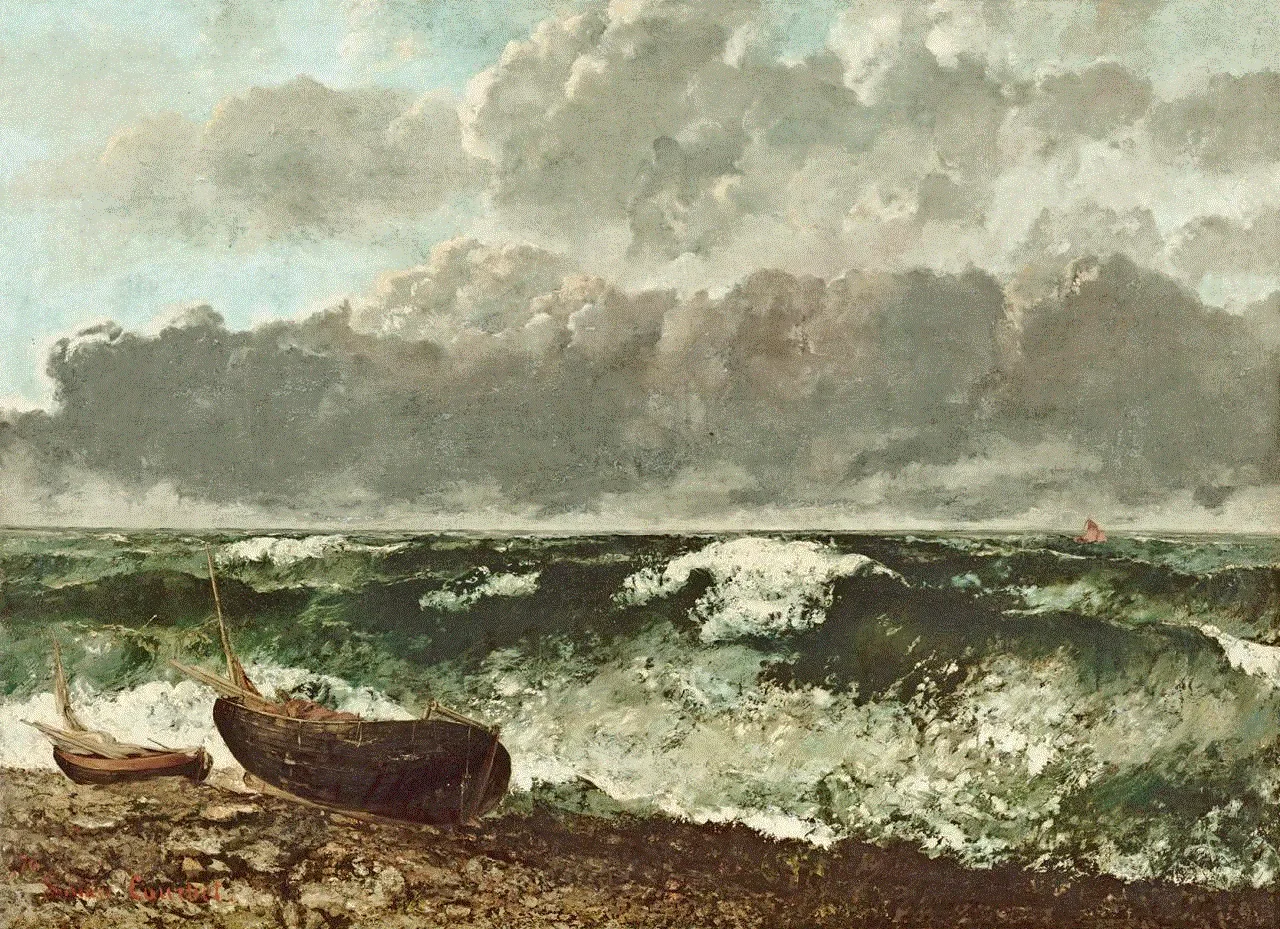
Gustave Courbet, the father of the Realist movement, arrived in Étretat in the summer of 1869. He wasn’t looking for idyllic beauty. He was looking for raw power, the material truth of nature. In his famous paintings, such as “The Wave,” he used a palette knife to apply thick layers of paint, depicting the sea not as a calm, blue surface, but as an immense, almost violent mass of water and foam crashing against solid rocks. Courbet painted eternity, matter itself, what had been there for millions of years and would remain for millions more.
Then came Claude Monet. Between 1883 and 1886, Étretat became an obsession for him, and he painted close to 90 canvases there. Unlike Courbet, Monet wasn’t seeking the eternal, but the momentary, the fleeting. He was hunting light. His letters from that period are full of frustration over the sun hiding, the tide changing too quickly, the wind that wouldn’t let him work.
His friend, the writer Maupassant, described him perfectly:
He was no longer truly a painter, but a hunter. He walked along, followed by children carrying his canvases, five or six works depicting the same subject at different hours and with different effects.
Monet did not paint the rock; he painted the way the light of sunset broke upon it at that exact moment.
Guy de Maupassant: The Boy Who Came Home
It’s impossible to tell the story of Étretat without mentioning Guy de Maupassant (1850-1893). For him, this was not just another resort; it was home. After his parents separated, he went to live with his mother at the “Villa des Verguies” in Étretat, and spent there a free and happy childhood.
Years later, once he had become a famous and successful writer, he did what many of us dream of doing: he came back. With the money he earned from his first literary successes, he built himself the house of his dreams, “La Guillette,” in the Mediterranean style he loved. In the garden he even set up a “caloge,” an old fishing boat converted into living quarters for his servant. Étretat was, for him, a closing of the circle: the place that had symbolized the freedom of his youth became a symbol of his success as a man.
The 20th century: between mystery and war
Arsène Lupin and the needle that lit up our imagination
If the 19th century made Étretat famous, the 20th century made it legendary. The man responsible for that was one person: the writer Maurice Leblanc (1864-1941), who himself lived in Étretat in the charming villa “Le Clos Lupin,” which today serves as a museum.
In 1909, Leblanc published a novel called L’Aiguille creuse (“The Hollow Needle”). In the story, his charismatic hero, the gentleman burglar Arsène Lupin, discovers that the famous needle of Étretat is not just a rock, but a hollow structure containing the lost treasures of all the kings of France.
This literary invention was nothing short of brilliant. It took a familiar landscape and gave it a whole new dimension of mystery and adventure. Suddenly, the needle was not just a masterpiece of nature, but a destination for treasure hunters. This myth became an inseparable part of Étretat’s identity, and to this day, thanks to the hit Netflix series “Lupin,” travelers from all over the world come to search for Arsène Lupin’s secret.
If you want to dive even deeper into the character of the gentleman burglar, I invite you to read my comprehensive article on Arsène Lupin.
From resort to hospital: Étretat in World War I
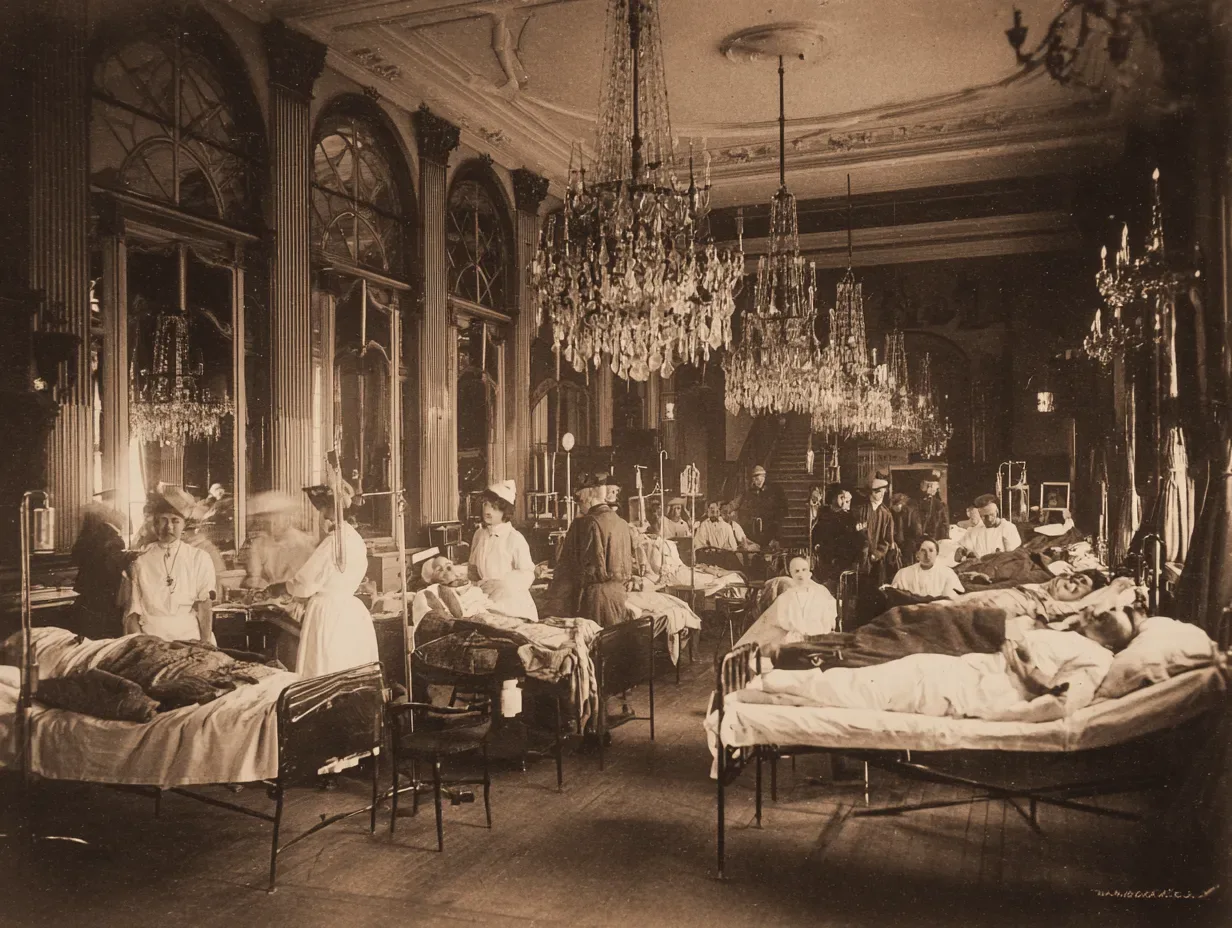
Just a few years after Lupin captured readers’ imaginations, a much harsher reality invaded Étretat. With the outbreak of World War I, the peaceful resort town changed completely. The grand hotels, the large villas and the casino were all converted into military hospitals.
For four years, Étretat served as British General Hospital No. 1, treating thousands of wounded soldiers who arrived from the bloody front. In 1917, the Americans joined in, setting up Hospital No. 2. The Commonwealth military cemetery, located quietly beside the old church, stands as silent testimony to this period, with hundreds of white headstones telling the stories of young soldiers who met their deaths far from home.
Scars on the Atlantic Wall: occupation and liberation
The Belle Époque dream in Étretat, cruelly interrupted by the Great War, was shattered to pieces in World War II. With the occupation of France, the Nazis turned Étretat into a strategic point on the “Atlantic Wall,” the line of fortifications they built along the coast. Concrete bunkers were carved into the white cliffs, and cannons were placed where painters once stood with their easels.
The heaviest price was the destruction of the seafront. To clear lines of fire in case of an invasion, the Germans demolished the famous casino and the row of elegant 19th-century villas that lined the promenade. In September 1944, the town was liberated by the British 51st Highland Division, but the scars remained. Today’s modern, concrete seafront is a permanent reminder of that dark period.
Visiting Étretat
Now that you know the history of Étretat, it’s time to visit it. And that’s exactly why I wrote Étretat: a coast of mystery and magic. That article was written by Yael Suliman, who has a wonderful apartment in Deauville, from which Étretat is an easy trip. Click here to check availability and prices for Yael’s apartment.
Related reading