

There’s something almost magical about stepping into a Parisian passage. The light filtering through the glass roof, the muffled hum of the street left behind, and the immediate feeling of time travel, to another era, more elegant, slower. I’ll admit it, I have a soft spot for these covered arcades, those hidden arteries that cut through Paris’s massive city blocks and offer a glimpse into a world that has vanished.
If you ask me which one matters most to me, my answer will always be the Passage des Panoramas. True, it wasn’t technically the first. It was preceded by the Passage de l’Ancre, a charming but uncovered relic from the 17th century, and also by the Passage du Caire, which opened in 1798, just two years earlier, and today looks like some forgotten arcade in a rundown corner of town (though it recently got a renovation and a facelift).
But the Passage des Panoramas, which opened in 1800, was the one that defined the genre. It wasn’t just a covered walkway, it was a destination. It combined commerce with revolutionary entertainment and cutting-edge technology, and it became the first public place in Paris to be lit by gas. It set the template that every other passage would follow, and it became the prototype for the modern shopping mall.
The Fascinating History of the Passage des Panoramas
Revolution, Real Estate and Two Bold Americans: The Birth of the Passage
The story of the passage begins, like so many Parisian stories, with a revolution. Before 1789, the grand Hôtel de Montmorency-Luxembourg stood on this spot, a symbol of aristocratic wealth. The French Revolution turned it into “national property” (bien national), and it was put up for public auction.

This is where two American entrepreneurs enter the picture. The first was William Thayer, a shrewd sailor and businessman. The government of France had seized one of his ships, and as compensation, he received a considerable sum of money. On the advice of friends, he used the money to purchase the prestigious estate, turning an international grievance into a brilliant real estate opportunity.
His partner in the venture was none other than Robert Fulton (1765-1815), an inventor and a genius across multiple fields. Fulton had come to Paris hoping to sell Napoleon his latest inventions: a submarine called the “Nautilus” and a torpedo. While he waited (in vain) for a response from the French government, he needed a way to make a living.
Fulton’s solution was an innovative attraction called a “panorama.” He built two large rotundas (round structures) at the entrance to the passage, and inside them displayed giant 360-degree panoramic paintings of famous cities like Paris, Rome and Jerusalem. Viewers stood in the center and felt as if they were truly inside the landscape. It was a revolutionary experience, a kind of cinema before the age of cinema.
To create the perfect illusion, Fulton hired the painter Pierre Prévost (1764-1823), who specialized in these hyper-realistic paintings. The passage itself was built to serve the enormous crowds that flocked to the attraction, and it was named after it. So, ironically, one of the quintessential symbols of Parisian culture was born out of American opportunism and military technology that Napoleon had turned down.
Lights, Operettas and Scandals: The Golden Age of the Passage
The passage’s dazzling success reached its peak with the opening of the adjoining Théâtre des Variétés in 1807. Behind the theater stood a legendary figure in her own right: Mademoiselle Montansier (Marguerite Brunet, dite Mademoiselle Montansier, 1730-1820), a 77-year-old businesswoman and impresario who, after being ousted from the theater at the Palais-Royal (the one that today hosts the Comédie-Française), managed to convince Napoleon himself to let her build a new hall.
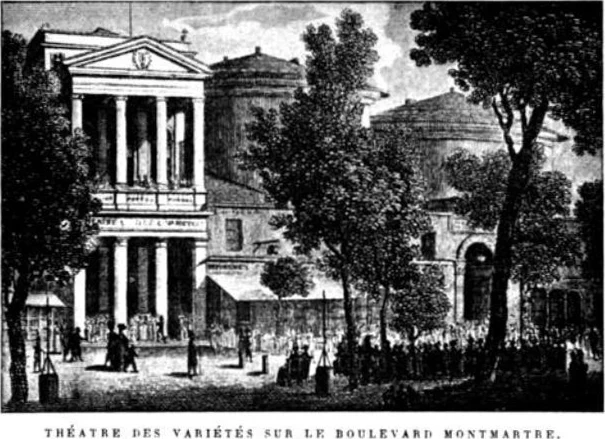
During the 1860s, the theater became the place to be in Paris, thanks to one musical genius: the composer Jacques Offenbach (1819-1880). His witty, satirical and daring operettas, like “La Belle Hélène” and “The Grand Duchess of Gerolstein,” swept the city by storm and defined the spirit of the Second Empire.
Offenbach’s leading lady, and the woman all of Paris talked about, was Hortense Schneider (1833-1920). She was a true diva, with enormous talent and an even bigger ego. She was known not only for her voice, but also for a long list of influential lovers, including the Duc de Gramont-Caderousse, with whom she had a child.
Her dressing room at the theater became a place of pilgrimage. Every king, tsar or prince visiting Paris considered it a must to pass through her dressing room after the show. The list included Tsar Alexander II, Emperor Franz Joseph of Austria, and the Prince of Wales (the future King Edward VII). She earned the nickname “Le Passage Obligé” (the required passage), a pun on her closeness to the Passage des Panoramas.
The passage and the theater weren’t just neighbors, they were a whole ecosystem. The passage served as the theater’s lobby, dining room and market. Wealthy, fashionable theatergoers would arrive at the passage before the show for dinner, and afterward return to shop and to see and be seen. The connection was so close that a renovation in 1834 created the Galerie des Variétés, which physically linked the two and included a dedicated entrance for performers.
Prestige, Expansion and Shops That Made It Into the History Books
The passage’s continued success led to a major expansion in 1834. The architect Jean-Louis Victor Grisart (1797-1877) added four new galleries: Saint-Marc, Variétés, Feydeau and Montmartre, creating the charming maze we know today. This expansion was a direct response to competition from newer, more lavish passages, like the Galerie Vivienne (Galerie Vivienne).
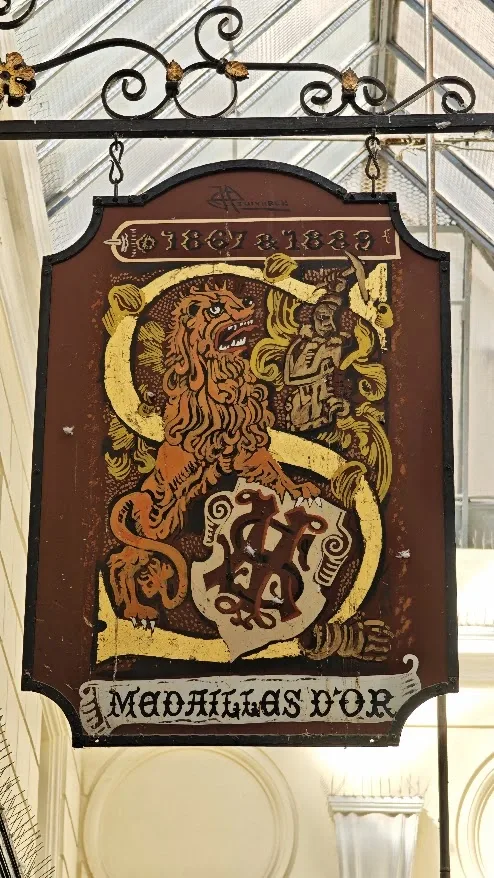
Over the years, the passage became home to some of the most prestigious artisans and shops in Paris. Two stand out in particular: “Graveur Stern” at number 47, an engraving and printing house founded by Isidore Aumoitte (1797-1846) and brought to worldwide fame under the direction of Moïse Stern (1826-1915). Their client list reads like a “who’s who” of world history, from European royal houses to Lenin and Charles de Gaulle.
At number 57 stood the chocolate shop of François Marquis, which opened in 1818 and became legendary. The Goncourt brothers and Sarah Bernhardt frequently praised his chocolates, and the shop’s original decor, including its carved wooden ceiling, has survived to this day.
This unique atmosphere of luxury, theater, art and the good life was immortalized forever by the writer Émile Zola (1840-1902). His famous 1880 novel “Nana” is set largely in the Théâtre des Variétés, with the passage serving as the backdrop for the rise and fall of its heroine.
From Postage Stamps to Bistronomy: The Passage in the 21st Century
Like Paris itself, the Passage des Panoramas knew how to adapt to the times. After the theater’s golden age faded, it found a new identity in the 20th century and became one of the world’s most important centers for philately, the collecting of stamps and postcards. To this day, you can find many shops here devoted to this hobby.

In recent decades, the passage has undergone another transformation and become a gourmet paradise. The historic shops of Stern and Marquis have become acclaimed restaurants: the Italian Caffè Stern and the French Canard & Champagne. Alongside them, dozens of restaurants, bistros and small bars have popped up, offering everything from classic French cuisine to Japanese gyoza.
This ability to constantly reinvent itself is the secret to the passage’s survival for more than 220 years. It was an entertainment hub, then an extension of a theater, then a haven for collectors, and today it’s a culinary capital. It’s a living organism that keeps changing its face, while keeping its architectural skeleton and historical soul intact.
Practical Information for Visiting the Passage des Panoramas
Getting There
- Addresses: The passage has several entrances, which makes it especially easy to access:
- 11 Boulevard Montmartre
- 10 Rue Saint-Marc
- 38 Rue Vivienne
- 151 Rue Montmartre
- Metro: The closest stations are Grands Boulevards (lines 8 and 9) and Bourse (line 3).
- Buses: Many lines stop at the Grands Boulevards station, including 20, 39, 48, 74 and 85.
When to Come?
- Opening hours: The passage is open to the public daily from 6:00 a.m. to midnight.
- Top tip: Let me give you a little friendly advice. I highly recommend visiting the passage twice. Once during the day, to take in the small shops, the natural light streaming through the glass roof and the lively atmosphere. And once in the evening, when the restaurants fill up, the artificial lights create an intimate, romantic mood, and the place feels like a magical Parisian secret.
Want to Discover More Charming Passages in Paris?
That’s exactly why I created the walking route following Paris’s covered passages for you. This route will take you through the most important passages of the City of Light and let you discover the unique charm of each one, at your own pace and for free.
Related reading
