
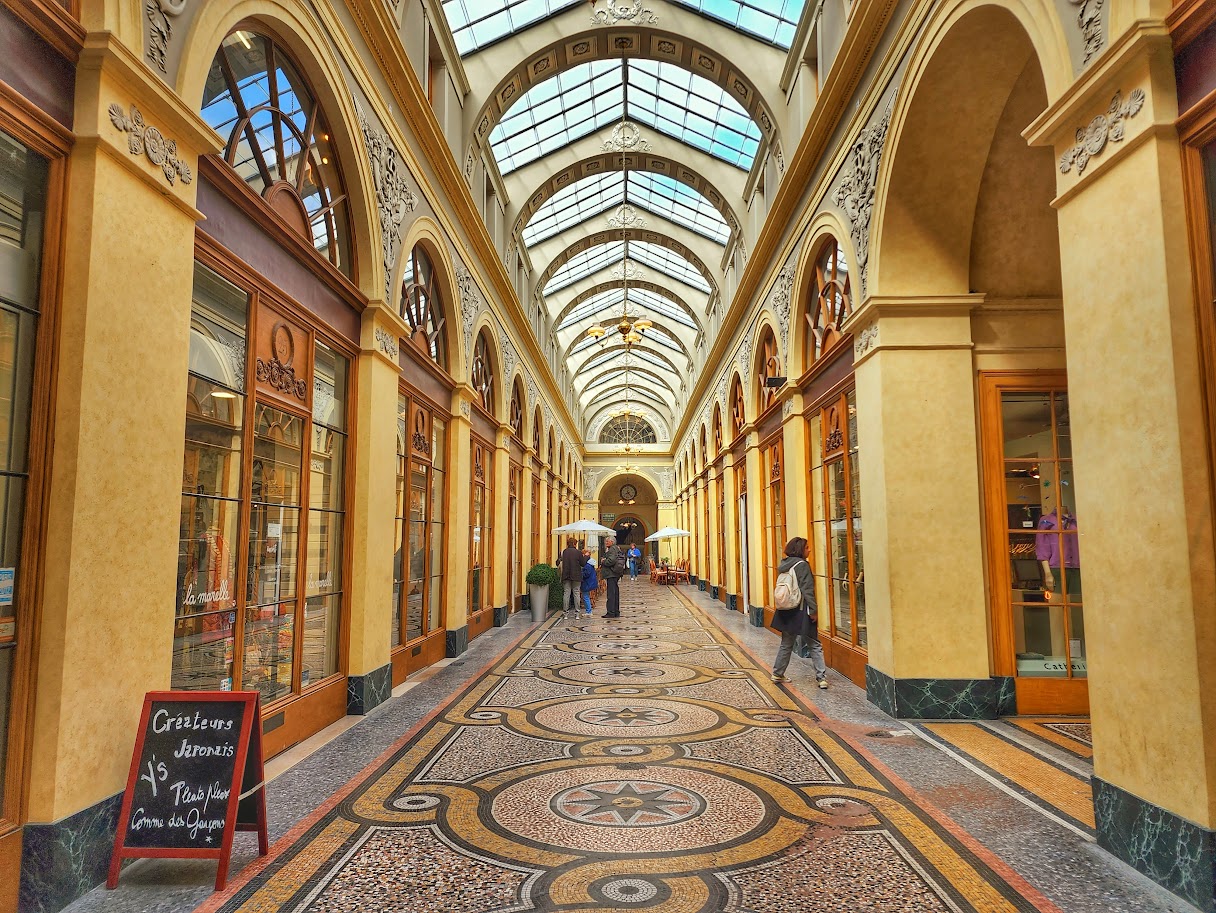
There are places in Paris that I keep going back to, no matter how many times I’ve already visited. They aren’t always the most famous sights, but rather those hidden, charming corners where time seems to have stopped. For me, two of the most magical places like this are Galerie Vivienne and Passage Colbert. Every time I step inside, I feel like I’m leaving the 21st century behind and walking into a time capsule.
The noise of the 2nd arrondissement disappears, the light changes as it filters through the enormous glass ceilings, and the air itself feels different. These covered passages are more than just pretty walkways; they are magnificent remnants of an era when Paris was reinventing itself. Picture the city in the early 19th century: narrow, muddy streets, no sidewalks, filled with noisy horse-drawn carriages. The passages were a real revolution: havens of luxury, warmth and cleanliness for the rising bourgeoisie.
At their peak, Paris had more than 150 such passages, a secret network of shopping and elegance. But the story I want to tell you today isn’t about all of them. It’s about two “sisters” born side by side, in the very same year, and destined for such different fates. One, Vivienne, became the belle of the ball: glamorous, successful and timeless. The other, Colbert, was the tragic beauty, an architectural masterpiece that failed commercially, and it was exactly that failure that kept her pure and perfect to this day. This is a story of success and failure, of commerce and culture, and about two of the most beautiful, best-kept secrets of Paris.
Galerie Vivienne: The Crown Jewel of the Passages
The Birth of a Legend
Our story begins in 1823, with a visionary and shrewd businessman named Maître Louis-Auguste Marchoux (1768-1854), who was president of the Chamber of Notaries of Paris. Marchoux recognized the enormous potential of a strategic location and bought up several properties, among them the Hôtel Vanel de Serrant and the Passage des Petits-Pères.
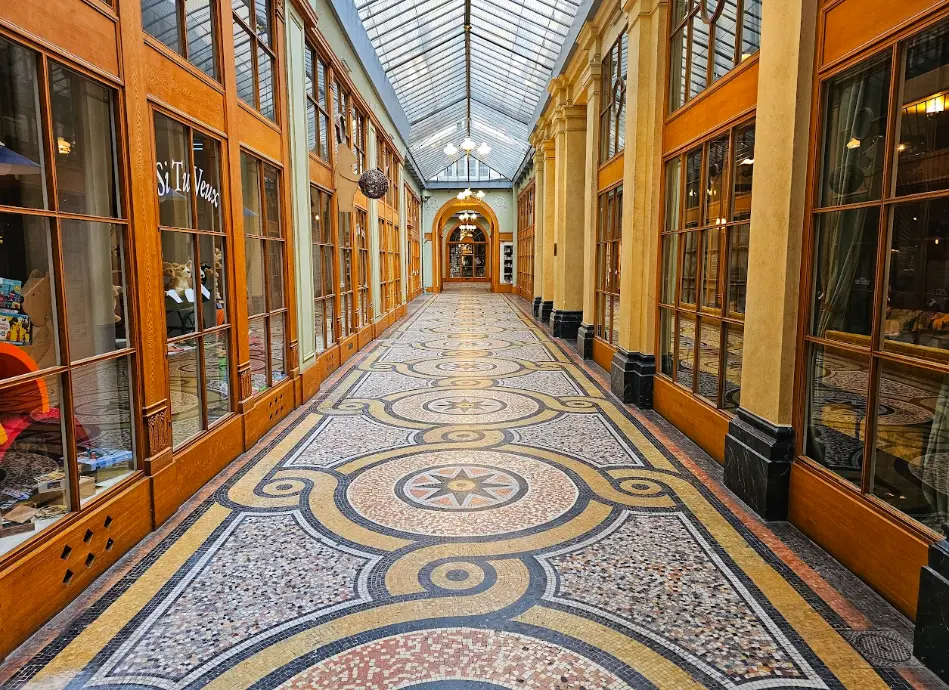
To turn his vision into reality, he hired one of the most prominent architects of the era, François-Jacques Delannoy (1755-1835). Delannoy was no ordinary architect: he was a winner of the prestigious Prix de Rome, a title that spoke to his absolute mastery of the Neoclassical style.
The gallery, officially inaugurated in 1826, was an instant, dazzling success. The reason was simple: location, location, location. It sat in the perfect spot between the Palais-Royal, the Bourse and the Grands Boulevards, which guaranteed a steady stream of wealthy customers, merchants and fashionable society hunting for the latest word in fashion and luxury.
Neoclassical, Pompeian-Style Splendor
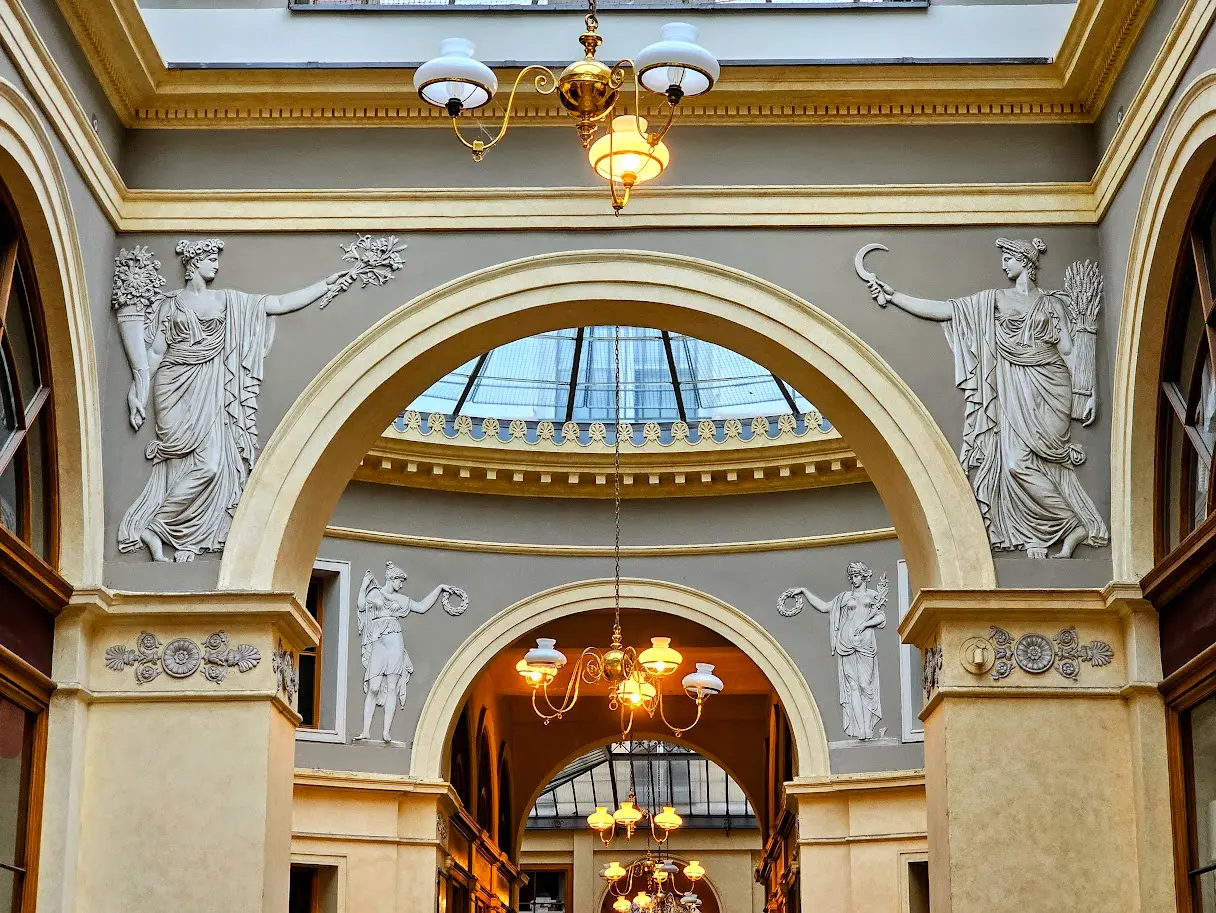
Delannoy’s design was a masterpiece in the Neoclassical, Pompeian style, and it wasn’t meant only to be beautiful; it was meant to send a message. Every architectural detail was designed to “glorify commerce” and celebrate the values of success, wealth and prosperity of the new bourgeoisie that had risen after the Revolution.
The walls and ceilings are decorated with classical symbols that echo that message: the caduceus, the staff of Mercury, god of commerce; cornucopias overflowing with every good thing; laurel wreaths symbolizing victory; and sheaves of wheat as a symbol of abundance. In the central rotunda, statues of goddesses and nymphs complete the feeling that you’ve entered a mythological temple dedicated to shopping.
But the crowning touch, the thing that always takes my breath away, is the floor. It’s a stunning mosaic artwork, signed by the artist Mazzioli. The intricate geometric patterns create the feeling of a warm, luxurious carpet guiding visitors’ steps along the gallery.
And here, friends, let me let you in on a little secret, an amusing historical anecdote. Many sources credit the mosaic’s creation to the legendary Italian artist Giandomenico Facchina (1826-1903). The only problem? Facchina was born three years after the gallery was built. So how can that be? It’s not a simple mistake. Facchina’s reputation in the 19th century was so enormous that his name became synonymous with the highest quality of mosaic work. It’s likely that his workshop carried out an extensive renovation of the floor later in the century, or that his name was simply attached to the site’s history as a stamp of quality, a mark of greatness.
A Golden Age: Fashion, Books and Secrets
At the height of its fame, Galerie Vivienne was a bustling microcosm of the good life in Paris. It was home to tailors, shoemakers, wine merchants, confectioners, print sellers and fashion boutiques. It was the place to be seen, as much a lively social hub as a commercial one.
I want to dwell on one special gem, the Librairie Jousseaume, located at numbers 45-47. This antiquarian bookshop opened its doors in 1826, the same year the gallery was inaugurated, and it’s still operating there today. It isn’t just a shop; it’s a living window into the history of the place, a gateway to the literary world of 19th-century Paris.
The Most Mysterious Tenant of the Passage
Around 1840, the apartment above the monumental staircase at number 13 became home to one of the most fascinating people in the history of France: Eugène-François Vidocq (1775-1857). Vidocq was an escaped convict who reinvented himself and became the founder and first commander of the Sûreté Nationale, the French national police, and later, the founder of the world’s first private detective agency.
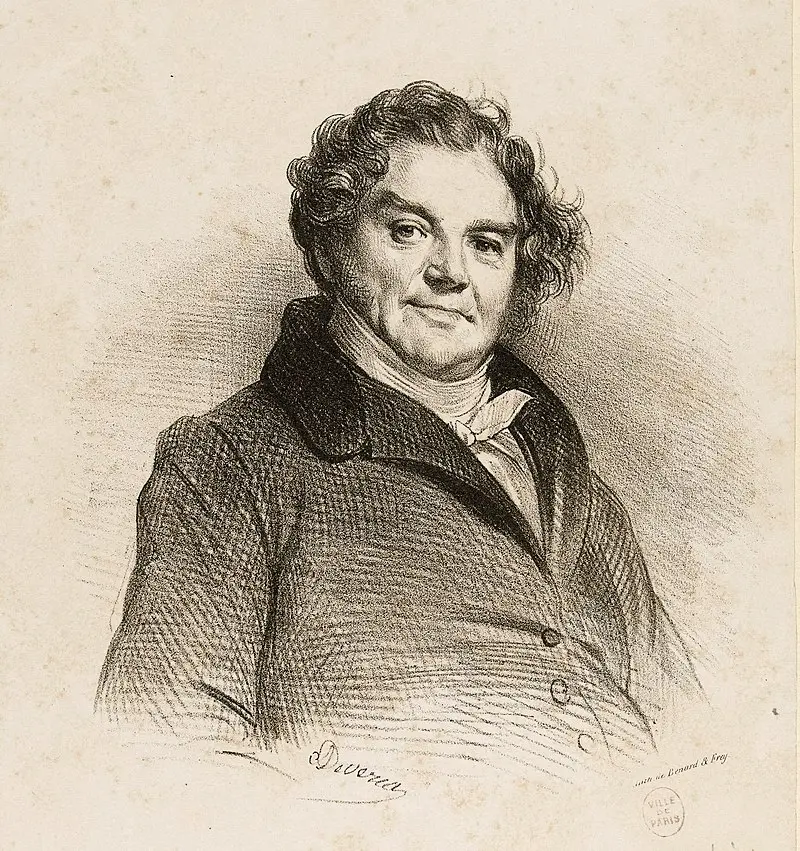
His life story was so extraordinary that it directly inspired the writer Victor Hugo when he created the characters of Jean Valjean and Inspector Javert in his immortal novel “Les Misérables” (he was also Balzac’s model for the character of Vautrin).
Legend has it that a secret underground passage connected Vidocq’s apartment to the gardens of the Palais-Royal, giving him an escape route from the many enemies he had made, both in the underworld and in the official police. This story captures perfectly the dual nature of the gallery: an elegant, lavish facade beneath which secrets and dangers stirred.
The Revolution Sings the Marseillaise
The gallery wasn’t only a stage for commerce and secrets, but also for revolutionary passion. In July 1830, just days after the outbreak of the July Revolution, the young composer Hector Berlioz (1803-1869) found himself swept up with the crowds in the streets of Paris. The crowd, which filled Galerie Vivienne and the neighboring Galerie Colbert, demanded that he sing.
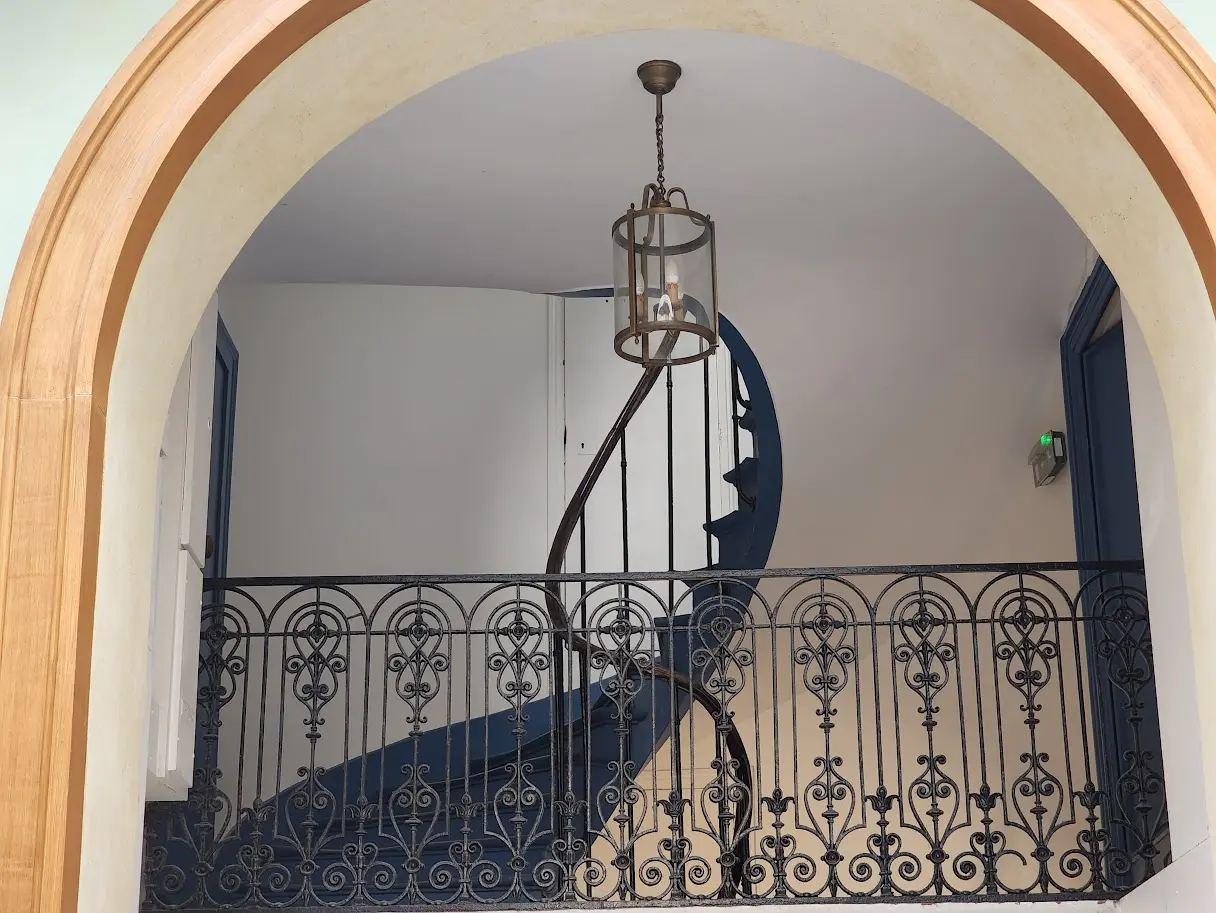
A shopkeeper at Galerie Colbert invited them up to the first floor of her store, and from there, above the heads of thousands of Parisians, Berlioz conducted a spontaneous, rousing performance of “La Marseillaise.” In his memoirs, he described the astonishing acoustic power of the voices in the glass-covered space, an experience so intense that he eventually fainted. The event was a defining moment in the history of the anthem, and it helped restore its status as a revolutionary song.
Decline and Revival
The gallery’s golden age came to an end with the rise of the Second Empire. The wide, grand boulevards laid out by Baron Haussmann (1809-1891) and the giant department stores that sprang up along them, like Galeries Lafayette, drew the fashionable crowd away from the intimate passages. By the 1960s, Galerie Vivienne was badly neglected and facing the threat of demolition.
Its rescue came thanks to the efforts of passionate local residents, among them the surrealist artist Huguette Spengler. The gallery was saved, and in 1974 it was declared a protected historic site. Its modern renaissance began in the 1980s and gained momentum with the arrival of fashion designers like Jean Paul Gaultier (born 1952) in 1986, who restored its status as a temple of high fashion. Today, it’s alive again, breathing, glamorous and essential to the Parisian experience.
Passage Colbert: The Beautiful, Tragic Sibling
Ambitious Rivalry and a Grand Birth
The story of Passage Colbert is a heartbreaking tale of beauty and failure. It was built on historic ground, where the Hôtel Colbert once stood, the mansion of Jean-Baptiste Colbert (1619-1683), the legendary finance minister of King Louis XIV, designed by the great architect Louis Le Vau (1612-1670).
In 1826, a group of investors called “Adam et Cie” saw the phenomenal success of the neighboring Galerie Vivienne and decided to build it a direct competitor, right next door. They hired architect Jean Billaud (1769-1846) and gave him a single mission: build a passage more magnificent and beautiful than the competition.
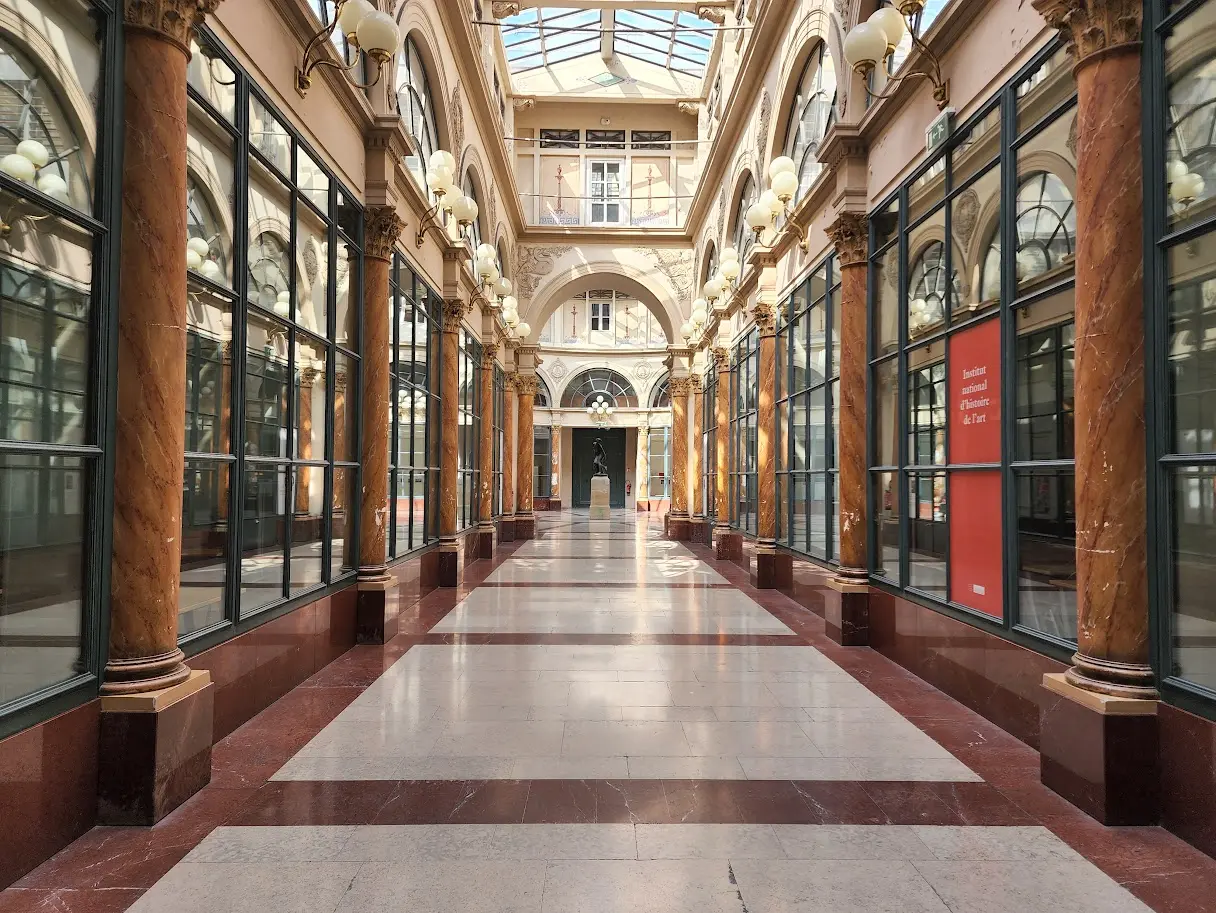
Billaud did indeed create a masterpiece. He designed a spacious passage with marble columns, intricate mosaics, and a breathtaking architectural centerpiece: an enormous, dazzling rotunda, with the clear intention of stealing the show from its successful neighbor.
The Rotunda and the “Luminous Coconut Tree”
The beating heart of the passage was, and still is, its magnificent rotunda, 15 meters in diameter, topped with an enormous glass dome. But originally, beneath the dome stood a design feature that became a Parisian legend: a stunning bronze chandelier with seven crystal globes lit by gas.
The chandelier was so striking and impressive that Parisians nicknamed it “Le Cocotier Lumineux”, the “Luminous Coconut Tree.” Under its soft, romantic glow, the rotunda of Passage Colbert became the most fashionable and sought-after meeting spot for romantic rendezvous during the July Monarchy.
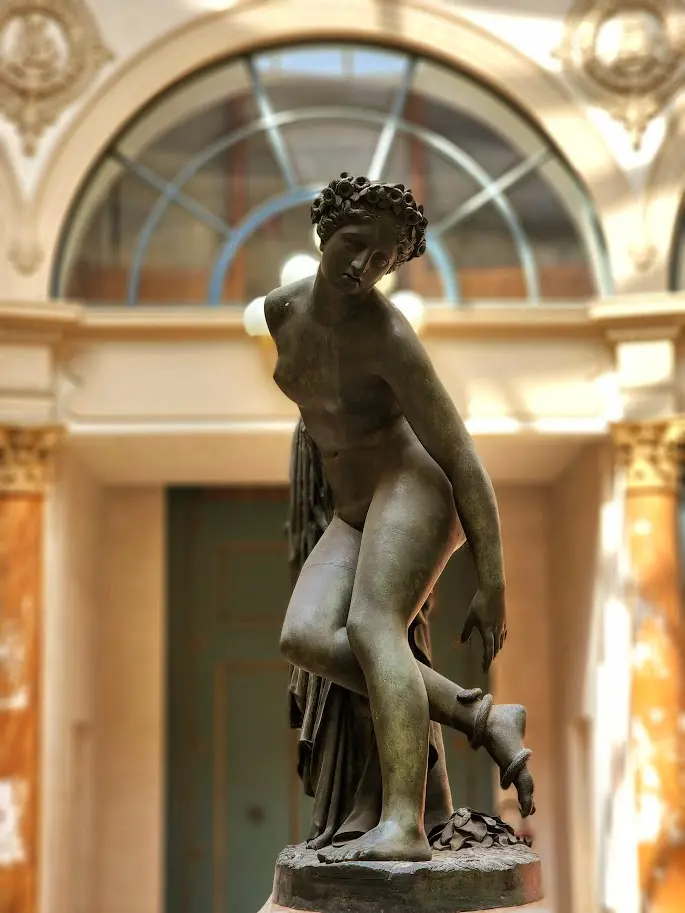
Sadly, this marvel was lost to the depths of history, but we are left with the wonderful statue by Charles-François Leboeuf (1792-1865), depicting Eurydice bitten by the snake.
A Resounding Failure and an Abyss of Oblivion
Despite all the splendor and investment, Passage Colbert was a resounding commercial failure almost from day one. It never managed to attract the shoppers or the luxury boutiques that flocked to Galerie Vivienne. The one notable shop that operated there was a department store called “Au Grand Colbert,” which is in fact the earlier incarnation of the famous brasserie “Le Grand Colbert” that operates there today.
The passage declined rapidly. In 1859 it was acquired by the state, which then let it rot and crumble. For most of the 20th century, it was nothing more than an empty, neglected shell, a pale shadow of its intended glory, a place forgotten by Parisians.
A Cultural Revival
Like its sister, Passage Colbert was also declared a protected historic site in 1974. But its true redemption came in the early 1980s, when it was acquired by the National Library of France (Bibliothèque Nationale de France).
After a thorough, meticulous renovation completed in 1985, the passage was reborn, not as a shopping center, but as a cultural one. The shops disappeared, replaced by an atmosphere of quiet study and research.
Today, the passage houses the National Institute of Art History (INHA) and the National Heritage Institute (INP), alongside other research institutions. It has become a temple of knowledge, a place where the past is studied and preserved rather than sold.
And here lies the true beauty of Passage Colbert’s story. Its commercial failure is the main reason it has survived so perfectly intact. While Galerie Vivienne evolved and changed over 200 years, with shops opening and closing and designs updated, Passage Colbert is an almost frozen snapshot of the original 1826 architectural vision. Its failure protected it from the wear of commerce and the whims of fashion. It isn’t a living shopping passage, but a museum of one, offering a purer, more scholarly glimpse into the past than its successful sister.
Practical Information for a Perfect Visit
Address
Galerie Vivienne: 4 Rue des Petits Champs
Passage Colbert: 6 Rue Vivienne
Opening Hours
Galerie Vivienne: open to the public daily, from 8:30 a.m. to 8:30 p.m. Free admission.
Passage Colbert: also open daily, but keep in mind it’s mainly used as a passage for academic institutions. The atmosphere there is quieter and more scholarly, so I recommend visitors respect the unique character of the place.
Part of My Passages Itinerary
These two magnificent passages are the highlight of my detailed walking route dedicated entirely to the covered passages of Paris. If this idea has caught your interest and you want to discover more hidden gems like these, I invite you to join me for a full journey in their footsteps.
You can find the complete walking route for the Parisian passages right here on the site.
