

I’ll confess: the first time I ever heard of Saint-Paul-de-Vence was while listening to the lovely song Ma môme by Jean Ferrat (1930-2010).
There, he sings about a couple who never actually make it to Saint-Paul-de-Vence.
Instead, they spend every vacation in Saint-Ouen, a suburb of Paris.
Since Jean Ferrat’s romantic song is about a working-class couple, I was sure Saint-Paul-de-Vence was a place where the high society of France went to vacation, and I immediately pictured a beach, luxurious hotels, and women dressed head to toe in Dior and Chanel.
I was wrong. Saint-Paul-de-Vence isn’t a seaside resort town on the southern coast of France like Saint-Tropez, but an ancient village. True, it has no shortage of glamour, like quite a few spots on the French Riviera, but what really stands out is its history, and especially the fact that it was one of the villages most loved by artists in the 19th and 20th centuries.
The more I read about the place, the more my curiosity grew, and in July 2023 I finally got to visit, as part of a press trip I took as a guest of the Côte d’Azur tourism board.
In this article, we’ll tour this enchanting village together, explore its history, which stretches back more than 1,000 years, discover the spots you shouldn’t miss, and of course, I won’t forget to give you all the practical information you need to plan your trip to this wonderful place.
So let’s lace up a comfortable pair of walking shoes and get going.
The history of Saint-Paul-de-Vence
Saint-Paul-de-Vence sits on a rocky hill between the Mediterranean Sea and the French Alps. Thanks to its strategic location, the counts of Provence built a castle at the top of the hill, with a church beside it (Saint Michel du Puy). In 1285, the Count of Provence granted the village the right to host a fair on its grounds, turning the small settlement into a thriving town.
In 1388, following the transfer of the County of Nice to the rule of the Count of Savoy, Saint-Paul-de-Vence came under his control as well, since it fell under the authority of the County of Nice. Its strategic position, right on the border between the County of Savoy and the County of Provence (which belonged to the King of France), meant its rulers never stopped fortifying it. Even today you can see the thick walls that protected the village from the 14th century onward, and you can still visit the Porte de Vence, which has survived from that era.

During the reign of Francis I (r. 1515-1547), Saint-Paul-de-Vence continued to be a strategic target, given its proximity to the Italian peninsula. After changing hands several times, the King of France decided to upgrade the village’s fortifications, and during the construction, the village even hosted Francis I himself.
If the 16th century is remembered in the village’s history as a time of wars (first between the King of France and the Habsburgs, and later the brutal wars of religion between Catholics and Protestants), the 17th and 18th centuries are considered a period of growth and prosperity, for two reasons.
The first reason was that, as part of the Catholic belief that making churches more beautiful would bring Protestants back into the fold (a process known as the Counter-Reformation), the village’s ancient church was upgraded. The second reason was that, during this period, more and more noble families from Provence came to settle in the village and built grand houses there, especially on Rue Grande.
In 1860, Nice came under French rule, and Saint-Paul-de-Vence lost its strategic importance. As a result, the French government decided to tear down the village’s walls in order to expand it. The village’s mayor, Henri Layet (1824-1899), managed, after quite a struggle, to prevent the worst in 1872: the village bought the wall from the French government for 400 francs and managed to preserve its character. In 1945, the village’s walls were declared a historic monument, which protects them from any future harm.
Saint-Paul-de-Vence becomes a village of artists
The peaceful, pastoral setting, combined with the stunning scenery and architecture, drew several important artists to settle in the village during the 20th century.
One of the first to discover the village for its unique light and colors was Paul Signac (1863-1935), the father of pointillism (le pointillisme), painting with dots, who painted several works of the village.

Later, Raoul Dufy (1877-1953) arrived here from the Fauvist movement, and the famous Jewish painter Chaïm Soutine (1893-1943) visited and painted here as well. They were later joined by another Jewish artist, Marc Chagall (1887-1985), whom I’ll write more about shortly, and so Saint-Paul-de-Vence became, in a way, a southern outpost of Montparnasse in Paris.
Quite a few of these artists loved staying at the hotel la Colombe d’Or, which belonged to Paul Roux, and it was Roux who decorated his hotel with paintings by some of the most important artists of the 20th century. Over the years, this hotel became a stronghold of Parisian bohemia, and it’s where the famous couple Yves Montand (1921-1991) and Simone Signoret (1921-1985) stayed during their wedding in 1951.

The couple met in August 1949, when Simone Signoret, who was living in the village at the time, walked past the inn I mentioned earlier together with her friend, the poet Jacques Prévert (1900-1977), and found Yves Montand there having dinner with his guitarist. Signoret, who had left her first husband only a short while before, fell for Yves Montand, invited him over, and the rest is history.
Montand and Signoret’s wedding marked the start of Saint-Paul-de-Vence’s golden age, between 1950 and 1960. During this period, many famous directors and film figures came here, largely thanks to the poet and playwright Jacques Prévert, who lived in the village.
Despite all the famous names I’ve mentioned, no name is more closely tied to Saint-Paul-de-Vence than Marc Chagall. He returned to France in 1948, after living in the United States for several years, and decided to move to the French Riviera, which had by then become a major center of art.
He chose Saint-Paul-de-Vence, not far from where Henri Matisse (1869-1954) and Pablo Picasso (1881-1973) lived. For nearly 40 years, Chagall continued to create there, and despite their geographic closeness to Picasso, the two never collaborated (though they certainly admired each other). In 1964, the famous modern art museum Fondation Maeght opened there, and in 2008, the painter Jean-Michel Folon (1934-2005) finished decorating the chapel of the local church.
All of this created new artistic attractions that drew pilgrimages of art lovers, cementing Saint-Paul-de-Vence in the national consciousness as “the village of artists”, a status it still enjoys to this day.
Fondation Maeght
Let’s begin our visit, fittingly, at a museum located outside the village itself, but tied to it by countless threads, and one that’s the village’s single most important attraction.
The story of this place begins when Aimé Maeght (1906-1981), a famous Parisian art dealer, arrived in Saint-Paul-de-Vence with his wife and their son, who was suffering from leukemia, in the early 1950s. Aimé Maeght, by the way, also organized the first historic exhibition of the Algerian painter Baya (Baya Mahieddine, 1931-1998) at his successful gallery. In 1953, Maeght’s son lost his battle with the disease and died at age 11. The grieving couple tried to pick up the pieces and get back on their feet after this terrible ordeal.
The ones who came to the Maeghts’ aid were the artists living in the village and its surroundings, whose work Aimé had shown in his gallery. Georges Braque (1882-1963) suggested that Aimé build a museum to honor the memory of their son, and the couple poured all their energy into making the project happen.

The museum opened in 1964, designed by the Spanish architect Josep Lluís Sert (1902-1983). The architect was also a painter and the husband of the cultural icon Misia Sert (1872-1950). In the third and fourth parts of my series on Misia Sert, you can get to know him in more depth. At the museum, you’ll find works by some of the greatest artists of the 20th century, including Georges Braque, Pierre Bonnard (1867-1947), Marc Chagall, Joan Miró (1893-1983), and Alberto Giacometti (1901-1966), among others.
Beyond that, you’ll also find a garden designed by Giacometti, Miró, and Braque, a plant labyrinth, and a pond with a fish mosaic. Alongside all of this is also a chapel dedicated to Saint Bernard, in memory of the Maeghts’ son, who was also named Bernard.
Address: 623 chemin des Gardettes
What should you see in Saint-Paul-de-Vence itself?
Now that you know a bit about the history of the place, it’s time to go out and see it for yourself. As you wander through the village, you’ll notice about 20 signs offering information on the various attractions. Each sign has an NFC chip, so you can tap your phone against it and watch videos describing the history of that specific spot.
Here are a few attractions you shouldn’t miss.
The churches of Saint-Paul-de-Vence
As a well-known lover of churches, there was no way I’d skip the village’s places of worship. To my delight, I found several churches, each well worth a visit since none of them is “more of the same.”
The Collegiate Church (L’ÉGLISE COLLÉGIALE)
This is the largest and oldest church in the village, built in stages between the 14th and 18th centuries, and so it contains a mix of different styles.
When you visit the church, you’ll find quite a few medieval elements. The most important part, though, is the Chapel of Saint-Clément, built in 1680. The reason is that in 1666 the church was “promoted,” becoming a collegiate church (a kind of cathedral, but without a bishop), and thanks to that it underwent an extensive makeover.
You can see the result in the Chapel of Saint-Clément, built by the Bernardi family, one of the important noble families of Saint-Paul-de-Vence. There you’ll find French Baroque art at its height, in the form of paintings and small statues. This spot is definitely not to be missed.
Address: Place de l’Église
The Chapel of the White Penitents (LA CHAPELLE DES PÉNITENTS BLANCS)
This chapel was built in the 17th century for the Order of the White Penitents (named for the white robes they wore). The order helped the sick, distributed food to the poor and hosted pilgrims, and it existed until 1920.
After the order disbanded, the chapel fell into disrepair, until a full renovation was decided on in 2000. The Belgian artist Jean-Michel Folon carried out the renovation, and today the chapel displays his work in the form of stained glass, murals and more.

Admission ticket price: 3 euros (as of July 2023).
Address: Place de l’Église
Open days and hours:
April 15 to October 15: daily, 10:00-12:30 and 14:00-18:00.
October 15 to April 14: daily except Tuesday, 10:00-12:30 and 14:00-17:00.
The Chapel of Saint-Charles-Saint-Claude (LA CHAPELLE SAINT CHARLES-SAINT CLAUDE)
This small chapel was built in the late 17th century by Charles Raymond and Claude Barcillon, which is why it is named after the saints whose names they bore.
Around 2010, the artist Paul Conte painted a series of murals in the chapel depicting the lives of Saint Claude and Saint Charles, and you’re welcome to step inside and see them.
Address: Chemin Sainte-Claire
The Chapel of Notre-Dame des Gardettes
This chapel, located on the road leading to Tourrettes-sur-Loup, is first mentioned in 1476. Like the Collegiate Church, it also received a significant upgrade during the 17th century, so you’ll find plenty of Baroque-era artwork inside. Alongside those, you’ll also find a series of murals painted by two artists who lived in the village between 1926 and 1930, depicting the life of the Virgin Mary.
Address: Chemin Sainte-Claire
The walls of Saint-Paul-de-Vence
We’re talking about a kilometer of walls and various fortifications, built by King Francis I (r. 1515-1547) during his wars in Italy. This is one of the earliest examples of this kind of fortification, which is where its historical importance comes from.

Sadly, building the walls forced a good number of the village’s residents to leave, since their homes were torn down to make way for the fortifications. On the other hand, the walls protected the village, and today you can walk along them and enjoy a stunning view. Was it worth the price? You decide.
While you’re visiting the fortifications of Saint-Paul-de-Vence, don’t miss these spots:
The donjon
A donjon is a tower usually found at the heart of a castle, and this one is the only remnant of the castle that stood here during the Middle Ages. The tower began to be built during the 13th century, and a bell was added to it in 1443.
Quite a few famous people lived here, including:
- Ramon Berenguer IV (1198-1245), Count of Provence and father of several women who became queens of France and England.
- Francis I, King of France.
- Sébastien Le Prestre de Vauban (1633-1704), the greatest of France’s military architects, who built no shortage of fortresses during his lifetime.
Since the 18th century this building has housed the town hall, and it’s here that Yves Montand and Simone Signoret got married in 1951 (one of their witnesses was the famous poet and playwright Jacques Prévert, whom I mentioned earlier).
Not far from there, at number 2, you’ll find the house where Yves Montand and Simone Signoret lived.
Address: Place de la Mairie
The Machicolation Tower (LA TOUR À MÂCHICOULIS)
The word “machicolation” might sound like something out of a medieval glossary, but it refers to a tower with openings in the floor through which rocks or boiling oil could be dropped on enemy soldiers.
This tower is important because it’s one of the only remnants of the village’s medieval walls (as you now know, most of the fortifications you’ll see were built by Francis I).
Address: Rempart Ouest
LA TOUR DE L’ESPERON
This is a square, multi-story tower attached to the wall built by Francis I. The site was once used to store gunpowder.
Address: Rue de la Prison
The Dauphin Bastion (LE BASTION DU DAUPHIN)
This bastion, named for the title held by the heir to the French throne, guarded the northern entrance together with the royal bastion. Together, the two were meant to create crossfire against the enemy to keep them from advancing and breaking through the village gates.
There you’ll find an old cannon named Lacan, taken as spoils from the Battle of Ceresole in 1544.
Address: Place Neuve
Place du Jeu de Boules
This square is dedicated to pétanque, a game hugely popular in Provence. Players throw metal balls, trying to land them as close as possible to a small target ball, and whoever manages that best is declared the winner.
Yves Montand and Lino Ventura, two of the most famous actors in French cinema (Yves Montand was, of course, also a singer), spent countless hours playing here.

Besides the ball games, you’ll find a café here (Café de la Place) where you can sit on the terrace and watch people playing pétanque while you sip a pastis. On the other side of the square you’ll find the famous inn La Colombe d’Or, which I mentioned earlier in the section on the history of Saint-Paul-de-Vence.
The cemetery of Saint-Paul-de-Vence
As a big fan of cemeteries, there was of course no way I could skip this one. The most famous person buried here is Marc Chagall (1887-1985), along with his last partner, Vava Chagall (1905-1993).

You’ll also find the graves of Aimé and Marguerite Maeght, who founded the Fondation Maeght, which I wrote about earlier. They’re both buried there next to their son Bernard, who died at age 11, and whose death became the trigger for the creation of Saint-Paul-de-Vence’s major museum.
Rue Grande
On your way out of the cemetery of Saint-Paul-de-Vence, don’t miss this street, lined with boutiques where you’ll find various artworks by local artists.

Also don’t miss number 71, which has stood since the 16th century, and number 92, which belongs to the Alziary family, one of the respected families of the village.
Place de la Grande Fontaine
This is one of the village’s main squares, named after the fountain found there, which once supplied water to the laundry building that still stands today. It’s one of the coolest spots in the village thanks to the flowing water and the stonework, and a great place to relax on a hot summer day.
Where should you eat in Saint-Paul-de-Vence?
For such a small village, there’s no shortage of restaurants and cafés, so everyone should be able to find something that suits them. Here are a few places that caught my eye:
LA COLOMBE D’OR
Saint-Paul-de-Vence’s legendary restaurant has been serving fresh, simple local food since it opened. On the menu you’ll find stuffed vegetables, baked tomatoes, anchovies and other traditional Provençal dishes.
Address: 1 Place du Général de Gaulle
Link to the restaurant’s website
CHEZ ANDREAS
A great spot for a meal or just a drink while you take in the stunning view spread out below you. The menu is fairly eclectic, offering small sharing plates alongside pasta, onion soup and foie gras. Prices are modest to reasonable.
Address: Rempart ouest
LA FONTAINE
This restaurant is open every day from 10:00 to 22:00 (a rare thing in France, and a welcome one in my opinion, since it lets you eat whenever you like without being tied to a strange schedule).
The place is run by chef Jérôme Garello, and you’ll find Mediterranean cuisine here along with set menus ranging from 19 to 35 euros (as of July 2023).
Address: 10 montée de la Castre
More restaurants
These were three restaurants that caught my eye, but there are plenty more in the village. You can find information about them at this link.
Where to stay in Saint-Paul-de-Vence
Want to feel a bit like Yves Montand and Simone Signoret? Why not spend a few days in this romantic, enchanting village and use it as a base for day trips around the region?
Here are a few hotels that might suit you:
Domaine du Mas De Pierre

A 5-star hotel with a huge pool, set in the middle of Saint-Paul-de-Vence’s olive groves. The property is made up of 5 bastides, old stone farmhouses, each containing several rooms (76 rooms in total). Beyond the pool and the garden you’ll find two excellent restaurants: the first (La table de Pierre) serves sophisticated international cuisine, while the second (Lis Orto) serves local fare.
If you’re traveling with kids, you’ll be happy to know the hotel grounds include a playground called Jardin d’Alice, based on the story of Alice in Wonderland, and the hotel staff are happy to keep your children entertained during the day (if you visit during school vacation season).
Hôtel La Grande Bastide
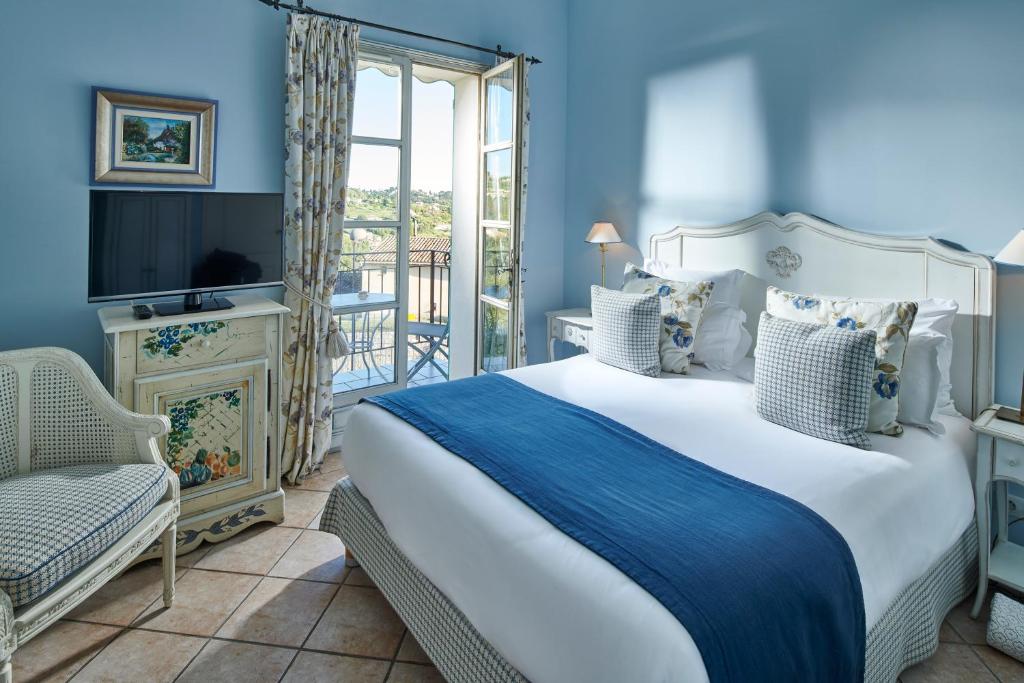
A 4-star hotel housed in an 18th-century building overlooking Saint-Paul-de-Vence. The rooms are decorated in a Provençal style, and as with many hotels at this level, you’ll also find a swimming pool here along with two terraces overlooking the scenery, where you can eat breakfast.
Les Messugues

If you’re looking for a cheaper option that’s just as indulgent, check out the 3-star Les Messugues hotel, a 5-minute drive from Saint-Paul-de-Vence and close to the Fondation Maeght.
Some of the rooms have terraces where guests can sit with a book and a glass of wine and take in the view. On top of all that, there’s a restaurant called La Table des Messugues, serving homestyle local food in a friendly atmosphere.
More hotels in Saint-Paul-de-Vence
If none of these hotels are available or don’t suit you, feel free to check out this link for a whole range of other excellent hotels in the area.
Related reading