

I first came to the town of Dinan (Dinan) in 2017, and I fell in love with it right away. The tiny streets where charming timber-framed houses hide, the history peeking out from every corner, and of course the little boutiques on rue de Jerouzal and rue de l’Horloge, all of it gave me that “wow” feeling (and anyone who knows me knows how hard it is to get me excited). And honestly, it’s not surprising. After all, Dinan was voted the second most photographed small town in France out of 50…
So nobody fell off their chair when I insisted that Dinan would one day star in my boutique tour of Brittany. But even if you never get the chance to travel with Dani and me there, I highly recommend the place. That’s why I made this article just for you, so you can discover Dinan at your own pace.
The history of Dinan
Dinan is like a swallow’s nest above the abyss. Victor Hugo (1802-1885)
Before we get into the practical stuff, it’s worth saying a few words about the history of Dinan so you understand where you’re walking and why Dinan is so beautiful.
Dinan was founded on the banks of the Rance river around the year 1000 AD by the Lords of Dinan, who ruled it until 1283. From that point on, the Dukes of Brittany ruled the town, and over the following years Dinan became one of the most important cities in the duchy thanks to the cloth and leather trade. Unlike other port towns that grew up in the valley next to the harbor, Dinan developed mostly on the hill overlooking the port, and thanks to its walls it became a fortress that was very hard to conquer.
Those walls came in handy during the 14th century, during the War of Breton Succession, when Dinan backed the French candidate, the Count of Blois, and managed to fend off two English attacks. The Count of Blois was killed in battle against the English in 1364, and the English won. But despite all that, Dinan managed to recover, and during the 16th century it became a wealthy town once again. Dinan’s golden age lasted until the end of the 18th century, and you can still see the results today in its streets. First, you’ll see quite a few colorful, beautiful timber-framed houses that once belonged to the town’s merchant families. Second, you’ll find no shortage of churches and monasteries that belonged to religious orders (Capuchins, Dominicans and others), who were apparently drawn to the town by its wealth.
During the 19th century, Dinan’s port lost its commercial importance because of the invention of the railway, and during the 20th century the town was bombed. Despite all that, the vast majority of the houses remained as they were, and the town’s charm was not only preserved but actually grew, thanks to the fact that it never became a large industrial city like other towns in Brittany.
So now that you know at least a little about the history of Dinan, it’s time for the practical part…
Recommended hotels in Dinan
If you’re planning to visit Dinan for just a few hours and have rented a car, I highly recommend staying at Manoir de la Chausée or at one of the recommended hotels in Saint-Malo. If you’ve decided to make Dinan the base for your trip, here are a few excellent options.
Le 27- Boutique B&B

An excellent, beautifully designed bed and breakfast in the heart of Dinan’s old town. Breakfast here is excellent and the rooms are indulgent. If you’re in the mood for a game of billiards after a long day of walking, you can do that here too.
La Maison Pavie

A very charming hotel housed in an ancient building from the 15th century. Despite the building’s history, the rooms are very modern and indulgent (including a wonderful bathroom). Breakfast isn’t bad at all either, and you can eat it in the hotel’s garden.
La Villa Côté Cour & Côté Spa

This is a charming, indulgent villa within walking distance of all of Dinan’s main attractions. Beyond its great location, the villa also offers guests a jacuzzi and sauna, a great option after a long day of touring Brittany. There’s also free parking on the street next to the villa, which makes this an excellent base for a trip through Brittany.
Hotel Arvor – O’Lodges by Arvor
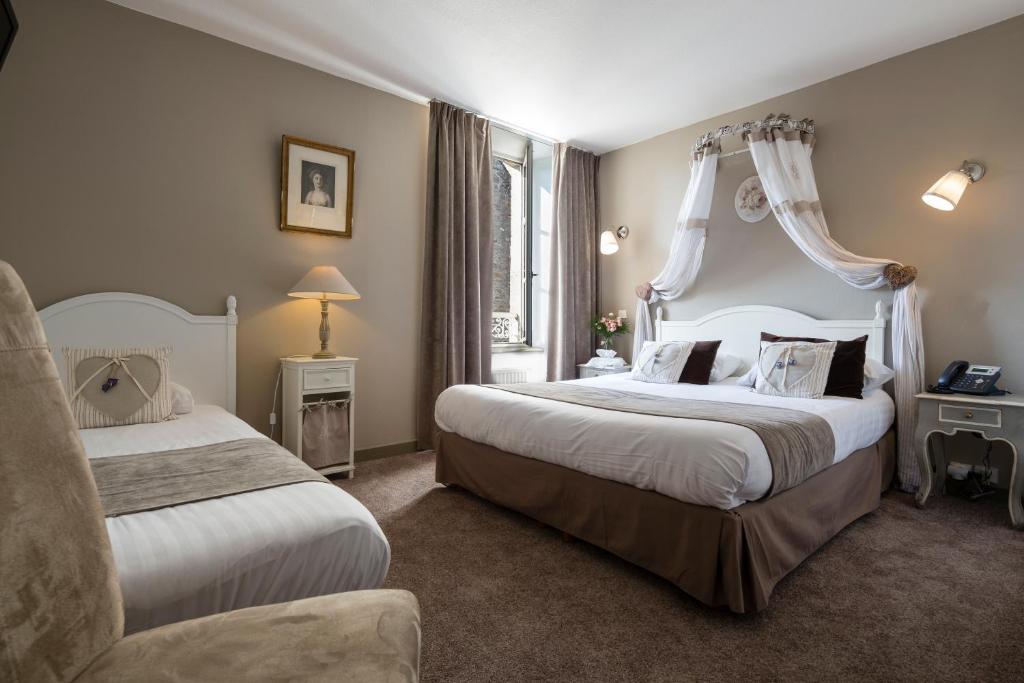
Want to stay in central Dinan, within the walls of an 18th-century monastery? This is the hotel for you. Every room is decorated in a different style, and despite being an old building, you’ll find everything a modern hotel offers, like fast WIFI.
Mercure Dinan Port Le Jerzual

An excellent 4-star hotel located in Dinan’s old port area. The rooms here are very modern and indulgent, so it’s no surprise it earned a high rating on Booking.com.
All the recommended hotels in Dinan are booked up?
Feel free to check out this link to discover a whole list of excellent hotels and indulgent vacation apartments.
A walking route through Dinan

Historic Dinan is a small town, and you can see most of the interesting sights in a single day. The route I’m suggesting runs through the town itself and starts down at the port. You can also do it in reverse, starting up near Dinan’s castle and ending at the port. You can also explore Dinan from up on its walls. If you decide to walk along the town’s walls (which, by the way, are the longest in Brittany), I’ll tell you later where you can climb up to them.
But as I said, we’ll start down at Dinan’s port…

You’re standing in the port that was responsible for Dinan’s wealth between the 14th and 18th centuries. Today you’ll find small boats and restaurants along the riverbanks here. I ate a seafood platter at the restaurant l’Atelier Gourmande that wasn’t bad at all, so I definitely recommend the place.

Rue Petit Fort and Rue Jerouzal
After you’ve walked along the river and maybe even eaten an oyster or two, it’s time to get in shape and start climbing up through Dinan’s most charming streets. Start at number 82, where you’ll find an excellent Breton pâtisserie that sells kouign-amann. What is kouign-amann, you ask? It’s a rich Breton pastry made of layers of butter, sugar and dough, baked until it’s dense, sweet and absolutely delicious (and absolutely not diet-friendly).
Whether you bought a kouign-amann or not, start climbing up Rue Petit Fort, and at number 24 you’ll find a lovely 15th-century house called the “Governor’s House” (Maison du Gouverneur). Keep climbing and you’ll reach the Porte du Jerzual, which is part of the 14th-century walls that surround the town. As I mentioned, you can climb up onto these walls for a panoramic view of the town and the surrounding area.
There are two “promenades” that let you see all of Dinan from the town walls: the first is the Promenade de la Duchesse Anne and the second is the Promenade des Grands Fossés. If you decide to walk them, don’t miss the impressive Beaumanoir tower.
If you decide to skip the walls for now, continue along rue de Jerzual and you’ll see colorful, charming timber-framed houses on every side. Today some of them house craftsmen and others small boutiques. It’s a pure visual treat.

Place des Merciers
Not far from the end of rue de Jerzual is the Place des Merciers (the haberdashers’ square). As I mentioned, the cloth and textile merchants made a fortune during the 15th to 18th centuries, and the result is a set of magnificent timber-framed houses and a simply charming square. If you want to eat there, try the old restaurant Chez la Mère Pourcel, which serves pretty good local food at very reasonable prices (18 euros for a three-course lunch).

The Clock Tower (Tour de l’Horloge)
Leave Place des Merciers and head to rue de l’Horloge. This is Dinan’s main shopping street, and you’ll find all kinds of shops here. But what’s most interesting about the street, in my opinion at least, is the clock tower that gave the street its name.

The tower was built by Dinan’s wealthy bourgeoisie during the 16th century, and the clock itself was a gift from Duchess Anne of Brittany (1477-1514), which makes it one of the oldest clocks in Europe. You can climb the tower, and you’ll be rewarded with a stunning panoramic view of Dinan and its surroundings (a great way to burn off the calories from the kouign-amann I recommended earlier, or at least ease your conscience a little).
Dinan’s castle and the statue of du Guesclin
Continue along rue de l’Horloge, which eventually becomes rue de Léon, and at the end of the street turn right. You’ll quickly reach Dinan’s castle. This is a very impressive castle built in the Middle Ages by Duke John V of Brittany (r. 1399-1442), and for a fee you can visit the site and learn about the castle’s history. I didn’t manage to photograph the castle properly this time, so here’s a short video instead 🙂
In the nearby square you’ll find the statue of Bertrand du Guesclin (1320-1380), a French war hero who managed to defeat the English again and again during the 14th century.

I suggest ending the walk here, but not before I recommend two restaurants about a five-minute walk from the du Guesclin statue.
- Fleur de Sel, a recommendation from my friend Anton Chili, who knows a thing or two about food, as you can read in the article A culinary tour of the Marais. This restaurant serves excellent seafood dishes and has a set menu for 32 euros (quite reasonable for a restaurant at this level).
- Crêperie Ahna, located at 7 Rue de la Poissonnerie. It’s considered the best crêperie in Dinan, and some say in the whole area.
Wait, what about a church or two?
You’re absolutely right! How could a church lover like me not weave in a house of worship or two into my route? So, having confessed my sin and owned up to it, here are a few churches you shouldn’t miss.
Basilique Saint-Sauveur

A beautiful basilica built between the 12th and 16th centuries. Inside you’ll find the heart of du Guesclin, whom I mentioned earlier. Take a close look at the church’s façade, whose statues depict mankind’s various sins in very graphic detail.
Address: 14 Place Saint-Sauveur.
Église Saint-Malo

This is a very beautiful church whose construction began in the 15th century (take a close look at the Renaissance door on the façade). The church was looted during the French Revolution, and as a result the interior might be a bit of a letdown (unless you love stained glass, in which case you’re in for a treat).
Address: 12 Rue de la Boulangerie
That’s it. I hope you enjoyed this, and if you’re looking for more information about Brittany, don’t miss this page.
Related reading