

There are cities you meet once, fall in love with, and move on. And there are cities that become part of your life’s journey, regular stops on a personal road. For me, Saint-Malo is one of those cities. Between 2016 and 2018, I lived on the island of Guernsey in the English Channel, and Saint-Malo was my gateway to France, the place where the ferry docked and from which I would continue by train to Paris.
Every single time, the approach to the city from the sea was breathtaking. Even before I could make out the coastline of Brittany, I saw it: a mighty stone ship, a “vaisseau de pierre” as it’s called, rising out of the waves. Its massive granite walls, encircling the old town, looked impenetrable, a statement of power and independence facing the wild Atlantic Ocean.
These repeated encounters with Brittany’s gatekeeper sparked my curiosity. I knew that behind these walls lay stories of saints who arrived by sea, of fearless corsairs who terrorized the English, and of a stubborn spirit that refused to surrender, even in the face of total destruction. In this article, I want to take you on a journey into the beating heart of Saint-Malo, to uncover its secrets and discover why it’s so much more than just a pretty port city.
A Stormy History: “Not French, Not Breton, but Malouin”
To understand Saint-Malo, you need to understand its soul, and that soul was born from the sea and the rock. It is rooted in stories of people who carved out their own fate, against the forces of nature and against great empires. This is a history of stubborn independence, one that was distilled into a single sentence that became the city’s motto.
From a Welsh Monk to a Stubborn Duchess
It all began, as so often happens in Brittany, with a Celtic saint who arrived by sea. In the 6th century, a Welsh monk named Maclou, one of the followers of Saint Brendan the Navigator, crossed the channel and settled on a rocky island near the coast, which until then had been home to another monk named Aaron. The small monastery he established there became the seed from which the city grew, eventually adopting his name and becoming Saint-Malo.

The island’s strategic location, naturally protected and commanding the mouth of the Rance River, turned the small settlement into an important trading and maritime hub. But along with prosperity came a growing sense of separateness. The residents of Saint-Malo, known as “Malouins,” saw themselves first and foremost as seafarers, loyal only to their city and its wealth. They managed their own affairs independently, often ignoring the orders of the dukes of Brittany or the kings of France.
Duchess Anne and the Tower That Annoyed the Malouins
The tense relationship between the fiercely independent city and the ducal authority reached a peak at the end of the 15th century, in the time of one of the most important figures in Brittany’s history, Duchess Anne de Bretagne (1477-1514). Anne, who was also queen of France, wanted to secure her control over the rebellious city. Between 1498 and 1501, she ordered the construction of an imposing tower at the city’s castle, a tower built deliberately against the wishes of the people of Saint-Malo.

To emphasize her supremacy and show the Malouins who was in charge, the duchess had an inscription carved onto the tower: “Quic-en-Groigne, ainsi sera, car tel est mon plaisir”: “Whoever grumbles, so it shall be, for such is my pleasure.”
The tower took the name “Quic-en-Groigne,” and it still stands today as a testament to the duchess’s stubborn spirit, and as a permanent reminder to the Malouins of the time they were shown their place.
The Independent Republic of Saint-Malo
This rebellious spirit reached its peak at the end of the 16th century. Amid the Wars of Religion that tore France apart, between 1590 and 1594, Saint-Malo did the unthinkable: it declared itself an independent republic. For four years, the city operated as a genuine city-state, with its own senate, and coined the motto that still sums up its essence to this day: “Ni Français, ni Breton, Malouin suis”: “Not French, not Breton, but Malouin I am.”
The Age of the Corsairs: Pirates in the King’s Service
The republic eventually fell and the city was finally absorbed into France, but its independent spirit didn’t die out. It simply found a new, equally bold and dangerous outlet: the corsairs. It’s worth making a distinction here: a corsair is not a pirate. A pirate is a sea robber operating outside the law. A corsair, on the other hand, was a private entrepreneur who received a “letter of marque” (Lettre de Marque) from the king, authorizing him to attack and plunder ships of enemy nations, mainly England and the Netherlands. In return, part of the loot went to the royal treasury.
Saint-Malo became France’s corsair capital, and the Malouins proved to be brilliant, fearless sailors. They brought legendary wealth to the city, wealth that built the grand mansions still standing today and funded its fortifications. Two of these corsairs became legends, and their names still echo through the city’s streets.
The first is Jacques Cartier (1491-1557), who was more an explorer than a classic corsair. He set sail from Saint-Malo on a mission for King Francis I (r. 1515-1547), aiming to find a sea route to Asia and riches in the New World. He never found that route, but he became the first European to sail up the Saint Lawrence River, mapped the region, and gave Canada its name, after hearing the Iroquois word “kanata,” meaning “village.”
An amusing anecdote tells how, on one of his voyages, Cartier returned to France loaded with what he believed was gold and diamonds. To his dismay, it turned out to be nothing more than pyrite (known as “fool’s gold”) and quartz. The disappointment was so great that it gave rise to the French expression “Faux comme des diamants du Canada”: “fake as diamonds from Canada.” Despite the embarrassing mistake, Cartier’s contribution to history is immense, and fittingly, he’s buried in the cathedral of his hometown.
The second figure, and the most colorful of all, is Robert Surcouf (1773-1827), “King of the Corsairs.” Surcouf was the embodiment of the bold, rebellious Malouin. His parents intended him for the priesthood, but at age 13 he fled the seminary (after biting the leg of the priest who tried to stop him) and joined the merchant navy. He became a legendary corsair who struck terror into the British fleet in the Indian Ocean.

One of his most famous stories is the capture of the British ship “Kent” in 1800. Surcouf’s ship, “La Confiance,” was smaller and far less armed than the “Kent.” Surcouf used a ruse: he flew a British flag and approached the “Kent” unopposed. Only at the last moment did he lower the British flag, raise the French one, and charge the enormous ship in a bold hand-to-hand battle, which ended with the stunned British surrendering.
The most famous anecdote about Surcouf tells of a captured British officer who taunted him: “You French fight for money, while we English fight for honor!” Surcouf, without missing a beat, replied: “Sir, every man fights for what he lacks.” That sharp reply, combining wit and scorn, became a symbol of the corsair spirit.
Surcouf’s legend is alive and well to this day, not only in history books but also in popular culture. One of the most famous examples is the enduring song by the group “Les Compagnons de la Chanson,” an upbeat, sweeping tune that tells the story of the legendary corsair. The song became part of the soundtrack of childhood for many French people, and it immortalized Surcouf’s image as a folk hero.
Fire and Rebirth: The Destruction and Revival of Saint-Malo in World War II
The darkest, and at the same time the most glorious, chapter in Saint-Malo’s history unfolded in August 1944. During World War II, the Germans turned the city into a fortress, “Festung Saint-Malo,” a key part of the Atlantic Wall. When Allied forces landed in Normandy and advanced into Brittany, they laid siege to the city.
The German commander, Colonel Andreas von Aulock (1893-1968), was a fanatical Nazi who refused to surrender. He declared that he would “defend Saint-Malo to the last man, even if that last man is himself.” This stubborn refusal sealed the fate of the old city. For nearly two weeks, the Americans and British bombarded the city mercilessly, from the air and from the ground.
The result was tragic. In a terrible irony, the city that had survived centuries of attacks from the sea was almost entirely destroyed by its own liberators. Eighty percent of the buildings within the walls, 683 out of 865 houses, were reduced to rubble. The cathedral was destroyed, and its Gothic spire collapsed in flames. Saint-Malo was mortally wounded.

But it was here, from the ashes, that the Malouin spirit rose again. After the war, instead of building a modern city on the ruins of the past, as was done in many other cities, a historic decision was made: to rebuild Saint-Malo exactly as it had been. Over 21 years, in a phenomenal restoration effort, the city was rebuilt stone by stone, following the original plans and photographs. It was the ultimate declaration of victory for the Malouins: not only had they refused to surrender, they also refused to let the war erase their identity.
One Day in Saint-Malo: A Recommended Walking Route
Now that we’ve dug deep into the history, it’s time to experience the city on foot. You could easily spend several days in Saint-Malo, but if you only have one, here is the compact, perfect route to help you soak up the best of this corsair city.
Morning: A Walk on the Ramparts (Les Remparts)
There’s no better way to start your day in Saint-Malo than with a walk along the ramparts that encircle the old town (Intra-Muros). The loop, just under two kilometers long, is like a grand balcony overlooking everything the city has to offer. On one side, a breathtaking panoramic view of the sea, the islands, the forts and the wide beaches. On the other, a peek down into the slate roofs and narrow lanes of the old town.

Start your loop near the Porte Saint-Vincent, the main gate into the city. As you walk, look for the bronze statue of Robert Surcouf, standing proudly on one of the bastions, his hand on his sword as he gazes out to sea, as if searching for his next target. It’s the perfect spot to recall his stories and feel the spirit of adventure.
- Open days and hours: The ramparts are open 24 hours a day, 7 days a week.
- Tickets: Free admission.
Visiting the Cathédrale Saint-Vincent
Once you’ve finished your loop on the ramparts, head down into the city and go straight to the Cathédrale Saint-Vincent. From the outside it might look a bit somber, but a surprise awaits inside.
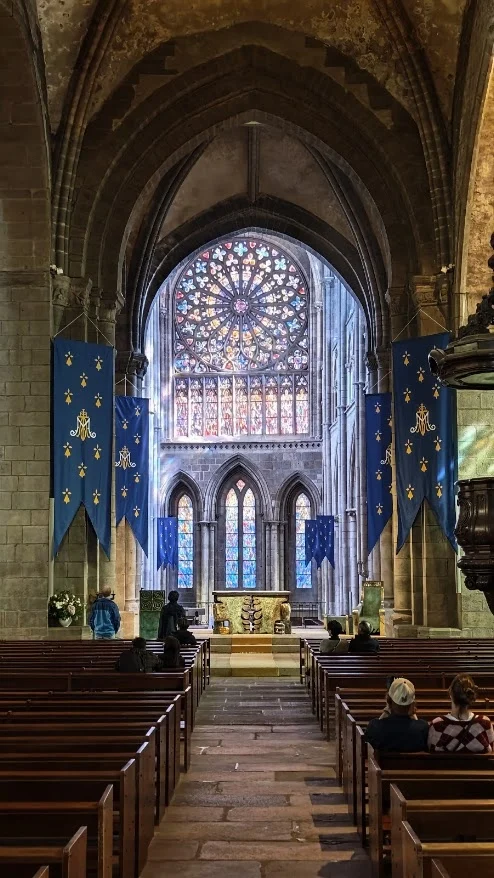
The cathedral, originally built in the 12th century and restored after being destroyed in the war, is a fascinating blend of Romanesque and Gothic architecture. Pay special attention to the modern and spectacular stained-glass windows, created during the restoration, which tell the story of the city, from the arrival of the monk Maclou to Jacques Cartier’s discovery of Canada.
And speaking of Cartier, don’t miss his tomb. It sits in a quiet chapel in the north aisle of the choir, a simple yet moving stone marker for one of history’s great explorers.
- Open days and hours: Generally open daily from 9:30 a.m. to 6:00 p.m., though hours may vary depending on services and events. I recommend always checking the official website before you visit.
- Tickets: Free admission.
Afternoon: Diving into the World of the Corsairs at Demeure de Corsaire
To truly understand the wealth and power of Saint-Malo in its heyday, you have to visit one of the corsairs’ mansions. The “Demeure de Corsaire”, officially called the Hôtel Magon de la Lande, is the only one open to the public, and it offers a rare glimpse into the world of the “Lords of Saint-Malo”.
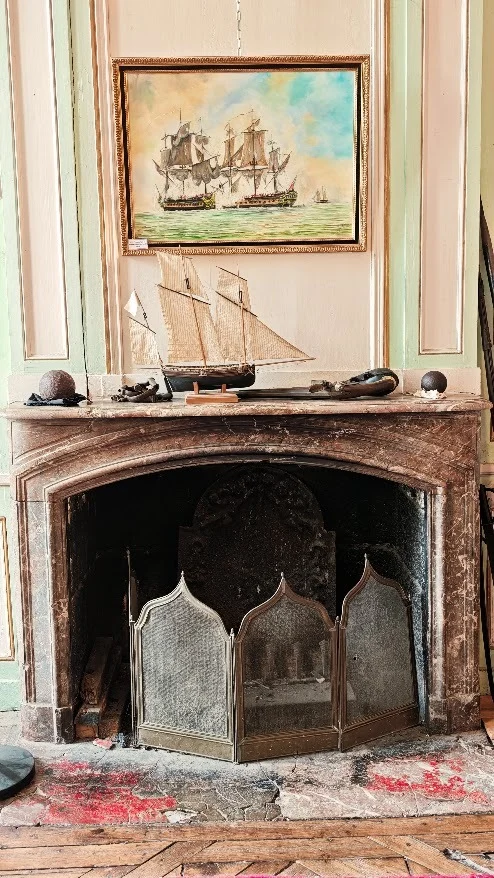
The house, built in the early 18th century, has survived remarkably well. Visits are only possible as part of a guided tour (in French, though English summaries are sometimes available), and it’s well worth it. The guide will lead you through grand reception rooms, show you hidden staircases once used for escape, and take you down to the vast cellars where precious cargo was once stored. It’s a fascinating trip back in time.
- Open days and hours: Outside school holidays: one tour daily at 3:00 p.m. (closed on Mondays). During July and August and school holidays: continuous tours between 10:00 a.m. to 11:30 a.m. and 2:30 p.m. to 5:00 p.m. (closed Sunday mornings). I strongly recommend checking the exact hours on the official website before arriving.
- Tickets: Tickets can be purchased on site. Official website: https://www.demeure-de-corsaire.com/
Late Afternoon (Tide-Dependent): Forts on the Water, Fort National and Grand Bé Island
This part of the day depends entirely on one of the strongest forces in Brittany: the tides. Saint-Malo sees the largest tidal range in Europe, which can reach as much as 13 meters! That’s why it’s essential to check the tide schedule (horaires des marées) before you set out. You can do this on the official tourist office website. Generally, you can reach the islands about an hour and a half before low tide and up to an hour and a half after.
If you’re lucky enough to have low tide fall in the afternoon, head out through the gates to Plage de l’Éventail. In front of you, you’ll see two rocky islands. The closer one is Fort National, an impressive fort built in 1689 by Garangeau, an engineer working under the famous military architect Vauban, to defend the city against English attacks. A useful tip: if the French flag is flying over the fort, it means it’s open for visits.
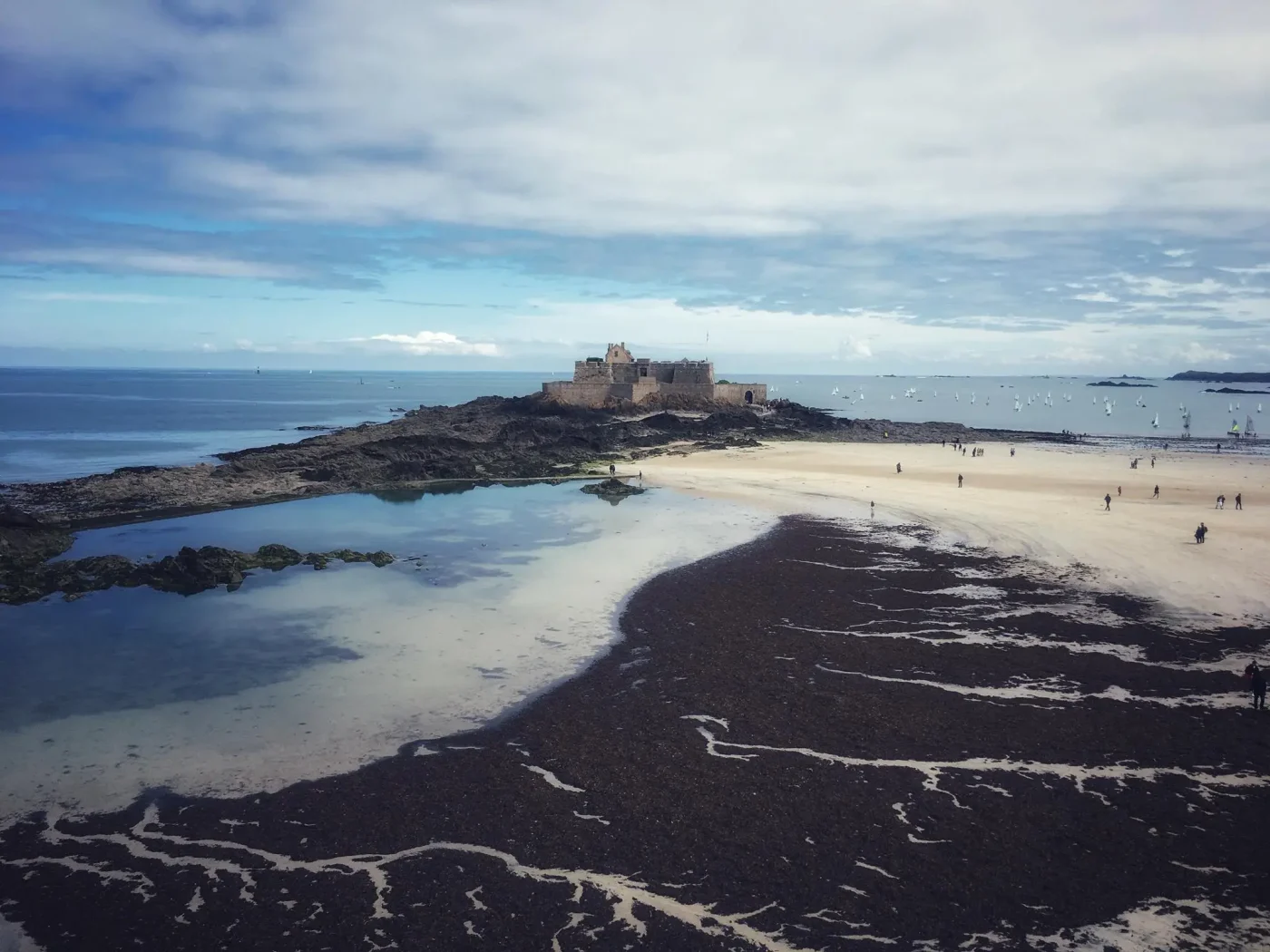
A bit further out is Grand Bé island. Walking out to it across the wet sand as the sea recedes is an experience in itself. On this island, facing the wind and the waves, lies the tomb of one of France’s great writers, François-René de Chateaubriand (1768-1848). Born in Saint-Malo, he asked to be buried here, on a solitary island, so that he would “hear nothing but the sea and the wind.” The grave is simple, unmarked, just a large granite cross, and it is one of the most moving and romantic spots in Brittany.
- Open days and hours (Fort National): Open only at low tide, when the flag is flying. Hours vary daily. Check the official website: https://www.fortnational.com/
- Tickets (Fort National): Can be purchased at the entrance to the fort.
- Open days and hours (Grand Bé): Accessible only at low tide.
- Tickets (Grand Bé): Free admission.
The Bordier Butter Shop
Let me let you in on a little secret, one of those delicious secrets reserved for true connoisseurs and dedicated Francophiles like us. Every time I arrive in the enchanting port city of Saint-Malo, in Brittany, there’s one essential stop I simply can’t, and won’t, skip.
I’m talking about the wonderful butter shop of Jean-Yves Bordier. This is no ordinary cheese shop or deli; it’s a true temple dedicated entirely to one of the most basic and wonderful ingredients in French cuisine. Visiting there has become a personal ritual for me, a kind of pilgrimage that connects me, in the deepest way, to France’s culinary culture.
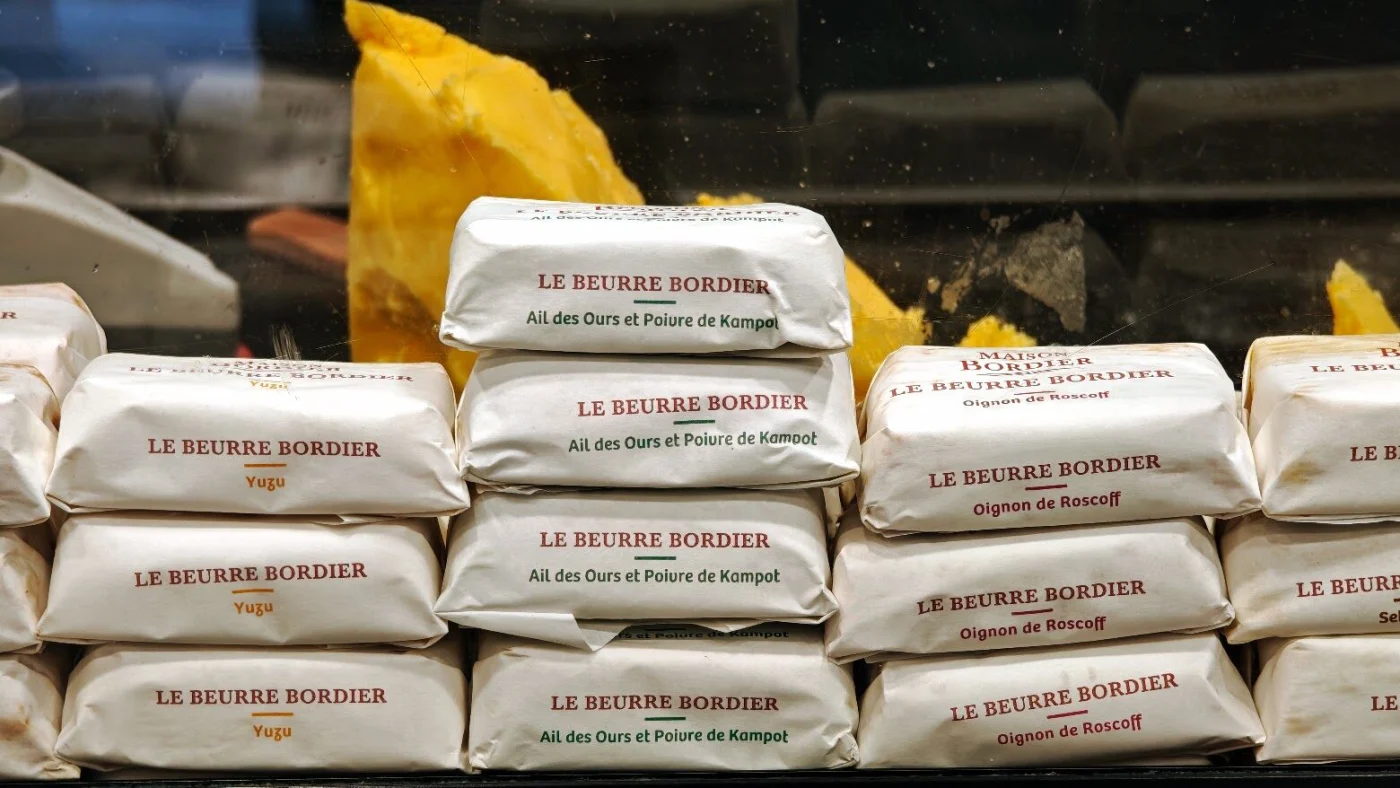
So what’s so special about this butter, you ask? Well, let me tell you, this isn’t the butter you know from the supermarket. Bordier’s butter is a work of art. It’s made through a traditional, slow process that includes hand kneading on an antique wooden churn, a process that gives it a silky, rich texture unlike any other.
Its flavor is deep, complex, and changes with the seasons and with what the cows have been eating. Alongside the classic butter (sweet or salted), you’ll find genuine culinary creations there: seaweed butter, Madagascar pepper butter, yuzu butter and even vanilla butter. Every bite is an experience, a whole story about the land, tradition and endless passion.
And here’s a small tip: the first time I was there, I discovered they also sell a small, stylish cooler bag that lets you carry that precious butter around for hours, even on a hot summer day, without it melting or spoiling. Ever since, every time I visit Saint-Malo I pick up both the butter and this bag, which lets me enjoy it on a picnic at the beach or bring it safely back to the hotel.
In short, if you’re coming to Saint-Malo, do yourself a huge favor and don’t miss Bordier’s shop. It’s located in the heart of the old town (Intra-Muros) at 9 rue de l’Orme. So you don’t show up to closed doors, it’s worth knowing that the shop is open Tuesday through Friday from 9:00 a.m. to 12:30 p.m., reopening in the afternoon from 3:30 p.m. to 7:00 p.m. On Saturday and Sunday it’s open mornings only, from 9:00 a.m. to 12:30 p.m., and it’s closed on Mondays.
I promise you, after you taste this butter, you’ll fully understand what I always say: the love of France lies in the small, perfect details, and Bordier’s butter is without a doubt one of them.
Guided Tours in Saint-Malo
If you’d rather let a local expert lead the way and tell you the city’s stories, there are some excellent options. Let me recommend a few tours I found on GetYourGuide that can enrich your experience. You can find them at this link.
Practical Information for Travelers
A few small tips from personal experience that can make a big difference in your visit.
Where to Stay in Saint-Malo
Since I’ve stayed in Saint-Malo quite a few times, both for short visits and as a stopover, I’ve put together all the hotels I liked best, along with more recommendations to fit every budget and travel style, in a dedicated article.
Read the full article on recommended hotels in Saint-Malo here.
Parking in Saint-Malo
The biggest challenge in Saint-Malo is parking. The underground garages and street parking near the old town are very expensive and fill up fast, especially in summer. My secret, which I’m happy to share with you, is Parking Paul Féval.
This is a huge “park and ride” lot located outside the center. The price is minimal (around 3.30 euros for a full day), and it includes a round-trip ticket on a free shuttle bus for up to 5 passengers, which drops you off right at the entrance to the ramparts. It’s the most convenient, cheapest and smartest solution.
When Is the Best Time to Visit?
As in most of France, the shoulder seasons (spring and fall) are ideal, with pleasant weather and fewer tourists. Summer can get very crowded, but the atmosphere is lively.
But my most important tip is to try to time your visit for a Tuesday or Friday morning. On these days, the local market takes place inside the ramparts, at the Halle au Blé (the covered food market) and Place de la Poissonnerie (the fish market square). There’s no better way to experience the real pulse of the city, see the locals, and enjoy the smells and colors of fresh local produce.
Culinary tips: what and where to eat in Saint-Malo
You can’t talk about Brittany without talking about food. Saint-Malo, as a port city, is a paradise for seafood lovers, and of course, crêpes and galettes. Here are a few personal recommendations.
Recommended restaurants (seafood and local cuisine)
Méson Chalut
This gastronomic restaurant is an institution in Saint-Malo. It used to be called “Le Chalut,” and today, under new ownership, it continues the tradition of refined cuisine based on local, sustainable catches and produce from their own garden. The place holds a “Michelin Green Star” for its ecological commitment. It’s a perfect spot for a special, unforgettable dinner.
- Open days and hours: Usually open evenings only, from Friday to Sunday. Reservations are required.
- Reservations: https://www.meson-chalut.bzh/
La Fourchette à Droite
This small, charming restaurant holds a “Bib Gourmand” distinction in the Michelin Guide, which means excellent value for the price. The kitchen here celebrates the finest ingredients of Brittany, with creative, precise dishes served in a warm, homey atmosphere. The playful name (“The Fork on the Right”) is a nod to the fact that one of the owners is left-handed.
- Open days and hours: Open for lunch and dinner. Closed on Wednesdays and Thursdays. Reservations highly recommended.
- Reservations: the restaurant’s page on the Michelin Guide
Your crêperie in Saint-Malo (because you can’t skip it)
Crêperie Le Tournesol
This is my favorite crêperie in Saint-Malo. It’s tucked away on a quiet side street, far from the tourist crowds, and serves simply perfect galettes and crêpes. They use fresh, local ingredients, and the result is an authentic, wonderful flavor. The service is friendly and the atmosphere is pleasant.
- Open days and hours: Open daily, usually for lunch service only (starting at 11:30 a.m.).
- Reservations (recommended): https://www.creperie-saint-malo.com/
Bergamote
Located right across from the cathedral, Bergamote is a combination tea room and crêperie. It’s an ideal spot for a stop during the day, since they offer continuous service. You can sit down for a light lunch of a galette or a salad, or simply treat yourself to a sweet crêpe and an excellent cake in the afternoon.
- Open days and hours: Open daily, year-round, usually between 11:00 a.m. and 7:00 p.m.
- Reservations: https://www.bergamotesaintmalo.com/
Related reading