

I have to admit I have a special fondness for this place, and not by chance. My name is Zvi, which means “deer” in Hebrew, and “cerf” is a deer (a stag) in French, so I already come to this with a built-in sympathy. But even setting the personal connection aside, there are plenty of good reasons to fall for the Passage du Grand-Cerf.
It’s not just the light, which pours in through the tallest glass ceiling in Paris, but the character of the place. It’s less polished, more raw, more authentic. It wasn’t built to impress aristocrats, but to serve as a workspace for makers and craftsmen. Here, between the wood and iron facades, I feel the pulse of the working Paris, the one that took raw materials and turned them into beauty. This is a passage with the soul of an artisan, a place where history isn’t gilded in gold, but carved into wood and metal.
If you’ve never visited this passage, here’s a short video that shows what it looks like:
Passage du Grand-Cerf: the story of the worker that became a prince
From tavern to coach station
The story of the passage begins long before it was built, with the site it now occupies. Before the French Revolution, a famous inn called “Le Grand Cerf” (the Great Stag) stood here and gave the place its name. Afterward, the site became something far more essential for 18th and 19th century Paris: a coach station.
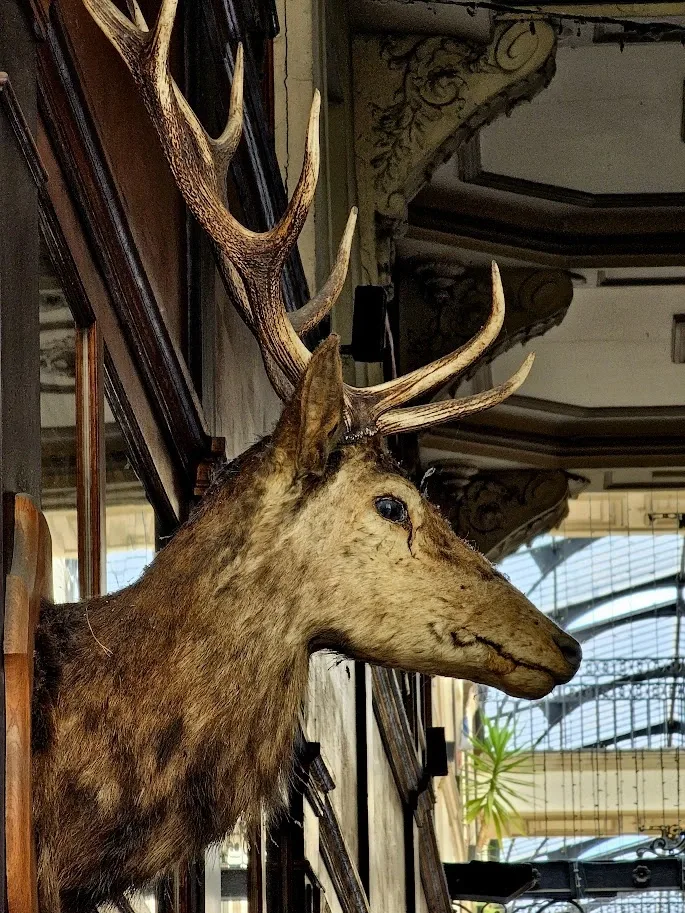
Picture the large courtyard, bustling and noisy, full of coach drivers (“rouliers”) and horses. This was the terminal of the “Messageries Royales,” the royal transport service, which connected Paris with the provinces to the east and north: Alsace, Champagne and Flanders. It was the gateway for goods, people and news, a pulsing artery of life at the heart of the city.
In 1812, the entire complex was sold to the hospital administration, and on May 24, 1825, it was purchased by the banking firm “Devaux-Moisson.” The bankers recognized its potential and immediately began planning to turn the working courtyard into a covered commercial passage, as the new fashion dictated. The passage apparently opened to the public around 1835.
Architecture of light and function
The first thing that strikes you when you step into the Passage du Grand-Cerf is the height. With a glass ceiling rising nearly 12 meters (11.80 meters, to be precise), it is the tallest passage in Paris. That height wasn’t just an aesthetic whim; it was the result of a functional and innovative vision.
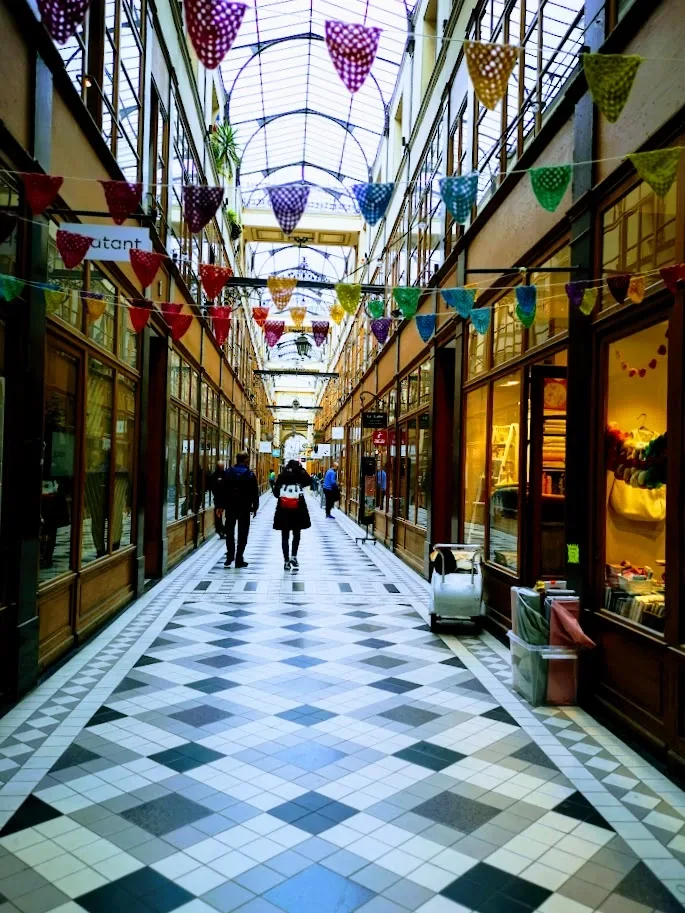
The use of a metal structure allowed the anonymous architect (whose name, sadly, has been lost to history) to create an unusually airy and bright space. Unlike other passages, here the living quarters start only on the third floor. The first two floors, with their wide glass facades and interior galleries, were originally meant to serve as workshops and ateliers, not luxury shops.
The passage was built in the heart of the Saint-Denis district, which at the time was the most industrial and working-class area of Paris, full of small factories and workshops. The architecture of the Grand-Cerf reflected the character of its surroundings: it was industrial, practical, and meant for production and craft, not for selling luxury goods.
Years of decline and neglect
Despite its architectural uniqueness, the Passage du Grand-Cerf never achieved the commercial success of its more glamorous rivals. It always remained in the shadow of the fashionable passages, and its industrial character failed to draw the bourgeois crowd. On June 7, 1826, a businessman named Isidore Monier, who already owned several shops there, bought the entire passage, but even he couldn’t turn it into a success story.
Over time, the passage was increasingly neglected. In 1862, Monier’s heirs, realizing the place wasn’t profitable, donated it to the “Assistance Publique” (the Paris public welfare authority). The authority tried to sell it in 1896, but found no buyer. The passage sank into a long slumber. It became a neglected, dark place, nearly forgotten by Parisians. At one point, its glass ceiling was in such poor condition that it posed a danger, and the passage was temporarily closed.
Revival and rebirth as a haven for artisans
Redemption came late, but it came powerfully. In 1985, the passage was finally purchased by a private owner, and that same year it was declared a protected historic site. In 1990 (some sources say 1988), it underwent a thorough, comprehensive renovation that restored its lost glory, and then some.

The restored passage was born again, and this time, it fully embraced its original identity. It didn’t try to compete with the luxury passages, but instead became what it was always meant to be: a home for artists, creators and craftspeople. The shops that opened there matched that spirit: jewelry designers, art galleries, design stores and unique boutiques.
Today, wandering through the Passage du Grand-Cerf feels like stepping into a hive of creativity. You can find the workshop of the last carpenter in central Paris, a shop specializing in contemporary French illustration, boutiques selling clothing made in France, and stores selling unique decorative objects. It’s the perfect place to find original gifts, the kind you won’t find at the big chain stores.
Zazie in the passage
You can’t talk about the Passage du Grand-Cerf without mentioning its unforgettable screen appearance. In 1960, the great director Louis Malle (1932-1995) chose the passage as a central location for his classic film “Zazie dans le Métro” (Zazie in the Metro), based on the novel by Raymond Queneau.
Ironically, the original novel makes no mention of the passages at all. But Malle, with his gifted cinematic instinct, understood that the height, depth and unique atmosphere of the Grand-Cerf would make a perfect backdrop for young Zazie’s wild adventures. The film turned the passage into a cinematic icon and immortalized its raw beauty on the big screen.
In this short clip, you can catch Zazie running through the Passage du Grand-Cerf for a few seconds (and also through the Galerie Vivienne).
Practical information for your visit
Addresses
The passage has two entrances:
- 145 Rue Saint-Denis
- 10 Rue Dussoubs
Opening hours
Passage du Grand-Cerf: open to the public Monday through Saturday, from 8:30 a.m. to 8:30 p.m. The passage is closed on Sundays.
Part of my passages walking route
Of course, this special passage is also an essential part of my walking route dedicated to the covered passages of Paris. If you want to experience the magic for yourself and see how it fits together with the rest of the city’s hidden gems, I’d love for you to join me.
You can find the complete walking route of the Parisian passages right here on the site.
Related reading
