

At the heart of the Latin Quarter in Paris stands the Montagne Sainte-Geneviève, and you really can’t experience everything this charming neighborhood has to offer without climbing it and discovering everything hidden up there. In the previous walking route in the Latin Quarter, we climbed the southern side of the hill and found no shortage of culinary and historical attractions. Today, let me offer you another route, where we’ll explore the northern part of the hill.
This area was once home to the various colleges of the University of Paris, founded during the Middle Ages, which I wrote about in my article on the history of the Latin Quarter. But the Montagne Sainte-Geneviève isn’t just a collection of colleges. It’s also home to beautiful churches, Roman baths, and quite a few other fascinating spots worth discovering (including the building where the main character of Emily in Paris “lives”).
Since time is short and the walk is long, let’s get started.
Starting point
We’ll start our walk outside the Cluny – La Sorbonne metro station, served by line 10 (you can also reach it via RER B and RER C, but that would mean a lot of walking underground, and that would be a shame). When you head out of the metro, look for the exit marked Boulevard Saint-Germain – Musée du Moyen-Âge.
A note about the map: under the heading of each stop you’ll find its address, and every address is a link. Click it, and the spot will open right up in Google Maps.
The walking route through the northern part of the Latin Quarter
Roman baths and a Renaissance mansion
When you come out of the metro station, you’ll find yourself on the famous Boulevard Saint-Germain, which runs from the 5th arrondissement to the 7th. Look southwest and you’ll see the remains of Roman baths, from the days when Paris was still Lutetia, along with a lovely garden where you can step in and rest (though why rest when the walk has barely begun? :-)).

Head to Rue Cluny and turn right onto Place Paul Painlevé, built in 1855. This is one of my favorite little gardens in Paris, and once you’re there, you’ll understand why. I’d guess the first thing you’ll notice (besides the Hôtel de Cluny, which I’ll get to in a moment) is the statue of Montaigne, standing just outside the garden and facing south.

Michel de Montaigne (1533-1592) is considered one of France’s great essayists and humanists, and I invite you all to read the article by Yigal Liberant, which covers his life and the important essays he wrote.
If you look closely at the bronze statue of Montaigne, you’ll notice his shoe is gilded while the rest of the statue keeps its greenish patina. This comes from a belief among Sorbonne students that rubbing the shoe brings good luck on exams. It reminds me of the tomb of Victor Noir (1848-1870), which also has its own good luck tradition, though there you need to rub something else entirely.
Inside the garden, you’ll find another interesting statue: a copy of the famous statue from Rome of the she-wolf nursing Romulus and Remus.

The statue was a gift from the city of Rome, in memory of Lutetia, the Gallo-Roman city that once stood here. I wonder how Paris would react if Germany sent over a copy of some famous statue standing in Berlin.
After visiting the garden, it’s time for the “main course”: the Museum of the Middle Ages, housed in the Hôtel de Cluny.

This grand mansion was built for the abbot of Cluny in the late 15th century, making it the second-oldest residential building in Paris (after the house of Nicolas Flamel). The man responsible for the building’s Renaissance beauty was Bishop Jacques d’Amboise (1440-1516), who clearly had exceptional taste.
The mansion underwent a major renovation and reopened to the public in 2021, with the entrance moving from the red gate on the square to a modern entrance hall on Rue de Sommerard. Inside, you’ll find a museum dedicated to the Middle Ages, home to the original statues of the Kings of Judah from Notre-Dame Cathedral, and of course the famous tapestry “The Lady and the Unicorn.”

I visited this museum about six months after it reopened, and I was really impressed, both by the exhibits and by the tasteful, pleasant way they’re displayed. In my view, this is a must-visit museum for anyone coming to Paris for the first time who wants to get to know the city’s history better, but also for “advanced Francophiles” who have visited before and can now enjoy it even more.
Since we’ve only just started our walk and there’s plenty more ahead, I’ll stop here. But if you’d like to get to know the museum better before visiting, I recommend reading Avital Inbar’s article Cluny Museum: Discovering the Medieval Treasures of Paris.
Legendary movie theaters and Richelieu’s final resting place
After visiting the Cluny Museum, head back to Place Paul Painlevé and turn right onto Rue des Écoles, built under Napoleon III and Baron Haussmann and named after the institutions of higher learning nearby, which we’ll get to shortly.

Right after that, take a peek to your left onto Rue Champollion. During the 19th century, this street was known for its cabarets, but over the course of the 20th century those cabarets turned into movie theaters, and today it has a one-of-a-kind cluster of independent cinemas, some of which have become something of a legend, since they’re still managing to hold their own against the big theater chains.
As I mentioned, these theaters and this street have a genuinely fascinating story, and if you’d like to dig deeper, I recommend Liran Hotmacher’s wonderful article Discovering the Real Paris Through the Cinemas of Rue Champollion. Once you’re done checking out what’s playing, head back to Rue des Écoles, turn left, and climb up Boulevard Saint-Michel, also built during Napoleon III’s reign.
Keep going up until you reach Place de la Sorbonne, where you’ll see the famous church designed by the architect Jacques Lemercier (1585-1654) at the request of Richelieu (1585-1642), who had initiated extensive construction across large parts of the Sorbonne.

Construction of the church was completed in 1635, and about seven years later it “hosted” the body of the cardinal, who had requested to be buried there (sadly for Richelieu, his body didn’t rest there forever; during the French Revolution, revolutionaries cut off his head and made off with his body, and only in 1866 were both returned to the church, where they remain to this day). Unfortunately, you can’t visit today unless you have a French student ID, but you can get a good sense of how the chapel looked back in the 18th century just by picturing the scene.
One summit and two churches you shouldn’t miss
place du Panthéon, and place Sainte-Geneviève
Head back to Boulevard Saint-Michel, turn left, and keep climbing until you see Rue Soufflot and the Panthéon on your left. Walk toward the Panthéon until you reach the square facing it.

This building has a fascinating story, which begins with a vow by Louis XV (r. 1715-1774) to build a church in honor of Saint Geneviève (who was Saint Geneviève? You can read about her in my article on the history of the Latin Quarter). Later, after the French Revolution, the place became a mausoleum for France’s great figures, went back to being a church, and finally returned to being a mausoleum for notable figures, which it remains today. If you’d like to read about the Panthéon’s history and its twists of fate, check out my article on the Panthéon.

Admission to the Panthéon is paid, and you can buy a ticket through this link. In my opinion, it’s well worth setting aside a little time for this church, not just for its beauty but especially for the tombs of the important figures buried in the crypt. Visiting there is a bit like traveling through a time tunnel of the last 250 years of French history.
Once you leave the Panthéon and stand with your back to it, you’ll see two neoclassical buildings, and you might assume they were built by the same architect at the same time. Let me surprise you: about 80 years separate these two buildings.
If you look to the right, you’ll see the Faculty of Law building, built in 1771 by Jacques-Germain Soufflot (1713-1780), the architect of the Panthéon.

To your left, you’ll see the town hall of the 5th arrondissement, completed in 1849. This building was constructed by Jacques Hittorff (1792-1867), one of the great architects under the reigns of King Louis Philippe (r. 1830-1848) and Napoleon III (r. 1852-1870).

I happened to visit there once during European Heritage Days, and I was really struck by how a completely functional place like a town hall can be so beautiful, both outside and in. Take, for example, their staircase:

And if you think only town halls and churches can be grand, what do you say about libraries?
Head to 10 Place du Panthéon, home to the Bibliothèque Sainte-Geneviève, which holds tens of thousands of books rescued during the destruction of the Abbey of Sainte-Geneviève during the French Revolution. The building you see today was built in the days of King Louis Philippe (r. 1830-1848) and stands on the ruins of the Collège de Montaigu, built in 1314.
Let’s just say you probably wouldn’t have wanted to study there, since the place was known for its appalling sanitary conditions and harsh discipline, which included violence against students, so much so that according to the famous writer François Rabelais (1483-1553), conditions there were worse than those of Tatar or Moorish slaves.
On the other hand, despite all that, the college produced some genuinely brilliant minds, including the famous philosopher Erasmus of Rotterdam (1466-1538), Jean Calvin (1509-1564), the founder of Calvinism, and of course Rabelais himself. So maybe they did something right after all.

Today you can visit the Bibliothèque Sainte-Geneviève, but it isn’t simple since you need a reader’s card (available on-site for free). If you manage to get in, you can see the main reading room, and if you visit during European Heritage Days, you can see a few more rooms, usually closed to the general public.
Whether or not you visited the library, continue straight ahead to the Église Saint-Étienne-du-Mont, one of my favorite churches in Paris. If, like me, you love Woody Allen’s timeless film Midnight in Paris, you’re welcome to sit on the church steps, and while you wait for the car that will take you to meet Ernest Hemingway (1899-1961) and Gertrude Stein (1874-1946), take a moment to hear a bit about this church’s history.

The first church on this spot was built during the 13th century, but the current church, in the Gothic style, was built in the 15th century. A beautiful Baroque facade was added during the 17th century.
I recommend stepping inside this church for a number of reasons, including the fact that it’s the burial place of the playwright Jean Racine (1639-1699) and the philosopher Blaise Pascal (1623-1662), as well as its wonderful organ (if you’re lucky, someone will be playing it just as you walk in). But the most important reason to visit this church, in my opinion, is the beautiful stone rood screen that divides the two sides of the church.
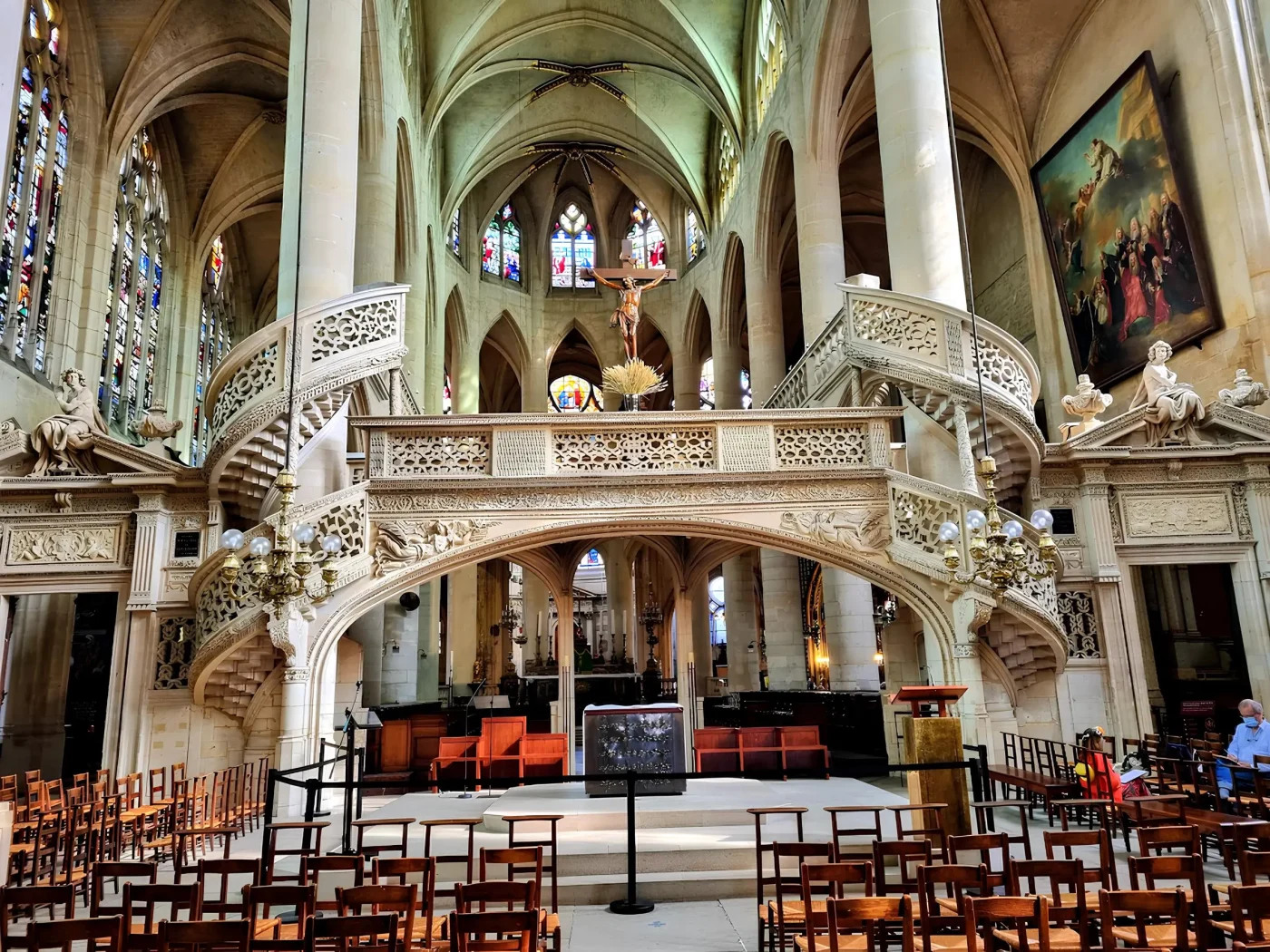
This is the only surviving rood screen of its kind (Notre-Dame Cathedral once had one too, but in the 17th century it was deemed too primitive and torn down), and it is simply beautiful. To me it looks like a kind of embroidery carved in stone, and I could stand there staring at it for minutes without ever getting bored.
The high school for France’s elite, and the house where the duke who studied Hebrew lived
rue Clovis, and rue Descartes
Leave the Église Saint-Étienne-du-Mont through the side entrance, straight onto rue Clovis. Right across from you, you’ll find the Lycée Henri-IV, named for King Henri IV (r. 1589-1610). The school stands on the site of the former Abbaye Sainte-Geneviève, where King Clovis I (r. 486-511) and his wife were once buried.
During the French Revolution the abbey was closed, and its building became one of the first public schools in Paris. Over the course of the 19th century the school went through a long string of names before settling on its current one in 1873. The school became famous for two things.

The first is the “Tour Clovis,” the bell tower of the old church of Saint-Étienne-du-Mont you just visited. The second thing that made the place famous is the list of notable people who studied here.
Here’s a very partial list of those celebrities:
- The sons of King Louis-Philippe I
- Victor Baltard (1805-1874), famous for the iron and glass structures of the wholesale market at Les Halles.
- Ferdinand de Lesseps (1805-1894), the engineer behind the Suez Canal
- Léon Blum (1872-1950), the Jewish prime minister of France, who during his time in office introduced the country’s first paid week of vacation for every worker (since grown to a month, and in some places even more).
- And speaking of Jewish alumni, the famous singers Patrick Bruel (b. 1959) and Guy Béart (1930-2015) studied here too.
Unfortunately, you can’t visit this school outside of European Heritage Days, and if there’s one thing I truly regret, it’s that on one of those open days I stood in line at the entrance and gave up right before my turn came. I’m hoping to make up for that the next time I’m in Paris in September.
And now let me recommend a wonderful place to have lunch (if you’ve made it here in time). Head back up rue Clovis to the main entrance of the Église Saint-Étienne-du-Mont, go down rue Montagne-Sainte-Geneviève, and turn left onto rue Laplace.
At number 17 you’ll find the restaurant La Table de Colette, which serves a sophisticated French menu with only a tasting menu on offer (the only choice you get is how many courses). At lunch you can get a three-course meal here for 45 euros per person, which in my opinion is an excellent price for this level of food and service.

Once you’ve finished eating, retrace your steps to rue Montagne-Sainte-Geneviève and continue until you reach a small square named for Jacqueline de Romilly (1913-2010), an important philologist and the second woman ever admitted to the Académie Française.
Across from the fountain you’ll find the building that once housed the École Polytechnique, before it moved to the suburb of Palaiseau in 1977, the year I was born. The school was founded in 1794 to train the scientific elite of the French army, and among its famous graduates you’ll find Marshal Foch (1851-1929), a hero of World War I, three Nobel laureates, and many others.

Continue up rue Descartes, and keep an eye out for a small, narrow street called rue Descartes. There, at number 30, lived Louis I, Duke of Orléans, known as “the Pious” (1703-1752). Unlike his womanizing grandfather and his skirt-chasing father (whose adventures you can read about in the article on the Palais-Royal), Louis was a one-woman man, and that woman was Augusta, Princess of Baden-Baden.

Unlike almost every other couple of their era, the duke and duchess loved each other deeply, and when the duchess died giving birth to their daughter in 1726, the grief-stricken duke decided to retire from the royal court and… go study Hebrew at the Sorbonne. To be close to the Sorbonne, the duke chose to live in this house, and it was here that he died, in 1752.

Verlaine’s house, later turned into Hemingway’s office
Continue down rue Descartes until you reach number 39. This is where the poet Paul Verlaine (1844-1896) spent his final years. Verlaine’s life was famously turbulent and included not only beautiful poetry but also a homosexual relationship with another gifted poet, Arthur Rimbaud (1854-1891). The two traveled across Europe together until Verlaine shot Rimbaud, ending up in prison. He later tried to turn his life around, but eventually slid back into drinking, and died in 1896, nearly destitute, in an apartment in this house that he shared with a retired prostitute.
Nearly 30 years later, the famous American writer Ernest Hemingway (1899-1961) rented this same apartment and turned it into a kind of “office,” since his own apartment on rue Cardinal-Lemoine was too small.
The peaceful street named after a torture device
Continue south on rue Descartes and turn right onto rue Thouin. Walk until you reach a small square named for Emmanuel Levinas (1906-1995), a philosopher and educator who ran the school where Avital Inbar studied. From this little garden there’s a lovely view of the Panthéon’s dome, which I was happy to photograph in the fall of 2023.

Now look to the other side, toward 3 rue de l’Estrapade, where you’ll find an 18th-century building. The philosopher Denis Diderot (1713-1784) lived here for several years, and it was here that he began working on his Encyclopédie, until the authorities arrested him in 1749. The reason for his arrest was his “Letter on the Blind,” a sharp piece of criticism of the authorities, which earned him an “all-inclusive vacation” at the Château de Vincennes.
Continue along rue de l’Estrapade and you’ll feel as if time stopped here somewhere in the late 18th or early 19th century. What’s interesting is that despite the peaceful atmosphere, the street itself is named after a torture device, very popular in the 16th and 17th centuries, that allowed a person to be hoisted up by their hands, which caused broken bones and torn muscles.
Continue to number 9 and you’ll reach a lovely orange building with an ornate metal gate. A sign on the building reads brûlerie Saint-Jacques. Don’t worry, no one was burned here, just as no one was hung by their hands on rue de l’Estrapade. Instead, this was once a coffee roastery (today it’s a private home).

Keep going until you reach place de l’Estrapade. At number 1 of that building lives Emily, from the show “Emily in Paris,” and there’s a good chance you’ll spot fans of the show taking photos by the building’s gate, like the fan I managed to photograph.

By the way, if you love the show and want to discover more Paris locations connected to it, feel free to check out my article about it on the site.
The beautiful church that quite a few tourists miss
23 rue d’Ulm, and the Église du Val-de-Grâce at 1 place Alphonse-Laveran
Once you’ve finished taking your photos, leave the square and turn left onto rue Lhomond. Continue along it and turn right onto rue d’Ulm.
Continue to number 23, where you’ll see a mural of the famous chemist Marie Curie (1867-1934). If you’d like, you’re welcome to visit the museum dedicated to her, which is just a short walk away at 1 rue Pierre-et-Marie-Curie (open Wednesday through Saturday, 1:00 p.m. to 5:00 p.m., and featuring exhibits on radioactivity). If you’d like to get to know Marie Curie’s story better, I recommend reading Dr. Orna Liberman’s article, Marie Curie and Paul Langevin: A Secret, Forbidden Love.
Whether or not you visit Madame Curie’s museum, you’re welcome to keep walking along rue d’Ulm until you reach number 45, home to the École Normale Supérieure. This is the most prestigious institute of higher learning in France (even more prestigious than the Sorbonne), where the country’s political elite is trained. Its list of graduates includes French president Georges Pompidou, Jean-Paul Sartre, Louis Pasteur, and many others. The facade of this school is simply beautiful, and you can sometimes go inside to see the institution’s lovely courtyard.

Continue to the end of the street and turn right onto rue des Feuillantines. Walk to number 8, where you’ll find the house where the famous writer Victor Hugo (1802-1885) lived during his childhood, and where he took his first steps into the world of poetry.

Continue straight ahead, then turn left onto rue Saint-Jacques, which leads south, out of Paris, and is named for Santiago de Compostela, since this is the route medieval pilgrims took to get there (they began their journey at the Tour Saint-Jacques, in the 4th arrondissement). Continue straight until you reach the Église du Val-de-Grâce.

The story of this church begins with a royal vow. Queen Anne of Austria, who was married to Louis XIII (r. 1610-1643), had no children despite many years of marriage to the king (most likely because he was a closeted homosexual).
The queen vowed that if God granted her a child, she would build a magnificent church in his honor. Indeed, a miracle occurred: a year later the queen became pregnant and gave birth to the future Louis XIV. In 1654, Queen Anne of Austria and her son laid the cornerstone of this church, which was built by the two famous architects François Mansart (1598-1666) and Jacques Lemercier (whom we already mentioned when talking about the Sorbonne).
The result is truly stunning, both inside and out. Especially striking is the beautiful dome the two architects built, decorated on the inside with a fresco by Pierre Mignard (1612-1695) that shows more than 200 figures in heaven, including Queen Anne of Austria’s patron saint.

To visit this church, you’ll need to visit the Val-de-Grâce museum, which is devoted almost entirely to military medicine. Although the subject itself might not sound especially exciting, a visit to what was once a royal abbey is definitely worth your time.

If you’d like to visit the museum, know that it’s open every day except Monday and Friday, from noon to 6:00 p.m.

Our walk ends here, at this lovely church. If you’re not tired yet, you’re welcome to head over to the Luxembourg Gardens, about a ten-minute walk away. In my opinion, there’s no better way to end a walk through the Latin Quarter (even though the gardens are technically already in the 6th arrondissement :-)).
Want to read more about the Latin Quarter?
If you enjoyed this walking tour and you’re looking for more itineraries in the Latin Quarter, feel free to visit the Latin Quarter page on the site, where you’ll find not just walking routes but also recommendations for restaurants, hotels, and more.
Related reading
