

Somewhere in the past I saw an exhibit, I don’t remember anymore if it was at the Centre Pompidou, or at the Musée Carnavalet, the museum devoted entirely to the history of Paris, that was all about what lies beneath Paris. You might ask: what could possibly be under the ground floor of a big city, other than maybe a water table? Well, in Paris, as apparently in a few other cities around the world, it’s not that simple.
It’s worth remembering that for centuries, the villages surrounding Paris were quarried for the limestone and other stone used to build the city itself. The quarrying intensified during the era of Baron Haussmann, as part of the drive to rebuild the City of Light.
As that building boom continued, some of those “outer” villages, Passy, Montmartre, Belleville, Butte aux Cailles and others, were annexed into Paris, creating the familiar spiral of 20 arrondissements we know today. But suddenly the city council found itself facing a different challenge: the city’s engineers determined that you couldn’t build wherever you pleased. Many neighborhoods sat on loose ground, above unstable underground quarries, and above them you couldn’t build more than two or three stories (see the article about the Mouzaia neighborhood in northern Paris).
One of the quarries around the city was in the area known today as Buttes-Chaumont. Unlike all the other quarries, this one was an open pit (not underground tunnels), and on top of that, it also served as the city’s execution site.
At the same time, the area became a public dump: a pile of garbage, stench, and leftovers of every kind. With no better option, it stayed that way for many years, until during the city’s renovation under Baron Haussmann (during the reign of Napoleon III, mid-19th century), the city’s engineers decided to turn the site into a green park for the city’s residents. Instead of covering the terrain, they decided to work with its existing shape and create an “English garden” (where the vegetation grows “as if” wild, as opposed to a “French garden,” where every flower is planned and placed exactly where it belongs).
All the other quarries, the ones the city’s building stones came from, were around Paris. As quarrying in the limestone bedrock gradually stopped, those villages were annexed into Paris and expanded it to roughly its current shape. But it quickly became clear that because of the many tunnels running underneath those areas, tall buildings couldn’t be built on top of them. With no other choice, some of those annexed villages kept their village character, which is how neighborhoods like Mouzaia (mentioned above), Butte-aux-Cailles, Montmartre and others stayed village-like, at least in parts.
Add to that years of urban, transportation, and technological development, and in cross-section, Paris looks like a wedge of Swiss cheese. As shown in the video above, in the first few meters below ground (0 to 5 meters) you find electricity, gas, and water pipes (and the old pneumatic mail tubes). Below those sits a first layer of metro tunnels, 5 to 10 meters down, where you’ll also find building basements, underground parking garages, and the treasure vaults of Paris’s churches.
A bit deeper, 10 to 15 meters down, you find more metro tunnels, along with the channel of the Seine cutting through the city, and the main large sewer tunnels. The metro tunnels that cross from the Right Bank to the Left Bank (and back) are the first to go deeper, and especially the fast suburban rail, the RER, which had to be dug even deeper (30 to 50 meters!) because by then all the other space was already taken.
So as you wander around Paris, marveling at the Eiffel Tower rising some 300 meters above you, try to imagine what’s happening about 30 meters beneath your feet!
The Sewer Tunnels and the Bièvre River
On one of my walks through the frozen city, I came to a neighborhood, a village really, in the southern part of today’s 13th arrondissement: “La Butte aux Cailles” (a short explanation: in French, “caille” is the word for the bird we call quail in English).
As in many other cases in French, and in other languages too, family names were taken from the world of nature and animals, and indeed the literal meaning here points to that bird. But the neighborhood is actually named after a wealthy farmer named Pierre Caille, who bought the entire hill in 1543, back then outside the city, in order to build houses there to house all the workers on his estate.
The name stuck, but its meaning got twisted along the way. A precise translation would be “the hill of the Caille family,” although on many websites, in guidebooks, and in other languages its name is translated as “Hill of the Quails.” On one of the streets of this charming, quiet neighborhood, I came across a metal plaque set into the sidewalk (I later found more like it).
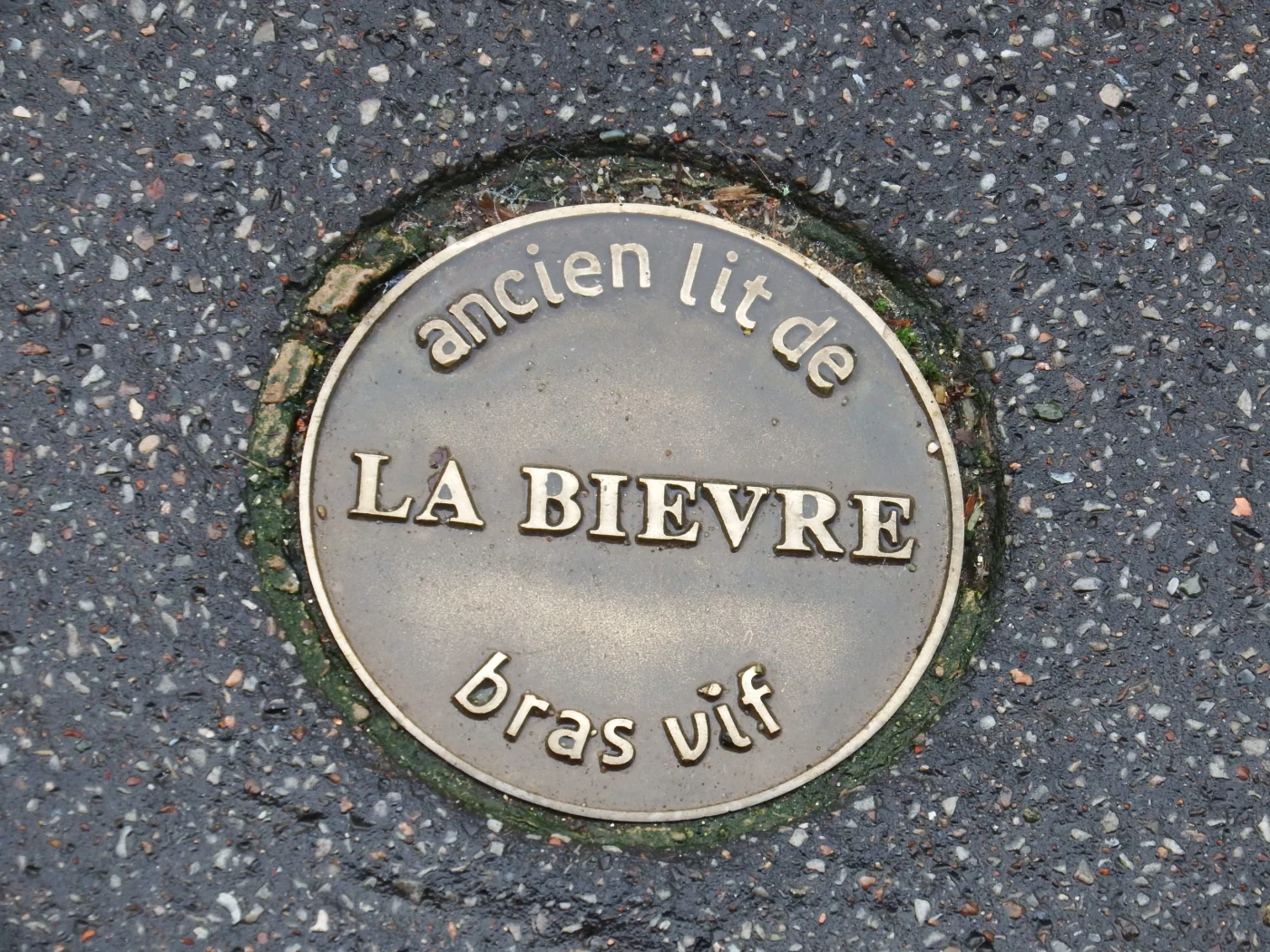
Which immediately reminded me of the history of the vanished stream.
But back to the beginning.
Forgive the somewhat graphic description, but what do you think happens when you press the flush button on a toilet? In the white ceramic bowl, the water swirls around, sweeps everything away, and disappears. Every city has its own story about this, but in Paris, the City of Light, it’s a little special.
Surprisingly, the Romans already thought about this. In their time, a tunnel was dug to drain “used” water beneath the route of what’s now Boulevard Saint-Michel, somewhere in the Latin Quarter. But that tunnel was forgotten over the course of history, and the next time anyone thought about the problem was under King Philippe-Auguste (1165-1223), though he settled for a sloped, open channel running down the middle of the city’s main streets.
Since the channel was open and accessible to everyone, people would empty their chamber pots straight into the channel running down the middle of the street, tossed right out their windows on the first, second, and even third floors. In summer, the heat and sun intensified the rot and stench. In winter, the frozen water, along with everything that came with it, splashed everywhere, and sometimes even froze right there on the open sidewalk. In no time, these streets became unbearable sources of stench and pollution.
Doctors quickly understood that city residents needed to be separated from the contaminated water. The solution was to cover the sewer channels (not yet called that) so their contamination wouldn’t spread through the air. Slowly, closed, covered channels appeared on certain streets of the city, but there still wasn’t an organized project covering every street in the city.
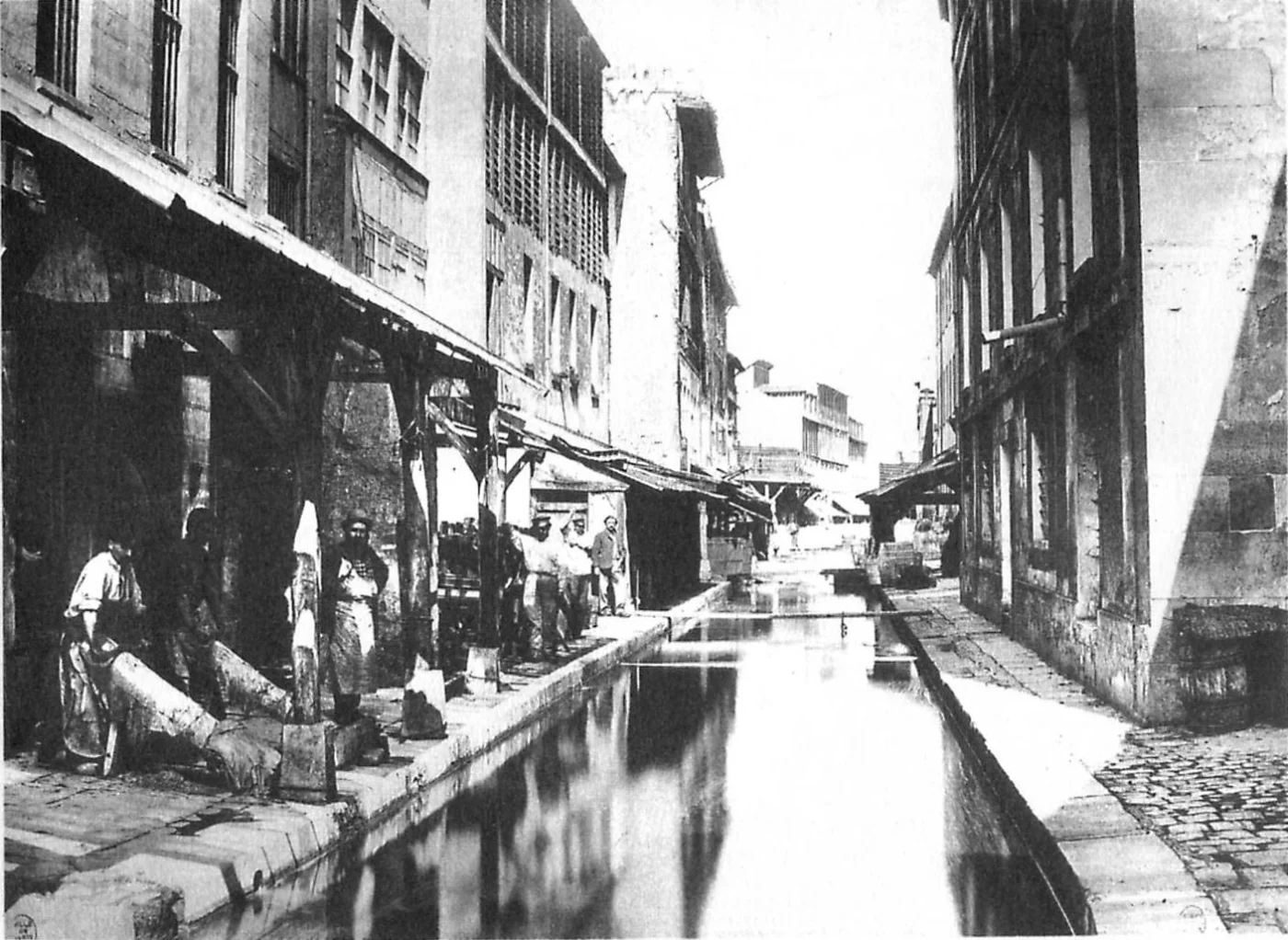
One of the biggest problems on this front, in the early 19th century in Paris, was the Bièvre, a small stream that flowed into the Seine in Paris. The stream ran through the southern part of the city, in what are known today as the 13th and 5th arrondissements. Along its banks were clustered many small factories, many of them working with leather and textiles, which needed large amounts of flowing water to clean their products.
Naturally, the little stream quickly became a channel of stench and pollution that affected the whole city. Over the years, the stream was enclosed and became an underground waterway whose path is no longer visible on the surface today, and it now drains directly into the Paris sewer system.
To skip over a lot of history and hardship, let’s jump straight to the second half of the 19th century. Baron Haussmann (Baron Eugène Haussmann, 1809-1891), who served as prefect of the Seine during the reign of Napoleon III, received from him “carte blanche” to remake the face of the city.
As part of all the work that was carried out, and we’ll write about some of it later, the Baron built an underground drainage system across the entire city. Naturally, sewer pipes ran along narrow alleys and streets, draining sewage from every building above them. These pipes drained into small underground channels, which also “ran” beneath the city’s streets, the whole thing powered by gravity alone, without a single pump. The small channels fed into the large boulevards, connecting to wider channels that drained those boulevards, along with all the small streets branching off from them.
A Visit to the Paris Sewers
Today, the Paris sewer system, still largely based on the system built in Baron Haussmann’s day, includes about 2,600 kilometers of channels of various sizes. The main entrance for tourists, yes, you can actually go in, is at Place Habib Bourguiba, near the Pont de l’Alma in the 7th arrondissement.
The system is set up as a “municipal museum,” and visiting it involves a boat ride in small metal boats, a ride in small carts running on rails set along the banks of the channels, and in some sections, even walking along the edge of the channels. Naturally, the tour comes with a variety of smells. The staff there are responsible for draining and clearing the channels of debris and blockages, or just the mud and sludge that builds up (yes, including urine, feces, toilet paper, and other “items”).
In the wide channels, which, as you’d expect, run directly beneath the city’s major boulevards, there are signs with the names of the streets, boulevards, and intersections, so you know exactly where you’re standing. Visitors spend about an hour there and see only a very small portion of the channels, but the staff working there wear thick, heavy rubber suits, and in most places also wear masks with breathing filters (gas masks).
Despite everything you might imagine, the tour is surprising and fascinating, with explanations (in French, of course) and examples of everything found in the sewer channels. And just to give you an idea, don’t picture the round concrete sewer pipes you’re used to. The channels here look more like the canals of Amsterdam, just covered and roofed over.
Want to visit the Paris sewers? Click here.
The Catacombs and the Metro of Paris
You can’t talk about underground Paris without mentioning the Catacombs of Paris, built inside abandoned quarries. If you want to read about their fascinating history and how to visit, I recommend the article by Zvi Chazanov and Dr. Orna Lieberman, The Catacombs of Paris: Not Just for Necrophiles Anonymous.
Also, the easiest way to go underground is simply by taking the metro. If you’d like to read about its history, get some useful information, and discover a number of stations that are really worth a visit, you should read the article about the Paris metro.
Related reading
